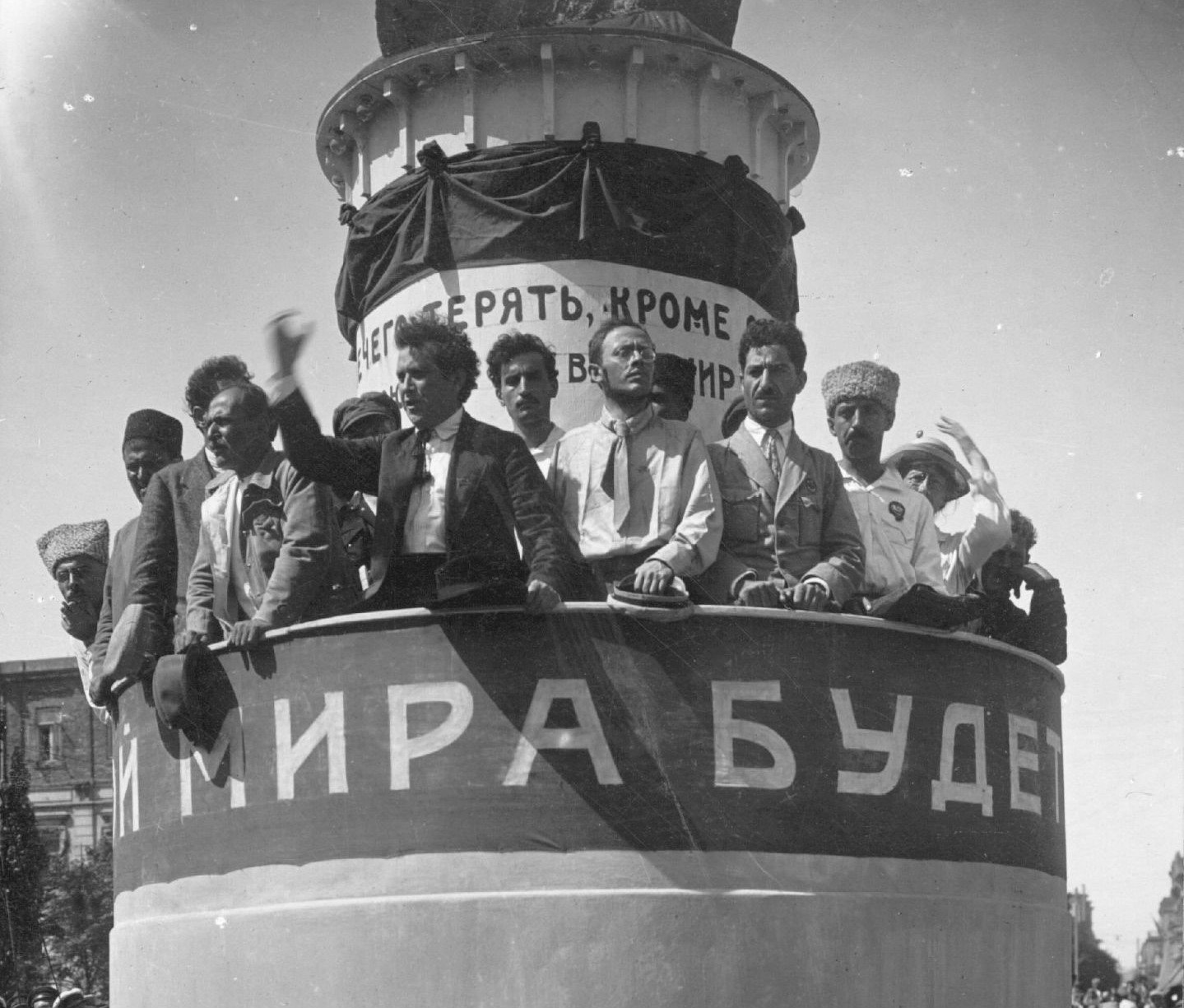
Valuable, detailed official calendar for 1920 which saw the end of brutal fighting in the Civil War and the beginning of the Polish War; the Congress of the East in Baku and the Second Congress of the Comintern, the 9th Congress of the Bolsheviks, War Communism, the first steps at post-war Reconstruction, and so much more.
‘Year Four: A Calendar of the Revolution for 1920’ from Soviet Russia (New York). Vol. 4 No. 19. May 7, 1921.
The Most Important Events of 1920
(This calendar gives the principal events of the last is translated from “Izvestya”, December 31, 1920.)
JANUARY
3. Drafting of citizens born in 1886, 1887, 1888 and 1901.
4. Formation of a committee for the purpose of drawing up necessary regulations for introducing universal labor conscription.
5. Red troops march down to the Caspian Sea.
7. Nationalization of dairy milk distributing centers in Petrograd.
11. Opening of the Museum of the Revolution at Petrograd.
13. News received of Kolchak’s arrest.
15. Abolition of capital punishment by Extraordinary Commission.
21. News that Red Army has occupied Mogilev-Podolaky.
22. Petrograd Commune establishes special food ration for scientists.
26. Opening at Petrograd of 2nd Army Conference of Communists.
27. Word received that Odessa is occupied by the Red rebels.
29. Liquidation of the Ural front announced.
FEBRUARY
2. Signing of Peace treaty with Esthonia.
4. Appeal of the All-Russian Central Executive Committee to the Polish people.
5. The occupation of Ochakov (on the Black Sea) by the Red troops.
7. Kolchak shot at Irkutsk by Social-Revolutionists.
8. Reestablishment of mail communications with Ukraine.
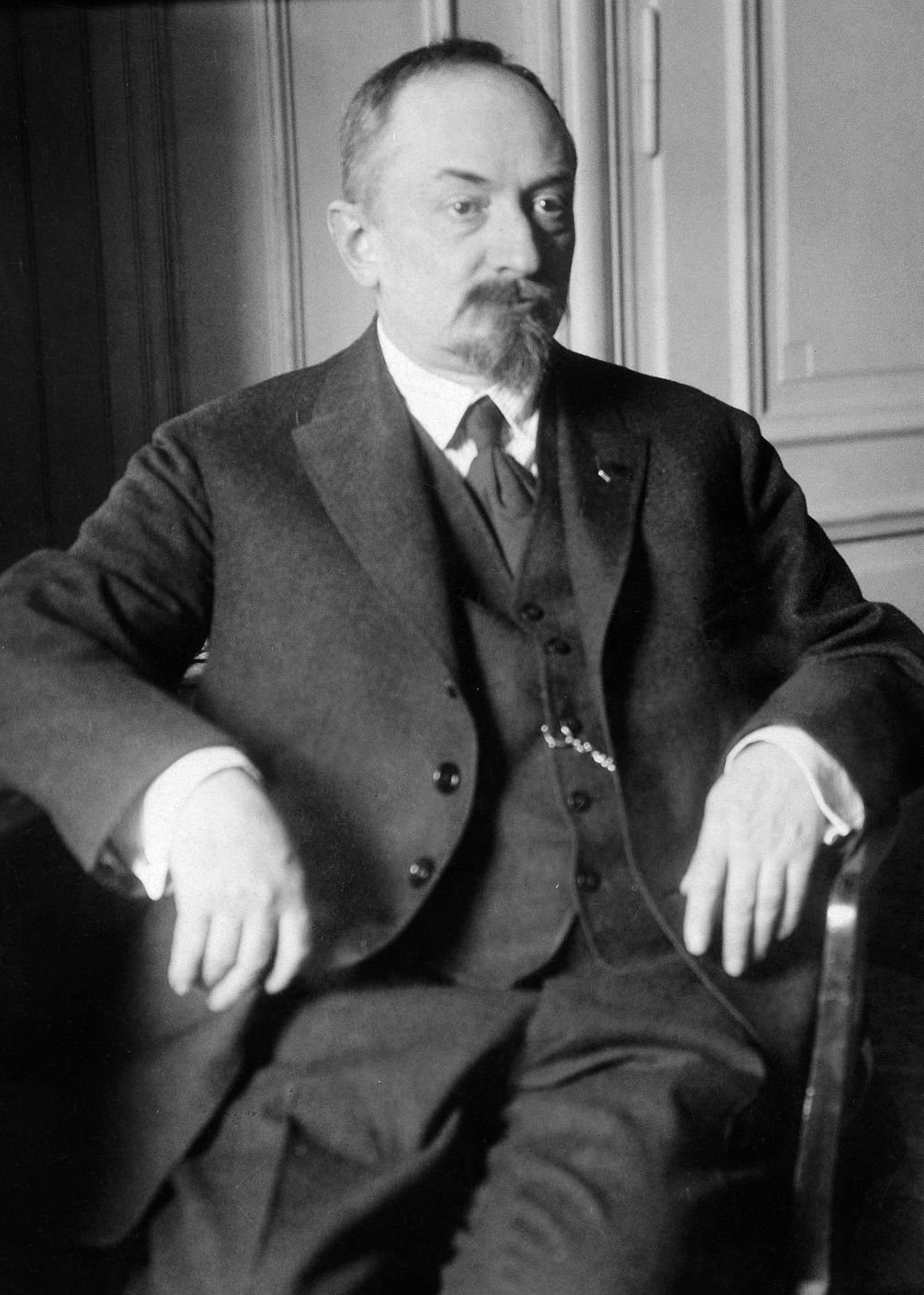
9. Comrade Chicherin’s appeal to the “Workers of the Entente countries.”
11. 7th Army transformed into a labor army.
13. Conference in Petrograd regarding the revolutionary labor army.
16. Opening of Convention for a campaign against the spread of spotted typhus.
21. News of occupation of Archangel.
22. Celebration of the 2nd anniversary of the Red Army at Petrograd.
25. Temporary halt in the evacuation of foreigners.
26. The beginning in Petrograd of the “Week dedicated to the aid of the Swedish workers.”
27. The committee on the organization of proletarian holidays becomes a government body.
28. Report received of occupation of the railroad station of Tikhoretzk (South East Russia).
29. The first “Sundaying” for clearing Petrograd of anew.
MARCH
1. Publication of the appeal of the All-Ukrainian Central Executive Committee to the workers of the world.
3. Publication of the appeal to the organizations of the Russian Communist Party on the question of transport.
8. The celebration of the “Woman-Worker’s Day” in Petrograd.
10. First conference of the Rnusian-Esthonian Economic Commission.
11. The conference of Communist Sailors closed in Petrograd
12. News of Constantinople’s occupation by the Allies.
19. City conference of the Petrograd organization of the Russian Communist Party opened.
22. Opening of the provincial conference of the Union of Educational Workers.
24. Occupation of Kislovodsk (North Caucasus), by the Red Army.
26. Poland, Finland, and Latvia express their willingness to make peace with Russia.

29. Opening of the 9th All-Russian Congress of the Russian Communist Party at Moscow.
31. Exchange of letters of ratification with Esthonia.
APRIL
1. Nationalization of Tolstoi’s house at Moscow.
5. Closing of the 9th All-Russian Congress of the Communist Party of Russia, at Moscow.
6. Opening of the All-Russian Congress of Trade Unions at Moscow.
7. News of Denikin’s flight.
12. Beginning of negotiations with Finland.
14. Agreement with England relative to the exchange of prisoners of war and civilian captives.
15. Exchange of notes between England and Soviet Russia, concerning Denikin’s men.
17. Opening of peace negotiations with Latvia.
20. American locomotives for Russia arrive in Reval.
22. Signing of agreement with France and Belgium on exchange of prisoners of war.
24. Comrade Chicherin’s note to Bulgaria.
25. Poland expresses willingness to negotiate with Russia.
26. Lithuania decides to send a peace delegation to Moscow.
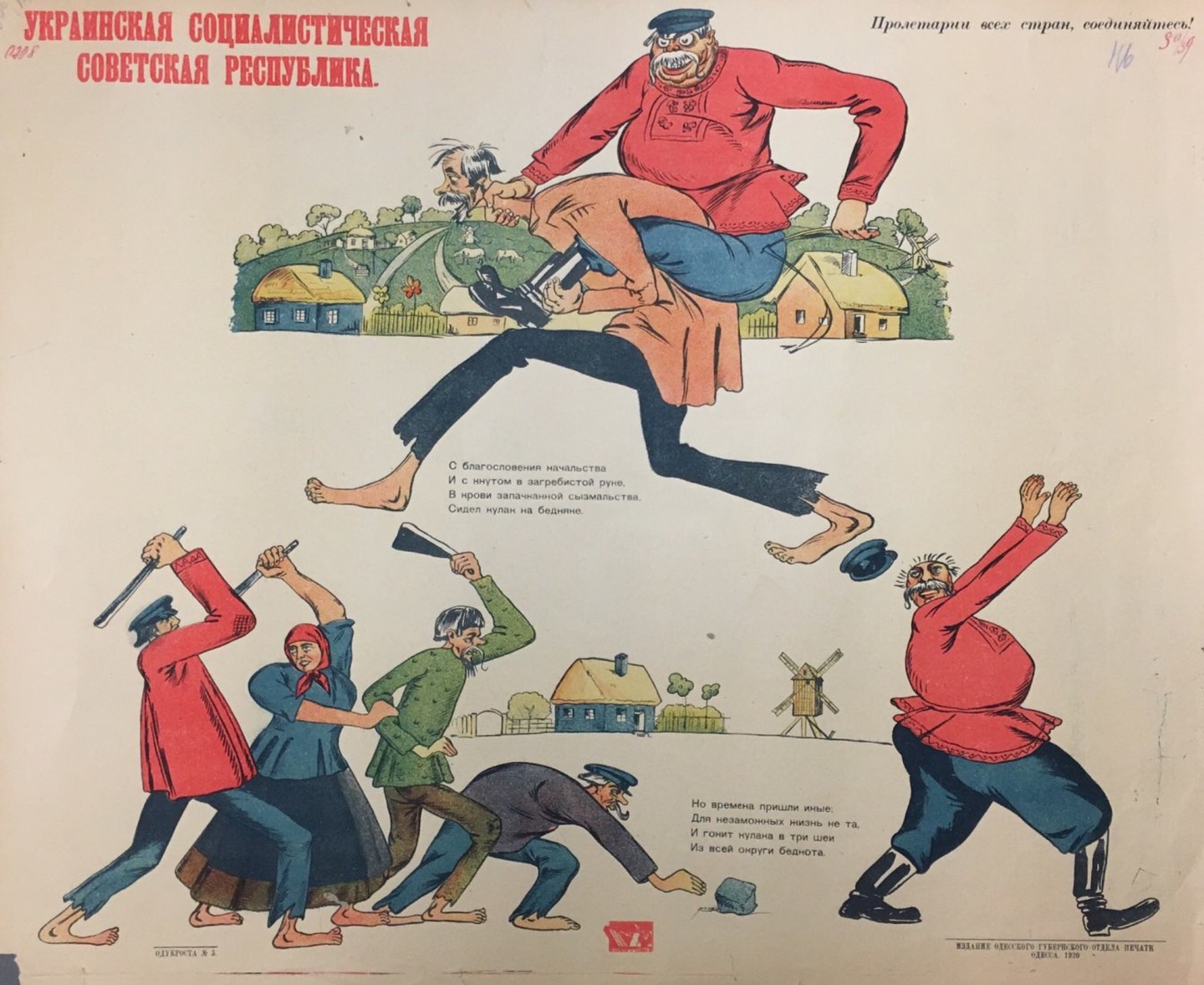
27. Ukraine protests against Polish atrocities.
28. The counter-revolutionary government of Azerbaijan overthrown.
29. An appeal of the Soviet Government to the workers, peasants and soldiers of the Red Army on the occasion of the Polish offensive.
30. Funeral of Comrade Timiryazev (famous naturalist) at Moscow.
MAY
1. Jubilant celebration of Labor Day with a review of troops on the labor front.-First of May “Saturdaying” (voluntary work).-First of May amnesty.

4. Breaking up of the Denikin army in the Caucasus (surrender of 60,000 men in the city of Sochi).
5. Eighth anniversary of Pravda. -360 Communists from the Petrograd organization dispatched to the Polish front-Truce signed in Vladivostok with the Japanese forces of occupation.
6. Decrees issued for redistributing the land and annulling the right of ownership of natural resources.
7. Notes exchanged between England and Russia regarding aid rendered by Great Britain to the White Guards of the Crimea and the Caucasus.-White Finland threatens Russia from the North.
9. The opening of peace negotiations with Lithuania (in Moscow).-The All-Russian Central Executive Committee sends an affirmative reply to the request of the League of Nations to send a commission to Russia to study her present situation.
12. British delegation arrives in Petrograd.
14. Soviet Government’s offer to Finland to start peace negotiations.
15. Grand demonstration of “Saturdaying” (voluntary work) for the Centro-Transport, with the participation of the British guests.
16. Celebration of the second anniversary of the Red fleet.
18. Announcement of wireless protest by the British delegation in Russia against the aid of the British imperialists to the Polish gentry-Finland agrees to open peace negotiations.-The Executive Committee of the Third Communist International issues appeal to the workers of the whole world in connection with the offensive of the Polish gentry against Russia.
19. Fourth convention of the Ukrainian Soviets opens in Kharkov.
20. England agrees to open peace negotiations with Soviet Russia.- The Second anniversary of the Red Army and the Red Commander.

22. Red forces launch a successful offensive throughout the Western front.
23. First day of the issue of labor booklets to Petrograd population.
24. Red armies on the western front are gaining victory after victory.-Revolt against the Poles in the province of Minsk.
26. All-Ukrainian Congress of Soviets endorses a resolution favoring vigorous fight against the White Poles.-Open protests by the Polish Communists in Warsaw.-Red Armies take the city of Borissov on the Polish front.
27. British troops evacuate the Crimea.
28. The “Maximalist Alliance” joins the Russian Communist Party.
29. Formation of Tartar Socialist Soviet Republic. 30 An appeal issued from the headquarters of the Commander-in-chief for a special conference, under the chairmanship of Brussilov, to all the former officers, urging their participation in the fight against the Polish nobility.-Orders issued by the All-Russian Central Committee, directing that extraordinary measures be employed in the fight against the enemies of the Republic.
JUNE
2. The Labor Party of England issues a manifesto against English aid to Poland.
3. Council of People’s Commissars appeals to all White Army officers urging them to make up for their former crimes against Soviet Russia by participation in the liquidation of the White Guard detachments in the Crimea, Caucasus, and Siberia.-Demoralization in the ranks of the Menshevist party (expulsion of the Saratov organization).
6. Italian Socialist delegation headed by Serrati arrives in Petrograd.
7. Comrade Krassin confers with Lloyd George at London.-Poland applies to France for military aid.
9. England officially announces that the blockade against Soviet Russia has been lifted. The Russian delegation leaves Moscow for Dorpat to negotiate peace with Finland.
10. Breaking through the Polish and South-Western fronts.-The Soviet forces occupy Berdichev, Zhitomir, Byelaya-Tserkov.
11. As a result of the negotiations led by Comrade Krassin in London, the Soviet Government received an offer to open a Bureau in England for the purpose of organizing the exchange of commodities.-The Italian delegation in Petrograd issues an appeal to the workers of the world.-The Russian trade unions send a delegation to England.
12. Occupation of Fastov on the Western front. Vigorous advance on Kiev.-Finland recognizes independence of Esthonia.-England refuses to aid Wrangel.-Beginning of peace negotiations with Finland.
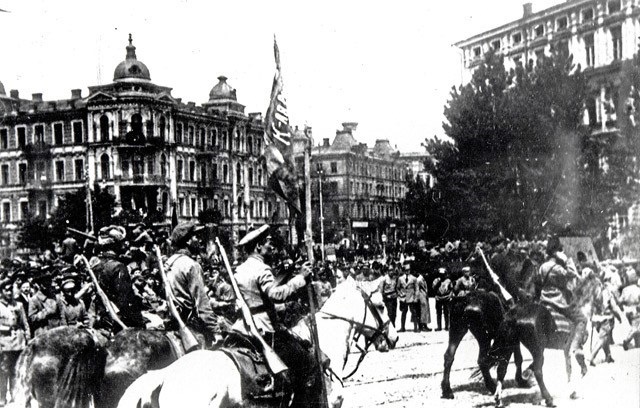
13. The Soviet troops occupy Kiev and Vassilkov. In their retreat the Poles blow up the railroad depot, the aqueduct, the electric power station, and the cathedral of St. Vladimir.
15. Italian delegation arrives in Moscow.
17. Representatives of the workers of Holland and Norway arrive in Petrograd.
18. The All-Russian Central Executive Committee and the Council of People’s Commissars issue an appeal to the Polish soldiers and legionnaires to cease the war.
20. Solemn opening of the Homes of Rest at Petrograd.
21. The city of Korosten taken.
27. Encounters at Helsingfors between the mobilized workers and volunteers over the question of their attitude towards Soviet Russia.
29. Soviet troops occupy cities of Novograd-Volynsky and Berdyanak.
30. Finland offers armistice terms.-Hostility towards Poland grows on the part of the workers of Western Europe.
JULY
2. English workers arrive in Russia-Elections to the Petrograd Soviets show 1579 Communists out of a total of 2,209 delegates.
4. “The Week for the Aid of the Western front” started.
7. Taking of Rovno; advance on Mogilev-Podolsky continued.-Leonid Krassin returns to Russia.
8. Mogilev-Podolsky and Letichev taken.-Chicherin’s note to the English Government on the establishment of mutual relations between the two countries.
10. France sends a battalion of volunteers to the Polish front.-A Russian mission again sent to England.
11. The Soviet troops occupy Dubno.-The day of the 2nd Congress of the 3rd International declared a holiday.
13. The occupation of a number of towns brings about disorganization of Polish front.-Polish diet organizes the Union for the National Defense of Poland.-Sessions of the Russo-Latvian peace delegation temporarily transferred to Riga-Peace treaty between Russia and Lithuania signed.
15. Soviet troops occupy Kamenetz-Podolsky.-Establishment of Soviet rule in Ossetia.
16. At the Polish front, Polish Soldiers’ Soviets are being organized.
18. Soviet troops take Vilaa.-England offers to act as mediator in the conclusion of an armistice with Poland and with Wrangel; Comrade Kamenev appointed chairman of the Russian delegation. The Western-European Secretariat of the 3rd International appeals to all the workers not to send any arms for Poland.
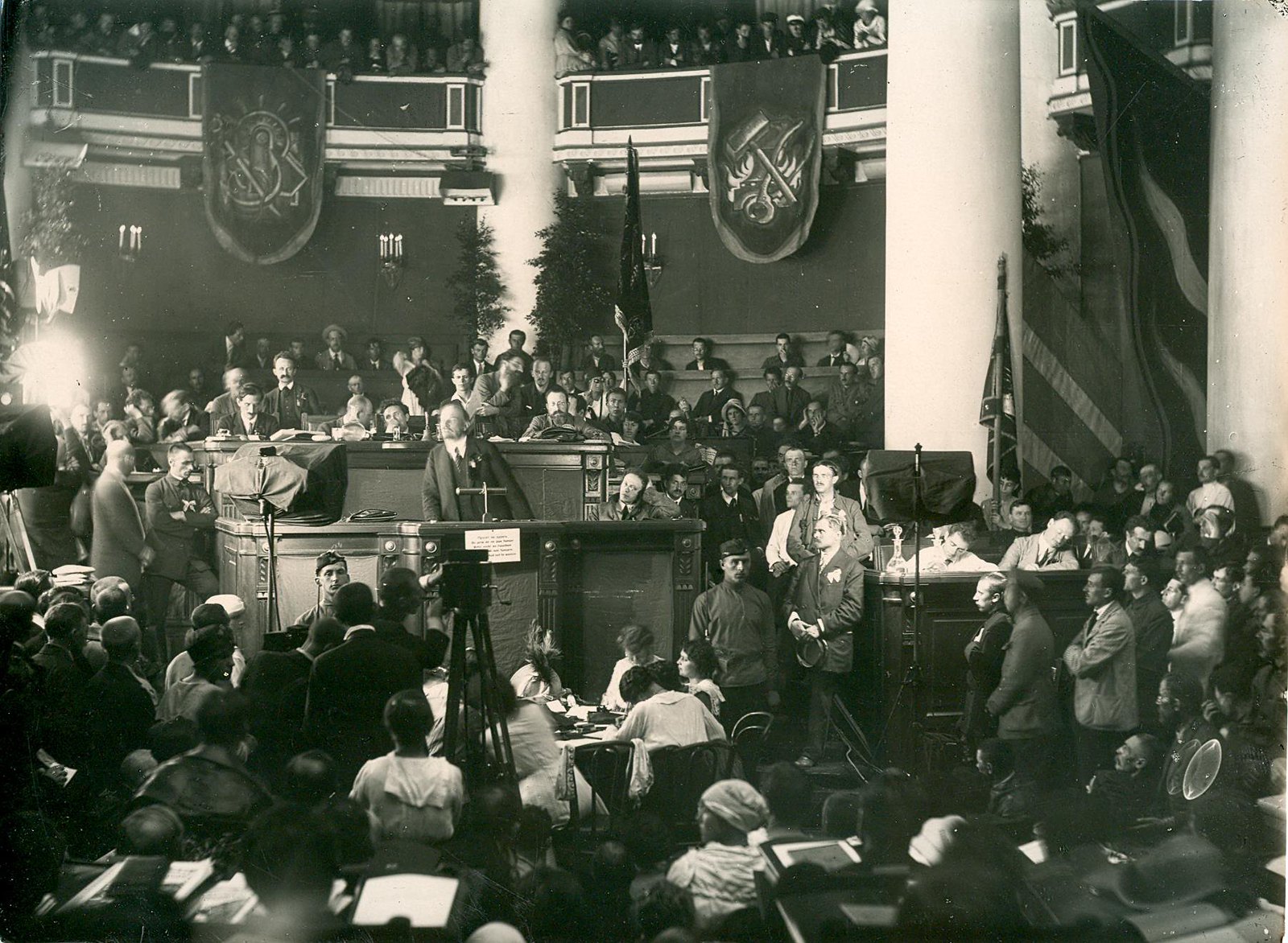
19. A solemn session of the 2nd Congress of the 3rd (Communist) International at Petrograd. Appeals to the workers of all countries.
22. The Supreme Council of Poland recognizes the impossibility of continuing war against Soviet Russia. Millerand announces that Poland will be aided by France. Sessions of the Second Congress of the Third International transferred to Moscow.
23. As a result of the success of the Soviet troops at the front, the Polish Government resigns. Hurried evacuation of Warsaw started.-Mobilization declared in France to aid the Polish front. Continuance of Peace negotiations with Finland postponed until July 28th.
24. Soviet troops occupy Grodno.
27. Red Army makes great progress at Volkovyssk, Pinsk and in other sections. Poland declares the mobilization of men up to 45 years of age.
28. Soviet cavalry occupies Tarnopol.-Solemn opening of the Shadursk electric (power) station takes place near Moscow.
29. Fortress of Ossovets occupied. 12,000 machine guns delivered at Sevastopol from England, for Wrangel.
30. An Italian delegate arrives at Odessa for the purpose of opening trade relations with Soviet Russia.
31. Soviet troops occupy Bielostok and Pruzhany.-Peace negotiations with Latvia and trade negotiations with England resumed.
AUGUST
1. Soviet troops occupy the city of Bielsk.-Private trade abolished in Petrograd.
2. Soviet troops take Brest-Litovsk.-Resumption of peace negotiations with Finland.
5. Soviet army occupies Lomzha.-Appeal of the International Council of Trades Unions to rally to the banners of the 3rd International.
6. Soviet troops take Kovel, Lutsk and Buczacz.
7. Ratification of the treaty with Austria by both countries.-Germany’s declaration of neutrality in the war between Poland and Russia.
8. Comrade Krassin and Kamenev arrive in London.
9. Soviet troops occupy Prasnysh, Vladimir-Volynsk, and other cities.-Millerand’s statement in Parliament as to danger of a Soviet regime “from the River Rhine to the remotest corner of Siberia and from the White Sea to the Mediterranean.”
12. Russian armistice terms with Poland published.-Bela Kun arrives in Petrograd.

14. Soviet troops advancing on Warsaw.-Polish Revolutionary Committee addresses manifesto to the Polish workers.-Peace Treaty between Russia and Latvia signed.
15. Signing of the Armistice with Finland.-Decision of London Labor Conference to endeavor by all means to compel England not to interfere in the Russian-Polish conflict.
17. Negotiations with Poland commence in Minsk.
19. Soviet troops take Vlotslavek.- Bitter fights in the Warsaw region.
21. Soviet troops occupy Polotak.-Entente countries demand of Germany to turn over all military equipment to Poland.
22. Soviet troops reach a point 8 miles from Lvov (Lemberg).
22. Delegation of the Petrograd Soviet of Trades Unions arrives in Norway.
26. France sends army of 100,000 through Austria to help Poland.-In Petrograd a celebration takes place in honor of the Communists leaving for the Western front.
31. Soviet troops occupy the city of Byela.-Red Army again begins offensive.-From Petrograd a new group of Communist sent to the Polish front.
SEPTEMBER
2. Soviet troops again occupy Grubeshov and the towns of Varenzh and Christianopol.
3. Soviet troops occupy the city of Zamosc.-Entente intervenes in the Russian Polish peace negotiations.
4. Bukhara declared a Soviet Republic.-Latvia and Poland resume diplomatic relations.

5. International holiday of the Youth in Petrograd.
6. Russian delegation leaves for Riga to negotiate peace with Poland.
8. First Congress of the Revolutionary Peoples of the East opens in Baku.
9. Latvian Constituent Assembly ratifies Russian peace treaty.-Petrograd sends another group of Communists to the front.
12. Solemn funeral at Petrograd of the Finnish Communists who were treacherously murdered.-Comrade Shlyapnikov, representative of the Russian Trade Unions, arrested in Stockholm.
16. Closing of Congress of the Peoples of the East held in the city of Baku.-Representatives of the Russian Trades Unions arrive in Berlin.-Peace negotiations with Poland resumed at Riga.-Conference of the national minorities opened at Petrograd.
17. Soviet troops occupy Berdyansk.
22. Political negotiations with England interrupted on account of the Southern front.-The terms of the peace treaty concluded by Soviet Russia with Latvia and Lithuania made public.-All-Russian Central Executive Committee appeals to the laboring people of Karelia concerning organization of a Karelian Commune.-Clara Zetkin arrives in Petrograd.
23. Russian-Polish conference opens in Riga.
25. All-Russian Central Executive Committee makes public the new peace terms offered to Poland.
30. Blockade of White Poland declared by German and Czecho-Slovak workers.
OCTOBER
1. Publication of proposed terms of Preliminary Peace with Poland.-Comrade Chicherin’s note to the Rumanian Minister of Foreign Affairs.
5. G. Chicherin sends a protest against the hostile actions of the French Government.

6. Soviet Government accepts Makhno’s offer of aid in the struggle against Wrangel.
8. Party of Revolutionary Communists (formerly “Left Social Revolutionists”) joins Communist Party of Russia.
10. Soviet troops occupy Berdyansk (on the Wrangel front).
12. Rumanian Communists arrive in Petrograd.
13. Poles occupy Vilna.
14. Peace Treaty with Finland signed.
15. Soviet Russia and Rumania exchange notes on the question of peace negotiations.
19. The Soviet troops occupy Minsk. Cessation of military operations between Russia and Poland.
23. All-Russian Central Executive Committee ratifies preliminary peace terms with Poland and peace treaty with Finland.
26. Soviet troops occupy the city of Alexandrovsk (on the Wrangel front).-Polish diet ratifies armistice and preliminary peace with Russia.
27. Manifestations in Italy in honor of Soviet Russia.
28. Japanese occupy Vladivostok.-Communists executed in Poland.
NOVEMBER
3. Soviet Government addresses the following notes to the English Government: 1) On the liquidation of the armed bands on the western frontier of Soviet Russia; 2) On activities of English war ships in the Black Sea; 3) On the terror in Vilna.
4. Soviet Russia and Poland exchange notes on the armistice.-Conference of the regions of the Far East issues a declaration regarding formation of an independent Republic of the Far East.

5. Wrangel troops cut off by Soviet troops from the Crimean peninsula.
7. Solemn celebration of the 3rd anniversary of the November revolution throughout Russia.-Amnesty granted by the All-Russian Central Executive Committee.
10. The Polish Government to refrain from supporting Petlura and Balak-Balakhovich.
11. Semionov’s bands crushed in the Far East.
12. English forces flee from the Crimea.
13. Chicherin’s note to England on the question of trade relations.
15. Soviet troops occupy Sehastopol, Simferopol, and Theodosia; Wrangel, defeated, flees from Sebastopol.
17. Peace negotiations with Poland resumed in Riga.
18. Soviet troops occupy cities of Kerch and Kamenets- Podolsky.-Soviet Government protests against England’s intention to occupy Baku.
19. Soviet divisions on the Crimean front reach southern shores of the peninsula.-Soviet troops seize Wrangel’s currency printing offices.-Chicherin appeals to the workers of the Entente countries.
20. Petlura’s flight. Allies proclaim blockade of the Black Sea.
21. In the Kamenets-Podolsky region the Soviet troops reach the boundaries of the neutral zone.-Japanese troops occupy Petropavlovsk (Kamchatka).
23. Soviet troops cut off Bulak-Balakhovich and his main force on the left bank of the Pripet.-Russia enters into an agreement with England for the delivery of 1,000,000 ties in exchange for coal.-All-Russian Central Executive Committee appeals for voluntary collection of articles for Red Army.

24. Remnants of Petlura’s troops driven beyond the boundaries of the Russian Soviet Republic, disarmed by Poland.-Trotsky appeals for aid to the Donets miners.-Council of People’s Commissars (Sovnarkom) issues a decree relative to the Central Committee for Political Educational Work, uniting all the political and educational work of the Republic.
25. Petlura’s troops completely routed.-Council of People’s Commissars issues regulations for the granting of concessions to foreigners.
26. Krassin addresses note to Lloyd George on the delay in the trade negotiations.
27. The first group of American workers arrives in Petrograd.
28. International Congress of Trades Unions in London adopts a resolution condemning the economic blockade and armed war against Soviet Russia.-Celebration at Petrograd of 100th anniversary of birthday of Friedrich Engels.
30. Free distribution of articles of common use adopted in Moscow as a matter of principle.
DECEMBER
1. Government announces that the Socialist-Revolutionists and the White Guards will answer for the lives of the leaders of the Workers and Peasants of Russia.-“Proletcult” (Proletarian Culture) becomes part of the Peoples Commissariat for Education.
3. Rumania declares Wrangel’s troops will not be allowed to cross her territory.-The English Government adopts a resolution on the resumption of trade relations with Soviet Russia.-The Commission of the Council of Defense begins investigation of the Donets region.
4. Lenin sends greetings to the Revolutionary Committee of Armenia on the occasion of the formation of a Soviet Government.-The Finnish diet ratifies the peace treaty with Russia.-The budget of Petrograd for the year 1921 estimated to amount to 140 billion roubles.-The state of siege is declared raised in Petrograd.
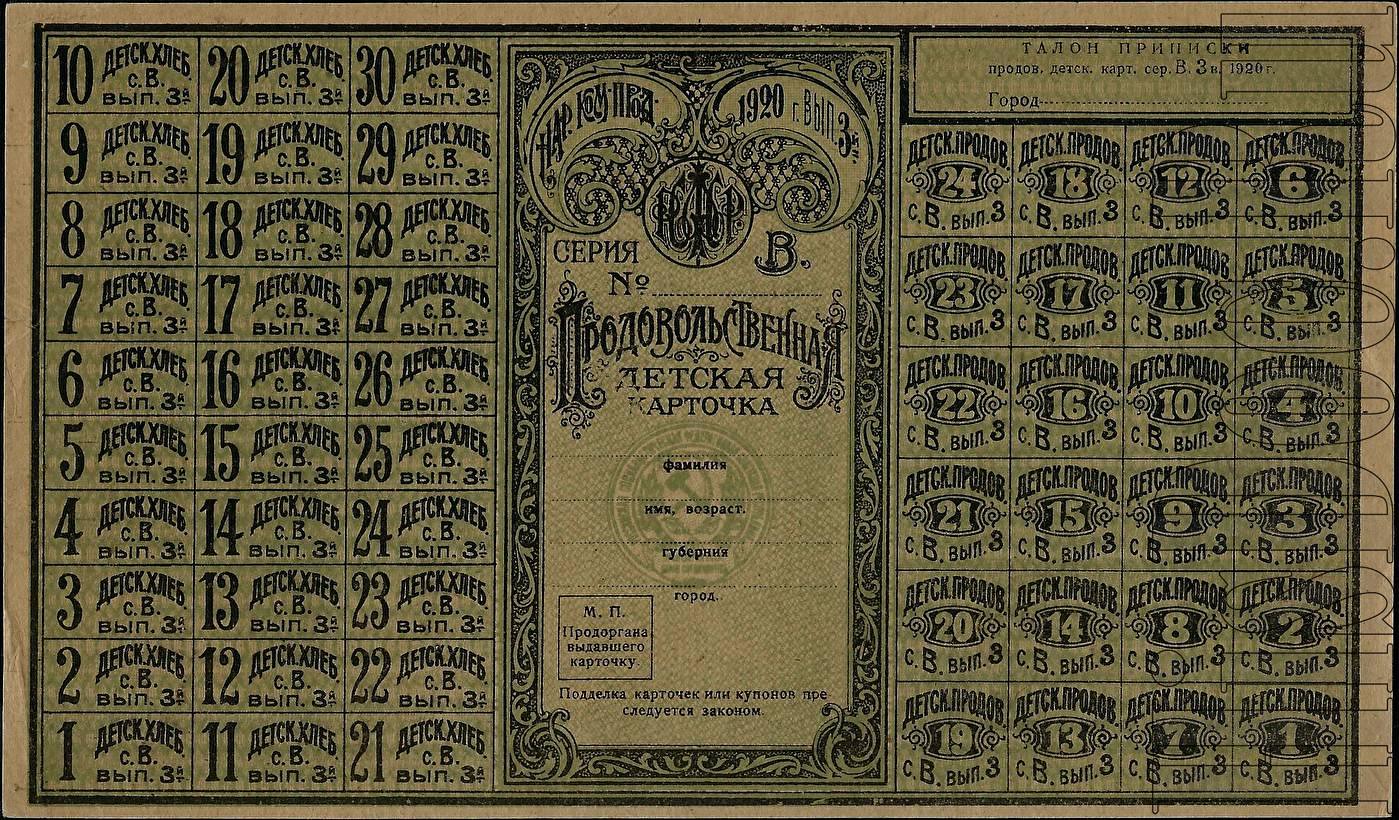
7. A decree is issued on the free distribution of products to the population beginning with January 1st, 1921.-“Children’s Week” begins in Petrograd.
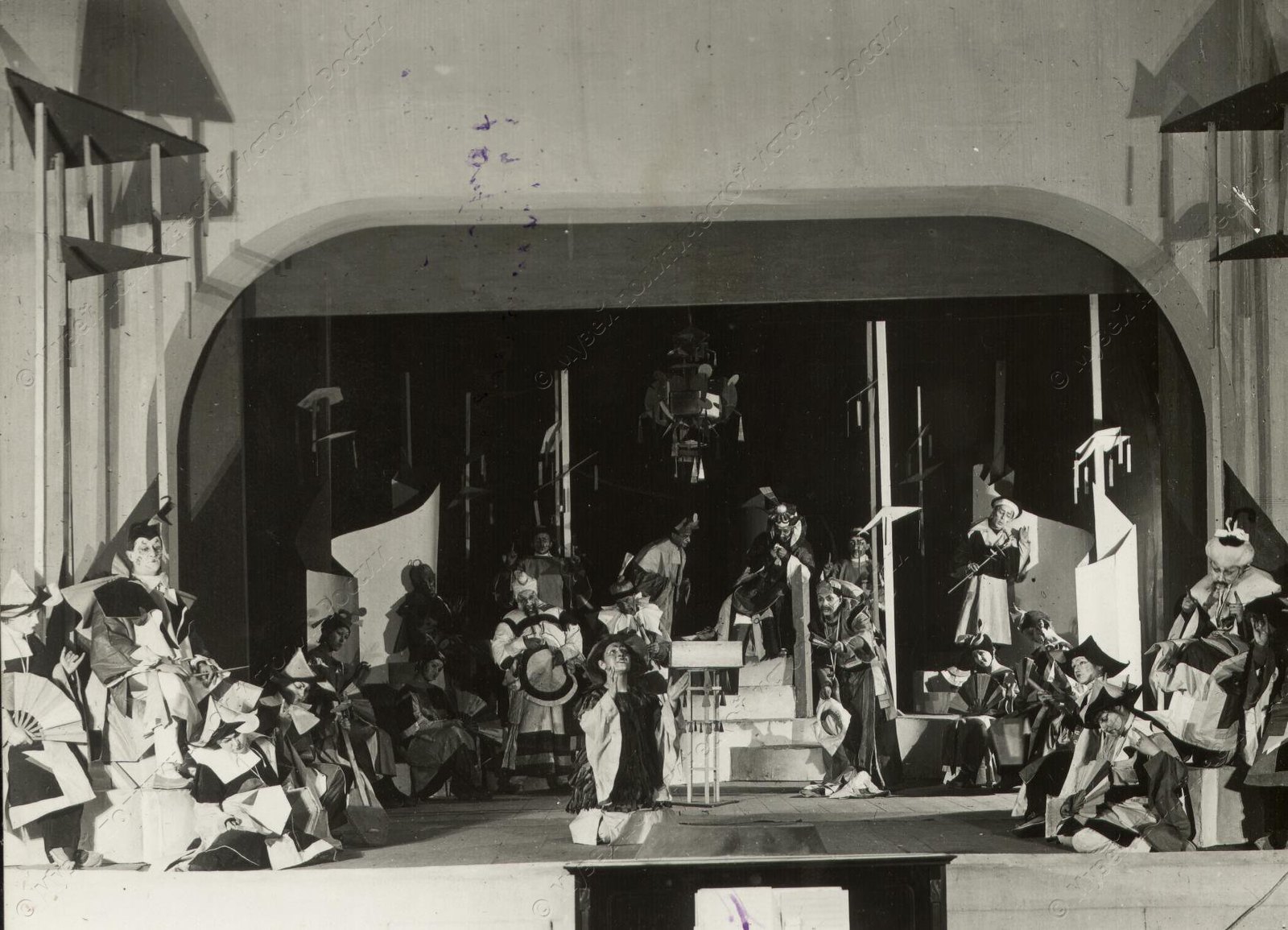
9. Wrangel liquidates all institutions on the South-Russian front.
10. Publication of second appeal by Comrade Trotsky for aid to the Donets basin.
11. First corpse cremated in Petrograd.
12. Offer of the Soviet Government to establish friendly relations with Yugo-Slavia, Georgia, and Bulgaria.-Publication of Zinoviev’s theses on the campaign against bureaucracy.
15. Cessation of the publication of bulletins on military operations.-Proposed legislation for the strengthening and intensification of agriculture made public.-Rumania asked by Russia to name time and place for peace negotiations.-The Congress of Soviets of the Province of Petrograd opens in the city of Petrograd.
18. Announcement by the Central Council of Trades Unions that industrial mobilization was discontinued on December 1st.
19. First cargoes of European wares arrive via Yamburg.
21. England officially declares blockade of Russia lifted.
22. The opening of the 8th All-Russian Congress of Soviets in Moscow. Lenin’s report on the international situation.
24. At the Congress of Soviets reports are made about the electrification of Russia and about the economic situation.
25. A train loaded with gifts for the workers of the Donets basin is sent off.

28. 15th anniversary of the December uprising (1905) celebrated in Moscow.-The Soviet of People’s Commissars issues a decree abolishing payments (in money) for fuel, and for the use of the mails, the, telephone, telegraph, and radio-telegraph.
29. Japan’s protest to all the powers against the granting of concessions in Kamchatka by the Soviet Government.-The last session of the 8th Congress of Soviets.-The Finnish peace delegation Arrives in Russia.-In Petrograd five days are set aside for the population to supply itself with fuel.
Soviet Russia began in the summer of 1919, published by the Bureau of Information of Soviet Russia and replaced The Weekly Bulletin of the Bureau of Information of Soviet Russia. In lieu of an Embassy the Russian Soviet Government Bureau was the official voice of the Soviets in the US. Soviet Russia was published as the official organ of the RSGB until February 1922 when Soviet Russia became to the official organ of The Friends of Soviet Russia, becoming Soviet Russia Pictorial in 1923. There is no better US-published source for information on the Soviet state at this time, and includes official statements, articles by prominent Bolsheviks, data on the Soviet economy, weekly reports on the wars for survival the Soviets were engaged in, as well as efforts to in the US to lift the blockade and begin trade with the emerging Soviet Union.
PDF of full issue: https://www.marxists.org/history/usa/pubs/srp/v4-5-soviet-russia%20Jan-Dec%201921.pdf
 Revolution's Newsstand