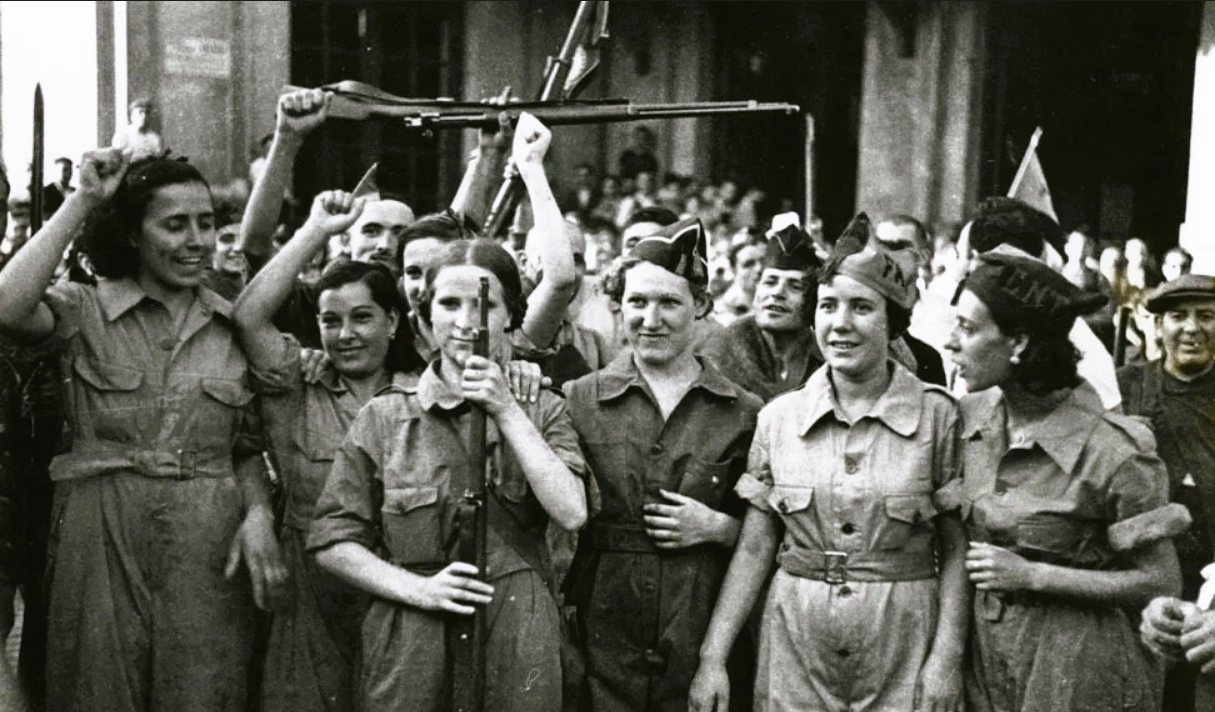
Transcribed here for this first time online, Felix Morrow with a sharp intervention into the debate over who and how would get to the Spanish workers get the weapons needed to resist fascism.
‘Arms for the Spanish Workers!’ by Felix Morrow from Socialist Appeal (Chicago). Vol. 2 No. 11. December, 1936.
Only the International Working Class Will Send Arms
HITLER and Mussolini s recognition of Franco’s forces means that two of the most powerful capitalist governments of Europe have irrevocably tied their fate to that of Spanish capitalism. The decisive defeat of Franco now can only mean, at the very least, a defeat to the prestige of Berlin and Rome such as has never been accepted by a capitalist government without resort to war. It must be said in passing that Hitler and Mussolini have so far played their cards very well indeed. But only with the aid of French and British capitalism and of Stalin. For not even the adventurous capitalists of Italy and Germany would have dared this move earlier in the game. Had Spain, in accordance with the traditional rules of international law which naturally favor established governments, been able to purchase arms in the first weeks of the rebellion, Franco-whose original strategy was shattered when the proletariat of the chief cities overpowered the garrisons-would have long ago been defeated. The Soviet Union’s acceptance of the non-intervention pact was a blow against the Spanish workers as even the Stalinist press in Spain which, as the Spaniard says, is on the same side of the barrier as the bull and therefore cannot be as philosophical as the DAILY WORKER, had to admit. In the first three months of the civil war no arms at all arrived from the Soviet Union and, of course, nothing to this day arrives with the consent of the French and British governments. Thereby Franco, with aid from Italy and Germany, was enabled to occupy sufficient territory which, coupled with the non-intervention pact’s placing of Burgos and Madrid on an equal plane, now enables official recognition with complete impunity.
If we stigmatize the crime which the Stalin regime committed against the Spanish proletariat, it is not for the sake of mere recrimination, but to emphasize as solemnly as we can the fundamental task of today and tomorrow:
Hitler and Mussolini’s open alliance with Franco means that the struggle for Spain can now only be won on the international arena. The Spanish proletariat is lost without the decisive intervention of international aid.
The Only International Aid will come from the Proletariat
AN ABSOLUTE pre-condition of effective international aid for the Spanish workers is to dismiss, to repudiate, the idea that the French People’s Front government and the British Tory government will help.
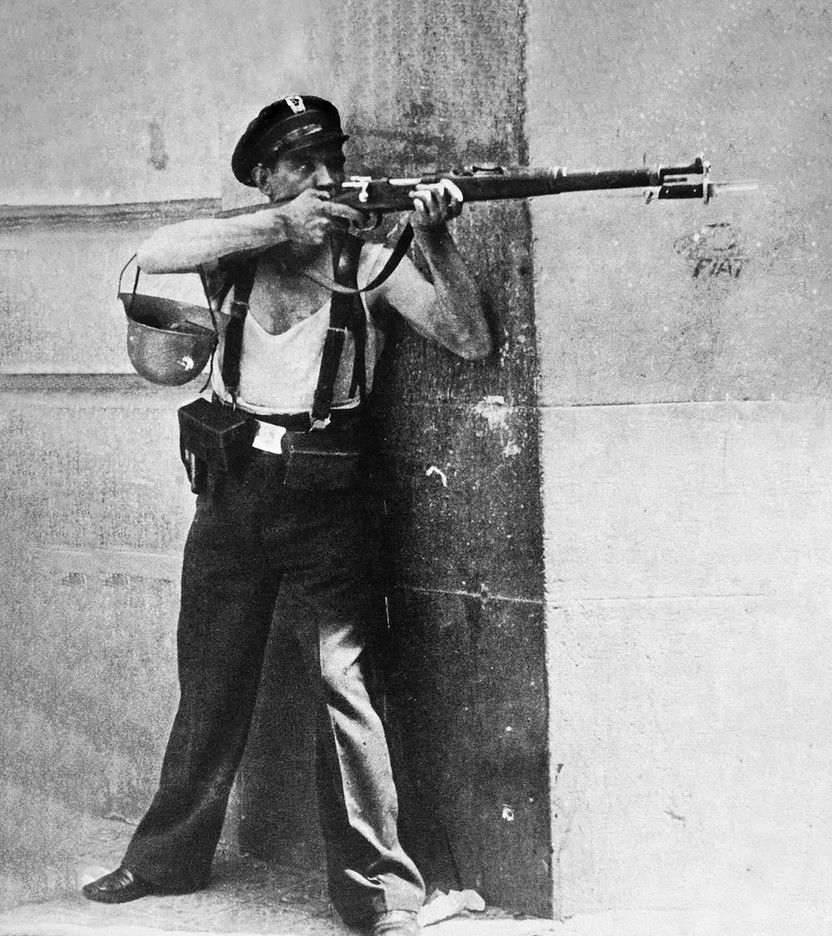
In the four months of civil war France and Britain have indicated their unyielding position. Official recognition by Hitler-Mussolini changes nothing, but on the contrary will, if possible, harden the present line of French and British imperialism. It is theoretically possible, were France-Britain ready to go to war and had concluded that Germany-Italy was definitely the enemy, that the French and British imperialists would make Spain the “little Belgium” issue for declaring imperialist war (this would also mean French-British intervention in Spain to insure control to the “anti-fascist” bourgeoisie). But if anything is clear in the European situation, it is that England and France are not prepared for war (England needs two years to complete her armament) and that both are not convinced that the German-Italian line-up is a definitive picture of the forces which will confront them in the next war. Italy is being assiduously courted by both France and Britain. Both undoubtedly plan to employ the technique traditionally associated with localized wars since the Congress of Vienna: diplomatic intervention after the fight is over to protect their interests. Capitalist politics is not based on pique: Franco (especially since Britain’s vassal, Portugal, has rendered him such generous aid) would scarcely be likely to break the long-standing economic ties with England and France, particularly since these countries are Spain’s largest market for agricultural products. No, aid from France and England for the anti-fascist cause is simply out of the question.
This is true quite independently of the fact that capitalist France and Britain prefer a victory for Franco rather than the possibility that the victorious workers and peasants-in spite of Communist and Socialist leaders’ declarations for the maintenance of the bourgeois republic-will go forward to the Federation of Socialist Republics of Iberia.
Pathetic Hopefulness of Stalinists
Four months of the civil war should have convinced those who, like the Stalinists, having left the moorings of Marxism and hence incapable of predictive analysis, had any illusions about help for anti-fascist Spain from capitalist governments.
The embattled workers’ militia will get help from the international working class, and from it alone.
But far from becoming more realistic, about this question, this key to the Spanish situation, the Stalinists have lost their heads completely. The false policy pursued by the Stalinists these four months has left them and the Spanish masses more isolated than ever. But the Stalinists behave like men gone mad with desperation and seize at non-existent straws. I take space to cite two fantastic instances out of many:
When Roosevelt (whose most solid backing came from the Curley, Farley, Tammany and other machines openly committed to Franco, not to speak of the class character of the Roosevelt administration!) was elected, the Stalinists said:

“Though the Spanish civil war was not a direct issue in the election, the Roosevelt administration cannot overlook the implications of the defeat ad- ministered to the American accomplices of the Spanish rebels.
“That vote should be regarded as a mandate to throw the weight of America’s influence on the side of Spanish democracy as a means of defending world democracy and world peace.” (DAILY WORKER editorial November 6, 1936).
And when American imperialism, in a bold and grandiose move against European and especially British imperialist interests in the Western Hemisphere, prepares the Buenos Aires Parley:
“That conference can become one of the most powerful forces to block the fascist drive to a new world conflagration.
“The Inter-American Peace Conference must act to stay the bloody hand of Hitler and Mussolini.
“By warning the fascist powers that the United States is ready to act with all forces standing for peace, with the Soviet Union, France, China, the small nations threatened with the Soviet Union, and with the League of Nations, as well as the people of Britain and other countries who so earnestly desire peace, the fascist bandits can be stopped in their tracks.” (DAILY WORKER editorial, November 19, 1936).
The hysterical syntax is appropriate for this raving. Are the Stalinists fools enough to believe this farrago of nonsense? Or are we witnessing a frenzied attempt to cover up a plan to leave the Spanish workers in the lurch, and to blame the capitulation on the “failure” of the “democratic” countries to come to the aid of Spain?
We must repeat, until we reach every worker befuddled by this Stalinist clap-trap, that no big capitalist government will aid the Spanish people. Only the aid of the international working class is available. And that aid cannot be organized, cannot be developed, until the proletariat clearly understands that only proletarian aid is possible for Spain.
Arms the Essential Need
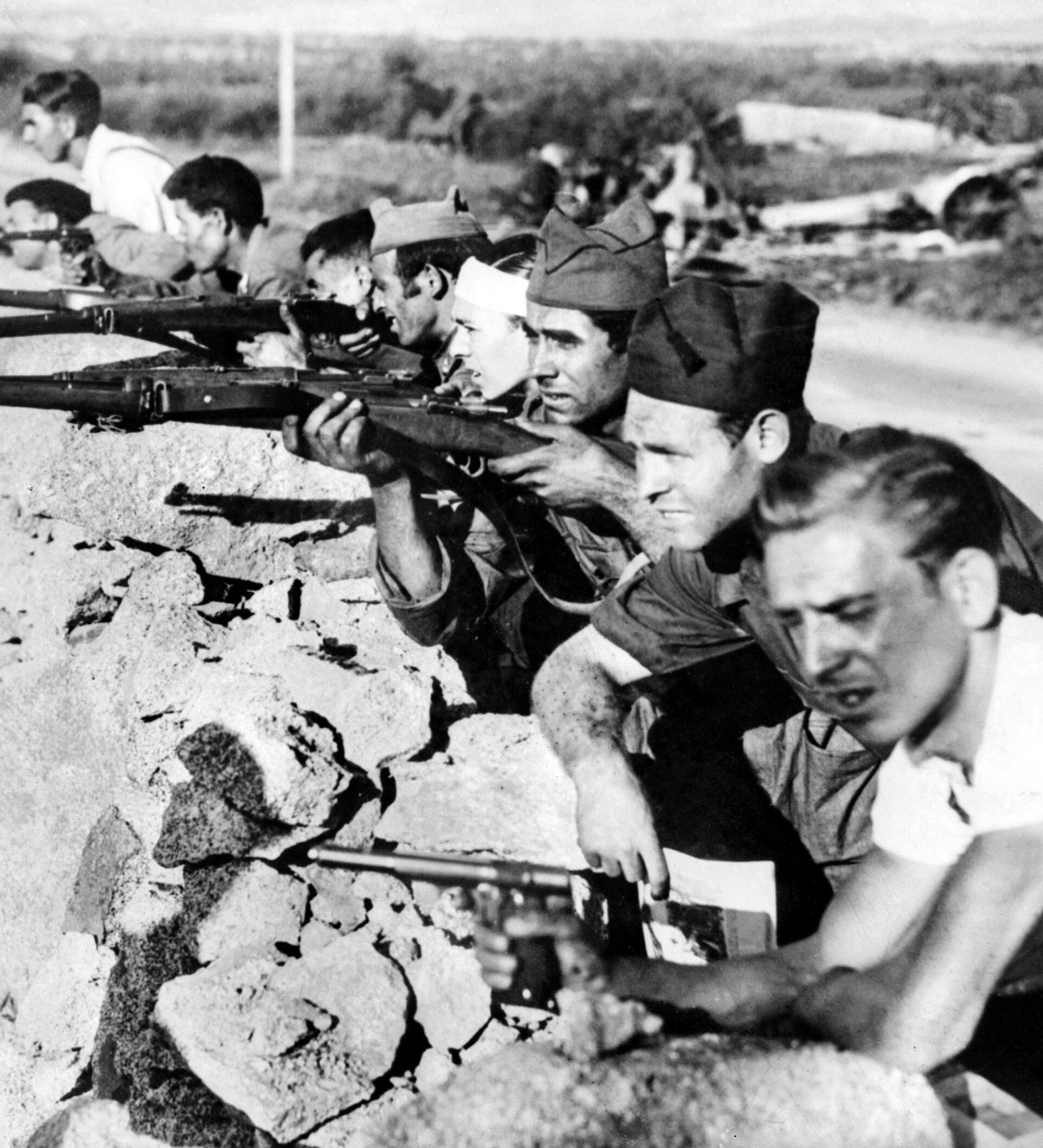
The only real material aid to the Spanish masses is to provide them with arms. The horrible irony of Irun must not be repeated: workers with empty rifles, all cartridges exhausted, waiting until the fascists would discover the situation and advance and execute them, while they watched the cars rumbling over the Behobia bridge, filled with food, tobacco and candy sent by anti-fascist funds. Spain has enough food to last for some months; but at the best, with the aid of the world proletariat organized and functioning, the anti-fascist forces can hope only to keep the gap from widening too much between the armament of the Franco forces and that of the masses.

Already, and especially in the revolutionary atmosphere of France, determined groups of workers are purchasing or in other ways securing arms (the workers in the munitions factories, the arsenals and in transportation of the arms which France is feverishly producing, are among the most class-conscious and courageous in the country). Among them are Communist workers, and we do not mean by this that the leadership of their party is hostile to their work. But to leave the securing of arms for Spain in such a conspiratorial atmosphere means to prevent the possibility that arms from the workers become an important source of military supplies for Spain.
Difficulties Can Be Surmounted
Naturally the technical aspects of securing arms for Spain must remain-especially with the methods involved in the work of the French comrades-a closely-guarded secret. But the political campaign must be openly developed in meetings, factories, the press, in the streets, wherever one can find the masses. The slogan “Arms for the Spanish People,” explicitly amplified to mean that “The Spanish People Can Get Arms Only If the Workers Will Provide Them,” must become a mass slogan, must reach millions upon millions. Out of those who are reached by this slogan will come, not only funds of such huge proportions as will make ridiculous the present humanitarian-level collections for food, but also-and this refers to America as well the highly-skilled technicians, so desperately needed to serve in the workers’ armies. A serious organization of advanced workers, with numerous contacts in every city and district, will find many ways at its disposal for testing the integrity of technicians offering their aid. In a country like France, with its vast workers’ parties, it would be a simple task to organize committees of factory workers known to each other and together knowing hundreds and hundreds of others, and thus protect their work against enemy agents. While not so easy in America, the fundamental process would be the same. If we show that we mean business, friends will turn up everywhere with information on where and how arms can be purchased. The traffic in arms goes on both here and in South America on a vast scale. It can be turned to use for the Spanish workers. But only if we rally great masses behind us. And that can be done only by a public, programmatic propaganda and organization for arms for the Spanish workers, which can in no way be confused with the necessary, carefully guarded, technical arrangements.
Undoubtedly there will be strong resistance from all capitalist governments against “their” workers organizing arm shipments to Spain. Workers will be learning how to organize revolutions! Even if, in a given country, the revolutionary situation may not materialize for a generation, this is far too valuable a field of training for any capitalist government to permit it to develop without hindrance. From this perfectly understandable situation, however, one cannot draw the conclusion that the arms campaign cannot be public in the sense we have above outlined. Some leakage is bound to occur in any large-scale activity; if it were being conducted secretly that is, without rallying large masses to the support of the principle involved-governmental suppression would be enormously facilitated.

Precisely when the funds will be collected out in the open, as a right and duty of all workers and serious anti- fascists, precisely then will governments hesitate to take actions for outright suppression of the movement.
French Workers Must Take Lead
It is to the French working class, far more than to the working class of any other capitalist country, that the Spanish masses look for such support. We in America, the workers of Mexico, England, Belgium, Scandinavia, etc. can do a great deal if we take the task seriously. But France is in a revolutionary situation, where organization of the factory workers has increased more than five-fold in the last year, with the morale and fighting mood of the workers surging forward. What a revolutionary party could do in France for the Spanish proletariat! The Communist party’s “demand” that the government come to the aid of Spain evokes little response among the non-Communist workers: Blum is able to convince them that governmental intervention means war, while the Socialist party functionaries in closed- party meetings get down to cases and tell their members that the C.P. slogan is a Russian trick to force France into war with Germany. But to the slogan for working- class organization of arms shipments, even the preponderately white collar and governmental employes of the S.F.I.O. would respond with all their energies.
Were the Communist party, with its vast apparatus and its great following among the workers in heavy industries, to raise this slogan, the S.F.I.O. could refuse collaboration only at the peril of losing its militant elements to the C.P., while even those who would remain would collaborate in the factories, etc. Committees of democratically-elected workers in factories and shops, ports and railways, could be established almost over-night; they could be joined together in local centers and finally in a national center. This powerful network, pulsing with the vast energies of the proletarians and sympathizers it directly represented, could answer governmental attempts at interference by political strikes and demonstrations on a scale which would surpass even the recent mass movements. It would concretize the fight against governmental interference by careful preparation of an open shipment of caterpillar trucks, for example; choose one of the ports like Brest, overwhelmingly revolutionary in its proletarian temper for a test-case. In the process of developing such a vast movement of aid to Spain, the French proletariat would take a gigantic step forward on the road to their own developing revolution!
The Soviet Union: Integral part of the World Proletariat
AFTER nearly four months of hesitation, the Soviet Union has sent arms to Spain. We are not revealing a secret unknown to the world. Indeed, no one is boasting more loudly of the Soviet’s shipments than the Communist party press in Spain. If we do not join them in their jubilation, it is because, firstly, we see no cause for congratulating the Soviet leadership for tardily making a beginning at a task which it is bound to carry out by the most elementary notions of duty. The constant din about proletarian solidarity in defense of the Soviet Union appears to assume that proletarian solidarity is a one-way process-toward the Soviet Union but not from it. Secondly, since the fourth month of the Spanish civil war no more propitious than the first month for sending arms- far less propitious, in fact, since the non-intervention pact was not then in existence-it is obvious that the Stalin leadership did not move entirely of its own volition. Not the least goad was the sharp criticism of the Spanish working class organizations. In the last weeks prior to the first shipments, the powerful press of the Anarchists, Syndicalists and Party of Marxist Unification campaigned vigorously on this issue. Thirdly, has the Stalin leader- ship made a “token payment” or does it intend to systematically supply Spain to the best of its capacity? We fear that the answer to this basic question is by no means as yet certain.
Revolutionists do not ask that the Soviet Union take the initiative in an open race to supply arms. Having made its first terrible error of joining the non-intervention committee, the Soviet Union cannot be the first to withdraw. But it can do what Germany and Italy are doing: sit in the committee and nevertheless ship arms systematically.

But will this not lead to war, and is the Soviet Union in a position to fight? This argument may be plausible to those “friends of the Soviet Union” to whom Marxism is an alien quantity, but the most elementary Marxian analysis will demonstrate the falsity of this question. We Marxists know that wars are not occasioned by “incidents.” They arise out of fundamental conflicts among the imperialist nations for markets, raw materials, etc. and-since the existence of the Soviet Union-the irreconcilability of capitalism with socialism. If a group of capitalist nations (Germany-Italy, etc.) are now ready to wage imperialist war against the Soviet Union then they do not require Spain as a pretext: we have only to remember that the Agadir incident of 1911, the Balkan war of 1912 and so many other propitious moments were not the occasion for war but when one camp was ready, in 1914, a prince’s murder was the “cause.” If the German-Italian imperialists are ready, they will war against the Soviet Union anyway.
Stalin’s “Breathing Space”
There is, however, a kernel of truth in the Stalinist argument. A kernel, however, that when brought to light reveals the anti-internationalist character of Stalinism. What is true is that, if the Soviet Union refrains from supplying arms to Spain, then Germany-Italy will (assuming they are actually ready to war against the Soviet) refrain from declaring war for just so long as it will take them to destroy the Spanish proletariat! In other words, they will delay war against the U.S.S.R. for some months.
Will those months constitute a “breathing space” for the Soviet Union? No! In actuality the war against the Soviet Union is going on already. For the Spanish proletariat constitutes a bulwark defending the Soviet Union. The destruction of the Spanish proletariat, a fate which is absolutely certain if the international proletariat and its Soviet section does not come to its aid, will leave the Soviet Union just so much weaker. This is the stark tragedy of the Stalinist policy: it is the policy of a solidified bureaucracy, which has become alien to the world revolution; which fears for its own status in the event of an extension of the revolution and the consequent quickening of the Soviet workers; which puts its faith not in its only real ally, the international proletariat, but in its manouevers and combinations with capitalist “allies.” Yet this policy endangers the very existence of the Soviet Union itself. The “breathing space” secured by taking the French proletariat, straining toward the revolution, and handcuffing it to the bourgeoisie, and the bloodcurdling possibility that a like “breathing space” may be sought by abandoning the Spanish proletariat to the fascist wolves-these are Pyrrhic victories. A few more, perhaps one more, perhaps this very Spanish “breathing space” if the Stalinist bureaucracy dares to do it and the Soviet Union may cease to exist altogether as a consequence.
Certainly the Soviet Union confronts many technical difficulties in aiding Spain: the distance, the lack of Soviet ships, etc. But these can be dealt with if its leadership first decides that it should help. Trusted revolutionary sailors and officers can be gathered from other countries, boats flying foreign flags chartered, etc. etc. Even if war does break out, the Soviet Union, repudiating bourgeois notions of prestige, could simply defend her well-fortified borders and continue shipping under flags of friendly nations. The technical question of how is secondary to the political question.
Under the inspiration of a Soviet policy of aid to Spain, which can only have meaning if simultaneously the Communist parties abandon their mad policy of demanding Spanish aid from capitalist governments, the world working class would experience a tremendous rebirth. The powerful resurgence of the international proletariat would provide the Soviet Union with a loyal, fearless defense such as no capitalist “ally” will give her for a single day.
International Aid Requires a Revolutionary Policy in Spain
AID from the Soviet Union and the rest of the proletariat can only be effective, however, if the Spanish. workers pursue a revolutionary policy in their struggle against fascism.
The latest-model People’s Front governments now reigning in Madrid and Catalonia are bourgeois governments. That a majority of the cabinet ministers belong to workers’ organizations does not change the class nature of these governments. On the contrary, it is precisely since these majorities were established, thereby resuscitating the prestige which these governments had lost by their cowardly and treacherous behavior in the first days of the civil war, that the “dual power” of the workers has. been almost entirely liquidated. The remnants of the notorious Guardia Civil, a body of men trained for generations in hostility to the working class, simply had its name changed to the “National Republican Guard” and is being rapidly expanded by careful recruiting under Guardia Civil officers. The workers’ militia, which has its own elected worker-officers and treated regular army officers as mere technicians, has now been militarized, subjected to the Military Code, and attempts are being made to transfer all authority to regular army officers. Compulsory mobilization of all able-bodied men into regular army regiments is now taking place. Thus all the armed forces are being gathered into the hands of the “republican’ military caste, that is to say, of the bourgeoisie.
If this trend continues it may lead to catastrophe. Like the “democratic” bourgeoisie of Germany, Italy, Austria, which quickly made their peace with fascism, bowing to the capitalist decision that fascism was necessary, the democratic politicians of Spain-Azaña, Companys, Barrios, etc.-actually attempted to make their peace with the Spanish fascists. As I have described elsewhere this treachery was only prevented by the independent uprising of the workers. Surrounded by the armed proletariat, with the real power in the hands of the workers’ committees, Azaña & Co. began singing a different tune. But if these politicians succeed in gathering back into their hands the power they lost on July 18, then they will again offer a deal to Franco. The only way to prevent that is for the workers to secure control, through factory and combatants’ democratically-elected committees, over the foundations of state power.
Moreover, political collaboration with the “democratic” bourgeoisie has prevented the workers from using the revolutionary weapons available for rallying the most backward sections of the masses in the anti-fascist regions and for driving a decisive wedge between Franco and the Moors and peasants: a general decree confiscating all landed estates, empowering their division by peasant committees, and guaranteeing permanent occupation of the land without compensation; decreeing the complete independence and freedom of Morocco and an alliance between the Spanish workers and peasants and the Moorish people; genuinely democratic rule of Spain through a National Congress of Workers, Peasants and Combatants’ Deputies; confiscation of all big enterprises and guaranty of jobs to all. What irony, that Franco has demagogically promised land to the peasants and autonomy to Morocco, while the Madrid government has remained silent!
Stalinists Corrupt Workers’ Organizations
The Stalin regime bears considerable responsibility for the reformist policy of the Spanish workers’ organizations. When at the celebration of the anniversary of the Russian Revolution!-Consul Antonov-Ovseenko declared, “Long live the Catalonian people and its hero, President Companys,” he was putting an official Soviet seal of approval on the policy of subordination to the “democratic” bourgeoisie. The most persistent advocate of this policy is the Spanish Communist party, and its press makes clear, in no uncertain terms, that behind it stands the Soviet Union. Caballero enunciated a policy of making the proletarian revolution simultaneously with fighting the civil war, before he became Premier; without white-washing his responsibility for reversing hi self, it is undoubted that he was subjected to Soviet pressure. After Soviet arms began to arrive the Catalonian Stalinists secured a pact with the Anarchist National Confederation of Labor, which wipes out the last vestige of the proletarian policy previously enunciated by the C.N.T.
The international working class must fight against this policy, which can only lead to defeat of the Spanish masses. We can and must urge upon our Spanish comrades the absolute necessity of a revolutionary course.
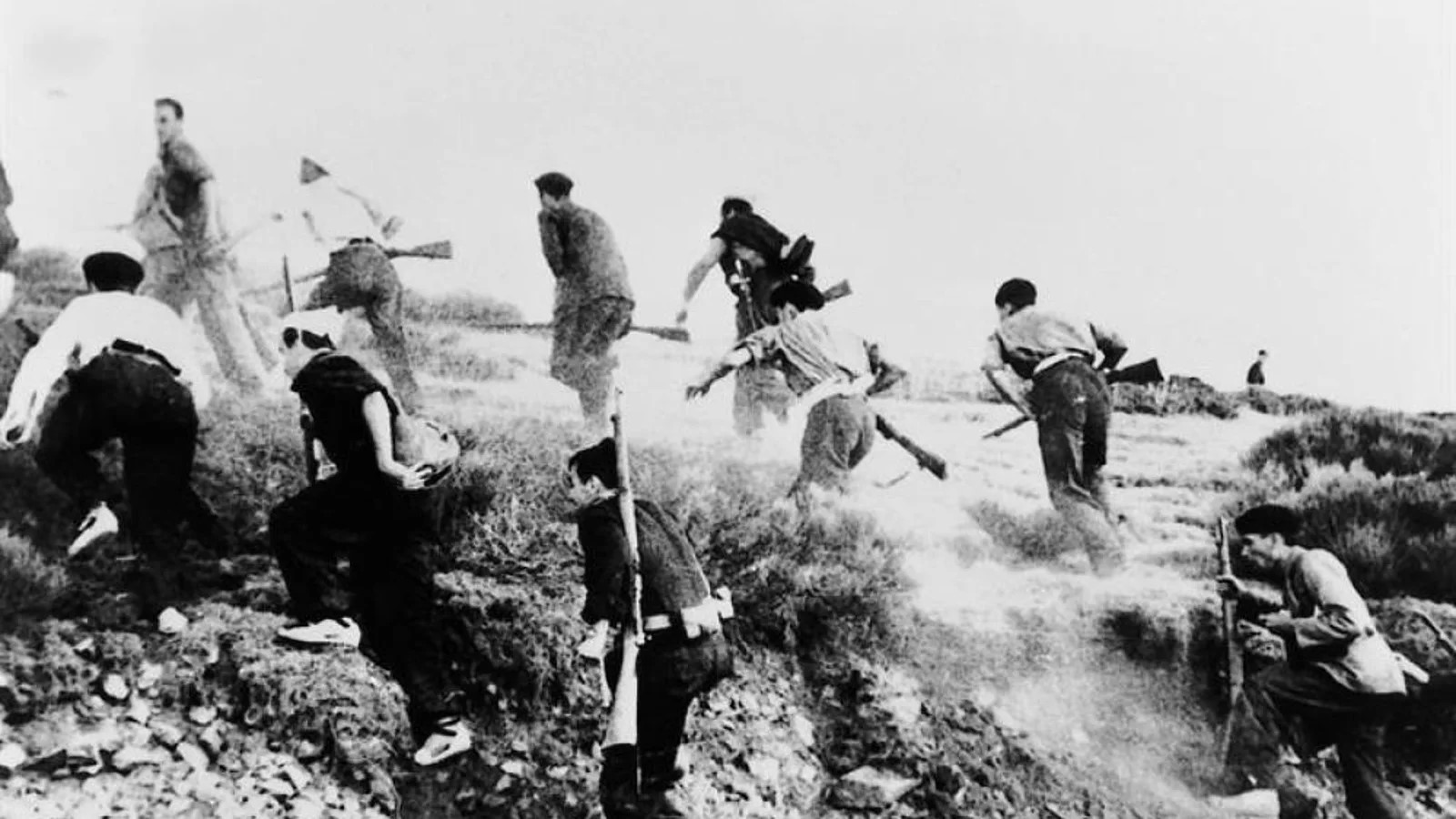
We can secure a hearing, we can lend conviction to our urging, only if we show that we mean business: that means immediate launching of an effective campaign of shipping arms to the Spanish people. Nothing can more quickly convince the Spanish workers that their struggle is a struggle of socialism against capitalism, than the contrast between the embargo by the “democratic” governments and effective aid from the world proletariat.
The Socialist party in America can and should play the leading role in initiating the campaign for armed aid to the Spanish people. We need not pretend to more numerical strength than we possess. But we can be the vanguard of a powerful, effective movement. The way to begin is to begin. We have no other alternative if we seriously desire to support our Spanish comrades. The struggle against fascism today centers in Spain and is an armed struggle. We must enter the struggle and em- ploy the weapons which can bring victory. Arms for the Spanish Workers! Only the International Working class Will Send Arms!
There have been a number of periodicals named Socialist Appeal in our history, This Socialist Appeal was edited in Chicago by Albert Goldman. After the Workers Party (International Left Opposition) entered the Socialist Party in 1936, the Trotskyists did not have an independent publication. However, Albert Goldman began publishing a monthly Socialist Appeal in Chicago in February 1935 before the bulk of Trotskyist entered the SP. When there, they began publishing Socialist Appeal in August 1937 as the weekly paper of the “Left Wing Branches of the Socialist Party” but in reality edited by Cannon and other leaders. Goldman’s Chicago Socialist Appeal would fold into the New York paper and this Socialist Appeal would replace New Militant as the main voice of Fourth Internationalist in the US. After the expulsion of the Trotskyists from the the Socialist Party, Socialist Appeal became the weekly organ of the newly constituted Socialist Workers Party in early 1938. Edited by James Cannon and Max Shachtman, Felix Morrow, and Albert Goldman. In 1941 Socialist Appeal became The Militant again.
PDF of full issue: https://www.marxists.org/history/etol/newspape/socialistappeal/pdf/v2n11-dec-1936-soc-ap-chi.pdf
 Revolution's Newsstand