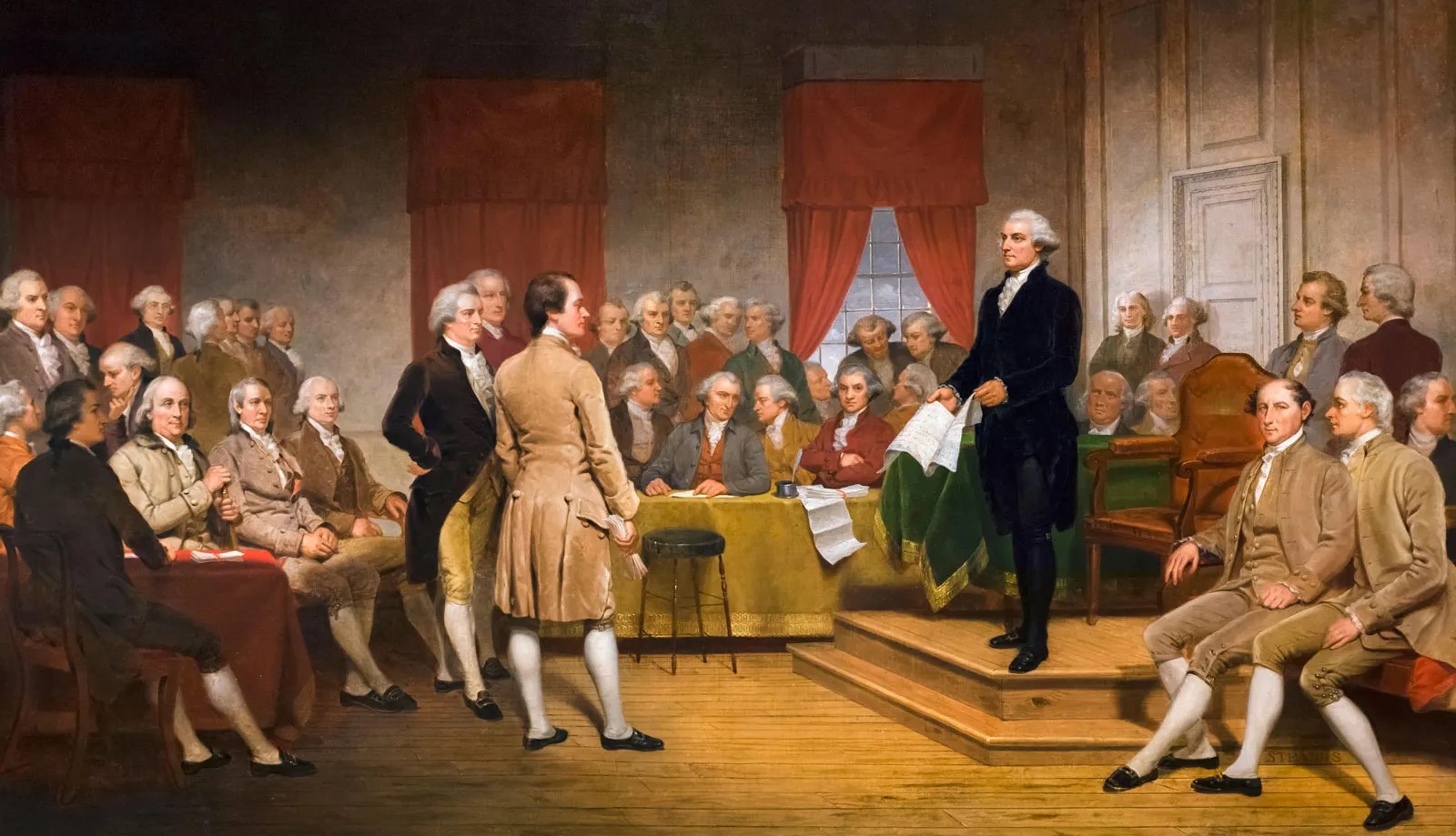
‘Some Notes on the U.S. Constitution’ by R.F. Pettigrew from One Big Union Monthly. Vol. 2 No. 4. April, 1920.
The convention that framed the constitution of the United States, at Philadelphia on the 25th day of May, 1787, was reported in long-hand by James Madison, a delegate from Virginia. The chief contention in that convention was over the representation in the Senate of the United States. The smaller states feared that they would be dominated by the larger ones and, after much debate, it was agreed that each state, no matter what its wealth or population, should have two votes in the Senate of the United States, while the House of Representatives should represent the people and the number of delegates from each state be in proportion to the population. As a concession to the larger states, a provision was inserted requiring that all money bills should originate in the House of Representatives, and this was considered important, in view of the fact that the states of small area and small population, such as Delaware and Rhode Island, had an equal voice in the Senate of the United States with Virginia and Pennsylvania.
The southern states believed they had secured protection for their peculiar institution by securing representation in the House of Representatives for the slave population. At the time of framing the Constitution and for many years thereafter it was supposed and intended that the Senate should represent the states. No particular and peculiar interest ever thought of gaining control of that body for the purpose of advancing the commercial or financial interests of any combination, corporation or individual, and it was not until a third of a century after the adoption of the Constitution that the southern states began to look to the Senate for the protection of their interests and insisted upon the admission of a slave state whenever a free state asked for admission into the Union.
This demand resulted in the exclusion of the State of Iowa until the State of Florida could be admitted and in the demand that Texas might be divided into five states, so that if slave territory was not sufficient in area to offset free territory and the free states clamoring for admission, Texas might furnish the additional states for this purpose, and this struggle to control the senate on the part of the southern states and the border states, in the interest of those who owned property in the person of human beings, continued until the war.
Let us see who were the members of the convention that framed the Constitution. There were 55 delegates in the convention that framed the Constitution of the United States.
A majority were lawyers.
Most of them came from towns.
Not one farmer, mechanic or laborer. 7 of 8 had property interests.
55 members.
40 owned Revolutionary Scrip. Washington was a big Scrip owner.
14 were land speculators.
24 were money-loaners.
11 were merchants.
15 were slave-holders.
Washington, Slave-holder, Land Speculator, Large Scrip Owner.
Jefferson was in France. The Constitution says nothing about the rights of man. It was made by men who believed in the English theory of government, that all governments are created to protect the rights of property in the hands of those who do not produce the property. Revolutionary Scrip was issued to finance the Revolution, and used to pay for supplies and the wages of the men that did the fighting, and had been bought up by the financiers and great land-owners and their attorneys for about nine cents on the dollar, and when the Constitution was adopted it was worth one hundred cents on the dollar.
The Constitution was made by property interests to protect the rights of property, rather than the rights of man.
It guarded against too much “democracy.” Supreme Court was appointed for life. Jefferson was in France.
Under John Marshall, First Chief Justice, the Supreme Court made the Constitution over in the interest of the rights of property.
The states refused to adopt the Constitution as first submitted; was not acceptable to the states and would never have been adopted if the ten amendments had not been submitted and adopted along with the Constitution.
One Big Union Monthly was a magazine published in Chicago by the General Executive Board of the Industrial Workers of the World from 1919 until 1938, with a break from February, 1921 until September, 1926 when Industrial Pioneer was produced. OBU was a large format, magazine publication with heavy use of images, cartoons and photos. OBU carried news, analysis, poetry, and art as well as I.W.W. local and national reports.
PDF of full issue: https://archive.org/download/sim_one-big-union-monthly_1920-04_2_4/sim_one-big-union-monthly_1920-04_2_4.pdf
 Revolution's Newsstand