William Z. Foster, here a member of the Syndicalist League of North America and a fierce critic of the I.W.W., on the events in Butte, Montana, a citadel of radical unionism, that resulted in an armed confrontation in the city between the wobblies and the Western Federation of miners in 1914.
‘The Miners’ Revolt in Butte’ by Willam Z. Foster from Mother Earth. Vol. 9 No. 7. September, 1914.
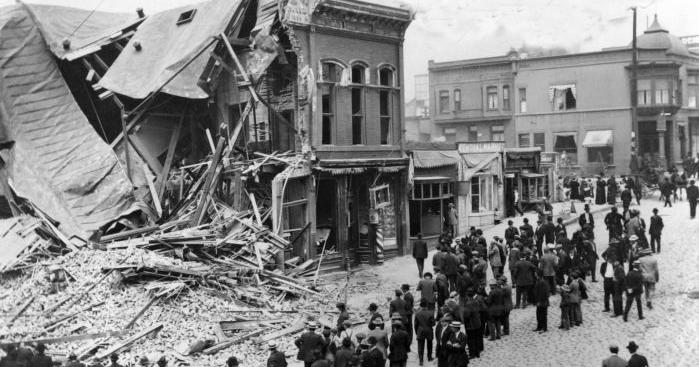
IN the history of the labor movement there is perhaps no more remarkable event than the revolt of the Butte miners against the Western Federation of Miners. Not only did the miners quit their old union in a body and start a new one, but they also drove the W.F. of M. officials out of town on pain of death, and finally dynamited and destroyed their historic union hall, doing some $50,000 damage. Such an event should give serious pause to all union men. Its causes should be most carefully studied and its lessons taken to heart.
The chief functions of the old union seem to have been to serve as a sick and death benefit society, to dig up vast sums of money in assessments to finance the many ill-fated strikes of the W.F. of M. in Cobalt, Bingham Canyon, Lead, Calumet, etc., and to boost the outside crafts to better conditions. It has done very little to benefit the conditions of the Butte miners.
For a long time, especially during the last two years, the progressive miners, led by a handful of I.W.W.’s and a large number of “red” Socialists, have diligently tried to put the union on an effective basis. They were opposed by their union officials, who used tactics comparable only to those of Tweed, Quay, Hinky Dink Cox, et al., in the palmiest days of American politics. Nor is evidence lacking to show that the company took an active part in the union affairs, with at least the knowledge, if not the connivance, of the union officials. One method of doing this is well worth a detailed account.
Though serving as a meeting place for a union of seven thousand men, the Miners Union Hall had a seating capacity of but about six hundred. To pack this hall so that undesirable elements would be kept out was an easy task for the company. The several hundred bosses in the fifty odd mines would each pick out one or two “good” men and quietly send them home on full pay, with instructions to go early to the union hall. Thus when the body of the miners would arrive at the hall they would find it already full to capacity with company lickspittles, ready for the work of reaction. This system of packing the hall was a growth of many years, becoming ever more elaborate. It was used whenever some important project was on foot among the miners.
The smallness of the hall played an important part in the history of the mismanagement of the Butte union. There are those who claim that it was the one insurmountable obstacle that prevented the rebel element from cleansing the union, hence their peculiarly bitter hatred for the hall that finally culminated in its destruction. It was a very monument to company control of the union. As long as it stood, the old danger of packed meetings loomed big.
The actual control of the union by its officials often bordered on the outrageous, if overwhelming testimony is to be believed. Elections were commonly a farce. Each member voting was supposed to have his union card stamped to that effect. However, the gang stamper would only pretend to stamp the cards of the “good” men. These worthies would thus be enabled to vote ad infinitum. Barefaced frauds were practiced in the counting of votes. Objectors to these practices were laughed at, or if needs be, slugged.
For years the militants stood these abuses. Appeals to the general officers of the W.F. of M. availed them nothing. A widespread report in Butte has it that the W.F. of M. officials winked at the Butte irregularities in return for the solid support of the Butte delegation. Finally came the straw that broke the camel’s back. At the last election, June 2, 1914, the militants made a determined stand, but were ingloriously defeated. They were unable to secure any judges of election, and worse yet, their proposition to use the city voting machines, which would at once have guaranteed an honest election and saved the union a large sum of money, was defeated by the usual tactics. Convinced that there was no chance for a fair election, they withdrew, leaving the old guard a clear field.
This incident produced a profound impression among the miners. Only a spark was needed to start a conflagration. This came at the Butte Miners’ Day celebration. The parade had halted. A few remarks were made by bystanders. Like a flash the long growing hatred for the union officials blazed forth and the affair was on. The union officials were driven off, and later on, the interior of the hall was wrecked.
After this event the miners held a big mass meeting in which they repudiated the W.F. of M. They then launched the new union. The latter, known as Butte Miners Workers Union, now claims a membership of over 8,000, while the old union, save for the engineers who remained loyal to the W.F. of M., is seemingly nonexistent.

After the launching of the new union, President Moyer went to Butte with a belated compromise calling for the resignation of all the local officials of the old union. But it was too late; the miners had taken the bit between their teeth. When President Moyer tried to put his proposition before them, the riot developed in which the hall was dynamited and he and the other union officials had to flee from Butte. The responsibility for this riot rests largely with the W.F. of M. faction, for it was from the inside of the hall that the fatal shooting began.
The Socialist party in the Butte affair has pursued a course of steering between the two extremes. It has at once opposed the old officials and the extremist “reds.” It has won the cordial hatred of both factions. Its chances to maintain itself in power in Butte are anything but bright,
The stabbing of the Socialist Mayor Duncan, done ostensibly because he would not order a W.F. of M. sympathizer from Butte, was in reality the culmination of a long feud between the “yellow” and “red” Socialists in Butte. The “red,” by clever manipulation, secured control of the S.P. in Butte. Wishing to fill the city with “reds” so as the better to carry on their propaganda in the unions, they decided to secure control of the position of street commissioner in order that the visiting “reds” could find ready employment. Mayor Duncan on learning their scheme circumvented it by appointing a hostile street commissioner. Then to avoid an open repudiation of the party mandate, he brought charges of advocacy of sabotage and direct action against the leaders of the “reds.” When they were acquitted he was instrumental in taking away the character of the local and organizing it upon a “yellow” basis. Thus he earned the bitter animosity of the expelled “reds,” of whom his assailant was one.
The part played by the I.W.W.’s and other “reds” in the revolt was a considerable one—they are in the majority on the executive committee of the new union. But to assert they are the cause of the present trouble, or that it is the result of a deep laid plot is nonsensical. Doubtless some of the I.W.W.’s afflicted with the chronic dual union idea, have all along dreamed of a day when they could break up the Butte union or force it into the I.W.W. and no doubt this element did much to emphasize the new union idea. But that they themselves caused the revolt is out of the question. Trade unionists do not destroy their unions and union halls, and chase their officials out of town at the simple behest of a handful of radicals. A profound discontent based on real grievances, was behind the action of the Butte miners. I am told by many that took part in the revolt that it was a purely spontaneous affair. The militants had exhausted every legitimate means to correct the abuses in the union, but without avail. The parliamentary machinery of the union was broken down. Force alone remained, and they used that, advisedly or not. The pitcher had gone once too often to the well.
What will be the attitude of the American labor movement toward the seceding miners? Will it take the narrow position that a breach of discipline justifies any and all reprisals? Will it encourage the W.F. of M. to go into Butte again and try to force the miners to time with the Golden or Tobin tactics? In full recognition of the seriousness of secession in the ranks of labor, the writer believes it would be wrong to do any of these things. The best thing to do would be to treat the matter in the big way.
True, the Butte miners have gone the limit, but so also have the W.F. of M. officials. They are the real cause of the present trouble; had they done their duty it would not have occurred. Therefore, let the score stand even. Don’t try to discipline anyone off hand. Have a national commission of reliable men hear both sides of the controversy. Let it make awards accordingly. If this is done, I am sure the Butte miners will soon be back in the fold again, probably through the medium of the U.M.W. of A., which they favor strongly. Contrary to the hysterical versions of President Moyer and a few others, the seceding miners have small liking for the I.W.W. and a strong sentiment for the U.M.W. of A., and no one knows this better than the I.W.W’s in Butte. Already they are in death grips with the more conservative elements for the control of the new union. They know that the best way to wreck it would be to try to swing it into the I.W.W.
Unless something like this is done to give the Butte miners a square deal; unless the W.F. of M. is discouraged from disciplining them, at all costs, the writer is convinced the outcome will be a calamity to the whole labor movement, as well as to the W.F. of M. Any interference of the W.F. of M. in Butte at this time, would at once provoke a great strike. To live up to its closed shop agreement the W.F. of M. would have to furnish strike-breakers. This would result in a war that would end by practically destroying both unions as well as work havoc in general throughout the labor movement.
Mother Earth was an anarchist magazine begin in 1906 and first edited by Emma Goldman in New York City. Alexander Berkman, became editor in 1907 after his release from prison until 1915.The journal has a history in the Free Society publication which had moved from San Francisco to New York City. Goldman was again editor in 1915 as the magazine was opposed to US entry into World War One and was closed down as a violator of the Espionage Act in 1917 with Goldman and Berkman, who had begun editing The Blast, being deported in 1919.
PDF of full issue: https://archive.org/download/mother-earth/Mother%20Earth%20v09n07%20%281914-09%29%20%28c2c%20Harvard%20DSR%29.pdf
 Revolution's Newsstand