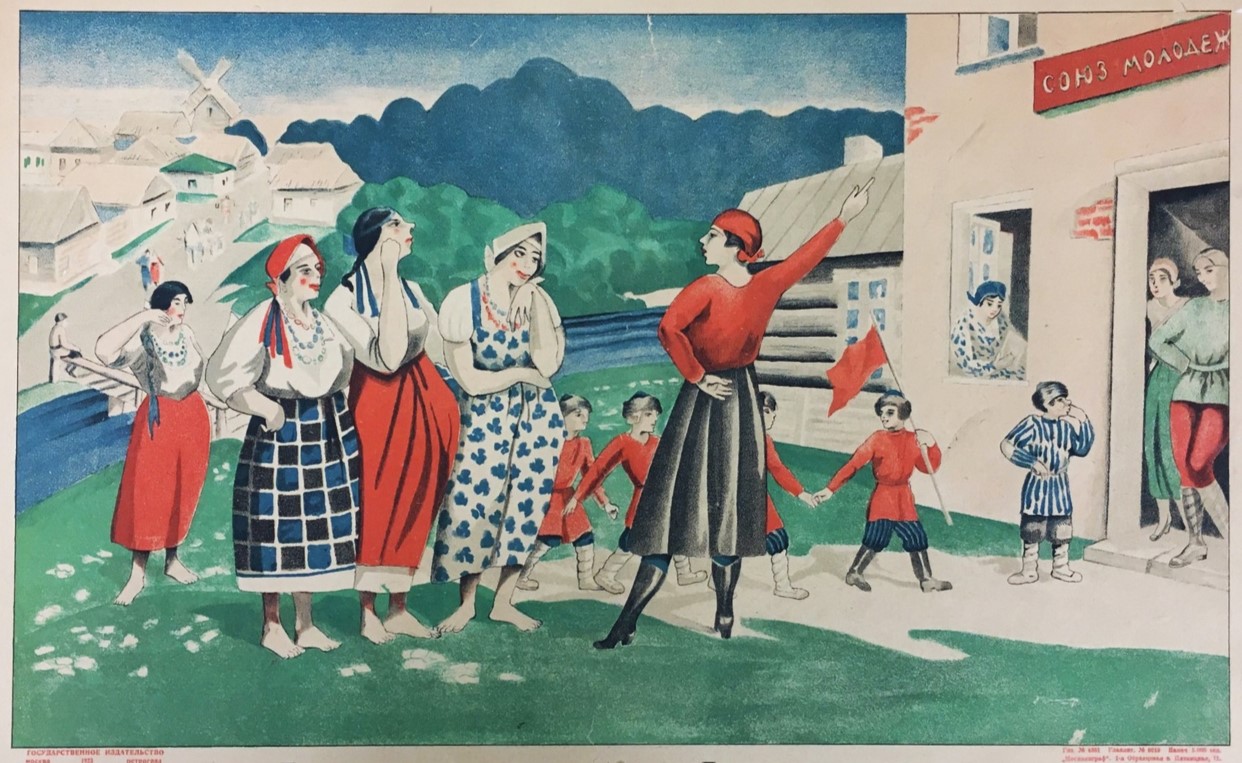
Facts and figures on the level of women’s involvement in the Party in 1922, with some clear work to do.
‘Women in the Russian Communist Party’ by E. Smitten from International Press Correspondence. Vol. 3 No. 48. July 5, 1923.
According to the Party census taken this year, the total number of members in the Russian CP. amounted at the beginning of 1922 to 402,030 members and 112,774 candidates. In this communist army of more than half a million, the women form but a small group of 39,434 members and 9,500 candidates. The women members and candidates in the republics of the Far East and Yakutsk are not counted among these, as no census was taken here in 1922; the number of women members and candidates is estimated at 13,500.
This is a comparatively very small number for a country with a female population of 70 millions, and a constitution which places no limitation whatever on the political rights of women. But the generally low level of education, the lack of schools, the cramping power of the family and the household, still continue to hold women back from participation in public life. However, even 40,000 women represent, in a revolutionary proletarian party, a very considerable force, when we consider the very short period which the Party has had for winning over these thousands of women.
At the present time, we possess no exact data on the social position of the women within the whole party; in 70 governments of Central Russia the women members of the Russian CP are drawn from the following social classes: Out of 18,945 members of the Party, 7,217 are wage workers; the main occupation of 8,060 members enables them to be classified under the employees’ group; 867 come under the peasantry; and 2,801 extremely youthful members of the Party, who have not yet adopted any profession, still belong to the mass of students attending various educational establishments.
With respect to education; 77% of the total women members of the Party have received elementary education or home instruction only; there are some among them who are totally illiterate.
The group of women communists in the Russian CP is mainly composed of women from the cities. The cities form that reservoir from which the Party organizations obtain their main supplies. The villages, with their individualist economics, supply a much smaller number of communists, male and female alike. But while in the cities, the number of men communists is one and a half times as large as in the villages, the number of women communists in the towns is three times as large as in the villages. In the towns the women find themselves in the midst of urgent and useful social work, demanding a fairly high degree of general development. Besides this, it is highly probable that the ten thousand or more women registered as communists in the village nuclei, do not belong to the country originally.
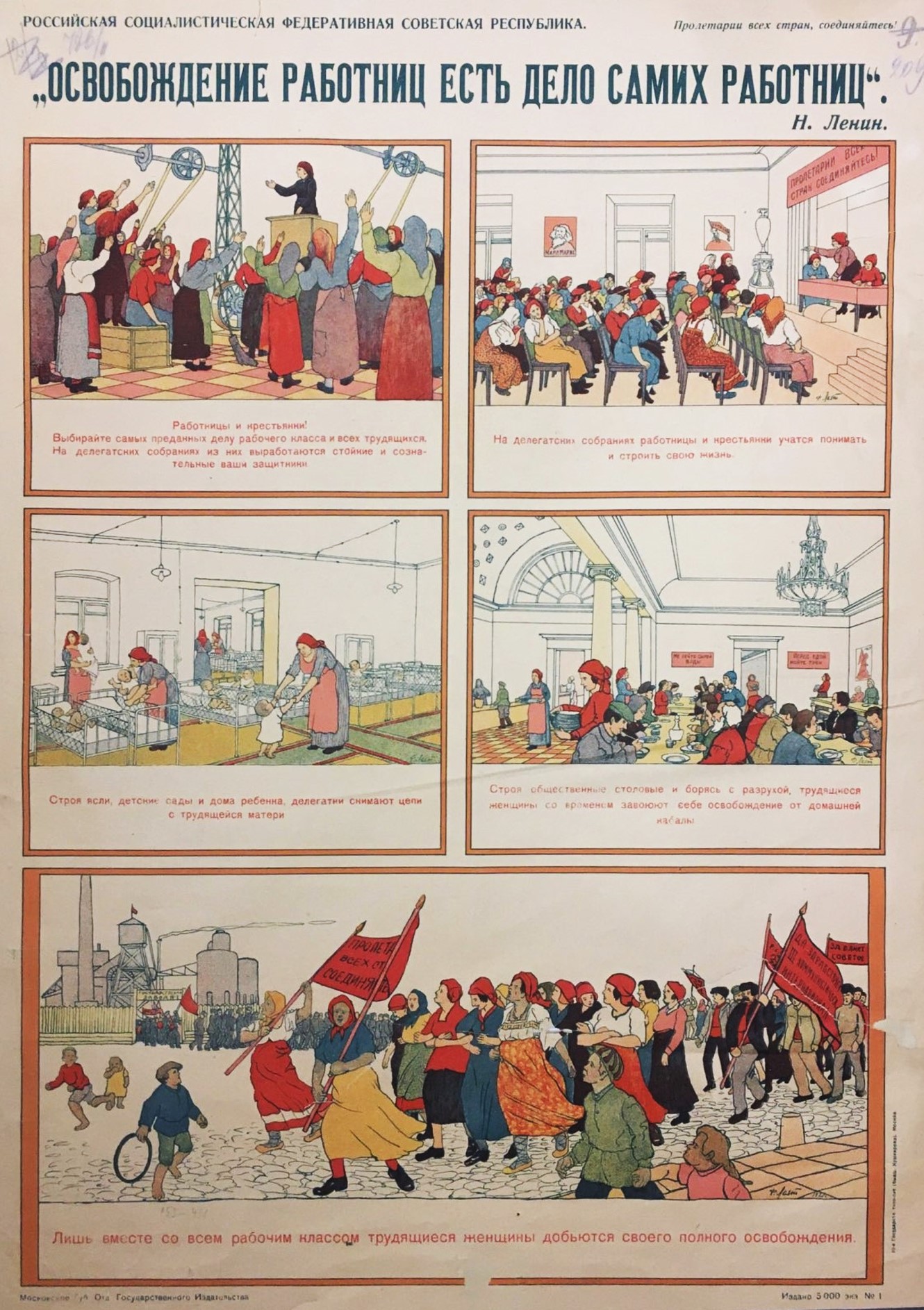
With regard to the distribution of women communists over the various districts, the absolute and proportional number of women differ greatly in the various districts.
In 12 governments and autonomous districts of industrial areas in Central Russian there are 14,727 (members and candidates counted together) female members 12.4% out of 118,62. In the 28 governments etc. of the agricultural districts of Central Russia 9161 7.7% of the 119,672 members are female. In the border districts the picture is different. The SSR Ukraine does not differ much, having a proportion of 5605 7.6% of female members out of a total of 73,804 in 12 governments; but in Siberia there are (in 7 governments) only 3060 women = 5.6% among 56,564 members; in Caucasia (7 governments) 1648 3.7% women among 44,841 members; and in Turkestan (6 governments) there are only 616 2.8% of women among 29,053 members.
These figures show that the communist women belonging to the Party organizations are divided by their numbers into two groups. The first group is formed by the organization of the 40 governments of Central Russia. Here almost 60% of the female members of the party are concentrated. And here the percentage of women to the total number of members is the greatest. The further we are away from the centres and the nearer the frontiers, the smaller the percentage of women among the communists. The number of women communists in Caucasia and Turkestan is especially small. The national composition of the Party and its separate organizations is still unknown to us, but it is certain that the small number of women won for the Party in these two districts is due to the national habits and customs.
There are eight female members to every hundred male in the Party, and 9 female candidates to every hundred candidates- that is, among the candidates the percentage of women is somewhat greater than among the members. In the towns, this difference between the comparative number of candidates and members is even more striking. In the cities there are 10 women to every hundred men members of the Russian CP, and 14 female candidates to every hundred male. However, small these numbers may appear, they at least offer the prospect that the percentage of women members in the Russian CP will increase in the immediate future.
International Press Correspondence, widely known as”Inprecorr” was published by the Executive Committee of the Communist International (ECCI) regularly in German and English, occasionally in many other languages, beginning in 1921 and lasting in English until 1938. Inprecorr’s role was to supply translated articles to the English-speaking press of the International from the Comintern’s different sections, as well as news and statements from the ECCI. Many ‘Daily Worker’ and ‘Communist’ articles originated in Inprecorr, and it also published articles by American comrades for use in other countries. It was published at least weekly, and often thrice weekly.
PDF of full issue: https://www.marxists.org/history/international/comintern/inprecor/1923/v03n48[28]-jul-05-Inprecor-loc.pdf
 Revolution's Newsstand