
Some fascinating inside details reported by ‘a striker’ of the Communist League-led Local 574 in the midst of 1934’s Minneapolis Teamsters strike.
‘How the Strike Was Organized’ by A Striker from The Militant. Vol. 7 No. 22. June 2, 1934.
Minneapolis, May 28.-The courage and determination so effectively displayed by the striking Minneapolis truck drivers and helpers has proven conclusively that the American working class is very well equipped to fight their exploiters. It only remains for a proper leadership to come to the front in the entire labor movement and guide these dynamic forces to victory.
The striking truck drivers and helpers were suffering from economic adversity but their condition was no different from that of other workers in the United States. These men were simply a representative cross-section of the American working class. The abilities which they brought into play are lying dormant in every group of American workers.
Every effort was made by the leaders to give these natural abilities an opportunity to come to the surface. No stone was left unturned in the attempt to do this. Something more than numbers is required on the picket line. The men must feel that their efforts are well spent, that they are a part of a smoothly functioning machine, that they can successfully hold every position they win. To stimulate and justify this confidence the leaders must perfect a thorough organization and all preparations must be carefully checked to the most minute detail. That was done in Minneapolis.
The Details of Organization
A large garage about 400 feet wide and a block long was selected to serve as the headquarters for the Minneapolis strike. A large sign was painted across the front of the building announcing that this was the strike headquarters. Supplementary field headquarters were set up at points where it would prove necessary to concentrate a sizeable force for mass picketing. At the main headquarters a stage was erected and a loud-speaker system installed to be used in dispatching of pickets and in addressing meetings.
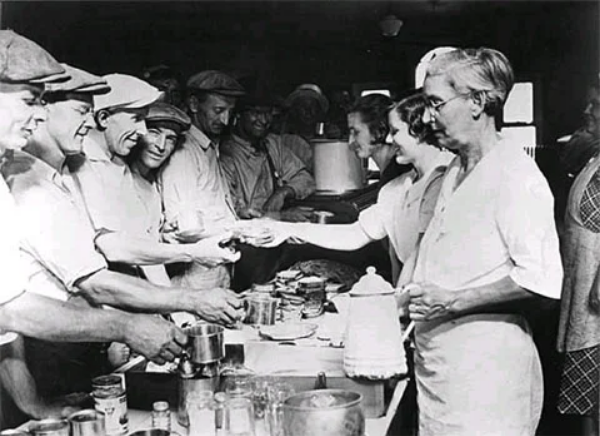
A commissary department requiring a personnel of 35 was set up and maintained throughout the strike. A special service and repair department was provided and a crew of 12 mechanics well equipped with tools, were busily engaged in keeping the cars and trucks of the pickets in good running order. Special arrangements were made to secure gasoline and to obtain tire repair service.
A first-aid station was established at the headquarters through the volunteer services of two doctors and two trained nurses. This department rendered an invaluable service because of the speed and efficiency with which injuries were treated and it is notable to record that in no case did an infection develop.
Within the headquarters offices, a crew of men with special instructions remained constantly at the telephones which were the nerve center of the strike. A corps. of women assistants under the direction of the financial officer received applications for membership which poured in by the hundreds and issued permits for the pickets to obtain gasoline and mechanical service. A special committee was set up to hear complaints and requests for special permits to operate trucks. The instructions to this committee were very strict. These special groups served excellently as a buffer to take the burden of routine matters off the shoulders of the leaders and to leave them free to direct the principal strategy of the strike.

Before the start of the strike a complete analysis of the picketing requirements had been made and, with a corps of stenographers and mimeograph operators, the leaders bad prepared a complete set of written orders and instructions to the pickets. As a result of this careful preparation, the entire picket line was established and functioning effectively within an hour after the beginning of the strike.
An Effective Strategy of Picketing
The principal strategy of the picketing was to establish stationary picket posts at the city limits on all highways, at all gasoline bulk plants and direct service filling stations, at the wholesale market, in the loop retail district, and at the truck freight terminals. These stationary pickets were supplemented by “cruising squads” which were assigned to definite districts throughout the town and by other cruising squads which were, assigned to cover certain areas where trucking activities would most likely be attempted.
The pickets were transported to and from the stationary posts by truck and the cruising squads were provided with fast automobiles. A reserve force with adequate transportation facilities was kept in the headquarters at all times. Each group of pickets and each cruising squad was commanded by a picket captain, who had been given written instructions as to responsibilities. Each truck driver was also given special written instructions to be followed.
Concentration of Mass Picketing
Wherever mass picketing was required a field commander was appointed and given special credentials with instructions to establish a field headquarters to maintain contact with General Headquarters. This was accomplished by stationing a contact officer at a suitable telephone location and providing him with assistants. In this manner G.H.Q. could phone orders to the contact officer who would in] turn send them to the field commander by one of the assistants. Reports from the field commander to G.H.Q. were also sent by this medium. To supplement this a special squad of motorcycle riders were kept at G.H.Q. to perform special liaison duties.

A number of special cruising squads manned by hand-picked men and captained by qualified leaders were kept under the constant control of G.H.Q. The captains of these squads were given credentials which superseded all other authority in the field. These squads were used to be sent into a tense situation for the purpose of reorganizing the forces and leading the fight. They did their work well and more than justified the continuation of this system.
It is well to note that in spite of the large number of cars, trucks, and motorcycles required for this method of picketing, there was an excess of vehicles volunteered for service by the strikers.
Handling Stool-Pigeons
It was naturally necessary to maintain a guard at the doors of the headquarters. But in spite of all precautions, stool-pigeons will slip through. Once within the building, these miserable wretches can do much damage if left unhindered. They operate principally by attempting to disrupt the ranks through the encouragement of drinking and through attempts to create disorder and discussion.
Special squads of reliable men were kept on duty constantly watching for these people and they did their work very effectively. There is another and more dangerous type of stool-pigeon, who comes well armed with credentials and attempts to insinuate himself into a position entailing some responsibility. It was found that by carefully selecting key men who are absolutely trustworthy and by using great secrecy in issuing orders that it is comparatively easy to discover these people through their great ambition to disrupt.
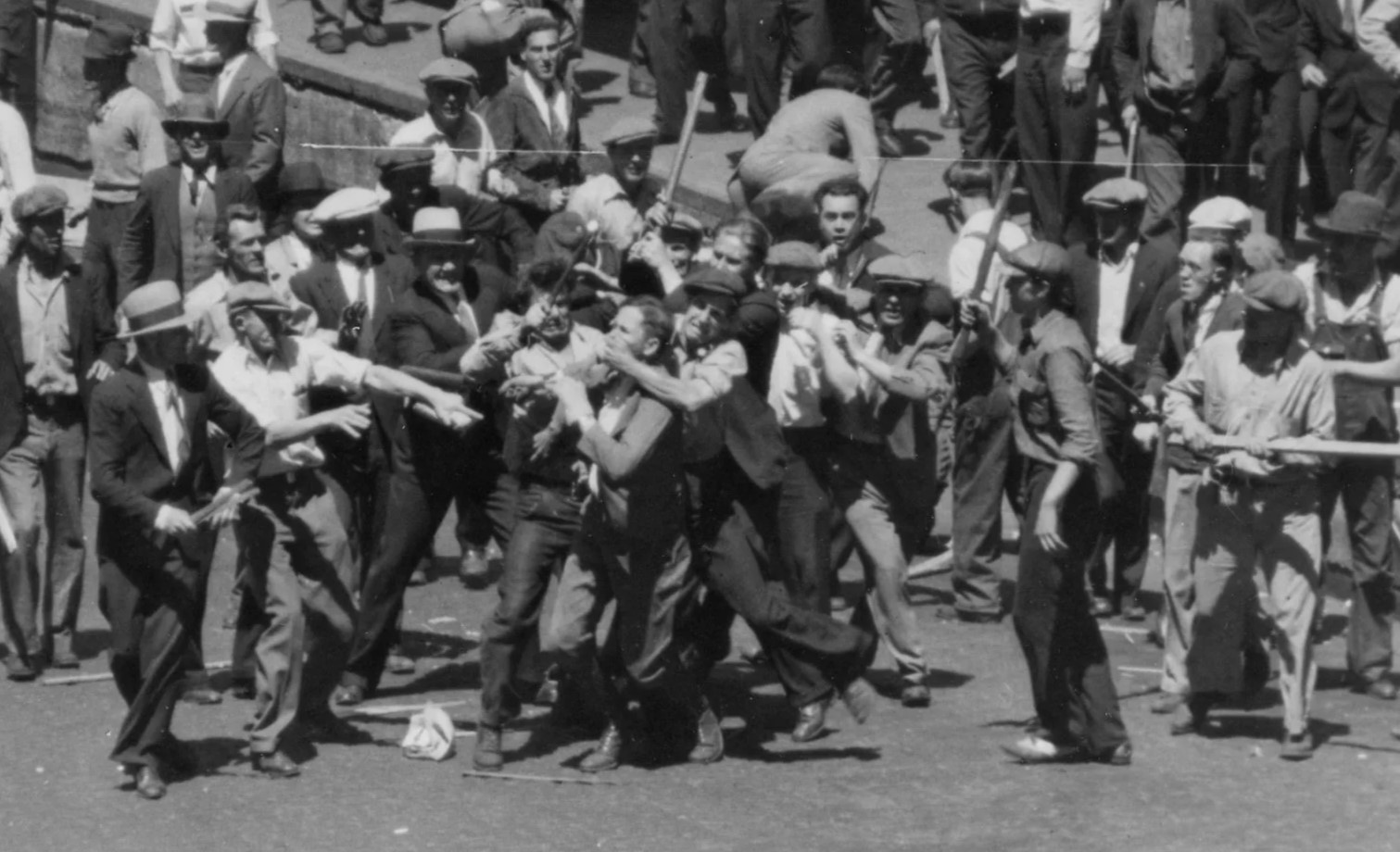
To summarize the general results of this organizational method, we find that we have a group of strikers who are given food regularly, and medical care for their physical comfort. We find that they have reliable mechanical equipment to do their job. And we find that they soon come to realize that their leaders know at all times where they are and what they are up against. They wade in fearlessly because they know that if they need help it will come, if they need new captains, they will come, and they feel confident that if they win any advantage their leaders will be able to hold it for them.
These Minneapolis workers then are merely representative American workers, who have risen to a new height because of the careful efforts made to uncover and develop their every resource. The Minneapolis workers call upon the workers of America to demand such cooperation and guidance from all labor leaders.
The Militant was a weekly newspaper begun by supporters of the International Left Opposition recently expelled from the Communist Party in 1928 and published in New York City. Led by James P Cannon, Max Schacthman, Martin Abern, and others, the new organization called itself the Communist League of America (Opposition) and saw itself as an outside faction of both the Communist Party and the Comintern. After 1933, the group dropped ‘Opposition’ and advocated a new party and International. When the CLA fused with AJ Muste’s American Workers Party in late 1934, the paper became the New Militant as the organ of the newly formed Workers Party of the United States.
PDF of full issue: https://www.marxists.org/history/etol/newspape/themilitant/1934/jun-02-1934.pdf
 Revolution's Newsstand