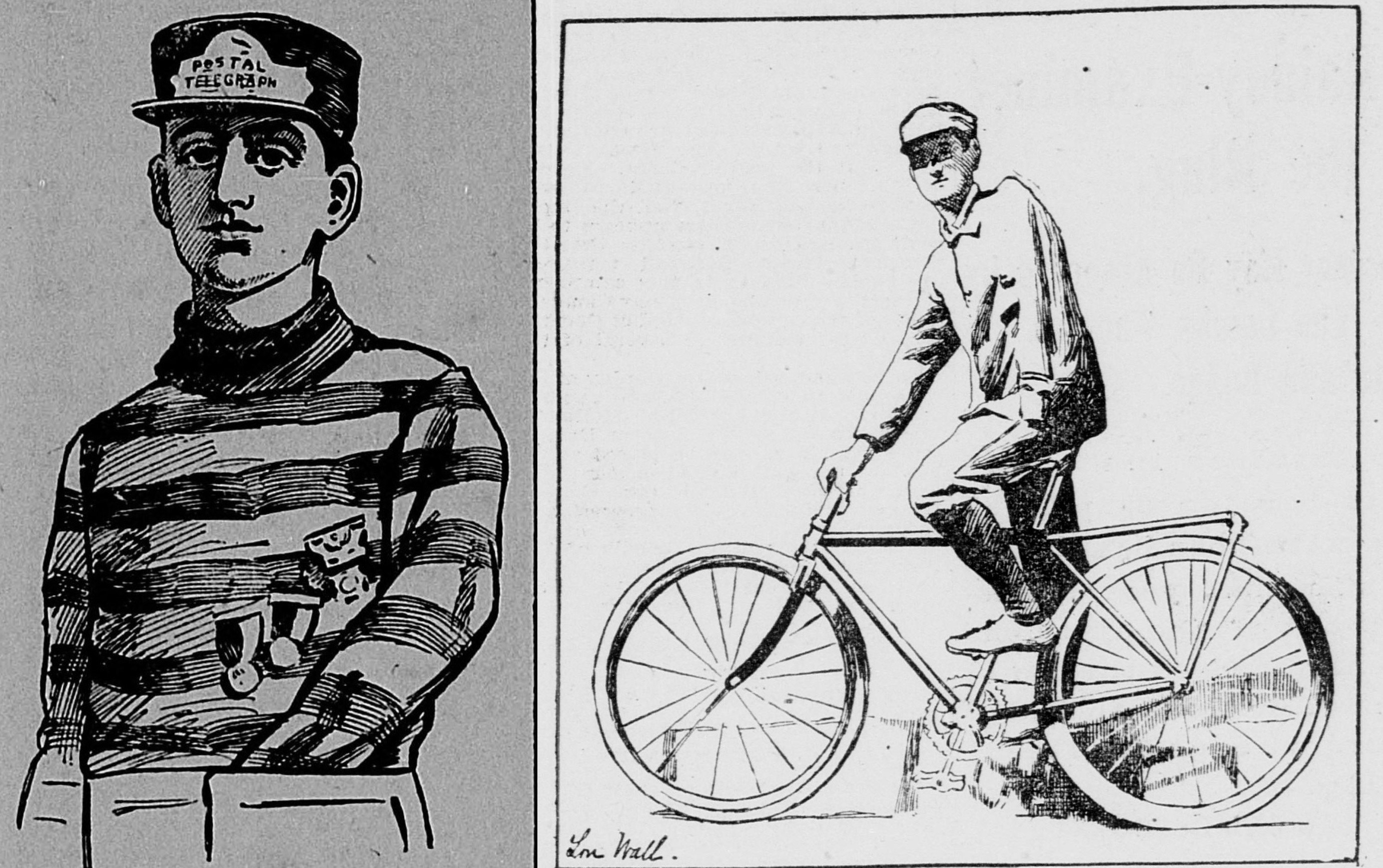
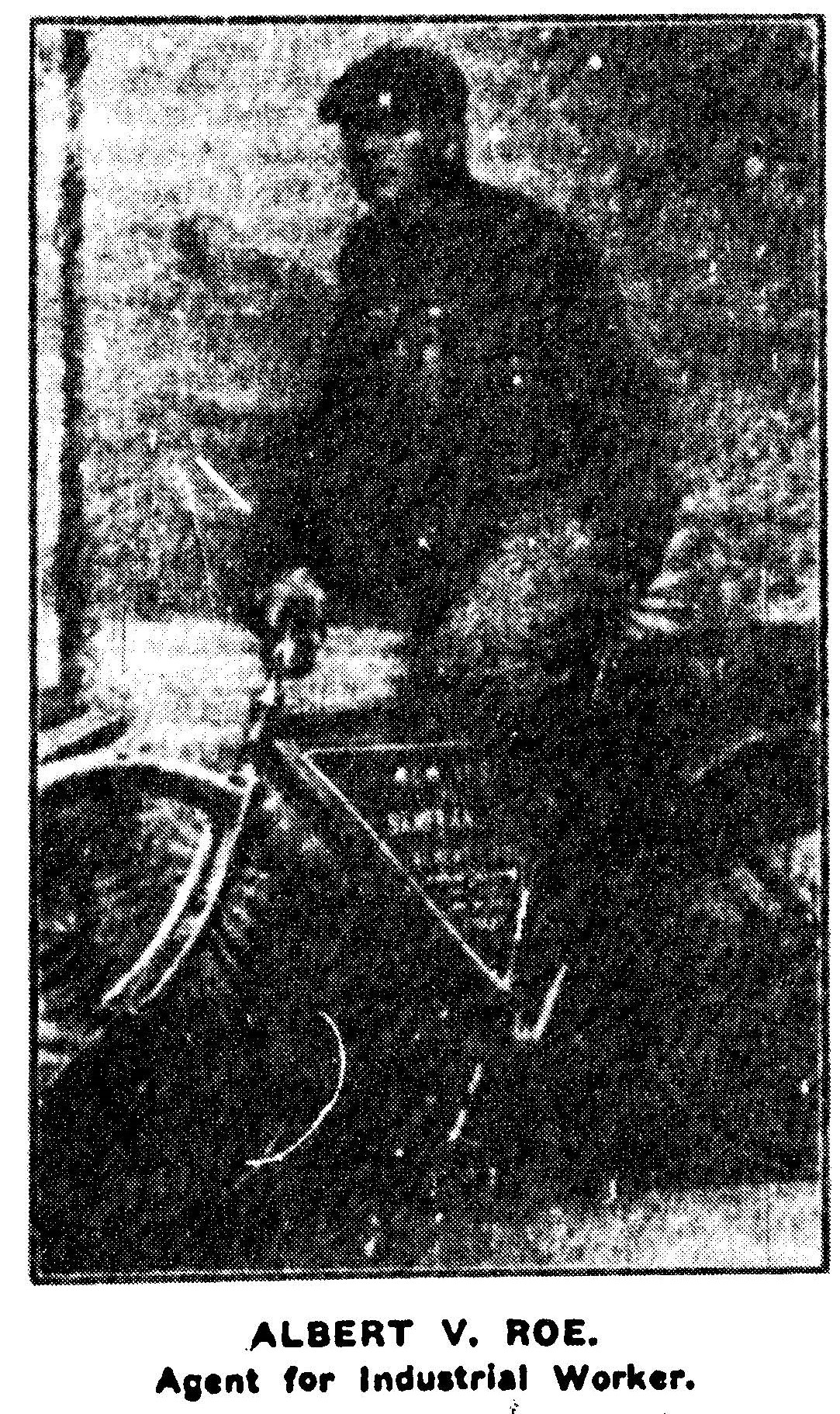
Meet the indefatigable wobbly agitator Albert V. Roe, known for riding his bike and spreading the Good News of industrial unionism from town to town. Born in 1880, at seventeen Roe lost an arm in a railroad accident, but that did not prevent him from becoming a bicycle messenger for the Postal Telegraph Company. In 1899, At 19, he made national news as one of the first people to travel across country by bicycle. He completed the journey in 70 days; the early auto he was racing quit a third of the way through. An evangelical member of the I.W.W., Roe was arrested more times that one can count as he soapboxed and sold the Industrial Worker from jungle camp to jungle camp. In 1913, Roe traveled all the way to Hawaii, where he helped revive the I.W.W there, winning Japanese and Filipino workers to the Cause. That is where he would perish, in a Honolulu jail from ‘heart trouble’ on April 14, 1914 at the age of 34. Here’s your chance to tag along with Roe, the ‘one-winged hustler,’ on his journeys with dozens of reports sent to the I.W.W. press of his activities. Red salute, comrade Albert V. Roe!
Wobbly Agitator Albert V. Roe Reports from the Road, 1909-1914 from The Industrial Worker.
‘Cripple Kicked by a Brute’ from Industrial Worker. Vol. 1 No. 7. April 29, 1909.
Albert V. Roe sells the “Industrial Worker” on the street of Spokane. The employment sharks do not like the Worker. On Saturday, April 24, 1909, as Roe was selling the paper on Stevens street he was brutally assaulted by Albert H. Jellsett, a Spokane policeman. Jellsett stole up back of Roe and kicked him. Roe it a man with only one arm. The police thug then took Roe to the police, station on a charge of “disorderly conduct.” Roe was let out of jail in two days with no trial. The police judge that incorruptible patriot—offered to let Roe go with no trial if Roe would agree not to bring charges against the police thug! A one-armed cripple assaulted—from behind—and then a judge trying to save the policeman from exposure! Comment is needless. Wait till we are better organized, and can regulate these crimes. Nothing has been done to Jellsett and nothing will be done by the courts. If Roe had been killed, is there any simple, plain fool who thinks that there would have been so much as an investigation by the officials? It is to be hoped that this is only an incident; that the I.W.W. men will continue to be clubbed, arrested and kicked; that the police will continue to enter the dwellings of Union men at night and search the house—a la Russia. This will get the scum off the workers’ eyes who still think they have any legal rights. It is a sharp medicine, but it will cure all diseases.
‘Trip of A.V. Roe’ from the Industrial Worker. Vol. 1 No. 16. July 1, 1909.
I left Spokane on Friday night on No. 4 as you know. Arrived in Sandpoint at 3 a.m. Saturday, canvassed the town, sold about 50 papers, and bought a box of tacks and tacked up the cards all over the town. Things look pretty good in Sandpoint in the way of Industrial Unionism, and I believe that if an organizer was to drop in on Saturday, give a Saturday night spiel on the street and stay over Sunday, that he would have no trouble getting enough members to start a local. It’s a fierce bunch of scabs in the sawmills at Sandpoint— the Humbird mills Nos. 1, 2. and 3. The scale of wages in the mills are $3.35 and $3.50 for ten hours and every other night they come back after supper and work from 7 till 9:30 at the same rate as the day work. I asked one of the slaves working there why they didn’t go out with the boys in Montana and get a little more of the products of their labor. But he got sore right away and told me that “the I.W.W. was. a scab bunch, as the men who went out In Montana were coming into their mill (Sandpoint mills) and taking their jobs away, from them and compelling them (the Sandpoint scabs) to go to Montana to scab on the men who were out there!” I have heard a good many excuses made, as to why men scab, but this one is a new one on me. I left Sandpoint Saturday night on the rods of the North Coast Limited and arrived In Paradise at 3:30 Sunday morning. Ate breakfast, scattered papers and cards all over town, and hiked 37 miles through the jungles to Dixon, giving away papers and tacking up cards all the way. Street speaking is all right In Sandpoint. Left Dixon at 9:03 last night, got here (Missoula) about 11 p.m. Crawled into a side-door Pullman, covered up with an Industrial Worker and dreamed about Judge Mann all right. As soon as I hit the street this morning the natives told me of an I.W W. man who got pinched last week for street speaking. I am going to hold a street meeting here tonight If they will let me. I guess I will get pinched all right, but I guess I can stand It. I had 3o song books that I Intended to sell here, but I lost them off the rods last night. I am going to scatter the May Day edition all over town today. From here I will jump direct to Minneapolis. ALBERT V. ROE.
‘From Minneapolis’ by A.V. Roe from the Industrial Worker. Vol. 1 No. 16. July 1, 1909.
June 25. Arrived In Minneapolis this morning at 6 a.m., safe, sound and hungry. Left Missoula at 11 p. m., June 21, on the rods of No. 6; arrived Mandan, N.D. June 23, 3 a.m. Made 805 miles on the jump. Could have gone clear through on her but got hungry and sleepy. Met Fellow Worker John M. Foss and Peter Geleyn, L.U. 33; and L.U. 434, in Mandan. We went down to the Jungles and had a good old fashioned mulligan-—the kind mother never had the nerve to make. The Jungles in Mandan are fine; right on the bank of a nice river, plenty of good water and wood and everything to make a slave, who is too wise to work, feel thankful that he is not a millionaire! If a bunch of the muck stick artists around Spokane, could see the “Boes” in the jungles at Mandan lying In the shade, drinking ice water, they would swear off work forever. I Intended to hold a street meeting in Mandan, but as I had no literature of any kind to pass out and as my clothes were a little seedy. I passed it up. I left Mandan at 2 a.m. June 24 on the rods of No. 6. Rode 56 miles and got ditched; caught a freight land went to “Jimtown” for dinner. After dinner, caught another freight and got to Staples at 9 o’clock last night. This morning I hit the rods of No. 4 at 2 a.m. and got to Minneapolis at 6 a.m. The biggest jump I made on the trip was from Missoula to Mandan. 805 miles in 37 hours. I am leaving for Chicago this evening. I have got to go out today and bum a suit of rags, as the rods are hard on clothes. The Minneapolis employment sharks are flooding the country around Glendive with working stiffs. There is going to be a branch built from Glendive to Omaha, but it Is not started yet. I will write you again from Chicago. Give my regards to all the boys. Well I guess I will ring off. I have got to get busy if I want to rag up here today.
ALBERT V. ROE. The Transcontinental Cyclist.
‘Out Again’ from Industrial Worker. Vol. 2 No. 9. May 21, 1910.
Fellow Worker A.V. Roe, member of Local Spokane, after ‘being released from the county Jail on the 10th of April, was rearrested on the 15th for alleged disturbance of the peace. “Thirty days on the rock pile and $100 fine; that’s the limit,” said the Judge. On the 20th of May a committee went to the city hall and succeeded in having Judge Mann sign Roe’s release at once. The fine was also remitted. “Nough sed.
‘News from the Man on the Job’ from Industrial Worker. Vol. 2 No. 9. May 21, 1910.
Last Monday morning a Fellow Worker was trolling along the railroad tracks, admiring the scenery, when the fast mail from the west pulled In. As the train passed him he reached out his hand and grabbed a rod rambler hot from the rods of a Pullman. When the cinders had been brushed away It proved to be Fellow Worker Roe, the One-Armed Wonder. “Ahr, the window was open and the cinders blow in,” he growled. Come to find out that he was fresh from Wenatchee, where he had gone the Saturday before. Ho had stopped for one day, organized a local which had rented a hall and taken in something like thirty-five members, and was off for this place to howl for a speaker. Nothing slow about Roe. Fellow Workers Roe and Foss will tourn the country this summer as literature agents. They are live wires, and all rebels should give them a boost whenever possible.
‘Postal Received from A.V. Roe’ from Industrial Worker. Vol. 2 No. 9. May 21, 1910.
Wenatchee, Wash., May 15. Fellow Workers: Arrived 2:50 a.m. Everything fine and dandy here. Have arranged with Fellow Workers here and am coming here next week to hold some street meetings and organize a local. Prospects seem good. Arrange things for me to that effect.
‘Report of Fellow Worker Roe’ from Industrial Worker. Vol. 2 No. 9. May 21, 1910.

I arrived In Wenatchee on the rods of No. 3 Sunday morning, May 15 at 2:50 a.m. I had come from Spokane to Wenatchee to see what excuses the wage slaves of the “City of the Big Apple” had to offer for not having a local of the I.W.W. in the burg. I had brought along with me a bundle of Industrial Workers, which I gave away to any wage slave whom I could persuade to take one. And it was no cinch to even give the paper to some of the rubes, either. The average working stiff will usually take any old thing if he can get It for nothing. He is so busy looking for a master that of course he hasn’t got time to read up on the subject that should interest him the most—that of getting more of what he produces- even If he is offered literature on the subject gratis. I succeeded in corralling a few working stiffs and “Comrades” long enough to hand them a few jolts on industrial unionism and as a result we, with a few Fellow Workers I had found, got together on the question of organizing a local of the I.W.W. In Wenatchee. There was all kinds of Interest shown and the S.P. local offered us a part of their hall for $15.00 a month with the use of as many of their chairs as we needed. The offer was taken under consideration and will probably be accepted. A business meeting was held In Fellow Worker McArthur’s cabin at 8 p.m. There was present at the meeting five men who were either already members of the I.W.W. or who pledged themselves to join at the first opportunity. A temporary chairman was elected and it was agreed to hold a propaganda and business meeting on Sunday afternoon at 2 p.m., May 22, for the purpose of organizing a local. Hand bills will be printed and distributed announcing the meeting. Arrangements have been made to have a few good speakers on hand to talk on industrial unionism. All workingmen, whether members or not are requested to stop off at Wenatchee and help make the introduction of the I.W.W. in the city a success. We expect to start the local with at least thirty-five charter members, and the indications at present are that Wenatchee will have a real live local. I left Wenatchee on the rods of No. 3 at 2 this morning and will go back there next Friday night.
ALBERT V. ROE. Local 222.
‘En Route – The Box Car Special’ from Industrial Worker. Vol. 2 No. 9. May 21, 1910.
Albert V. Roe and John M. Foss will tour the West on behalf of the Industrial Workers of the World. Their purpose is to hold meetings, sell literature and take subs for The Industrial Worker. Their road, as you may well Imagine, not be strewn with roses, but members I.W.W. can greatly encourage these Fellow Workers by lending them every possible aid In their work. Both workers are fully able and capable to carry on missionary work; If slated, they are willing to stick to it and give the best that is in them toward spreading the propaganda for Industrial unionism. Go to It, boys. Help them out at meetings, put them wise to a thing or two. In other words, do all you can and you’ll help them as well as yourself.
‘A.V. Roe, The Rambling Rebel’ from Industrial Worker. Vol. 2 No. 12. June 1, 1910.
Fellow Workers: Just a word of my trip around the circle last week. I left Spokane Monday night on No. 2. On account of the train being two hours late I dropped off at Adrian, Wash. Was in Adrian all day Tuesday. Distributed a bunch of literature, including some Industrial Workers, and got one sub. Met a Fellow Worker from Spokane. Caught the fast mail that night and went to Everett. Was in Everett all day Wednesday, distributed some literature and held a meeting on the show grounds of the Sells-Floto circus. Wednesday night caught a train for Vancouver, B. C, and arrived at 10 p.m. Visited the hall in Vancouver Thursday, but hall was closed. Went to New Westminster In afternoon. Had a funny experience In New Westminster by reason of which I am now sporting a new sky-piece. While waiting at the depot for No. 44, which I intended to ride to Seattle (and which I afterward did), a special pulled in loaded to the bumpers with wage slaves bound for the Fort, shipped out by the employment sharks of Vancouver to work on the Great Northern on the new cutoff that is being built between Keremoo and Vancouver. Each slave hid a tag attached to him showing that he—or “it”—had paid for the job which he hoped to get. Most of them were pretty well soused with boose, probably furnished by the Great Northern for that very purpose. Tho most of the jobs nowadays, especially the ones furnished by Jim Hill, are so fierce that about the only way to get slaves to work on them at all is to first get them full of booze and keep them that way until they are landed on the job. The same methods that used to be used by the captains of ships to get a crew. It is against the “law” to shanghai a man aboard; a ship, but to shanghai a wage slave onto a railroad job Is all to the merry. When the special with the slaves pulled In there was a free-for-all fight going on over a bottle of booze in one of the cars, and in the mix up a brand new hat came flying through window which I nailed before it hit the ground, I became Interested in the scrap at once and was in hopes that the fight would keep up long enough for me to get a suit of clothes, but although I watched the train till It got out of sight there was nothing doing. Was in Seattle all day Friday selling literature, and went to Tacoma Saturday morning. A word about Tacoma. In the first place, just take it from me that Tacoma is very much on the I.W.W. map. There is a real live bunch of revolutionists here. Every member is a live one and they are all working for a good local in Tacoma. They are holding meetings on the corner of Fourteenth and Pacific every night and twice on Sunday. We held a street meeting last night (Saturday) and, considering the opposition we had from the Starvation Army and a few other grafters of different kinds, we made out very well. The Tacoma hall Is at 23 Commerce street, and Fellow Workers coming this way are asked to stop in and see us, especially soap boxers, is we have no good speakers here. Each and everyone takes his turn on the soap box, and lit, though not able to deliver a flowery Marxian lecture, they are all wiling to do their best, and Tacoma should eventually turn out some good speakers. Keep your eye on Tacoma and watch us grow. The local has been organized only two months and has over fifty members already. I will be In Portland on Monday and will probably return to Seattle the last of next week. I expect to be In or around Seattle all summer unless there is some trouble started somewhere by the capitalist slugging committee trying to suppress free speech. Yours for Industrial Freedom.
ALBERT V. ROE, Local No. 222.
‘A.V. Roe’s Travels’ from Industrial Worker. Vol. 2 No. 12. July 2, 1910.
Editor Industrial Worker: Am still on the job. Left Portland Sunday night. Was in Tacoma Monday and arrived in Seattle Monday night, on the rods, as usual. Yesterday morning—Tuesday—I got busy in the slave market with The Worker and Solidarity and from the way the sharks squirmed I guess I had them going. They tried their usual tactics, offered to ship me out to good jobs where I would have nothing to do but look wise and sign pay checks. Yours for Industrial Unionism.
A.V. ROE.
‘Rock Creek Washington’ from Industrial Worker. Vol. 2 No. 12. July 2, 1910.
Chicago A. Milwaukee Railroad. Smith ft Young, contractors. Wages, 2.25 for muckers, $2.50 for hammersmen; board above the average, $5.25; concrete and rock work putting in culvert sand bridges in the Cascade mountains. Boss on the job runs the boarding house. I W.W. men can get on. Men not shipped from employment office can get on at the camp or ship from company office in Seattle.
A.V. ROE.
‘A Report from Fellow Worker Roe’ from Industrial Worker. Vol. 2 No. 17. July 10, 1910.
Edmonton, Alberta, July 7. Editor Fellow Worker: Just a few lines to let you know that I am still alive and on the job. I arrived here on the 5th and yesterday made the rounds of the different railroads looking for a Job telegraphing, but there don’t seem to be anything doing at present. Last night I met a bunch of slaves who had just got back from the front on the Grand Trunk Pacific railway. Following are their experiences on the job. Shipped out by Logan & Co., employment sharks, Edmonton, Alta,; fee $1. The company’s agent is a plug by the name of Kruekle. Took the train 120 miles to Wolf Creek, fare of one cent a mile being advanced. Had to wait in Wolf Creek two days for baggage, and had to pay 50 cents a meal, the meal consisting of bacon, bread and 16 to 1 coffee. Camps are numbered 1 to 86—one camp to the mile. They were billed for Camp 86 and so had to walk 86 miles. The baggage Is hauled in a wagon, but the slaves all have to walk and pay 60 cents a meal and find their own place to sleep, which means on the bare ground unless you are prosperous enough to own a pair of crumby blankets. Contractors are Foley, Welsh and Stewart, Wages, 22.2 cents per hour, with all the overtime you want at time and a half, but you are rushed so hard all day that the regular 10 hours is enough for the most of the slaves. Must work seven days a week or get fired. Go to work and back to camp on your own time. Sleep in tents and the grub is rotten. Board, $5.50 per week; hospital $1. Charged 76 cents a month for mall whether you get any or not. A regular three-gang job—always short of men. No one can go to work unless he has got a shark’s ticket When you quit you have to pay your fare or walk. The gang of men who told me this worked for a week and still owed the company money. It is a rotten job all the way through and I advise all slaves to keep away from it. The job is so extraordinarily rotten, even for a modern railroad job, that It is interesting, and I am going to go out on the job and see for myself just how fierce it really is. It certainly is fierce what the average wage slave, and especially the brand of wage slave that Is found in the average railroad camp, will stand for without a protest. I wonder how long It will take for them to wake up to their actual condition? If they have any brains at all, and it certainly don’t seem so, such conditions as they have to work under on the above mentioned job should make them see their only weapon of defense against the capitalist class is Industrial organization. For mercy’s sake, fellow worker wage slaves, let’s get together, organize, and show the exploiting, grafting capitalists where to get off at it is up to the wage slaves themselves. We can never hope to rid ourselves of the chains of wage slavery unless we get together and organize in a compact industrial organization whose motto is “An Injury to one Is an Injury to all,” and have for our watchword “Abolition of the wage system.” I am going out on the above mentioned job and will write it up for The Worker and for the benefit of all wage slaves who contemplate coming up here to make a stake. Yours for Industrial Freedom.
Albert V. Roe L.U. 92.
‘From Our One-Winged Hustler’ from Industrial Worker. Vol. 2 No. 19. July 30, 1910.
Editor Industrial Worker: In my letter of this date I failed to give you the names of the employment sharks, contractors, etc. The shark who shipped me out was Logan & Co. The contractors are Foley, Stewart and Welsh, and also Peterson and Shirley. I am shipping out again tonight through Logan Employment Company; no office fee, no car fare to 27 miles south of Calgary. Contractors are Hryson & Sons. Teamsters, wages $30 to $40. I don’t know anything about the job and don’t know whether I will go to work when I get there or not. Will write you about the job later. I want to go to Calgary anyway and I might as well ride the cushions when it don’t cost anything.
ALBERT V. ROE.
‘Some Bad Jobs in Canada’ by A.V. Roe from Industrial Worker. Vol. 2 No. 20. August 6, 1910.
Editor Industrial Worker: On July 7th I went to the Logan employment office In Edmonton, Alberta, and after giving them a hard luck story they booked me for a job gratia, A bunch of 100 slaves booked in that office the same day I did and each dug up $1 apiece. After several days we got a train. There were about 180 In the bunch, and we were told that when we arrived in Wolf Greek the cook would be waiting for us with a good supper. We arrived in Wolf Creek about 3 a.m., and it was raining hard. We were all lined up after leaving the train and marched through the woods about three miles, wading through the mud and soaked by the rain. Before getting to camp we had to cross the McLeod river in a scow. When we arrived in camp we were wet to the skin and hungry as bears, but there was no sign of anything to eat. We were all so tired that we flopped down any place we could in our wet clothes and slept until breakfast time. The grub in this camp (Headquarters No. 1) was something fierce. It was so rotten and, so poorly cooked that it made nearly everyone sick in hiding myself. I hiked to Camp 38 (38 miles from Wolf Crock) and hit the boss for a Job. getting a team of mules to drive on a dump wagon. I started to work about 9 a.m. and worked till quitting time. After supper I went to the boss and asked him where I was going to sleep. He told me that they didn’t charge anything for flopping in the bunkhouse, but that I would have to furnish my own blankets and towels and soap. Upon Inquiring I found that before going to work I was in debt to the extent of fare advanced from Edmonton to Wolf Creek, $1.25; meals eaten from Wolf Creek to camp. 50c each, 6.00. Hospital fee, $1, and mall. 25c, making a total of $8.50. If I had stayed on the job I would have bought a pair of blankets at a cost of $4.50 and soap and towels would have cost some more. I sat down and figured it out and I saw that if I held the job down the first twenty or thirty days I would have to work for nothing, so I told the boss that I didn’t think I needed the job. He tried to make me stay and work, as I had about $8.00 the best of it by quitting. The wages are $30 If you stay less than a month, $35 for over a month, and $40 if you stay the season. I worked just seven hours and started back to Wolf Creek, doing out on the job you can’t eat unless you have an employment shark’s ticket and go with a wagon or pay for it at 50 cents a meal. Coming back you have to pay 50 cents a meal, as you are not supposed to quit unless you have a stake made. The contractors have got it figured out so that it is impossible for anyone to make anything on the job because it will take you at least a couple of weeks to get square with the company, and when you get ready to make a few dollars for yourself they fire you. I went out on the job with Fellow Worker J.H. Coplin of L.U. No. 62. In going out to the job most of the slaves say they are going to make a stake and take up a homestead. As soon as they strike the job and see what they are up against they are satisfied to make enough to take them back to where they came from, and after they have been on the job a few days they are satisfied if they can make enough to take them back to Edmonton again. I saw five men who worked at Shirley’s camp. No. 23. who couldn’t get a cent of wages when they quit. They had to hike to town without money to eat on, and wouldn’t have eaten if the cook hadn’t put them up a lunch. It is a rotten job all through and a man would better off on the bum than working at it. The most or the slaves who work on the job get away with practically nothing to show for their work. There are several branch roads building out of Edmonton and they are all about the same.
ALBERT V. ROE.
‘Albert Roe Pinched Again’ from Industrial Worker. Vol. 2 No. 24. September 3, 1910.
Fellow Worker Albert Roe is again behind the bars of the city jail. Roe is the premier newsboy of them all and does valuable work in keeping men from buying jobs of the employment sharks. He is probably the best hated member of the I.W.W. in Spokane, and the sharks cooked up a scheme to remove him from the streets Roe was selling papers in front of the Inland Employment shark at 417 Front avenue, a notorious labor skinning establishment, when a pretended telegrapher approached Roe and ordered him to move down the street. Roe refused and the stranger, probably a “gum shoe.” started a ruction. Immediately a known “fly” bull rushed from the shark’s office and placed Roe under arrest. He was sentenced to 30 days and $100 line by the labor soaking Judge Mann. The sharks have been much disturbed by Koch expose of their tactics and are trying to retaliate by accusing the I.W.W. of graft.
‘Roe vs. the Bulls’ by A.V. Roe from Industrial Worker. Vol. 2 No. 26. September 17, 1910.
In again, out again, me, Mann and Sullivan. I was released again yesterday from Long John’s bull pen after 20 days of solitary confinement. And I never broke a rock. Long John may think he has a pretty husky bunch of bums—I would hate to call them men—to assist him collect the graft, but he hasn’t near enough sluggers on the force to make me work on the chain gang. I was arrested on August 26, and for the heinous crime of saying “Damn employment shark” on the street. That swell friend of labor, Judge Mann, gave me the limit, 30 days, $100 and costs. I wonder what I would have got if I had said damn the bulls. When he handed it to me the Mann (?) told me that I would do every day of it. I guess I got his goat when I showed my contempt for him and his gang of grafters by refusing to take the stand in my own defense. Awful sorry, old “Mann,” but I have been there before. He, Judge Mann, once told me, on the quiet, of course, that he had come to Spokane in a box car. I guess, according to yesterday’s election, he will have to hike out of town, too, unless he can hock that piece of glass he wears under his chin for enough to tip the shack. Well, to resume my story. While I was in jail I got hold of a copy of the Industrial Worker—by the underground route, of course—and read of the big doings coming off in Fresno, Cal. Believing that I could do more good on the outside than I could on the inside I decided to see if I couldn’t exchange my cell in the Spokane bull pen for a similar suite of rooms in Fresno jail. Therefore I wrote to his nibs, “the long string of misery,” a note saying that if he would turn me out at once I would bulls, would take me down, let me buy ticket, put me on t train, and I was to leave Spokane ‘with the understanding that I was never to come back. “All the same Russia.” I thanked him very kindly for offering to I go to all that trouble, but told him there was nothing doing. Yesterday morning he came to me with the same proposition and he got the same answer from. me. I told him that as far as I was concerned I would stay in jail till Hell froze over before I would let them banish me from the town in any such manner, but that I would leave it to the organization and do as directed. Captain Burns said he would go see the fellow workers and see how they stood on the matter. After being gone a few minutes he came back and said the organization had promised to buy me a ticket to Fresno and get me out of Spokane in 24 hours. I said all right, if that was the wishes of the fellow workers I was satisfied. I was turned out on those conditions and when I inquired at the hall, could find no one who had made any such arrangements on behalf of the organization. This morning I was again arrested by one of the gum shoe artists and taken before the long chief. He asked me why I hadn’t left town. I told him that I had no intention of leaving until I got good and ready and that when I did leave I would go of my own sweet will and would come back when I wished and he could turn on the fire works as soon as he liked. For some reason or other he turned me loose and said nothing more about my blowing out. Long John can rest assured that whenever I think I can be of any service to the organization to which I belong by coming to Spokane I will come, and he probably will again have the pleasure of putting me in his bull pen.
Yours for Industrial Freedom, ALBERT V. ROE, L.U. 222, Spokane.
‘Roe and Long John Tangle’ by A.V. Roe from Industrial Worker. Vol. 2 No. 27. September 12, 1910.
Long John says that it is against the law to criticize the public officials—Especially the bulls in Spokane. And, of course, what he says goes. It didn’t take the chief of the slugging committee long to get busy after he read the write-up I gave him in last week’s Industrial Worker. I didn’t say anything about the rotten grub that is furnished by an ex-slugger, who, in addition to getting a pension from the city, is making big money by starving the prisoners and feeding them rotten grub. Neither did I mention the fact that I was kept in solitary confinement for two weeks without any bed clothing of any kind and no opportunity to either take a bath or wash my clothes, and consequently, was covered with vermin. I wonder how many citizens there are in Spokane w io know that all the meals that are sent out for by the prisoners are sent in by a scab restaurant? All you union men who voted for’ that great friend (?) of labor, Judge Mann, in the last election, please take notice. While selling the Industrial Worker on Front street last Saturday afternoon I was approached by one of the “finest” and told that some one wished to see me at the police station. I was taken to Long John’s office and the gentleman from inland asked me why I hadn’t left town. He ordered me locked up, and as I was being led away he yelled at me, “You will either work on the chain gang or eat bread and water. I told him that I would see him in these union sailors who are striving to obtain h—l before I would work on the chain gang and the last I saw of him he had gone off in another fit. I was held all night and the next morning I was again turned loose. I want to go to Fresno and help my fellow workers there give the slugging committee of Fresno a few lessons on Industrial Unionism as we gave Long John last winter. But if he wants to see me blow back here again all he has to do is just to start something against the I.W.W. and I will resume my occupancy of the suite of rooms, number 13, in his boarding house. Hoping the long string of misery will throw another fit when he reads this letter; I am yours for Industrial Freedom.
ALBERT V. ROE. L.U. 222.
‘Roe Pinched Again’ by Charles G. Carter from Industrial Worker. Vol. 2 No. 28. October 1, 1910.
Fellow Worker Albert V. Roe blew into Wenatchee last Wednesday and while talking to some of the boys on the street the Chief Hull walked up to him and reminded him that he had three weeks unexpired sentence to serve here. So Fellow Worker Roe is now a guest of the city of Wenatchee again. Fellow Worker Roe seems to be doing his Wenatchee jail sentence on the installment plan. Fellow Worker Kurd is doing good work in the agitation line along the Great Northern. He has several lined up who will join as soon as work starts. Will write you more next week. Yours for the Revolution.
CHARLES E. G. CARTER, Local 434.
‘More Recruits for Fresno’ by A.V. Roe from Industrial Worker. Vol. 2 No. 29. October 8, 1910.
We, myself and four others, left Tacoma Wednesday night, after holding a street meeting. We came over from Tacoma all four of us on the rods of the same coach. “The workers build the palace cars and ride under them.” We have about 75 rebels, here in Portland now bound for the “front” and more are showing up all the time. We have 500 Workers, 100 songs books and about 140 pamphlets in the way of literature. We are going to go down the line holding propaganda meetings selling literature, and I guess we will be able to raise enough of the “root of all evil” to keep us in mulligan on the road. The fellow workers are going to try and ship out through the sharks as far as Eugene, Oregon, where we will hold a street meeting Saturday night, October 1. I don’t know at what towns we will stop on the route, as the Fresno Free Speech Brigade is going to hold a business meeting in the hall tonight and fix things. Tonight we are going to hold a special street meeting for the benefit of the free speech brigade. We probably won’t make more than a dozen stops on the road. Any mail for any of us will reach us at Fresno. The fellow workers are all determined to make the free speech fight a winner and if we all get in and do our part we will soon have the capitalist slugging committee on the run. An injury to one is the concern of all, and the free speech fight in Fresno is not a fight’ against the petty larceny grafters in Fresno, but a fight between the exploiting capitalists and the exploited working class. Let all get together, do their part and the fight will be short and swift. Yours lor Industrial Freedom,
A.V. ROE. Agent for I.W.W. Literature. Local 222, Spokane, Wash.
‘Some of the Free Speech Fighters’ by A.V. Roe from Industrial Worker. Vol. 2 No. 30. October 15, 1910.
We of the free speech brigade held a special business meeting in Portland last Friday night, September 30th, and decided to hold a street meeting the next night in Eugene, Ore, We were given a tine reception by the citizens and also by the S.P.ites. We were urged to stay and organize a local, but, of course, were unable to do so. There is a fine field in Eugene for a local and I hope it won’t be long before some one gets in there and organizes one. After the meeting in Eugene I hit the rods of the Shasta Limited and rode her to Ashland. I arrived in Oakland last night. Oakland has a good live bunch of workers and a nice hall. All fellow workers and especially soap boxers are invited to stop. I am in Frisco now, but will leave here this evening for Fresno, as I am broke arid lumps hang high in Frisco. I will be in Fresno on or before the 15th. The free speech brigade has a street meeting scheduled for Sacramento next Saturday night, but I don’t know whether I will be there or not I found out today that Fellow Worker Little got out of jail September 25th. He is now in Coalingo, a small town on a branch road out of Bakersfield. Will write you again soon, yours for Industrial Freedom,
A. V. ROE.
‘Fight Starts in Fresno’ by A.V. from Industrial Worker. Vol. 3 No. 31, October 19, 1910.
Jungle Camp, Free Speech Brigade, October 15. 1910. Fellow Workers: I was arrested on the street yesterday for the heinous crime of selling THE INDUSTRIAL WORKER on the street without a permit. I was charged with disorderly conduct, making loud and unnecessary noises on the public streets and a few other things. I demanded a jury trial and was locked up in default of $100 bond. I was held until today and turned loose without any explanation whatever. The fight starts tomorrow afternoon. Sunday, and we have a large gang here ready to go to it. Rebels are coming in on every train on the rods on the blind and any other old way. Come on boys, we have nothing to lose but our chains. Let the job go to H-l. If we believe in free speech an injury to one is the concern of all, let’s show it now. Yours for industrial unionism.
A.V. ROE. Agent for I.W.W. Literature, Local 222.
‘One on Roe’ from the Industrial Worker. Vol. 2 No. 38. December 8, 1910.
Fellow Workers: Nov. 9, 1910.
I left Sacramento yesterday morning, and after hiking all day arrived in Woodland last night about 8 o’clock. I had quite a funny experience last night in Woodland and I will tell you what it was and you can have a good laugh on me. After dark last night I started out and painted signs all over town, mottos and quotations from I.W.W. literature, such as “Workers of the world unite,” “Labor produces all wealth,” etc. All went well until I got to a large flour mill. I was working away painting a sign: “Read the Industrial Worker, Spokane, Wash.,” on the side of the concrete mill when the watchman came out and caught me dead in the act. He read the sign and then read the articles of war to me, which were that if I didn’t go to work and scrape the sign off again and that immediately, he would have to run me in. I saw that I was up against it, and so I promised to do what I could to get the dope off. He started with me for the office of the mill, and just as we got to the door I cut it and run. I tore off up the track and was making my getaway all right, when I ran against a bank and took a header. When I got up his nibs the watchman was standing over me with a .44 stuck in my face, and I decided to cut out the Marathon stunt for the present. I was escorted back to the mill again and taken into the office. The watchman telephoned for the owner of the mill to come down. In a few minutes the Chief Mogul came in with a few of his aristocratic friends, and upon being questioned as to my reason for decorating his mill with the hand writing on the wall, I gave him a few jolts on industrial unionism. After hearing my explanations they (the whole gang) not only were not angry with me, but approved of my way of putting industrial organization before the eyes of the unorganized wage slaves. The only objection they had was that I had not picked out some other mill to put my signs on. I had already put signs on every mill and factory in town, but they didn’t know it. They talked so nice to me that I volunteered to do what I could to remove the obnoxious sign, and they got out a can of turpentine and a bundle of four sacks, and I went to work. The whole gang, with the addition of a few natives, stood around holding lanterns and asking me questions about the “new union,” of which they had never heard until I told them about it. I held quite a street meeting while I was at work removing the sign, and when I had succeeded in getting the last of it off I continued the meeting in the office of the mill. I expounded industrial unionism dope to them for about an hour and they all, even the boss himself, agreed that it was the real dope. I opened my bundle of literature and sold them all a song book and some pamphlets. Several of them said they were going to send for a copy of the Industrial Worker and would probably subscribe for the paper. And to show that they were good union men they took up a collection for me. I stayed there till nearly midnight. and instead of getting thrown into the can, as I expected to he. I was given the glad hand and told to paint all the signs I wanted to, but to pass up that particular mill. The Globe flour mills of Woodland. Cal., is its name I arrived in ‘Frisco this morning and the first thing I did was to make up a bundle of literature, which contained a copy of Solidarity, the Worker, several application blanks, sub cards and a few other leaflets, and sent them to the night watchman and employes of the Globe Flour Mills, Woodland, Cal. Yours for a big, strong organization.
A. V. ROE. Agent for I.W.W. Literature, Local No. 222,
Spokane, Wash.
‘Out of Jail, Again’ by Albert V. Roe from the Industrial Worker. Vol. 3 No. 42. January 11, 1912.
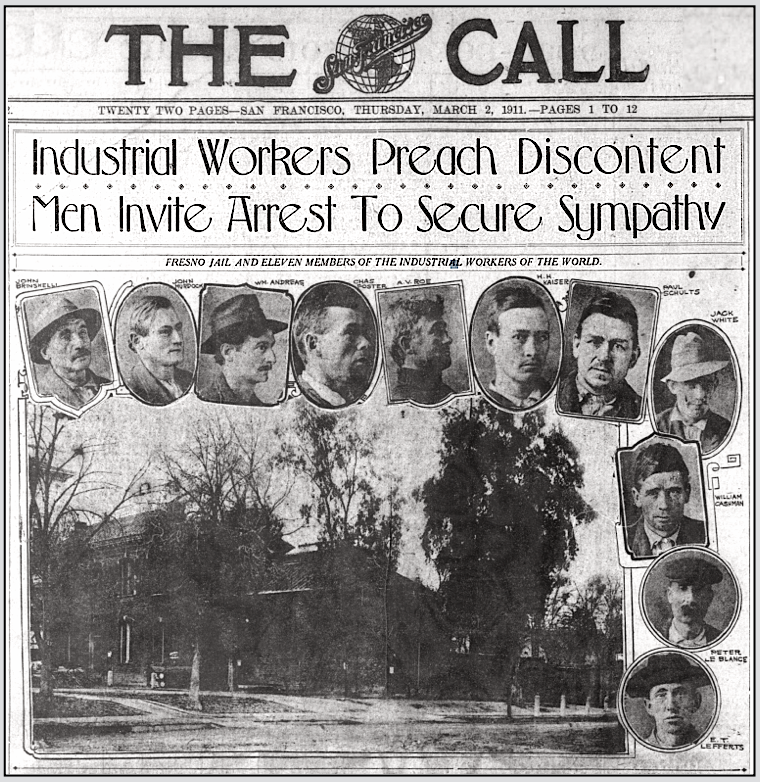
I am out of the “can” again and again on the job. It has got to be a regular thing and I don’t suppose it will surprise any one to hear that I have been in jail again. On December 1, I got a bundle of “Workers” and “Solidarity’s” in Galveston, Texas, and at once got busy to let the natives know that the I.W.W. was on the job. I was handicapped from the start, as that was the day that the McNamaras had pulled off their stunt in Los Angeles, and as soon as I said anything about unions, the natives went up in the air, condemning all unions and union methods. I don’t blame them either, as they had never heard of the I.W.W. I was kept busy all day explaining the difference between the Gompers-McNamara brand of anti-unionism and the ONE BIG UNION, the most of the patriotic, contented slaves had never heard of the I.W.W. and didn’t care to hear anything about it, as they said, “We are doing very well as it is,” and the only way I could get them to read the “Worker” and “Solidarity” was to give them a copy.
I hustled around all day, selling t few papers and giving away a good many more. That night I met Fellow Worker Ham, who is a veteran of the Franklin school in Spokane. On Sunday morning I was again on the street selling papers when a “fly bull” stopped me and asked me if I had a license to sell papers. I said “no,” and that I had never heard of any one being required to get a license to sell papers. He “pinched” me and I was given a ride in the band wagon down to interview the chief of the slugging committee. The chief asked me what my business was. I told him I was agitating and selling literature for the I.W.W. “Well,” he says, “we don’t allow any Socialist agitators in this town and you can’t hold meetings in this town either I hadn’t said anything about holding meetings and I asked him if the Salvation Army was allowed to hold meetings on the streets, and when he said they were, I asked him if the I.W.W. didn’t have as much right to hold meetings on the streets as they did. He said “No,” and if I or any one else tried to hold meetings on the streets they would be arrested, and he ordered me locked up for agitating and selling papers. I asked him if I would have been arrested if I had been selling a capitalist paper and he refused to answer me.
The next morning I was taken before the dispenser of “justice” and charged with “disturbing the peace.” The judge nearly fell dead when I pleaded not guilty and he handed be “ten and costs,” which meant that I would eat macaroni at the expense of the city for the next 25 days. I was held until the 22nd then I was put in solitary confinement, with nothing to eat, not even macaroni. The next morning about 2 a.m. I was taken out of the cell, thrown into the wagon with the brass trimmings and taken down to the Santa Fee station. To make a good job of it they took my own money that I needed to eat on and bought a ticket to Virginia Point. I was put on board the train and an officer went along with me to see that I reached my destination all right and when I was ditched at the blind siding called Virginia Point I was told that they would try and run Galveston without my assistance. From what I can see the only way to do any agitating in Galveston for the present at least, is to get on the job and as I can’t connect with a job there I will have to pass it up. The colored people have got control of most of the work in Galveston and as they have been given a pretty raw deal by both the unorganized whites and the craft unions, it won’t take very much work to get them to come into the union that recognize no race, creed or color. In fact, when I was arrested I had a date to meet a bunch of the colored men who wanted to learn about the new union. If some of the fellow workers would go to Galveston and get a job there they could do some good work toward getting a local started.
There is one of the “Ham track” Mich, bunch of knockers in Galveston. He is holding street meetings in contradiction to the chiefs statements to me. He distributes leaflets knocking the eight hour proposition, in fact knocking everything that the I.W.W. stands for and he claims that he is organizing for the “only real” I.W.W., but I was unable to find a single person that he had got to join his (as he claimed) the GIGANTIC ORGANIZATION. He is allowed to hold his street meetings whenever he wants to, unmolested by the “czar” of Galveston, but Socialists and labor, agitators will be put in jail if they try to hold street meetings. And so I guess the disciple of De Leon, hailing from “Ham track” is neither a Socialist or a labor agitator, but merely a common labor fakir and judging from what results he has got in Galveston, he isn’t doing much harm.
‘Letter from A.V. Roe’ from the Industrial Worker. Vol. 4 No. 19. August 1, 1912.
Fellow Workers:-Just arrived in Vancouver last Saturday from San Diego, via the coast locals. I was arrested in Portland for selling the “Worker” and picketing the slave market. Hansen, the employment shark, had me pinched and I agitated on the “job” for six days at the Linden rock pile. I am selling literature here in Vancouver, and I believe a big demand for industrial union literature can be worked up here with the proper amount of hustling. We are arranging for a joint mass meeting here for the benefit of Ettor and Giovannitti, but there is no date set as yet. Next Sunday we are going to hold a meeting on the Powell foot ball grounds, where we expect to sell a few bales of the special edition of the “Worker” and other literature. This town is full of strikers from the Grand Trunk Pacific and the tales they tell or conditions along the line, in the various camps, are, or should be, enough to keep any scab from shipping there. If only half of the rumors of dissatisfaction and contemplated strikes, heard around here, are true, there will sure be come- thing doing here in the near future. I am watching developments in San Diego and will jump back down there as soon as the curtain goes up on the second act. The impression I got coming up the coast was that there will be many more going the same way. The fight in San Diego isn’t over yet, it has only started. Yours for the one big fighting organization,
ALBERT V. ROE.
‘Frisco Thugs Assault a Cripple’ from Industrial Worker (Spokane). Vol. 4 No. 32. November 1, 1912.
Albert V. Roe, the one-armed newsboy of the I.W.W., was severely beaten in front of Murray and Ready’s employment office on Howard street in San Francisco, October 19. Roe was selling the “Worker” on the sidewalk when a thug stepped from the office of the employment shark and struck him in the face. Roe then handed his papers to a bystander and endeavored to defend himself, but was unsuccessful, although he put up a good fight.
The crowd that quickly collected became threatening toward Roe’s assailant and forced the cowardly cur to flee into the office, where he remained all day. Police officers refused to issue a warrant or do anything in the matter. Roe held a sidewalk meeting and upon gathering a considerable crowd adjourned to a vacant lot nearby. Here the talk was continued | and several men joined the I.W.W. Murray and Ready are known as the most scientific skinning outfit on the whole Pacific Coast and there is a general opinion that they paid the thug to beat up Fellow Worker Roe.
The I.W.W. will be on the job in Frisco, however, when Murray and Ready are on the hummer through lack of suckers to fall for their con games.
‘A Letter from Honolulu’ by Albert. V. Rose from Industrial Worker (Spokane). Vol. 4 No. 35. November 21, 1912.
Honolulu, T.H., Nov. 1. Just a few lines to let you know that we are still doing business and that the last few days things have been moving along pretty swiftly in this burg for the ONE BIG UNION.
I landed here lost Wednesday from San Francisco and was met by a bunch of real lite rebels who, although doing all in their power to put these Islands on the map of the ONE BIG UNION, had been handicapped by the lack of a speaker and agitator who could spend all of his time working for the organisation without the fear of losing “his” job.
Election is near and the politicians are working hard trying to get the slaves to vote for them. They hold a public street meeting every day at noon on one of the busiest corners in the city. Last Thursday, after the politicians had talked all they could, the chairman, who Is an ex-socialist speaker, asked if there was any one else who wanted to take the soap box. The soap box in this instance was a large barrel with a banner on it proclaiming it to be the “barrel of prosperity,” but it, like the full dinner pail, was empty, I asked him if I would be allowed to take the box for a few minutes. He asked me what I wanted to talk about and I told him “socialism,” “Oh, all right,” he said, “if you are a socialist, go ahead.”
I got up and told the crowd that although I claimed to be a socialist, I was not Interested In who won out in the coming election, but that I was there to tell them of the ONE BIG UNION. I held a large and enthusiastic crowd for over an hour. As soon as the politicians got wise to what I was telling the slaves, they started to squirm. I could see that they wanted to pull me off the box, but they were afraid to for fear of queering themselves in the coming election. I saw the advantage I had on them, and made the best of it I never saw a crowd of working men so eager to listen to a speaker in my life, and when I spoke of concluding my talk. It nearly caused a riot The slaves were anxious to hear of the union that takes in all wage workers and that bars no workingman because his skin is not just the proper shade. The only way I succeeded in getting off the box, was by promising to address them the next day. When I got off the box I was bombarded with questions from what seemed to me to be about 57 varieties of workers.
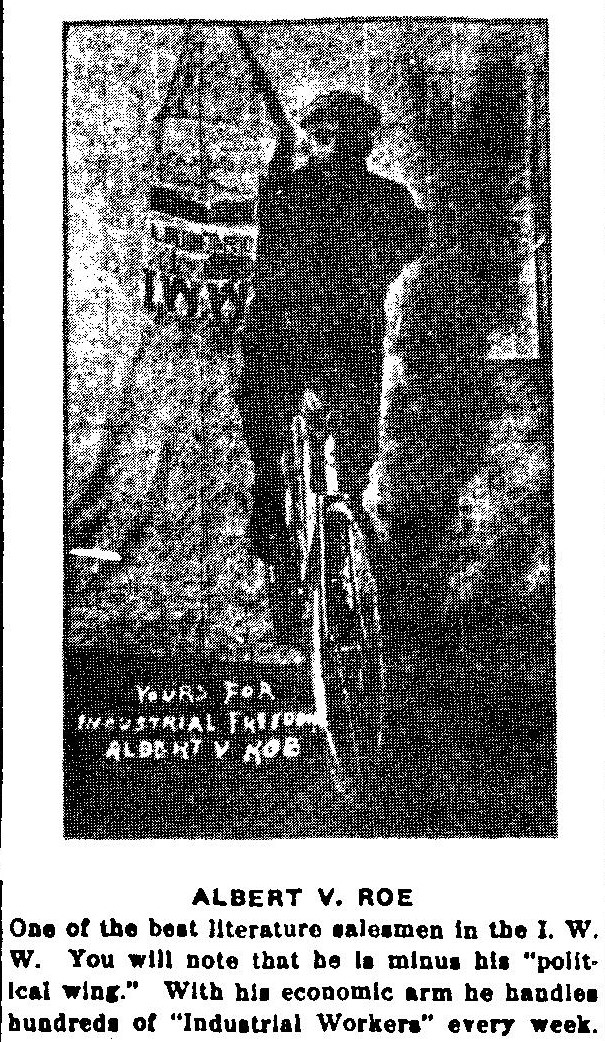
The following day the politicians tried to keep me off the box, but there was “nothing doing.” The workers wanted to hear that “socialist” again and wouldn’t be satisfied until they got what they wanted. I have talked off the politicians” soap box every day since to ever increasing crowds of workers and to the consternation of the office seekers. They are afraid that will queer them in their political schemes but a few votes. There Is no danger of us getting they are afraid to do anything for fear of losing into trouble with the “powers that be” until after election, and we are making the best of our opportunities.
The Hawaii islands are in complete control of a small group of non-resident capitalists and as soon as they get wise to the fact that the slaves are waking up and organising, they will do all they can to suppress the agitation as they tried in Lawrence, Mass., and in other parts of the world, and with the same results.
I was on the streets last night with a bundle of “Workers” and was agreeably surprised to have Chinese, Japanese, Hawaiians and workers of several other races, come from all directions to buy the paper to read about the union that accepts all wage workers into membership without regard to race, creed or color. Conditions here are ripe for the industrial union and there is no reason why we shouldn’t have a strong organization in the near future. The I.L.A. are trying to get the slaves to join that union, but they are making little or no headway.
Although the I.L.A. is supposed to be a craft union of the Longshoremen, they are trying to get all kinds of slaves to join. An organiser of that “anti union” went over to the island of Hawaii last year, and tried to organise a bunch of Russian laborers. He was getting along pretty well when one of the Russians asked him if the I.L.A. took Japs and Chinese into the union. Upon being informed that a Jap or Chinaman couldn’t join, the Russian exclaimed “That’s a hell of a union. Me no join a union like that, me join the I.W.W. he take in all workingmen.” The poor labor fakir had to come back to Honolulu, and that Is why the I.L.A. disorganlsers cuss whenever they see at I.W.W. button.
Japanese contract sugar workers arriving in Hawaii.
There are a few “scientific” socialists here who are trying to educate the natives to the mysteries of Marxian philosophy, but they are having poor success. Before the I.W.W. got here they did stand a little show, but when the natives heard of the benefits to be derived by the general strike, intermittent strike, etc. They lost all Interest, if they ever had any, in scientific stuffing of the ballot box, we are going to educate the slaves here along strictly industrial lines. There has been some agitation here, advising the workers to use their political as well as their Industrial arm and that has led to more or less confusion in the minds of the workers. We have developed several good Chinese, Japanese and other native organisers, who are doing good work among the laborers of the various Islands, and we’re making special efforts to educate more native agitators who can do organisation work than an English speaking organiser cannot do. Our hall and reading room are at 22 Pauahi street, rear, upstairs. All fellow workers coming this way are asked to drop In.
PRESS COMMITTEE, Per Albert V. Roe.
P.S.—Increase our bundle order to 600 copies each week.
‘The I.L.A. in Honolulu’ by A.V. Roe from Industrial Worker. Vol 4 No. 41. January 2, 1913.
The International Longshoremans Association in Honolulu is a “bona-fide wage workers organisation.” Sure! Listen to Who’s Who in Honolulu. The president is George Hanner. He is turnkey of the city and county jail. The financial secretary Is O.K. Heawehanu. He is guard at the city and county jail. The vice-president is W.R. Alull. He Is an attorney-at-law. Then there is Johnnie Wilson, a large contractor, employing slaves all over the islands. He is a leading member. When the slaves in the union wanted to strike for a raise from $1.60 to $2.00, Johnnie Wilson advised them as brother unionists,” as manager of the I.L.A., and as their employer that the time was not ripe. There was no strike. There is also another leader, the great proletarian, L.L. McCandless, defeated candidate for congress, who said from the soap box in the last campaign, that he had accumulated 50,000 worth of real estate in the past ten years and had earned it all by the sweat of his brow. He is an ex-sugar-planter. The I.L.A. is on its last legs in the Islands. Their treasury consists of $17. Their hall is used only to play cards in. Those members who are real working men are talking of having the union join the I.W.W. in a body, leaving the fakers outside. Some have already joined as individuals. The future is grey for the fake I.L.A. and bright for the I.W.W.
‘Always on the Job’ from Industrial Worker. Vol 4 No. 43. January 16, 1913.
Albert V. Roe is in jail again. This happens so often that it is no longer news. Roe is in Honolulu right now. His agitation has been the means of bringing many new members into the I.W.W. and the authorities there made the same mistake they did here. They put him in jail. Al has been in pretty nearly every jail in America and they were always glad to let him out. He is a rebel inside as well as out. The real reason Roe was pinched was because he is an agitator. The charge he was picked up on is pushing his bike along the sidewalk Instead of the street. Shortly after Roe was handed $5 and costs, which he never pays, there was a strike in jail for better grub and better treatment. The strikers won and the capitalist press blames it all on to Roe. Roe is already out and is agitating among the free slaves who don’t eat regularly instead of among the prisoner slaves who have their meals brought to them. He says the prime need in the Hawaiian Islands is literature in several different languages, the most important one being Chinese. The Chinese in Honolulu did not seem to think that the Vancouver paper “Self Conscience” was revolutionary enough.
A Korean local has been formed and the slaves are strong for the One Big Union.
‘Another Local in Hawaii’ from Industrial Worker. Vol 5 No. 1. March 27, 1913.
Through the effective work of fellow worker A. V. Roe, the Hawaiian Administration has added another local to its list. It is Mixed Local No. 2 of Hilo. The local started with 47 charter members among whom were Japanese, Filipinos, Hawaiians, Chinese and several other nationalities. This shows that the One Big Union recognizes no distinctions of race or color but only the great class division between exploited wage workers and exploiting employers. Roe took possession of the band stand at Hilo directly following a ball game. He put up his banners and opened fire. When he had spoken about an hour he appointed a temporary secretary to get the names of those who wished to join. The band stand is being utilized as headquarters until the new local secures a hall. Several fellow workers off the ships that were in port gave Roe help in his work and prospects are good for a strong organization. The Hawaiian Administration hope soon to follow the lead of the New Zealand Administration by starting an official organ for propaganda purposes.
‘Where There’s Life There’s Hope’ from Industrial Worker (Spokane). Vol. 5 No. 7. May 8, 1913.
Fellow worker Al Roe, in making a 240-mile agitational tour of Hawaii on his bicycle, was caught in a heavy rain at Honokaa. He found shelter over night with a young Porto Rican who belonged to the Salvation Army. The Salvationist tried to convert Roe but the one- winged agitator kept him up nearly all night- reading chapters from I.W.W. pamphlets and explaining industrialism. As a result the Porto Rican took off the badge of superstition of General Booth and put on the red button of the General Strike. He is now one of the best of the plantation delegates and volunteer organizers in the islands. Moral: Never think a case is hopeless.
The Industrial Union Bulletin, and the Industrial Worker were newspapers published by the Industrial Workers of the World (IWW) from 1907 until 1913. First printed in Joliet, Illinois, IUB incorporated The Voice of Labor, the newspaper of the American Labor Union which had joined the IWW, and another IWW affiliate, International Metal Worker.The Trautmann-DeLeon faction issued its weekly from March 1907. Soon after, De Leon would be expelled and Trautmann would continue IUB until March 1909. It was edited by A. S. Edwards. 1909, production moved to Spokane, Washington and became The Industrial Worker, “the voice of revolutionary industrial unionism.”
 Revolution's Newsstand