
Veteran workers’ journalist Art Shields on the perennial problem of the U.S. labor movement, organizing the South.
‘Organizing the South, How Labor Movement Can Do This Job’ by Art Shields from Labor Age. Vol. 17 No. 11. November, 1928.
l. THE OPEN SHOP MENACE
ORGANIZATION of the open-shop South is a matter of self-preservation to the American labor movement. It is no longer a sectional issue. The products of southern mines and factories, often owned in the North, flood markets once supplied by unionized plants or at least by plants where the unions had a foothold. Loss of the coal strike in the central competitive field was directly due to the influx of non-union coal from the South. The rise of low wage southern cotton mills loosens the fingers of the textile union in New England.
After six months in the South the writer will not minimize the difficulty of this undertaking. But he emphasizes its necessity. And in this he voices the views of southern unionists who are now taking steps towards coping with the problem.
By the South is meant the southeastern quarter of the United States, containing a quarter of our population. This region is loosely bounded by the Atlantic and-Gulf of Mexico on the east and south. It includes Oklahoma and eastern Texas on the west, and Virginia and Kentucky on the north. Its people, white and colored, have been there from pioneer days. There are few foreigners. Most of its industrial development is along the slopes and valleys of the Appalachian Mountains, running through the east-central portion. Here northern manufacturers are. moving with increasing speed to exploit its low-paid labor at long hours, its rich raw materials, hydro-electric power and proximity to national markets. It is a gold rush of business.
The South is fat with raw materials for manufacture. Everyone must recognize the importance of the primary products listed below. Annual southern output is here given in percentages of national production:
SOUTH’S PER CENT OF U. S. TOTAL
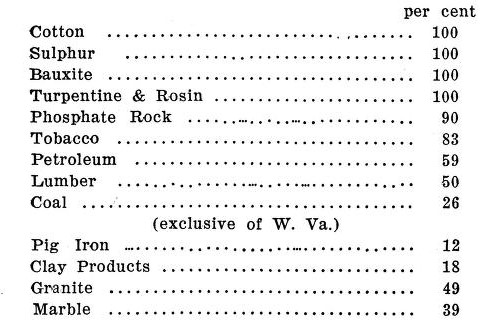
Scores of other important raw materials may be found listed in the United States census or in the Blue Book of Southern Progress, issued by the Manufacturers’ Record.
Using these raw materials, and in some cases others freighted in for manufacture by low-paid labor, the © South produces 62 per cent of the nation’s cotton goods; most of its 100,000,000 pounds of rayon; 65 per cent of its cigarettes and pipe, snuff and plug tobacco; 73 per cent of its commercial fertilizers; 15 to 20 per cent of its furniture, and a growing share of pulp and paper; 10 per cent of its iron and steel, and of the output of numerous other industries. The world’s two largest aluminum plants are in Tennessee and North Carolina.
Growth of Cities
With industrialization comes a shift from farm to city, though the rural population is still in the great majority. This urban movement is accelerated by the boll weevil, low cotton prices and other agricultural hardships. Hundreds of company towns have arisen and central cities grown. Take two towns for illustration: Winston-Salem, N.C. (Camel City) doubled its population to 80,000 in ten years and is now the largest in North Carolina. Atlanta, Ga., rose from 200,000 in 1920 to 260,000 today. This meant expansion of building, printing, auto repair work, amusement enterprises and other occupational opportunities for A.F. of L. craft organization. Unionism in the South is largely limited to the skilled non-factory workers of these bigger cities. Such city craft unions are generally weaker than in northern cities of equal size. Exceptions are Asheville, N.C., and a couple of cities each in Tennessee, Kentucky, Louisiana and Florida, where such organization is relatively strong. All mining and almost all manufacturing is open shop, a few cases of union recognition appearing in some Tennessee foundries and stove plants, Florida cigar factories, several miscellaneous plants in Kentucky and work garment shops in a number of states. An unrecognized tobacco workers’ union exists under difficulties in Winston-Salem and there are vigorous underground locals of the American Federation of Full Fashioned Hosiery Workers in North Carolina. But these exceptions do not invalidate the broad rule that unionism is rare in southern manufacturing.
After the war the coal miners’ union was smashed in Alabama, Tennessee and Kentucky. The post war movement of the United Textile Workers in Dixie was liquidated by strikes and unemployment in 1921. After the 1922 strike the shop craft unions generally passed out of the railroad industry in the southeast, retaining recognition only on the Southern, Seaboard Air Line and some lesser mileage. The railway clerks, however, retained more of their original strength. And the longshoremen’s union continues at Hampton Roads and some Gulf ports, with its Negro members a strong asset.
Strongest Open Shop
The South has the most virile open shop movement of any similar-sized region in America. The open shop is organized by bankers and manufacturers’ associations; by chambers of commerce and power companies. An incessant propaganda is conducted. The chambers of commerce and the power companies make a business asset of the open shop in their advertising. They finance the full page and double page advertisements in Northern newspapers, magazines and trade journals, inviting employers to come South where labor is unorganized.

“This is an open shop town in most trades, and we aim to keep it so,” the publicity director of the chamber of commerce of the South’s second largest city assured me. You may read his group’s advertisements in the Saturday Evening Post, extolling Anglo-Saxon labor and the 10-hour day.
Of course, this reputed bias of Anglo-Saxon workers against the unions is all nonsense. Anglo-Saxon England has strong unions. And Anglo-Saxon Southern labor has tried often to organize. It is open shop by force. The employer who would recognize a union is first argued with by his chamber of commerce associates: next his bank credit may be withdrawn or his taxes raised. Workers’ organizations are fought by the blacklist, the labor spy and employers’ war chests. In addition, Southern unions have peculiar obstacles: race prejudice between whites and colored is in the way; the surrounding farms are a labor reservoir for the employers ; and in so many cases the striking Southern worker would find that his employer has duplicate plants in the North for supplying his market.
Some of these difficulties, and new tactics the unions are devising in the struggle, are given in the following section:
II. NEW ORGANIZING TACTICS
Six years ago the young and aggressive hosiery workers’ union came South, following the opening of the first full-fashioned knitting mills in North Carolina. Local unions were chartered, and two or three strikes conducted for recognition. But the hosiery union found itself unequally pitted against a group of knitting companies, some of them affiliated with other industries. One of these hostile hosiery concerns was controlled by the super-powerful Duke interests, who own the dominant power company in the Carolinas and have many millions in tobacco, cotton mills and hosiery, aluminum and construction. Worse yet, the other trades were poorly organized, and thus the union could not benefit by a favorable local labor atmosphere, such as is aiding its present fight in Wisconsin.
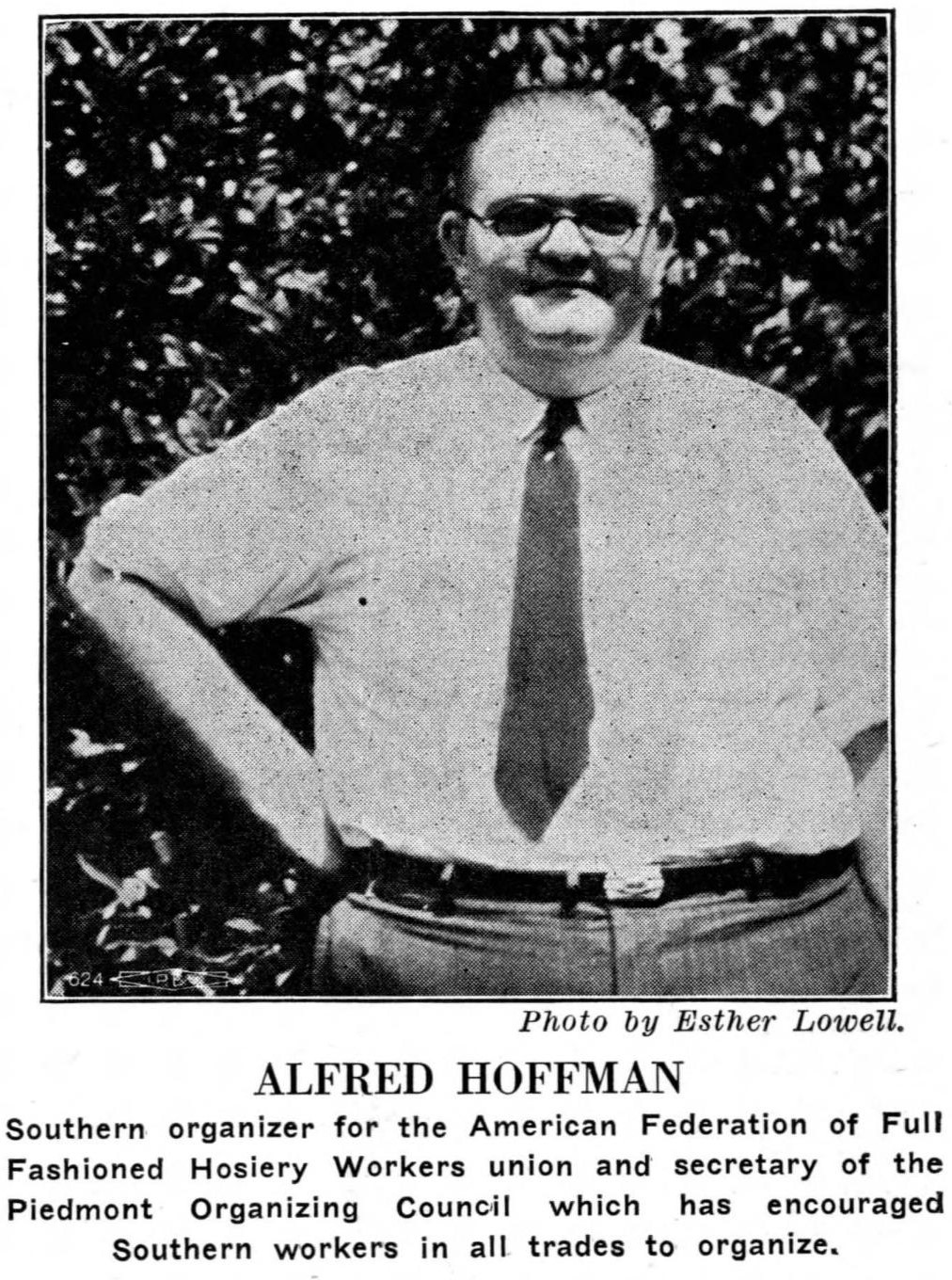
Southern unionists of every craft must unite for their mutual protection, argued the hosiery organizers: Individual craft union representatives, cruising separately through the Southern field, were ineffective against such united foes, they pointed out. And rank and filers, isolated in the separate unions, lacked vision and enthusiasm. So last year Alfred Hoffman, the Southern hosiery representative, in line with the views of his predecessor, Edward Callaghan, and his executive board, put the case before the leaders in the building and printing trades of Durham, Raleigh, Greensboro and Winston Salem.
Piedmont Organizing Council

Response was immediate. Durham building trades had been ousted from Duke University campus where a $22,000,000 construction program was under way. Tobacco workers were organizing in the scab Camel and Prince Albert plants in Winston Salem and needed help. So Hoffman’s plan for a Piedmont Organizing Council as a basis for inter-trade and inter-city cooperation was eagerly accepted. The council took its name from the Piedmont plateau where Carolinas’ industries are developing. It generated solidarity by uniting unionists regardless of community or craft. Though endorsed by the A.F. of L. it departed from pure and simple craft union practices. Meeting monthly in different cities by turn any trade unionist from the region was ex-officio a delegate. The first conference in Durham brought 30 from a 120-mile region embracing Raleigh, Durham, Greensboro and Winston Salem. Since then 250 to 500 have attended, city movements often chartering busses. The council’s field has extended west and south to Charlotte. A meeting across the border in Danville, Va., this summer, led to the formation of a similar movement sponsored by the Virginia Federation of Labor.
Union tactics are discussed at these mass conferences, and sessions are jazzed up by music and entertainment. One Greensboro meeting directed its fire at local full-fashioned knitting mills violating the law by Sunday work. Another at Winston Salem boosted the tobacco workers’ drive in the scab Camel plants, giving heart to them at a critical time. Actual enrolling of members remains in the hands of the individual unions but the council mobilizes the labor sentiment that facilitates their work.
Unions Gain
“The gains by North Carolina unions this year can be largely credited to the Piedmont Organizing Council,” said President T. A. Wilson of the State Federation of Labor to the writer.
Greensboro unions doubled membership and formed a central labor union, now the strongest in the state. Durham in 60 days chartered new locals of printing pressmen, auto mechanics, street carmen and Negro building laborers. “We could not have done it but for the new labor sentiment in the town,” said Secretary Parker of the Durham central labor union. Winston Salem organizations gained remarkably; carpenters from 15 to 300, or half the wood workers in town; electricians from 3 to nearly full membership. New lathers and Negro building laborers’ locals were chartered. Tobacco workers gained many members, though since set back by the discharge of 600. Their employer, R.J. Reynolds Tobacco Co. is the richest member of the “Big Three” cigarette group, and a union drive has all the obstacles incidental to trustified industry.
As yet the Piedmont council’s work is chiefly felt in the more easily organized city crafts, but its sponsors say the community labor spirit it generates can be utilized in more arduous campaigns in the future in manufacturing industry. Hoffman is already using this sentiment for the hosiery knitters. Durham’s first Fourth of July parade this summer, which he helped to stage, was a demonstration for the knitters’ union. Eighty autos rolled through the streets of the “Bull City” on slow gear, displaying blue and red lettered slogans of encouragement to the knitters in the city’s big open shop mills. Durham city craftsmen drove 50 of these cars, the remaining 30 piloted by ex-Southern knitters who were enjoying a Home Week vacation from Philadelphia and New Jersey union jobs. The Fourth was a gala day for labor. The parade ended with a feast in Oxford 30 miles away, where hundreds of mechanics and knitters enjoyed a Brunswick stew that had been brewing for 15 hours in Southern style in 30-gallon pots tended by the Oxford machinists who played host.
Chattanooga Conference
Realizing that the open shop must be tackled on a wider front a conference of southeastern state federation of labor representatives is assembling in Chattanooga, Tenn., as this issue of LABOR AGE goes to press. Organization of the unorganized, workers’ education and labor legislation are topics for discussion. The conference was sponsored by Wilson of North Carolina, W.C. Birthright of the Tennessee federation and other Southern unionists attending an informal trade union weekend at the Burnsville, N.C., summer school for women workers in industry last August. It is too early to anticipate the conference’s decisions, but the following observations are in order:
Broadly speaking the Southern workers to be organized fall into two divisions: (1) the skilled nonfactory workers in the larger towns—building tradesmen, printing craftsmen in the newspaper offices and those printing plants not on a mass production basis; amusement workers, auto mechanics, street carmen, etc.; (2) the workers in the basic industries—manufacturing, including the 250,000 cotton mill workers ; mines, railroads.
The line of least resistance is with the first group.
They have skill to sell, and what is more strategic, their work must be done on the spot and cannot be transferred a thousand miles away during a strike. These city crafts already have local unions which need only be strengthened greatly, so the drive in this field is not starting from scratch as in the basic industries. There are considerable obstacles, but none which energy, enthusiasm and intelligence cannot overcome. Such obstacles are: Chambers of Commerce which bully the union employer; flivver commuters from surrounding farms; and, most serious of all, race prejudice between white and colored.
At the Burnsville conference Wilson frankly said he regarded the organization of Negro workers as the most important task before Southern unions. Negroes, though barred from many occupations, occupy a key position in others. In Atlanta, for instance, they are a majority of the union plasterers, strongest organized group in town. But the Negroes who form almost 100 per cent of building laborers and truckmen are unorganized. Obviously a building trades movement is proportionately weak if mechanics helpers, common laborers and the men who haul building materials are out of the unions.
The Basic Industries—A Giant Job
Organizing the basic industries is vastly more difficult, though more important, for it is the output of Southern mines and factories, not the building industry that is wrecking organization in other centers. How shall this job be done? Let us say at once that it is only possible as part of a broader organization movement North and South.
Note obstacles: The Southern industrial workers are usually isolated in company towns; employers are in powerful associations that make the fight of one the concern of all; the employer may be a New England, New York or Illinois capitalist, with duplicate plants 500 to 1,000 miles away to use for his customers during a labor dispute.
Suppose a union bids for the 1,100 oppressed cotton mill employes of the Borden Mills of Kingsport, Tenn. This concern is affiliated with the Southern cotton manufacturers’ association, and is a subsidiary of the American Printing Co., whose 4,000 employes in Fall River, Mass., would supply the market during a labor contest unless a similar attack were synchronized in the Bay State. Kingsport offers other barriers. It Is a unique type of company city, built 15 years ago by a group of railroad bankers according to a design furnished by the Rockefeller city planning commission, and with a city charter drawn by the Rockefeller Bureau of Municipal Research. It is now occupied by a dozen corporations—Eastman Kodak, the Kingsport Press, producing over a million books monthly; a pulp and paper company, an internationally owned glass factory, a cement mill, brick yard, hosiery mills and others.
All are committed to the open shop, and a union movement in one would arouse the opposition of all. No one union, even an industrial union, can tackle Kingsport unaided.
Or consider the new unit of the Cannon cotton mill chain, started in Badin, N.C., at the invitation of American Aluminum which owns the town. Does any one fancy Andy Mellon would sit idle while a textile union organized his employes’ wives?
Or could Tennessee Coal & Iron steel mills in Birmingham be unionized without a general struggle with the parent U.S. Steel Corporation in Gary and Pittsburgh? Or may the new and booming rayon industry, which closely knits American, British, Belgian, German, Dutch, French and Italian investors together in united holdings be organized in Georgia North Carolina, Tennessee, Virginia and Kentucky without a wider movement behind the drive?
Admittedly some plants are more easily approached. Labor research must chart out such data and all other industrial information essential to the task of organizing the workers within the complicated frame-work of finance-controlled industry. This research, coupled with an aggressive movement on the broad front required, is necessary if Southern industry, which means all American industry, is to be organized. Supremely difficult? Yes. But a necessity for the preservation of the American labor movement which sees unions in one region riddled by the open shop products of another.
Labor Age was a left-labor monthly magazine with origins in Socialist Review, journal of the Intercollegiate Socialist Society. Published by the Labor Publication Society from 1921-1933 aligned with the League for Industrial Democracy of left-wing trade unionists across industries. During 1929-33 the magazine was affiliated with the Conference for Progressive Labor Action (CPLA) led by A. J. Muste. James Maurer, Harry W. Laidler, and Louis Budenz were also writers. The orientation of the magazine was industrial unionism, planning, nationalization, and was illustrated with photos and cartoons. With its stress on worker education, social unionism and rank and file activism, it is one of the essential journals of the radical US labor socialist movement of its time.
PDF of full issue: https://www.marxists.org/history/usa/pubs/laborage/v17n11-nov-1928-LA.pdf
 Revolution's Newsstand