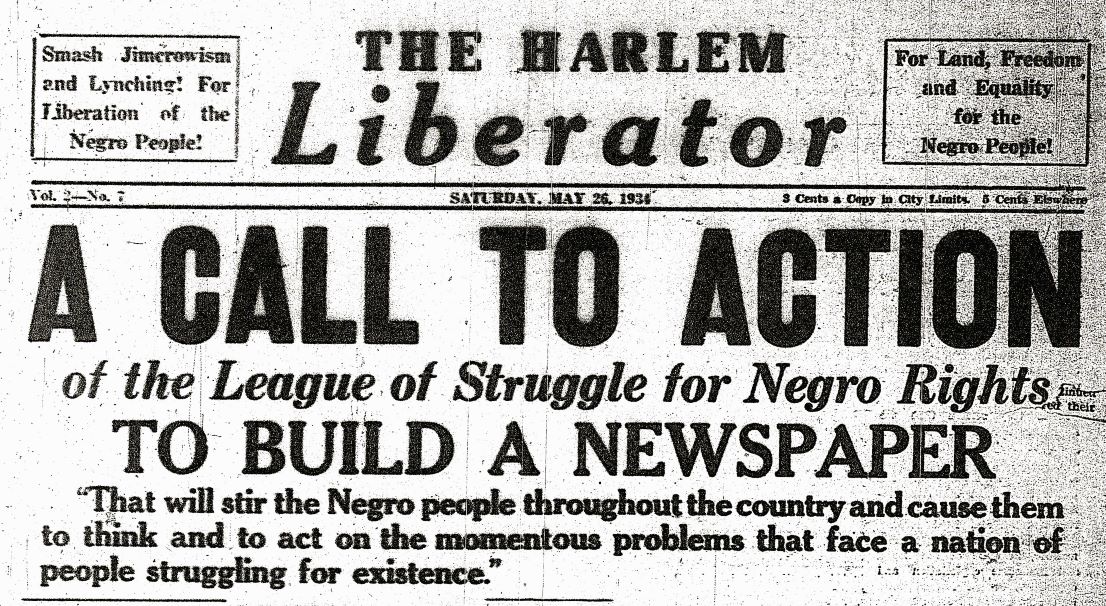
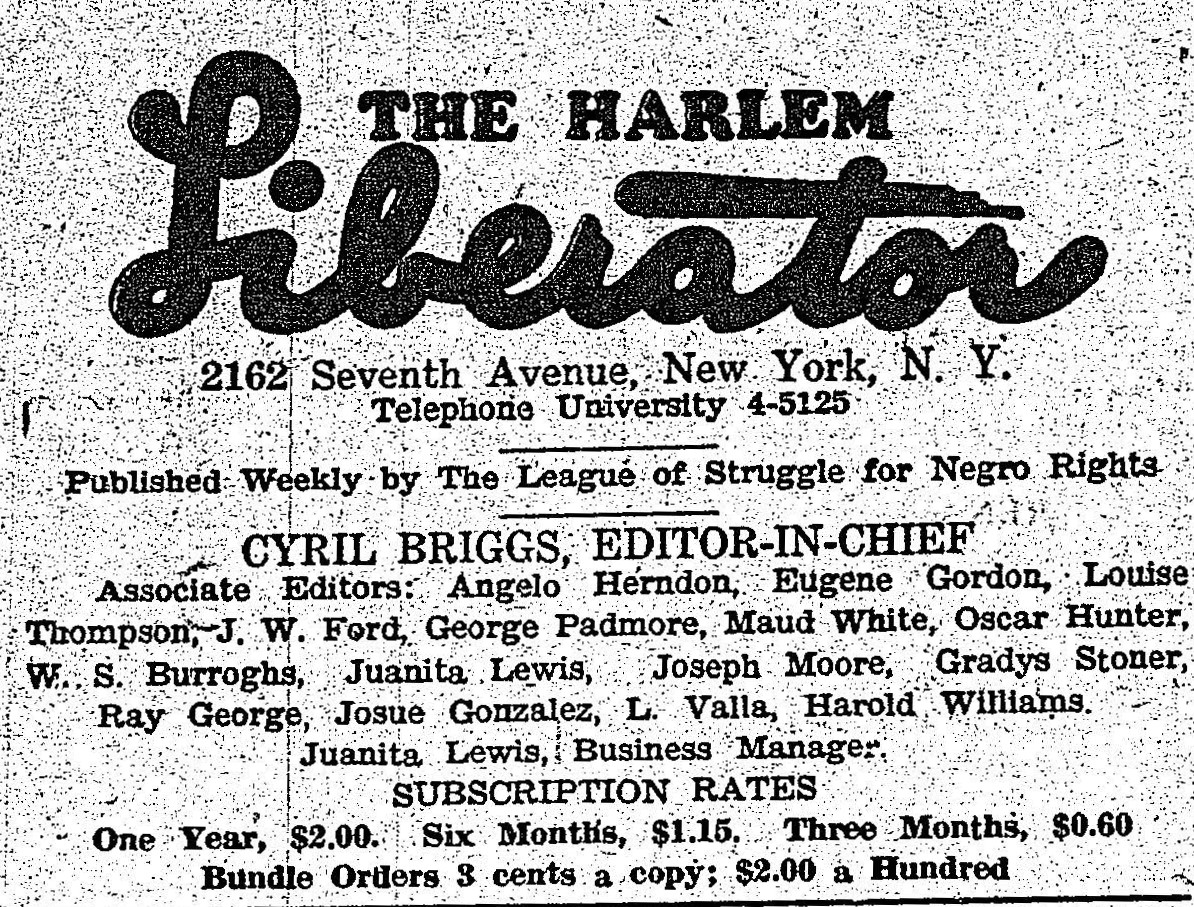
Cyril V. Briggs, formerly editor of the African Blood Brotherhood’s ‘Crusader’ journal became the editor of the Communist Party-supported ‘Harlem Liberator’ newspaper established in 1933. Here he critically reviews the first months of the project, including his own arrest in the process.
‘Achievements and Shortcomings of the ‘Harlem Liberator’’ by Cyril V. Briggs from The Harlem Liberator. Vol. 1 No. 14. July 22, 1933.
In the course of the recent struggles in Harlem, the Liberator has come forward as a powerful weapon in the hands of the militant working-class movements developing in this section. It was in the very forefront of the preparation of the Scottsboro Protest March. It has vigorously supported the actions of the hungry unemployed workers before the relief bureaus. It is today leading the struggle against the recent police jim-crow order aimed at disrupting the growing unity of black and white workers in the struggle for bread and freedom. Cyril Briggs, editor of the Harlem Liberator, was the first victim of this vicious jim-crow edict.
The Harlem Liberator has thus become an important factor in the struggles of the toiling masses of Harlem for the right to existence, for bread and against the cutting off of relief, against police terror and all forms of oppression. It is no accident that the editor of the Liberator has been twice hauled into court during the three months the Liberator has been in existence, in an attempt in railroad him to jail. The Tammany bosses fear the growing power of the Liberator. They know the value of the Liberator as a weapon in the hands of the toiling masses of Harlem.
Shortcomings Can Be Overcome
At the same time, it must be frankly stated that the Liberator still suffers from certain shortcomings. These shortcomings, however, can come by and will be over support and constructive criticism of the workers of Harlem. It is their paper. Its existence is tied up with their struggles for existence. Some of these shortcomings are the small size of the paper, and skeleton staff which makes it sometimes impossible to properly report all struggles that the Harlem masses are involved in.

In addition, the Harlem Liberator must compete with the reformist papers for the masses still under their influence. While functioning as the voice of the Negro workers already involved in the struggle freedom, against starvation and oppression, the Liberator must act as the agent of these awakened masses in penetrating the ranks of other sections of the toiling population of Harlem. The Liberator is thus faced with the necessity of reporting all phases of community life, of meeting the varied interests of all sections of the Harlem working-class. It must reach these masses in order to combat the influence of the reformist misleaders who seek to divert these masses from struggle into channels harmless to the lynch lords. It could not reach these masses by any sectarian approach in handling news. Its news columns must reflect the interests of the sports fans and of the housewife, etc.
Workers Must Build Their Paper
The workers in the militant organizations in Harlem can and should build the Liberator. On the other hand, these organizations can be built into powerful instruments of struggle only with the help of the Harlem Liberator. The Liberator in reporting the activities of the I.L.D., the Unemployed Councils, etc., brings these organizations before those masses they have not yet reached, serving to popularize them and clarifying the masses on the militant programs of these organizations as opposed to the treacherous activities of the reformists. The task of building the Liberator is therefore intimately tied up with the work of building the Unemployed Councils, the I.L.D. and other militant organizations in Harlem.
Already Popular With the Masses
The shortcomings of the paper already mentioned above can be overcome with the support of these organizations and the broad masses of Harlem. The size can be increased as enough support is developed around the paper and its circulation and advertising built up.
Even with these shortcomings, the Liberator has already made a warm response from the masses of Harlem who are increasingly recognizing in it their staunch defender and champion and a relentless fighter against all forms of oppression, against the hunger policies of the bosses and for the daily needs of the masses. The increasing popularity of the Liberator was graphically demonstrated last week when by Saturday every copy of that. week’s edition was sold out. The Liberator can be and must be built into a mass organ in Harlem Building the Liberator is the task of every sincere worker, black and white, desirous of supporting the liberation struggles of the Negro People.
The Liberator was the paper of the League of Struggle for Negro Rights, largely edited by Benjamin Davis and begun in 1930. In 1932, its name changed to the Harlem Liberator, an again to the Negro Liberator before its run ended in 1935. The editorial board included William Patterson, James W Ford, Robert Minor, and Harry Haywood. Printed, mostly, every two weeks, The Liberator is an important record not only of radical Black politics in the early 1930s, but the ‘Harlem Renaissance’ as well. The successor to the American Negro Labor Congress, The League of Struggle for Negro Rights was organized by the Communist Party in 1930 with B.D. Amis as the LSNR’s first General Secretary, followed by Harry Haywood. Langston Hughes became its President in 1933. With the end of the Third Period and the beginning of the Popular Front, the League was closed and the CP focused on the National Negro Congress by 1935. The League supported the ‘Self-Determination for the Black Belt’ position of the Communist Party of the period and peaked at around 8000 members, with its strongest centers in Chicago and Harlem. The League was also an affiliate of the International Workers Order.
PDF of full issue: https://dds.crl.edu/item/57603
 Revolution's Newsstand