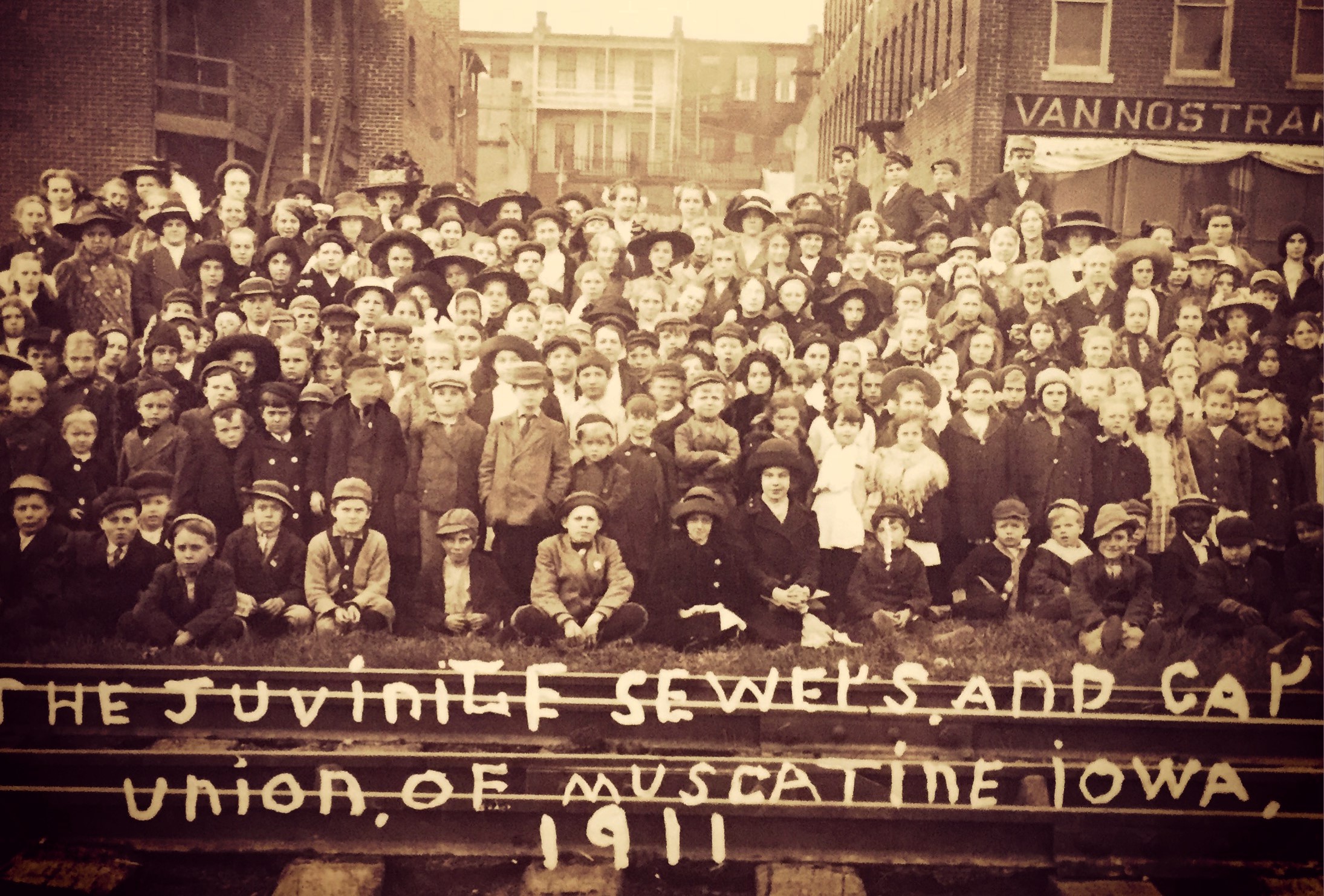
This strike in Muscatine, Iowa’s dominant pearl button industry would continue another year before folding. It would not be until 1933 that workers would union recognition. However, the strike helped build the Socialist Party in the state, with Muscatine itself electing two Socialist aldermen during the conflict.
‘Muscatine Button Makers in Hard Battle for Union’ from St. Louis Labor. Vol. 11 No. 531. April 8, 1911.
Charles Reynolds and James Gray, representing 2,600 locked-out button workers of Muscatine, Iowa, have arrived in St. Louis, where they intend to visit most of the local unions in behalf of their constituents half of whom are women. These two comrades and brothers are expected to remain here for probably three or four weeks, and we hope that they will be cordially received by every local union in St. Louis.
The story of how the button workers of Muscatine, seeing ahead of them a hard and uphill fight for better wages and better conditions, organized and were locked out will be told before the unions.
These two men are members of Button Workers’ Protective Union No. 12,854 of Muscatine. Assist them financially as much as you can. The story of the lockout of the button workers, as told by them, is a graphic one.
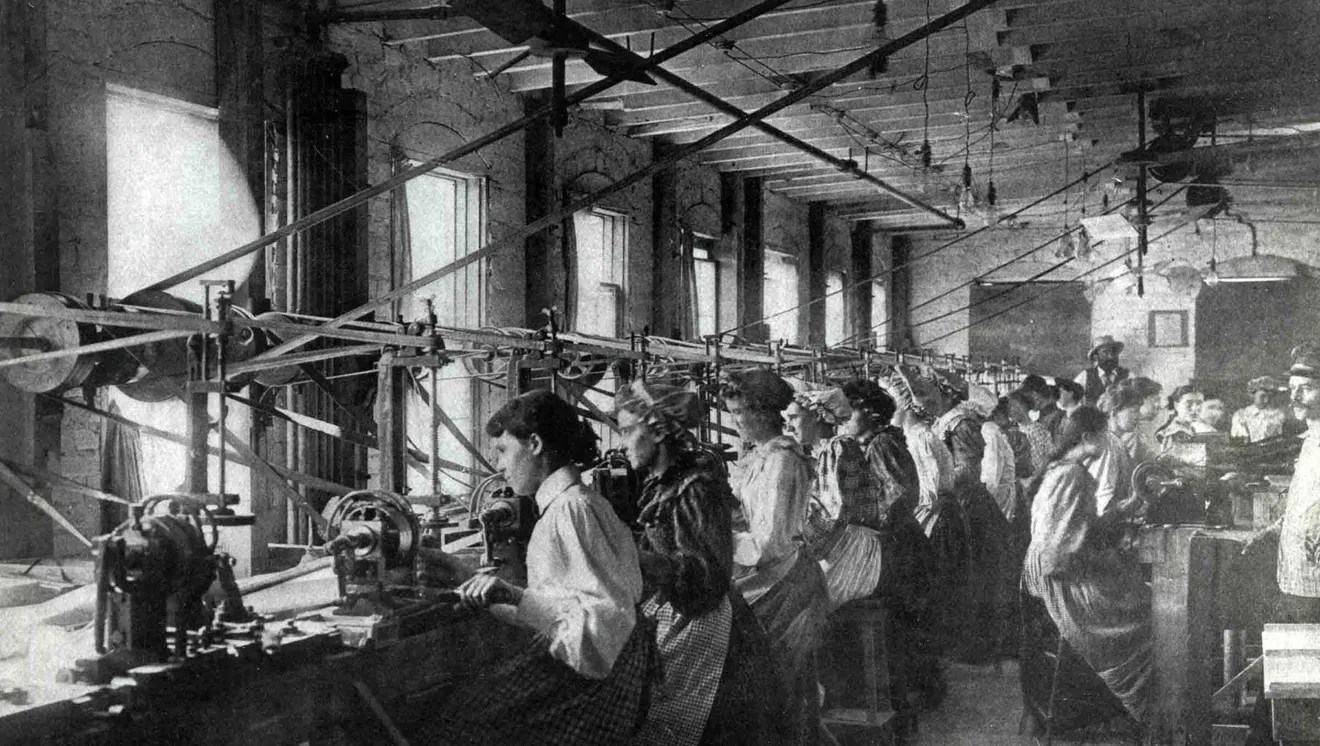
Conditions in the shops are fearful. The cutting plants where the blanks are cut are breeding places of disease, as the cutting out of the blanks for the buttons must be done in a rush, for there is no telling when the work is going to stop.
While the saws are cutting the blanks out of the mussel shells a constant stream of water plays on the saw. This keeps the lime dust out of the air, but makes everything soaking wet, causing the men to stand in what is practically a pool of water.

The girls who do the facing, drilling of the buttons, have a worse time of it. The lime dust from the drills flies through the air and coats the lungs of the workers. Most of the machinery is unprotected, the manufacturers fighting the state labor commissioners at every step. Unprotected belts are ready to catch the clothes or hair of the workers and carry them to a smashing death on the floor or ceiling.
The result of the lime dust on the lungs is terrible.
The button manufacturers as a rule pick out old buildings and remodel them for their purposes. There are never enough toilet facilities or sufficient ventilation. State factory inspectors always have something to say about the button factories.
The workers are paid a piece-work scale, except the very young children, who are paid $3 a week. These are under 16 years of age. By setting pacemakers who will keep up a high speed the price paid per gross is automatically kept at a dollar a day. If a girl is very efficient and makes more she is made a pacemaker and the price adjusted to the minimum.
The buttons are weighed, instead of counted, and the girls are not allowed to see the buttons weighed. They are docked and fined with great regularity and precision. They are worked overtime without any extra compensation.
Seeing that an organization would be needed to combat the evils of the industry, the workers started to organize their union November 1 of last year. The first month only 25 women and 75 men joined the union. After the women started to join they all started to come in, and for six weeks 100 were taken in each week, until nearly all had joined the organization, with the exception of some of the men who belonged to the state militia. There are now 2,900 members in the organization. This was the first of four attempts to come out successfully.
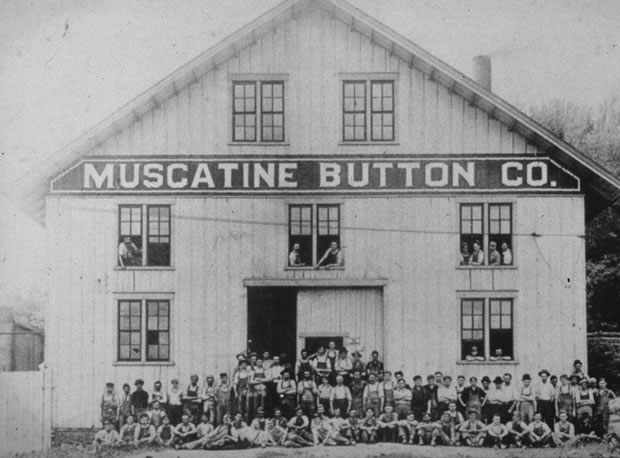
Captain Long of Company C, state militia, had refused to allow some of the men to join the union. A delegation called on him and obtained the honorable discharge of the men involved. Organization was complete. The manufacturers had to pay attention to this, so they met in the parlors of the Grand Hotel at 3 p.m., February 25, and at 5 o’clock that evening all the workers were informed that the plants would close down on account of over-production. The only exception to the lockout was the plant of Leo Hirsch, which was out of the combine. A flood of telegrams and a personal visit from the members of the combine to that firm’s headquarters in New York produced results and a week later that plant also closed. The lockout was complete.
On March 20 the orders had piled up to such an extent that the factories got out a special edition of the Muscatine Journal offering to take back the workers.
Several conferences, in which the workers demanded that all be taken back, produced no result, and the plants, after keeping open four days with only twenty workers, closed again.
Regarding the report of bombs being thrown, they said: “The pickets do not throw bombs; those were eggs; some were good and some were bad.”
“They are being thrown by our sympathizers, of whom there are many in Muscatine. We are in this fight to win.
“They locked us out for unionizing, but they will have to get out their orders pretty soon or they will lose all their trade, and they know it.
“Since they were successful in getting Governor Carroll to send the militia, we will peaceably, but thoroughly, picket those shops.”
The following official circular is self-explanatory:
“Muscatine, Iowa, April 4, 1911.
“To Organized Labor and Friends- Greeting:
“The Button Workers’ Protective Union No. 12854 of Muscatine, Iowa, a local union affiliated direct with the American Federation of Labor, was organized in last October. The union was born of the misery of the button workers. Under prevailing conditions, it grew by leaps and bounds until early in February over three-fourths of those employed in the industry were organized.
“Notwithstanding the oppressive conditions, no demands were ever made on the employers, the union being content to continue the work of organization in outside places, with the intention of organizing the industry in its entirety before presenting any demands. Until this period was reached the employers paid little attention to the organization. Then, without warning on Saturday, February 25th, ten of the largest employers locked their employes out. The lockout affects over two thousand workers, among whom are eight hundred women. The employers immediately disclosed the purpose of the move by endeavoring by every low and unfair means to get the women to desert the men, the offer being held out that they could have their positions back if they would destroy their cards and leave the union. This the women refused to do.
“Owing to the fact that the button workers have no national union of their own, and to the additional fact that the organization is so youthful, we are in this emergency, required to appeal for financial assistance to our fellow unionists. Local unions and the Muscatine Trades Assembly are doing all they can to sustain the button workers until relief can be had from the outside, but brothers, we need your aid to win this fight. To you it means at most a few dollars; to us the right to organize, to live better and enjoy the blessings that come to the organized worker.
“Any assistance, however small, that you may be able to grant, will be gratefully received, and should the occasion ever present itself, you can rest assured that Button Workers’ Protective Union No. 12854 will reciprocate. We are in this fight to win and will never forfeit our right to organize.
“Send all donations to
“FRANK SWOPE, Treasurer, “516 E. Fifth St., Muscatine, Iowa.”
A long-running socialist paper begun in 1901 as the Missouri Socialist published by the Labor Publishing Company, this was the paper of the Social Democratic Party of St. Louis and the region’s labor movement. The paper became St. Louis Labor, and the official record of the St. Louis Socialist Party, then simply Labor, running until 1925. The SP in St. Louis was particularly strong, with the socialist and working class radical tradition in the city dating to before the Civil War. The paper holds a wealth of information on the St Louis workers movement, particularly its German working class.
PDF of full issue: https://www.marxists.org/history/usa/pubs/missouri-socialist/110408-stlouislabor-w531.pdf
 Revolution's Newsstand