
A valuable survey of the political economy of Nebraska, once home to a powerful Populist movement, and the outlook for Socialism from the Socialist Labor Party’s historic leader in the state Dr. H.S. Aley.
‘Socialism in Nebraska’ by H.S. Aley from The People (S.L.P.). Vol. 9 No. 5. May 1, 1899.
The Socialist vote in this State last fall (248) is not a fair criterion of our real strength in Nebraska, as, I am confident, not 10 per cent. of the voters knew a Socialist ticket was in the field, thanks to the news gathering organs of bourgeoisdom — Republican and Demo-Pop-who took good care that the people should not be informed upon THIS point.
Aside from the distribution of 30,000 manifestos-principally in Lincoln and Omaha-and five speeches at Hastings, Grand Island, Kearney, Lexington, and Omaha, no campaign was made at all. The tone of letters received, during the past two months from different parts of the State, makes me think that bad we been in a position to have let the voters know a Socialist ticket was nominated, 1,500 or 2,000 would come nearer than 248 in expressing the true revolutionary sentiment in this State.
Although Nebraska contains at least 100,000 proletarian voters, the Socialist Labor party will gain but little strength from this State for some time to come and mainly for the following reasons: The census returns of 1890 show the wealth of this State to be $1,275,685,514; the population, 1,058,910; and the average wealth, $1,204, or about $150 more than the average per capita for the United States. For obvious reasons, this wealth is more evenly distributed than in most of the other States. The census also shows that 5 per cent. of the people of Nebraska lived in towns of 100 to 500, 4 per cent. in towns of 500 to 1.000, 5 per cent. In towns of 1,000 to 2.000, 4 per cent. in towns of 2.00 to 5,000, 4 per cent. In towns of 5,000 to 10,000, and 20 per cent. in towns of 10,000 to 150,000 population. In other wards, 58 per cent. was strictly rural, and the balance, or 42 per cent., lived in towns and cities.
In all towns of this State containing less than 5,000, the people are semi-agrarian, i.e., dominated largely by agricultural interests, and even those who do not depend directly on the farmer’s support, at least share, in great measure, indirectly in their prosperity as well as in their adversity; hence only 24 per cent. or those living in cities of over 5,000 could be said to be dominated by urban interests.
This 24 per cent. lived in 10 cities whose population ranged from 6,742 to 140,552, and 7 of these cities depended largely on the farm trade. Omaha, South Omaha, and Lincoln are the only ones whose manufacturing Industries wield any considerable influence, and the latter’s “cut but little ice” when compared to the influence of the B. & M. R.R. corporation.
This company so completely dominates the city of Lincoln that at least 75 per cent. of the population either have situations on the B. & M., want situations on the B. & M., want favors of the B. & M., or they are dependent on those who have situations, want situations, or desire favors of this corporation. In Lincoln, the situation is such that the working class have to dance to the B. & M.’s tune or go without a job; in South Omaha, they have to cater to the packing house magnates or starve, and in all of the other 7 cities, most of the proletariat are dependent on the will of some one railroad corporation, either directly or indirectly for an opportunity to live. In Fremont, Grand Island and Kearney, it is the U. ., in Hastings, Beatrice, Nebraska City, and Plattsmouth, it is the B. & M.

In all these cities, the merchants, shippers, manufacturers, and professional classes are influenced to a great extent by these same corporations, and the working class, dependent on the mercantile and professional classes have also, in consequence, to sneeze whenever the railroad magnates take snuff. Not long since I asked an ex- Attorney-General of Nebraska how, nearly all the attorneys of the State secured free railroad transportation, and was informed by him that those who did, had-as one of the considerations-agreed to prosecute no case for damages against the road tendering the transportation. Even the Demo- Pop Reform politicians have their pockets filled with these bribes, and so well satisfied is the B. & M. with its part of the bargain, with these emblems of purity, that its general manager last summer is said to have “called down” one of the correspondents of their State organ-“The Journal”-who had scored the Pop State House officials for accepting free passes while pretending to be virtuous. He was informed that the B. & M. was PERFECTLY SATISFIED with things as they were in this particular.
From 1890-1895, we had three almost general crop failures in Nebraska, and these, with the low prices for corn and wheat, that had prevailed for some time previous to 1890, reduced many of the farmers to a very precarious financial condition. In fact, the low prices had nearly bankrupted many of them before the crop failures came, hence, the strength of the Populist movement -70,000 voters-in 1890. Doubtless. many of the more unfortunate land owners, most of the renters, and all of the farm proletariat would have then furnished splendid material for Socialist propaganda. Many of them did, by reading Bellamy, become thoroughly imbued with Socialistic ideals. However, good crops, for the past three years, with fair prices-due in the main to crop failures abroad-has put many of these sentimental revolutionists on the high road to prosperity, and just in proportion as their equity has in- creased in their mortgaged property, in that ratio have their revolutionary ideas vanished and their conservatism returned. Occasionally one may be found who has been reading and thinking about something else than the free and unlimited coinage of silver, 16 to 1, “without the aid and consent, etc., etc., etc.,” who comprehends that the Nebraska farmer’s prosperity is due to the adversity of the farmers of Russia, India. and South America., that the increased price for wheat here, during these years of plenty, was simply the recompense for energy expended where crop failures prevailed, and that under normal conditions, with good crops here and abroad, prices will drop to the cost of production in those countries where wheat and corn can be produced the cheapest. He also sees that under these conditions only 4 or 5 years will be needed to bankrupt the 160-acre Nebraska farmers, as he will be unable to compete with the bonanza farmers of California, the Dakotas, and those who employ the ryots of India. Until this condition prevails, little can be done in this State to interest the agricultural class nor those living in the smaller towns, that are dependent on this class for their trade.
In the larger towns, the department store is “getting in its work” among the small business men, regardless of the prosperity boom among the farmers, and many of these are anxiously inquiring “where are we at?” On account of the limited opportunity for securing a variety of situations in all the Nebraska towns-with the single exception of Omaha, it having a diversity of Industries-, Socialist ideas will secure but little attention in these towns from the working class, as the restricted labor market, even in the nine other cities, tends to make cowards of the wage earners. Therefore, at the present time. Omaha is the logical centre for the Socialist Movement In this State. It is honey-combed with the reactionary old style trade unions, and to counteract their influence, the first thing needed is a staunch Local of the S.T. & L.A. This, as a recruiting station for the Section already organized there, would soon establish a healthy nucleus, from which our ideas I would rapidly spread at the first favor- able opportunity-say a strike like the packing house strike of 1894, or the one on the B. & M. in 1888-to all the largest towns in the State, and from thence to the smaller towns and agricultural districts whenever the prosperity prop–good crops here and poor crops abroad-gives way.
Events have proven during the past year that our best time to work among the working class is when they are in open economic warfare with their employers, then only as a class, under present conditions, does their latent manhood become fully manifest.
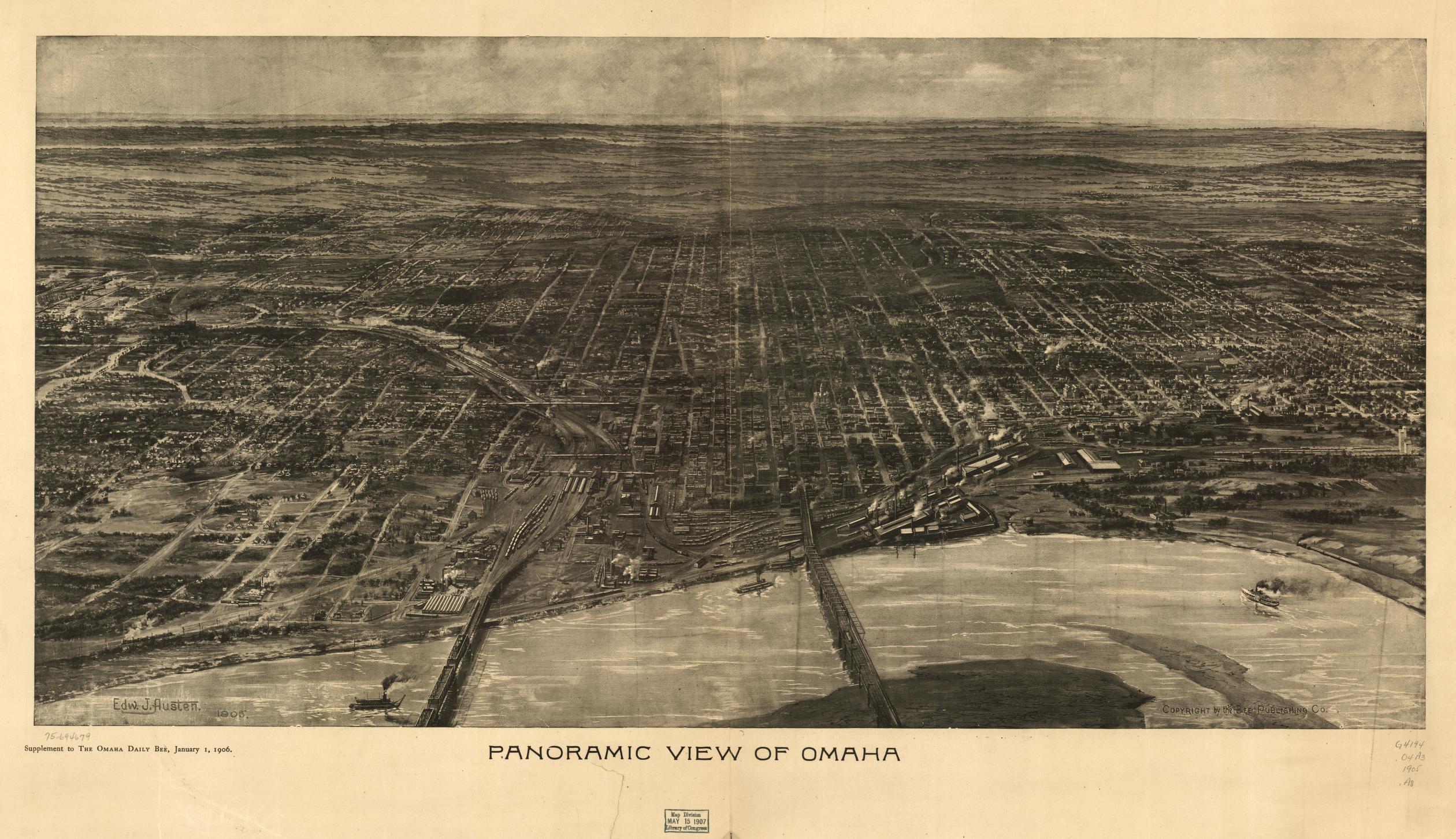
In short, in the country and smaller towns of Nebraska, middle rural class interests prevail, in the largest towns, corporate greed reigns supreme, and in the medium-sized towns, a mongrel cross, between the first and second, acts as the spoke in the wheel of social progress. In all these, the working class are in utter subjection to the dominant class in their respective locality.
In conclusion we, of Nebraska, exclaim, Speed the day here as elsewhere when consolidated capital shall have swept from the economic battlefield the reactionary middle class and thereby cleared the way for the two vital contending forces, viz.: plutocracy and proletariat in the oncoming social revolution.
New York Labor News Company was the publishing house of the Socialist Labor Party and their paper The People. The People was the official paper of the Socialist Labor Party of America (SLP), established in New York City in 1891 as a weekly. The New York SLP, and The People, were dominated Daniel De Leon and his supporters, the dominant ideological leader of the SLP from the 1890s until the time of his death. The People became a daily in 1900. It’s first editor was the French socialist Lucien Sanial who was quickly replaced by De Leon who held the position until his death in 1914. Morris Hillquit and Henry Slobodin, future leaders of the Socialist Party of America were writers before their split from the SLP in 1899. For a while there were two SLPs and two Peoples, requiring a legal case to determine ownership. Eventual the anti-De Leonist produced what would become the New York Call and became the Social Democratic, later Socialist, Party. The De Leonist The People continued publishing until 2008.
PDF of full issue: https://www.marxists.org/history/usa/pubs/the-people-slp/990501-thepeople-v09n05-maydayspecial.pdf
 Revolution's Newsstand