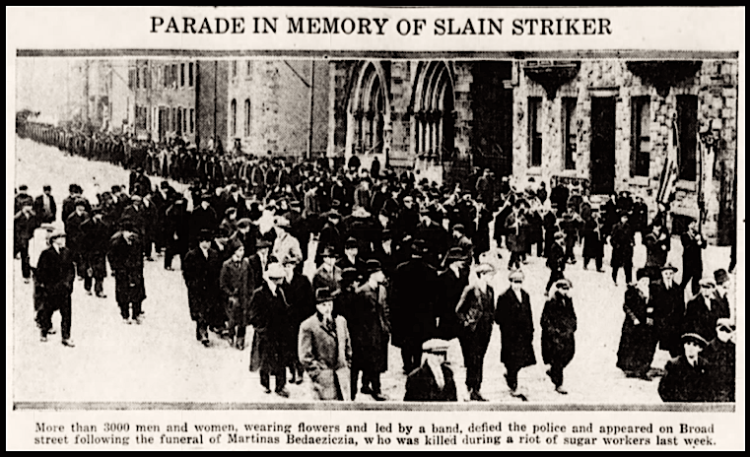
A report on the police killing of striking sugar worker Martinus Petkus during the 1917 I.W.W.-led confrontation in Philadelphia.
‘Murder in Philadelphia Sugar Strike’ from Solidarity. Vol. 8 No. 373. March 3, 1917.
Philadelphia, Pa., Feb. 26. Sugar workers strike still on-fourth week. I.W.W. longshoremen standing solid with the sugar workers. Picket lines getting bigger from day to day. Wives and daughters of workers also on picket lines.
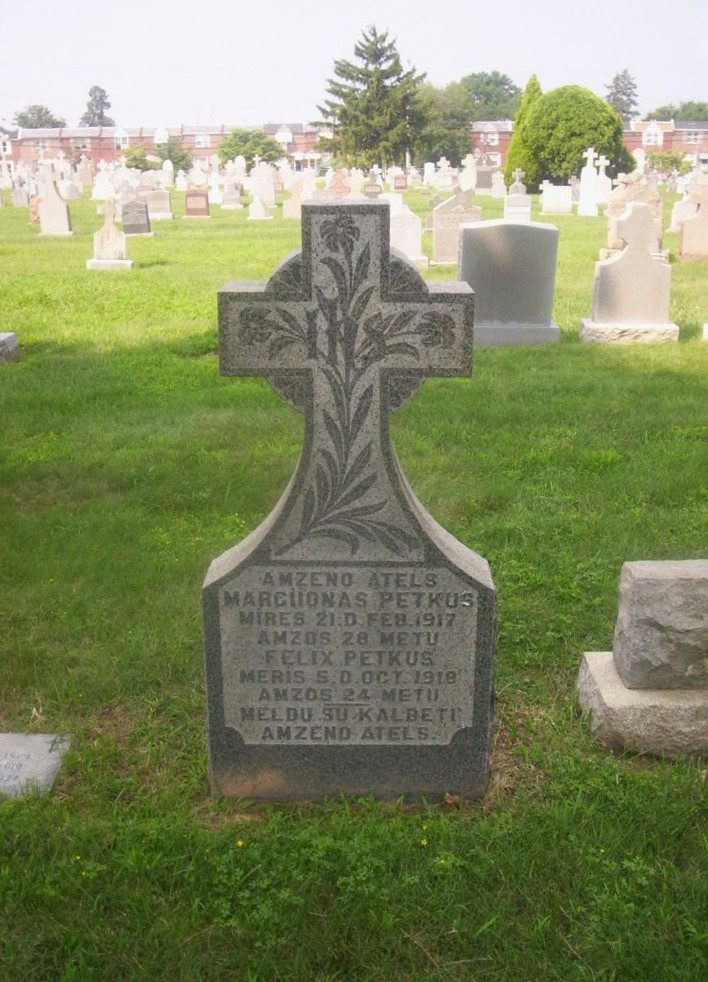
Police charged strikers Feb. 21 and shot Martinus Petkus, a striker, to death, wounding many other strikers. Many arrests made; more are threatened; strikers clubbed every day.
Sugar companies getting desperate; have but few scabs in four weeks. Strikers growing more determined to win. Sugar workers in New York and New Jersey still out. Report sugar in some small towns as high as 25c a pound. Atlantic coast short of sugar. Many factories depending on sugar badly crippled.
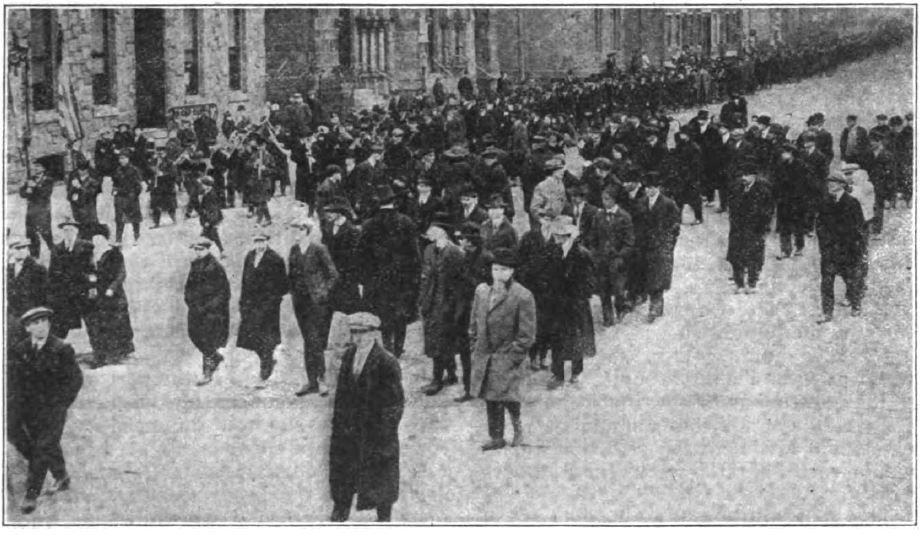
Funeral of Martinus Petkus today. About ten thousand people attended; 2,500 I.W.W. in line. Two hundred colored I.W.W. longshoremen in the procession.
Funds needed to carry on this fight to a finish. Act and act quickly. Address funds to W.T. Nef, 800 Parkway Bldg., Philadelphia, Pa. DOREE AND NEF
If there was ever any doubt in the minds of the strikers of the sugar refineries, docks and ships as to what their future action would be in regard to this strike it was all dispelled on Feb. 21st, when the police murdered one of our pickets, Fellow Worker Martin Petkewicz, and sent many more to the hospitals suffering from broken heads and gun wounds.
The strikers’ faces have become grim and there lurks a look of hatred in the eyes of the fellow workers of the dead. These strikers are no longer easy-going, as is their way, but are now determined to win. Their story of the strike is written in blood, the blood of a fellow worker. The men on strike are thoroughly disillusioned. They know the murderer: Suffice to say it is the name of Spreckles that is met with hisses and jeers.
For more than three weeks now the strikers have battled for the right to live better. They are standing with a solidarity seldom seen among workers who have never before been organized. No one has returned to work, and, Spreckles and his allies are finding it a terribly hard job to get the scabs necessary to their operation of the plants.

The strikers have kept up a large and effective picket line from the beginning of the strike. This seemed to agitate the bosses and peeve the police and private detectives who were on the scene to break the strike, and, if they couldn’t break the strike to do the next best thing: break the heads of the strikers.
When the police and detectives were unable to break the spirit of the strikers, they began the head breaking. Strikers were clubbed and arrested. One fellow worker was picked up by the private detectives, taken to the office of the agency and from there to the Moyemensing prison. This fellow worker had never had a trial and was not even booked at a police station. The strikers and their lawyer was looking for the missing picket from early in the morning until after 8 o’clock that night. When our fellow worker was taken up for trial next day he was released by the magistrate. This is but one of the many cases of like character.
On Feb. 21st, in the morning, a meeting was held of women -the wives and daughters of the strikers. At this meeting the women decided to aid in the picketing and on the same evening a large number of them, many with babes in their arms, went to the strike zone to meet the scabs.
No sooner had they arrived than the police started to bully them, first by pushing them around and then by slapping their faces. The men on the picket line objected and the police and the men clashed. For a time 2,000 pickets and strike sympathizers and what appeared to be all of Philadelphia’s police force battled. The pickets fought back bravely, but bare hands were no match for guns and clubs. When the slaughter was over-and it was a slaughter, for the police on foot and horseback charged the pickets from all sides clubbing and shooting-one of our best was dead, shot through the breast with the bullets of the police. Several of our fellow workers were wounded and sent to the hospitals. Thirteen police found out where the hospitals were located also.
Many strikers are being arrested. Many are under arrest. The police threaten to arrest more. Our fighters must be defended. It is for the workers to see to it that they are defended. Hold mass meetings. Collect funds. Take the matter up at your union meeting.
Send all funds to W.T. Nef, Secy.-Treas., Strike Finance and Publicity Committee, 800 Parkway Bldg., Philadelphia, Pa.
The most widely read of I.W.W. newspapers, Solidarity was published by the Industrial Workers of the World from 1909 until 1917. First produced in New Castle, Pennsylvania, and born during the McKees Rocks strike, Solidarity later moved to Cleveland, Ohio until 1917 then spent its last months in Chicago. With a circulation of around 12,000 and a readership many times that, Solidarity was instrumental in defining the Wobbly world-view at the height of their influence in the working class. It was edited over its life by A.M. Stirton, H.A. Goff, Ben H. Williams, Ralph Chaplin who also provided much of the paper’s color, and others. Like nearly all the left press it fell victim to federal repression in 1917.
PDF of full issue: https://www.marxists.org/history/usa/pubs/solidarity-iww/1917/v8-w373-mar-03-1917-solidarity.pdf
 Revolution's Newsstand