
‘The “Red East” Propaganda Train’ from Soviet Russia (New York). Vol. 3 No. 21. November 20, 1920.
The propaganda train “Red East” began in August its second tour to Turkestan. The following appears in Izvestia on its first tour:
“In January the first propaganda train was sent to Turkestan, which only in July, that is half a year later, returned to Moscow. The area of Turkestan is four times that of France, but it is very thinly populated, four persons to each square verst. For this reason, our efficiency has had to be increased as well as methods of work better developed. Sixty-eight lectures with 7,453 attendants; 334 meetings with 106,080 Russian and 124,605 Mohammedan participants were held; 173 cinema productions were given, the number of those present being 153,330. Members of the political divisions conducted four conferences and took part in 14 party and trade meetings and conferences. The train visited 49 districts and 95 villages. In the internal parts of the country, work of instruction was carried on in five districts, 14 counties and 12 smaller localities. In the Board of Complaints, 938 cases were examined and sentence passed in 433 cases. Out of the book stock 3,073 libraries were provided with 186,431 volumes, 58,171 leaflets, 37,390 newspapers and 5,598 posters. 125,000 leaflets and 9,000 newspapers were distributed free. The “Rosta-Division”, attached to the train, carried with it 24,500 copies of the publication The Red East, in the Russian language, 12,900 in the Tartar, Kirghiz and Sari languages; besides, 76,000 leaflets in Russian and 111,350 in Mohammedan dialects; 7,000 pamphlets in Russian; 4,600 appeals and placards in Russian and 4,300 for Mohammedans. There was also provided in the train a sanitary exhibition, which was visited by 34,767 persons.
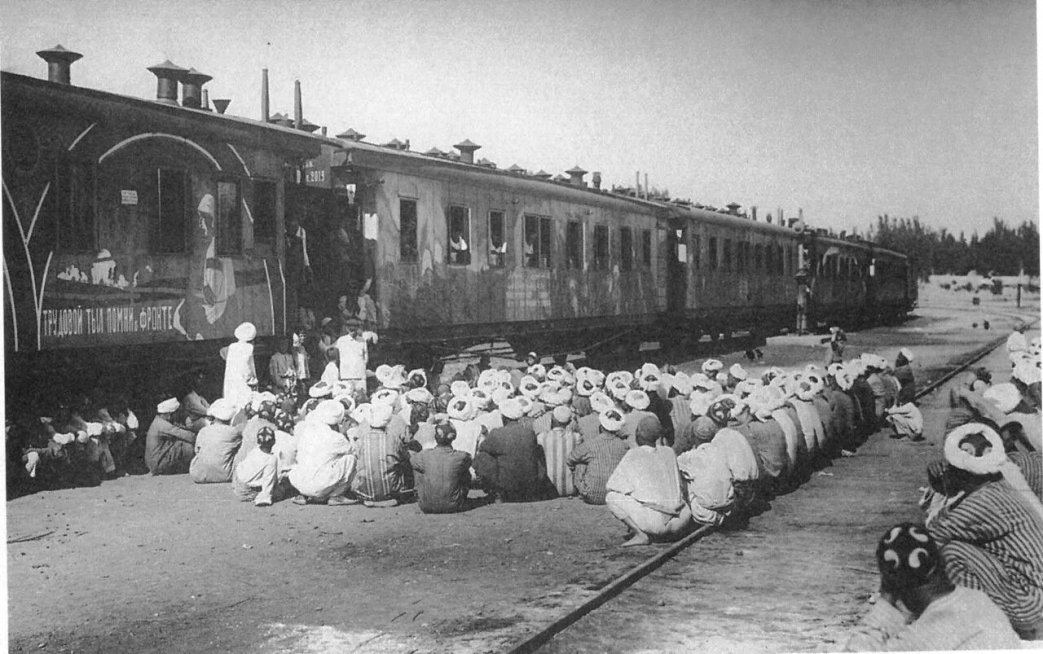
These are only figures. The chief task of the train was to lay the foundation for a great and effective activity and to afford the working people a practical support in their struggle for their national independence and their right to self-determination. Thus far the Soviet organizations in Turkestan have reached only the preparatory stage, for as yet there is an absence of a unified plan and of a clear view of the tasks that should be performed in a country that was for decades a colony of Czarist Russia. For a year and a half or longer, a colonization policy has been pursued here, according to a Socialist plan, under the protection of the Soviet power. The Russian population was considered to be the sole support of the Soviet power, while the poorer classes of the Kyrgyz, Uzbek, and Turkestan population are suffering considerably from the depredations inflicted by the most varied classes of adventurers, under the guise of requisitions and confiscations. We can speak to the population in their own language. Wherever there are no railroad lines the political section of the train sends its members into the remotest villages, often situated from 10 to 100 versts from the railroad line. Thousands of persons assemble who are eager to learn something about the real nature of the Soviet; in mosques, workshops, market places, and out on the steppes meetings were held; everywhere where the working people could be reached. The Red East has carried out not only a great labor of agitation and construction but also has gathered a large amount of technical material on Turkestan, as well as undertaken the inspection of thousands of Soviet institutions. This material and other labors carried out by the personnel of the train will later doubtless become a basis for estimating the Soviets and the work of education carried on by the Communist Party in Turkestan.
Soviet Russia began in the summer of 1919, published by the Bureau of Information of Soviet Russia and replaced The Weekly Bulletin of the Bureau of Information of Soviet Russia. In lieu of an Embassy the Russian Soviet Government Bureau was the official voice of the Soviets in the US. Soviet Russia was published as the official organ of the RSGB until February 1922 when Soviet Russia became to the official organ of The Friends of Soviet Russia, becoming Soviet Russia Pictorial in 1923. There is no better US-published source for information on the Soviet state at this time, and includes official statements, articles by prominent Bolsheviks, data on the Soviet economy, weekly reports on the wars for survival the Soviets were engaged in, as well as efforts to in the US to lift the blockade and begin trade with the emerging Soviet Union.
PDF of full issue: https://www.marxists.org/history/usa/pubs/srp/v3n21-nov-20-1920-soviet-russia.pdf
 Revolution's Newsstand