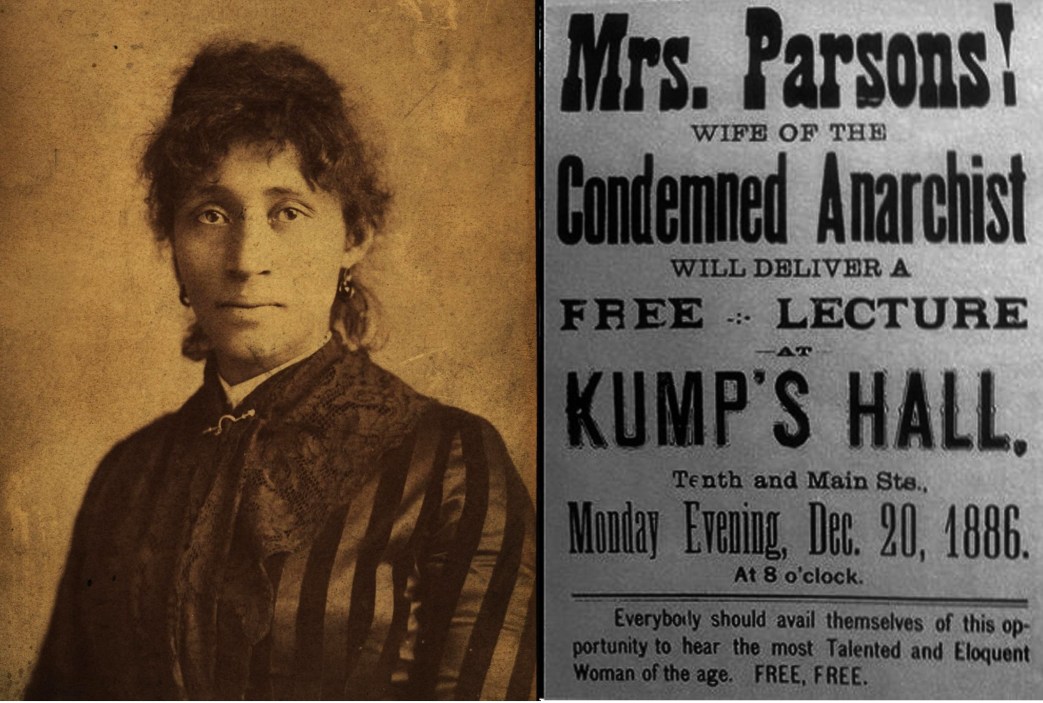
For the first anniversary of her comrade and husband Albert R. Parsons and fellow Haymarket Martyrs’ execution, Lucy Parsons traveled to Europe on a solidarity tour. She spent the hallowed day with comrades in London, events and relationships that would be instrumental in inaugurating May Day as international workers’ day. On the journey she sent letters back to Chicago and Parsons’ old paper, ‘The Alarm’, describing her her visit and the movement as she found it. This one tells of London’s commemoration that first anniversary.
‘Letter from London’ by Lucy Parsons from The Alarm (Chicago). Vol. 1 No. 38. December 31, 1888.
Magnificent Memorial Demonstration by the Workers.
My last letter closed with my arrival in this bustling city of five million souls. I found the movement here in a healthy condition. A warm welcome was tendered me on Saturday, Nov. 10, at which were assembled delegates from all the provinces. The address of welcome was delivered by Cunninghame Graham, M.P., in an eloquent and impressive manner, followed by a ringing address from Comrade Wm. Morris. Then I spoke. Excellent vocal and instrumental music was rendered and the evening’s programme ended with singing the Marseillaise. More enthusiasm and hearty concord it was never my pleasure to witness.
On Sunday, Nov. 11, notwithstanding the fact that one of the famous London fogs had set-in, the meeting called for Regent’s Park at 10 a.m. was well attended by an attentive audience, who stood for over an hour and listened carefully and apparently sympathetically to the details of that foul murder of our martyrs at Chicago. At Hyde Park in the afternoon there was an immense demonstration preceded by a procession in which that emblem of emancipation- the red flag was most prominent, many beautiful banners and appropriate mottoes lent an air of imposing grandeur to the whole affair not to be easily forgotten.
At the memorial services on Monday evening the large hall was thoroughly packed, a large number being obliged to stand, and a more enthusiastic meeting I do not believe was ever held. The music was excellent. Speeches were delivered in many languages, and letters of sympathy and regret were read from many well-known reformers on this side of the Atlantic, among whom were Professor Stuart, M.P.; Michael Davitt; W.J. Stead, editor Pall Mall Gazette; C.A.V. Conybeare, M.P.; P.T. O’Connor, editor Star; H.M. Hyndman, Social Democratic Federation; S.D. Headlam, priest, and others. Telegrams were also received from Leeds, Bradford, Norwich, Glasgow, Edinburgh, Leicester, Oxford, Ipswich, and also from the editorial staff of La Bandera Roja, Madrid; Pierre Lavroff, in behalf of the Russian socialists of Paris; Edouard Vaillants, ex-member of the Paris commune; the central revolutionary committee of Belleville, and from the groups of the Hague. [Space obliges me to omit these latter telegrams which accompany the letter. Ed.]
I shall possibly cross to the continent next week and then will give the readers of THE ALARM an account of the movement elsewhere. I shall try to close my engagements by Dec. 1, and endeavor to be in New York about Dec. 10, where, if opportunity is afforded I shall be pleased to give the public an idea of the progress of the movement in “despotic” England as compared with “free” America. With fraternal greetings to all engaged in the cause of the social revolution.
Mrs. A. R. PARSONS.
The Alarm was an extremely important paper at a momentous moment in the history of the US and international workers’ movement. The Alarm was the paper of the International Working People’s Association produced weekly in Chicago and edited by Albert Parsons. The IWPA was formed by anarchists and social revolutionists who left the Socialist Labor Party in 1883 led by Johann Most who had recently arrived in the States. The SLP was then dominated by German-speaking Lassalleans focused on electoral work, and a smaller group of Marxists largely focused on craft unions. In the immigrant slums of proletarian Chicago, neither were as appealing as the city’s Lehr-und-Wehr Vereine (Education and Defense Societies) which armed and trained themselves for the class war. With 5000 members by the mid-1880s, the IWPA quickly far outgrew the SLP, and signified the larger dominance of anarchism on radical thought in that decade. The Alarm first appeared on October 4, 1884, one of eight IWPA papers that formed, but the only one in English. Parsons was formerly the assistant-editor of the SLP’s ‘People’ newspaper and a pioneer member of the American Typographical Union. By early 1886 Alarm claimed a run of 3000, while the other Chicago IWPA papers, the daily German Arbeiter-Zeitung (Workers’ Newspaper) edited by August Spies and weeklies Der Vorbote (The Harbinger) had between 7-8000 each, while the weekly Der Fackel (The Torch) ran 12000 copies an issue. A Czech-language weekly Budoucnost (The Future) was also produced. Parsons, assisted by Lizzie Holmes and his wife Lucy Parsons, issued a militant working-class paper. The Alarm was incendiary in its language, literally. Along with openly advocating the use of force, The Alarm published bomb-making instructions. Suppressed immediately after May 4, 1886, the last issue edited by Parson was April 24. On November 5, 1887, one week before Parson’s execution, The Alarm was relaunched by Dyer Lum but only lasted half a year. Restarted again in 1888, The Alarm finally ended in February 1889. The Alarm is a crucial resource to understanding the rise of anarchism in the US and the world of Haymarket and one of the most radical eras in US working class history.
PDF of full issue: https://dds.crl.edu/item/54023
 Revolution's Newsstand