
Boris Shumyatsky, head of the Far Eastern Secretariat of Comintern, looks at Japanese imperialism in Korea after hearing reports from delegates at the Congress of the Workers of the Far East held in January, 1922.
‘The Tragedy of Korea’ by B. Shumiatzki from International Press Correspondence. Vol. 2 No. 19. March 10, 1922.
The Congress of the Workers of the Far East just held in Moscow furnish interesting data on the life of the Far Eastern countries, especially in Korea, suffering under the imperialist heel of Japan.
The most careful analysis of the data as far as they relate to Korea show that there is not one class in Korean Society not even the bourgeoisie satisfied with the present state of affairs. Naturally the bourgeoisie lives quite differently from the poor and working masses of Korea. Nevertheless it is dissatisfied. The Japanese capitalists gather the largest part of the surplus value created by the Korean workers leaving the rest to the Korean bourgeoisie. From the ranks of the bourgeoisie there is recruited one of the most powerful nationalist organizations of Korea, called the Protestant Party. It counts a few hundred thousand members and looks with sympathy to American Capitalism.
The Korean peasantry, forming the large majority of the country- 14,322,295 out of a population of 16,617,431 or 87% is in a miserable condition and full of hatred for Japanese imperialism. The colonial policy of Japanese imperialism is to split the industrial forces of the country and deliberately to create national and economic conflicts. The Japanese government has a state trust in the form of the colonial society “Tchek- Sik-Tchvei-San”. The Korean government and the Korean capitalists proletarize and pauperize the Korean peasants with the aid of this society. The Korean peasantry hates the Japanese plantation owner. Recently an insurrection of the Korean peasants in Kandotal broke out which was drowned in blood.
The Japanese capitalists also rob and oppress the city middle class and officialdom. All sea and river harbors of Korea, the richest parts of the cities, the most valuable real estate are in possession of Japanese and foreign capital. The Korean capital, Seoul, has among the 300,000 of its population 50,000 Japanese composed of policemen, gendarmes, officials, officers, capitalists and their agents. The best part of Seoul has been converted into a Japanese settlement Tchingota (an independent city district governed by Japanese laws). The most important harbor city, Tchemulpo, is cut into four parts. The Japanese, the Chinese, the English and American capitalists have each their own settlement. Over two-thirds of the city and harbor area belong to two gigantic joint stock companies, Ultungann & Co. and Wolter & Co. The same condition obtains in Fusin, the second largest city of Korea. Out of its 61,506 inhabitants 27,000 are Japanese retail merchants, money changers, stock exchange speculators, officials and policemen. In Wanson (Genson) out of 50,000 inhabitants 10,000 are Japanese businessmen, officials and gendarmes. In Pienjanne out of 25,000 inhabitants 12,000 are Japanese bourgeois and their agents. In Sienguscho out of 20,000 inhabitants 5,000 are Japanese of the same classes as in Seoul.
What is the result? Japanese imperialism holds the land and all the classes of the population paralyzed in its grip by means of mass immigration, colonization of the villagers and taking possession of the cities, the cultural and economic centres of Korea, which are the organizational and proletarian nuclei in the chaos of an agricultural country.
The condition of the Korean working-class, as pictured by the delegates to the Congress of the Far East, is so miserable that one is shocked by the very thought of the sufferings of the Korean proletariat exploited by the Japanese capitalists. A twelve hours working day, an incredibly low wage, from $2.50 to $5.00 per month, absolutely no laws for the protection of labor and a continual orgy of the Japanese soldiery are the living conditions of Korean labor. This state of affairs is turning the Korean working-class, in numbers rather weak but none the less an important part of the population, into slaves. This condition of the Korean proletariat is making it the most irreconcilable and determined fighter against the imperialist capitalists.
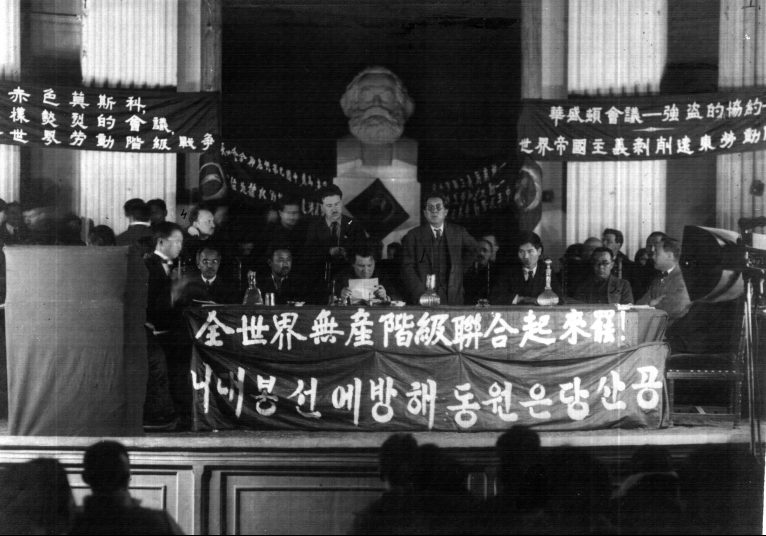
All classes of Korea’s population are indomitable enemies of the existing regime. The Congress of the Workers of the Far East and the large Korean delegation, representing numerous organizations, completely confirmed this. Only a short time ago a part of the Korean bourgeois-democratic intelligentsia, in their faith in the Washington Conference, believed that it was possible to obtain the voluntary evacuation of Korea by the imperialists of the Far East by means of negotiation.
The course of events and the results of the Washington Conference proved to these naive visionaries that the day of miracles exists no more, that it would, to say the least, be out of the ordinary to expect that the wretched tragedy of the Korean people can be brought to an end by the voluntary renunciation of their booty by the imperialists. Now, after the world war, after Washington and Versailles, it must be clear to everyone that the freedom and independence of the country can only be achieved through struggle.
International Press Correspondence, widely known as”Inprecorr” was published by the Executive Committee of the Communist International (ECCI) regularly in German and English, occasionally in many other languages, beginning in 1921 and lasting in English until 1938. Inprecorr’s role was to supply translated articles to the English-speaking press of the International from the Comintern’s different sections, as well as news and statements from the ECCI. Many ‘Daily Worker’ and ‘Communist’ articles originated in Inprecorr, and it also published articles by American comrades for use in other countries. It was published at least weekly, and often thrice weekly.
PDF of full issue: https://www.marxists.org/history/international/comintern/inprecor/1922/v02n019-mar-10-1922-inprecor.pdf
 Revolution's Newsstand