
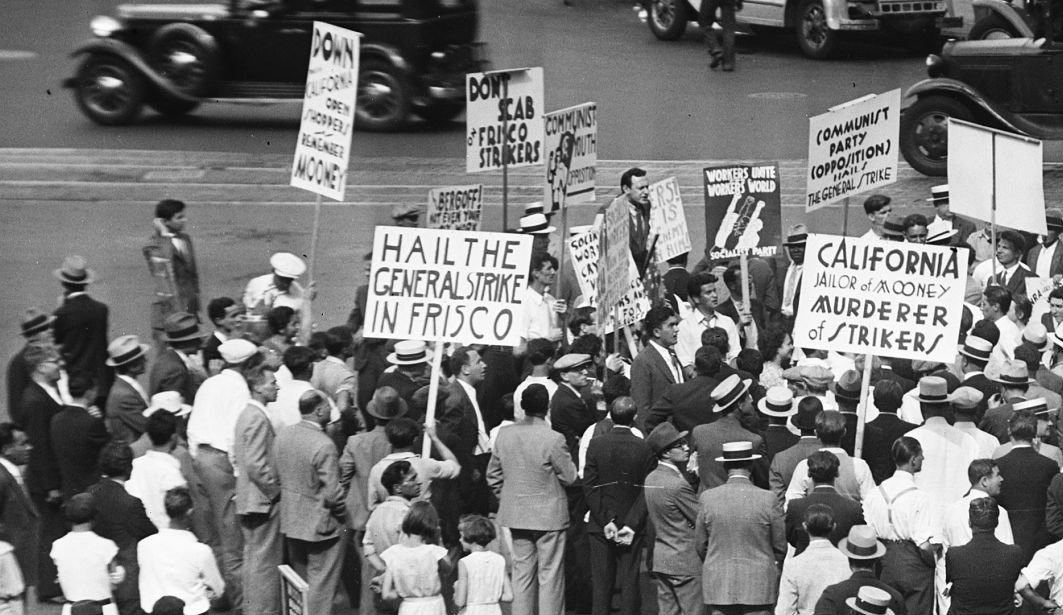
Among the most important labor struggles led by Communists in the 1930s were the West Coast maritime strikes of 1934-36. Roy Hudson, a leader of that work, reports to a meeting of Party leadership on that process and how it fits into the larger, new ‘People’s Front’ orientation of the Communist Parties. For decades afterwards, the C.P. would have real weight in many waterfront unions.
‘Rooting the Party on the Waterfront’ by Roy Hudson from The Communist. Vol. 14 No. 12. December, 1935.
(Speech delivered at the November Plenum of the Central Committee of the C.P.U.S.A.)
THE willingness of the American workers to struggle, their tremendous desire for unity and organization, and their growing dissatisfaction with craft forms of organization and conservative policies and leaders are reflected to a marked degree in the marine industry. And here, too, we see reaction mobilizing its forces, resorting to terror and fascist measures to crush the struggles of the workers, to weaken and wipe out the unions. The class relations are becoming more and more strained; we are in a period where each sharp conflict between the employers and the workers is followed very soon by even greater conflicts involving wider masses of workers.
The conclusion of the West Coast strike a year ago did not mark the beginning of an era of peace in the marine industry. On the contrary, it led to more extended organization and new struggles throughout the industry, to prolonged, stubborn resistance upon the part of the West Coast marine workers against the provocation of the ship owners and in defense of their gains. During the past months the West Coast marine workers have been able to maintain their unions only through correct leadership and tremendous demonstrations of strength and unity backed up with a general strike threat.
The present Gulf strike, which aims to smash the last stronghold of company unionism in the industry, shows how widespread is the determination of the marine workers to organize. Another example of this determination is the United Fruit docks in New York. Here is a company which, despite the fact that it is probably the most reactionary open-shop company in the industry, and that has blacklisted union men, the I.L.A. officials for about eight months pointblank refused to organize. The sentiment for organization grew in spite of this to such an extent that the I.L.A. officials have been forced officially to organize the docks.

The experience in this direction shows how the Communist nuclei through shop papers and the initiative of our Party members on the docks use their efforts for organizing the unorganized, as the means of increasing their influence. Our Party members among the longshoremen have for almost a year been urging them to join the International Longshoremen’s Union. A number of our Party members were blacklisted and victimized because of their activities, Delegation after delegation went to the I.L.A. officials with demands that they organize the docks, but they were repeatedly rebuffed. So much pressure was exerted by the workers, however, that the I.L.A. officials were forced to call a mass meeting to begin to organize the docks.
The second such meeting was called last night, the first one officially called by the IL.L.A. The meeting was opened with 250 or 300 longshoremen present from the United Fruit dock, with seven speakers, all official I.L.A. spokesmen. Every one of these seven struck the same note: they said that the Communists were spurring the workers on to organize, because we had a plot to smash the I.L.A. Other deliberate attempts to stir up a Red scare were made. Then one of the spokesmen read a leaflet which had been issued by the dock nucleus, calling the workers to stand behind the I.L.A., warning them against stool pigeons, urging them to join the union, and also pointing out to them that anyone attacking the union or the Party was trying to split their ranks. After the speakers concluded, the workers said, “Well, that is a good leaflet”. ‘Then the officials mentioned a leaflet issued by the Rank and File Organizational Committee. The same people, they said (the Communists), must have issued this leaflet, too. One longshoremen got up and said, “No, our committee issued it. We elected the committee, we wrote the leaflet”. The officials were forced to retreat. They said to the workers, “Well, even Communists can join the union, as long as you work for the union”. ‘Thus, we see how sentiment for an organization aroused by a Communist nucleus grew to such an extent that the I.L.A. officials were forced finally to organize this very important dock.
TRADE UNION UNITY THE MAIN FACTOR IN GROWTH OF I.S.U.
Of the seamen on the East Coast and on the Gulf, tens of thousands have entered the International Seamen’s Union. The establishment of trade union unity and the increased activities of the Left wing are undoubtedly also the main factor for the growth of the I.S.U., and the reactionary policies and tactics of the top leadership have been the main obstacles to the still more rapid growth of the seamen’s union.
The efforts to achieve unity of action become ever stronger. The Gulf strike, for instance, has already brought thousands of longshoremen into action on the basis of solidarity. Spontaneous efforts of the seamen to support a strike on a major scale have been checked only by the I.S.U. top leadership, who are resorting to the most reactionary measures, such as forbidding all union meetings in the Gulf ports and instituting open terror against progressive and militant rank and filers.
“Hot cargo” has become such an issue that Ryan can no longer use his false promises to the workers with the same effect—the Gulf strike daily promises to involve the East and West Coast marine workers.

These experiences prove also that the question of industrial unionism has become a major issue in the labor movement. Every single strikes raises more and more sharply the question of industrial action, of solidarity action upon a national scale. Every strike shows a growing understanding upon the part of the workers that even the existence of craft unions depends upon the united action of all unions.
For years the marine unions have been dominated by ultrareactionary leaders. But masses of workers opposing these leaders, their influence has been weakened and in places they have been replaced with militant, progressive workers.
While noting the strengthened position of the marine workers, and the increased influence of militant progressive policies, it is just as important to record the determination of the employers to destroy the marine workers’ unions, the measures they are using against the workers, and the steps they are taking to launch another offensive. They have tried unsuccessfully to provoke the Western unions into a premature strike. But in spite of the fact that the Western seamen have the united backing of all other crafts, the shipowners arbitrarily refuse to consider any changes in the arbitration award. In the Gulf they have made clear that they intend to wipe out the longshoremen’s union. The use of violence proceeds to an unheard of degree, and an organized campaign of incitement in the press prevails against the marine unions, especially on the West Coast. This is combined with the development of a large number of mass “vigilante committees” organized by the Chambers of Commerce. Finally, the government-controlled Shipping Board which for a number of years has been nearly out of business, recently announced wage rulings on a number of their ships which amount to a reduction of wages and are in violation of existing union agreements. The recent announcement that government hiring halls will be opened, especially on the Pacific Coast, is tantamount to a declaration of open war upon the unions by the shipping companies headed by the government.
Also, this announcement takes place at a time when negotiations are still pending in the West and when the East Coast seamen’s agreement expires in January. The renewed activity of the Shipping Board and the role it is playing also express quite clearly that the increased offensive against the unions is determined by the present war situation. The progress made by our Party in both the marine and steel unions, two basic unions where reactionary policies have long prevailed, shows the tremendous possibilities that exist for correct work in the trade unions. Experience in marine also shows that where organization of the unorganized is made a central task, and struggles are developed, we can most effectively counteract the disruptive tactics of the reactionaries, tactics which prevent the unions from getting a mass base.
But a number of serious shortcomings prevent us from fully utilizing all the possibilities to the fullest advantage. For instance, at a time when the shipowners are seeking to crush the unions out of existence, we hear statements from some of our Party comrades that “the ship owners will renew the agreement because they do not fear the fakers”. It is also only in recent months in New York that many of us have learned that there are such things as “progressives” amongst the lower officials of the I.L.A.; that there are also a few Socialists on the dock with whom we can work, and that it is possible for us to develop activity inside of the unions.
LONGSHORE WORK HAS RECEIVED INADEQUATE ATTENTION
And in spite of the great importance of longshore work, it has received inadequate attention from the Center, and especially from myself.
Our work among the seamen, even when it mobilizes the support of thousands, suffers from the fact that we do not draw non-Party seamen into the leadership of the rank-and-file movement. Strong “Leftist” tendencies, which at times lead to trying to replace the unions with rank-and-file committees, must be closely guarded against, especially in the work of the seamen’s fractions. The seamen forces have been shifted too often, and often without consulting the Districts. This does not mean that we put the main emphasis on the bringing in of outside forces. On the contrary, we have always tried to stabilize our forces and develop them locally.
While we have developed a number of important local movements, we are just beginning to bring forward a program and demands that will enable us to coordinate our activity in all ports. Among the seamen, we are confronted with the serious and difficult problem of developing proper organizational forms for the rank-and-file movement, and to prevent it from being disorganized and dispersed in a situation where every semblance of democracy is being denied and the most reactionary measures resorted to by the reformist leaders. We are on the eve of great and decisive struggles. New tasks face us. At the same time, we must recognize that we have not yet solved a number of old problems and in some places we are lagging dangerously behind the masses of marine workers. We want to sail more quickly, and for this reason we should strengthen our work and overcome our shortcomings.

What is the immediate problem that arises out of the Gulf strike, a struggle that involves to a great extent the future of the unions in the industry? It is the problem of mobilizing the workers to stop the terror in the Gulf, of developing an effective boycott of “hot cargo” on both the East and West Coasts. Our ability to get results in this situation depends upon a correct policy, upon our strength, and the coordination of our forces and activities. A number of important things have been achieved, especially in the Texas District, where, in spite of previous neglect, the District has established important contacts in a number of unions, which, if followed up, will enable us to be a powerful factor in the strike now, as well as in the future work of the unions. It is important to emphasize what took place in Texas, because it represents practically the first time in our experience that lower officials, influential workers inside of the American Federation of Labor marine union, came directly to the Party for advice and assistance.
But no one can be satisfied with what we have accomplished. Our strength on the West Coast could have been utilized much more for influencing the strike, and in giving leadership to the movement for a national boycott. At the same time, a uniform application of our policy, which is of the utmost importance, has been missing.
WORK OF PARTY FRACTIONS NEEDS TO BE STRENGTHENED
Some of the most effective work of our Party has been carried through in a number of Pacific ports, where we have a strong position, and our influence as a result extends throughout the industry. While we have strengthened this influence, we have not utilized it to extend the movement and give it leadership. ‘There is no strong feeling of responsibility for developing the movement on a wider scale, because its importance is not fully appreciated. Consequently, the work of our Party forces and fractions is not properly organized. A recent examination of our work in the strongest ports shows that the fractions were not organized even on a local scale. You can imagine what the situation is on a District and national scale.
When we are participating in mass struggles such as the Gulf strike, when we are faced with the expiration of the seamen’s agreement in January, and the coming International Convention of the I.S.U., this becomes a serious question. The Central Committee and the District Committees must give the greatest assistance to the organization of functioning fractions in each port, and to the co ordination of the work of these fractions on a coastal and District scale. Likewise, the proper form for developing and coordinating the rank-and-file movement nationally has not yet been solved. These are decisive questions to solve, if we are to improve our work, consolidate and extend our influence and give leadership to the coming struggles.
I would like to emphasize Comrade Browder’s remarks that in applying the decisions of the Seventh World Congress of the Communist International we must do it in the light of the concentration tasks set before us in the Open Letter of our Party two years ago, The development of a broad united front and people’s movement does not lessen the importance of winning the workers in the basic industries; on the contrary, our ability to develop a broad people’s movement in which the proletariat will play a leading role will be determined by the extent to which we win over the basic workers, It sometimes seems that we do not sufficiently appreciate this yet.
Let us take a few examples. In my opinion the convention of District 3 was a landmark in the history of our Party. It showed that the whole composition of the Party was changing, that a really serious beginning had been made in trade union work, that cadres which the District had been striving for were beginning to come forward. The discussion was concrete and rich with experience and showed that the Party was able to examine critically its work and weaknesses. There were many encouraging signs of growth, but the Convention had to record that no serious progress had been made in mining, steel and marine and that the work was extremely weak in these fields.
As for marine, the District Organizer, in his report to the Convention, stated:
“In marine we do work when a political club is over our head. After we’ve had a beating, we are active and pay attention. But when the effects wear off, we go to sleep.”
Well, it is good to see that we are capable of such ruthless criticism, but I think we are all agreed that it would be much better if we did not have to admit such things. It is my opinion that in Districts 1 and 3 our position among the mining, steel, textile and marine workers is weaker, and we do at least no more, if no less, work than we did two years ago. The most glaring example, however, is in longshore work. New York with all its forces and resources is just beginning to scratch the surface by conducting systematic work. t has some forces and can at least say it is in a position to talk about developing a broad mass movement. Progress in New York is important especially from the point of view of showing that we have overcome our isolation of a year ago. But as to progress in the sense of establishing ourselves as a factor with mass strength able to carry through the actions which the situation deserves, we must admit there has been none. We must admit that, after a month, we have been unable to develop any struggle on the question of “hot cargoes”.
In Baltimore, Philadelphia and Boston we have not even started to carry on sustained, systematic work after all these years.
Let me cite one more example of a different type, one where we have led mass struggles and have a strong position in the union. A member of the Central Committee, not a marine worker, writes:
“The District Bureau still does not pay sufficient attention to the marine workers, does not fully understand the problems and is not marine conscious.”
What do these things indicate? At our last Convention, I said that to some people the Open Letter was still a closed book. Well, the “book” is still closed to them, and that section of the Open Letter stressing the political importance of strengthening the Party’s influence in the basic industries has not yet been digested by some. But some comrades will say that putting the question in this manner does not answer the question. Yes, we appreciate the importance of work in marine, but the methods that have been used and our policies were not satisfactory, they say. True, we must seriously review all our work and activities and invite suggestions, improvement and criticism in this Plenum. But unless at the same time the Party committees assume the political responsibility for the work and concentrate their attention upon these tasks, they will not be solved.
RECENT EXPERIENCES IN THE STRUGGLE AGAINST WAR
This becomes even more important when we review our recent experiences in the struggle against war. Our Party has carried through some important actions in marine. Even where we have been weakest and faced strong opposition from the bureaucrats, we have secured the adoption of resolutions against handling of war materials. Where we are stronger, we have developed important actions. Our greatest weakness lies in the fact that we have not always proposed actions that were capable of immediately being realized, and also some hesitation about making concrete proposals in the unions for fear of being labeled “Red”.
Everyone agrees that, “Stop the shipment of war materials to Italy”, is one of the central slogans of the marine workers. If this slogan is to be taken seriously, it will mean that we will first of al] guide and check up on the work of our comrades in the marine industry to make sure that general literature receives adequate distribution on the waterfront and that special anti-war literature is issued, In developing our general anti-war campaign, we will always stop to consider how to apply them concretely in this field. We will also attempt to develop the general struggle for peace in such a manner as to stimulate and strengthen the work directly on the waterfront, If this is done seriously, systematically, by any of the Districts, then I don’t know about it.

There are several cities where a fairly broad people’s peace movement has been developed that is of the greatest importance even though we cannot expect at this time to secure the participation of the marine workers in this movement. But at the same time there does not exist the determination seriously and systematically to strengthen our work amongst the marine workers in order to secure their participation in the broader movement.
While I’m on the subject, I’d like to add just a word on the question of people’s movements. We shouldn’t play around with words. I haven’t heard any estimation of the New York people’s peace parade, but I watched the parade from one end to the other, and it certainly lacked the broad character necessary for a people’s movement.
Comrades, I want to emphasize again that in developing our broad united front movement we must not lose sight of the fact that our main task is still to strengthen our position among the basic workers. We must not lose sight of the task of winning the workers in the decisive industries and making them a factor in the united front.
BUILD THE FARMER-LABOR PARTY ON THE WATERFRONT
Every District, in concretizing the work of this Plenum, should review its work in the concentration industries. With all our weaknesses, we are by the proper organization of our forces strong enough to make a decisive step to penetrate these fields. Outside of the West Coast, we must recognize that practically nothing has been done to bring the Farmer-Labor Party to the waterfront. Leaflets, pamphlets and meetings on this question are most necessary. In developing the labor tickets in seaports we must pay particular attention to the utilization of the experiences of the marine workers in connection with terror, the organization of vigilante committees by the shipowners as well as the question of the enormous marine subsidies and the disfranchisement of many seamen. We should work out concrete plans for bringing the campaign more systematically into the union.
Comrade Dimitroff in all of his speeches at the Congress dealt with the question of cadres. Comrade Browder has also given it special emphasis in his report. Certainly, every word that has been said on the subject is justified and needs the most serious study. I wish to deal with a certain problem we sometimes encounter with our forces, especially among seamen and other basic workers. I will introduce this question by quoting from a recent letter:
“I raise this here because it seems every time I have a meeting with you that I make attacks on the Party leadership locally and I sure am trying hard to keep from having an anti-Party approach. It is just trying to get some of these comrades to act and help us to solve our Party problems. I say that if we could solve our Party problems and act on some of our proposals we could go ahead where we are short of forces in marine, and do more work in the union and also more work among the seamen, and not have to spend so much time trying to get the leading comrades to act on certain questions that come up in marine at this time. I also realize that they have plenty of problems but of course they also have plenty of forces. I think that the Center will have to come out more sharply and not only attack the marine comrades but also make them directly responsible. I hope that you understand my point and will think things over before you send me an answer telling me how cock-eyed my line is because I have been doing a lot of thinking lately and some of my thoughts were worse than this.”
Certainly this letter reflects an unhealthy state of mind, one in which the comrade sees all of the problems from an inner point of view, and lacks confidence in the Party leadership as well. Now, if this were just an individual or an isolated case, it would not deserve to be raised at this Plenum. But this complaint is far too common. I know this, because a good part of my time has been spent in struggling against this tendency. These ideas are dangerous and must be fought against. But before stating that these comrades are all dangerous and disloyal to the Party, we must find out the source of the trouble. Why do these tendencies arise?
First, because these comrades are often confused about the most elementary things concerning the Party. Second, they are usually the most active forces bearing the brunt of the work. They feel the need of more help and leadership from the Party, help which is often lacking; and often they are more conscious of shortcomings in the Party than some of the leading Party comrades. But while they often see weaknesses, they often arrive at incorrect solutions to the problems because of their inexperience.
Third, they have at times been influenced by anti-Party theories which prevailed at one time and probably still exist in remnants.

These are the major reasons, and if we are going to solve this problem we must, on the one hand, struggle against these tendencies, and, on the other, maintain a correct reaction to justified criticisms, Shortcomings should be eliminated instead of just talked about, and we must closely examine our methods of work with cadres in order to replace such comrades with comrades capable of winning the confidence of workers in basic industries.
Finally, more attention must be given to our forces. We must exert serious effort to study them, to learn their shortcomings and help them develop those qualities of devotion to the working class and loyalty to the Party, which are the first prerequisite raised by Comrade Dimitroff for cadres.
There are a number of journals with this name in the history of the movement. This ‘Communist’ was the main theoretical journal of the Communist Party from 1927 until 1944. Its origins lie with the folding of The Liberator, Soviet Russia Pictorial, and Labor Herald together into Workers Monthly as the new unified Communist Party’s official cultural and discussion magazine in November, 1924. Workers Monthly became The Communist in March, 1927 and was also published monthly. The Communist contains the most thorough archive of the Communist Party’s positions and thinking during its run. The New Masses became the main cultural vehicle for the CP and the Communist, though it began with with more vibrancy and discussion, became increasingly an organ of Comintern and CP program. Over its run the tagline went from “A Theoretical Magazine for the Discussion of Revolutionary Problems” to “A Magazine of the Theory and Practice of Marxism-Leninism” to “A Marxist Magazine Devoted to Advancement of Democratic Thought and Action.” The aesthetic of the journal also changed dramatically over its years. Editors included Earl Browder, Alex Bittelman, Max Bedacht, and Bertram D. Wolfe.
PDF of full issue: https://www.marxists.org/history/usa/pubs/communist/v14n12-dec-1935-communist.pdf
 Revolution's Newsstand