The first sustained Communist mass work in the South centered on the bloody North Carolina textile strikes of 1929 which saw a number of leading Party members faces murder charges and the possibility of the electric chair. Six months into the struggle the International Labor Defense held its first Southern regional conference. J. Louis Engdahl reports.
‘Six Months in the South’ by J. Louis Engdahl from Labor Defender. Vol. 5 No. 1. January, 1930.
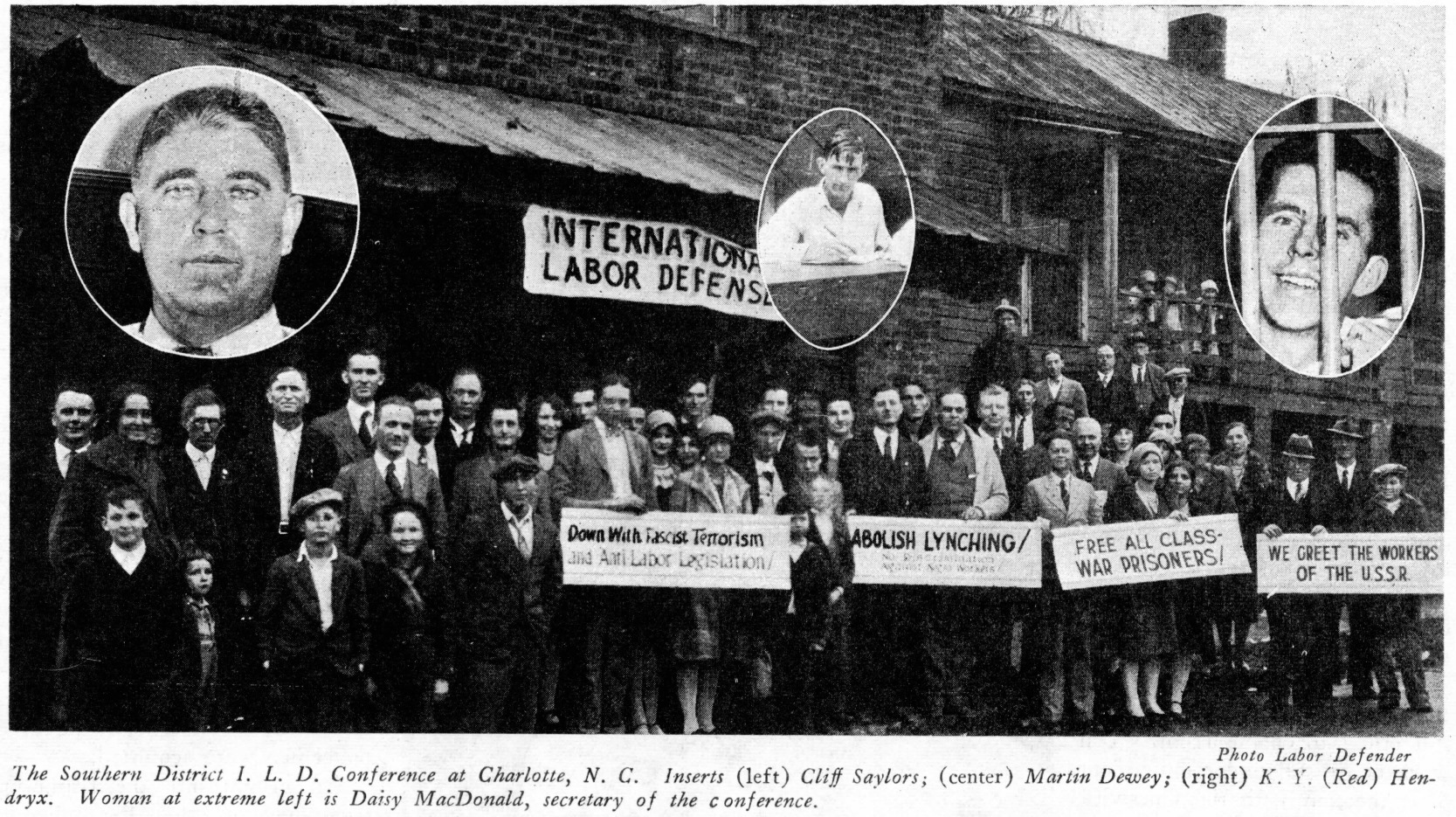
SIX months after the joint police and mill owners’ mob attack on the textile strikers’ tent colony at Gastonia (June 7) the International Labor Defense held its first District Conference (December 8) in the South, at Charlotte, North Carolina, scene of the ruling class effort to send 16 strikers and organizers to the electric chair.
It was the bloody and murderous war waged against the Loray Mill strikers of the Manville-Jenckes Corporation that called the I.L.D. into the South; its successful and now historic fight for the lives of “The 16” condemned to death that rooted it deeply in the ranks of the Southern toiling masses, Negro and white; while bitter struggles ahead promise it continued growth and influence.
The I.L.D. became a really national organization, covering all the struggle centers in the land, with the holding of its First Southern Conference in the little hall, now known as “The Workers’ Center,” at Belmont and Caldwell streets, out where the textile workers live in North Charlotte, edging on the Negro neighborhood.
Six months ago the I.L.D. was practically unknown in the South. Today its every movement is watched. The kept press builds full page headlines and endless articles in an effort to misrepresent and slander its activities. Its organizers have been kidnapped, mobbed, flogged and all but lynched. Ella May was murdered. In New Orleans its headquarters have been raided and its members jailed. This same press predicted that the I.L.D. would desert the South following the Gastonia trial. The First Southern Conference was the answer this press and its masters received-clear, uncompromising.
This Conference opened a new day in that it revealed not only that the I.L.D. had become national in scope but that the Southern workers, coming from four states- North and South Carolina, Georgia and Virginia- had come to think nationally and internationally. Lack of funds alone kept delegates at home in Florida, Alabama, Mississippi and Louisiana.
Here was B. W. Miller, the Negro delegate from Atlanta, who spoke for the unity of workers of all races, not only Negro with white, but also of the exploited masses of China, India, Africa, Japan; eloquent in speech, magnetic in personality. He beholds in the I.L.D. an organization helping to liquidate the prejudices between workers, white and black, yellow and brown.
Out of this Conference came the first voice of protest in all America against the murderous war renewed by Wall Street’s butchers against the worker and peasant masses of Haiti.
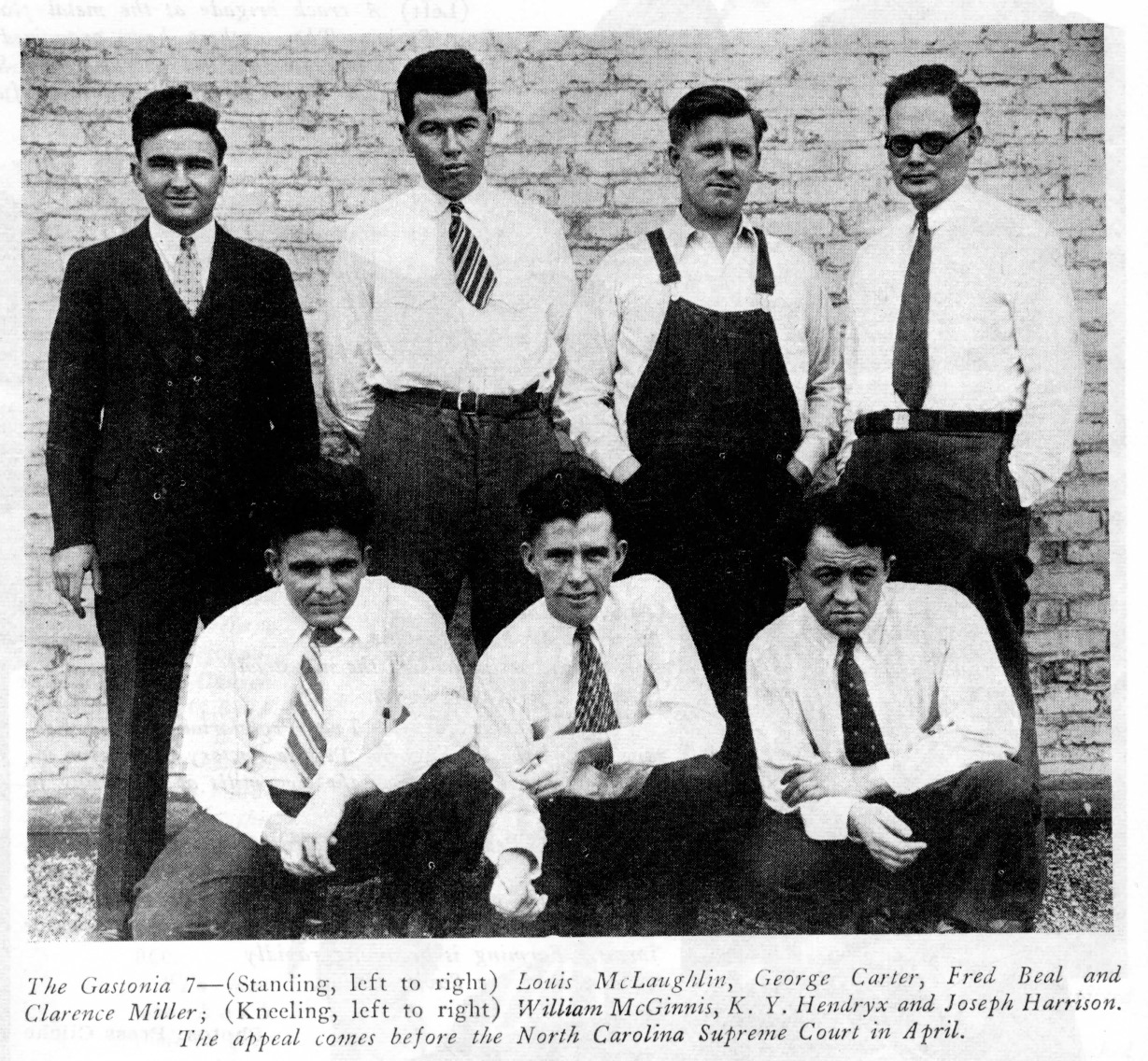
K.Y. (Red) Hendryx, one of “The Seven,” who is facing seven years in 5 prison, urged the struggle to save Salvatore Accorsi from the electric chair in Pennsylvania. Here was the handclasp of the Southern textile worker with the Pennsylvania coal miner, the solidarity born in the crucible of bitter class battles.
Cheers of approval echoed the reading of greetings to the workers and peasants of the Soviet Union, carrying the congratulations of these Southern toilers on the triumph of the Five Year Plan. Elmer MacDonald, member of the Children’s Delegation but recently returned from the U.S.S.R., spoke for the Pioneers. The delegates knew that one of their number, K.O. Beyers, was at that moment touring the Soviet Union, being greeted by workers everywhere, while he had been refused admission to Great Britain by the MacDonald government, that feared his message to British labor.
The Gastonia gang of the Manville-Jenckes outfit refused to permit the release of George Carter, the last of the defendants held in prison, on bail, so that he could attend the conference. While the conference was on, the mill owners’ press spread provocative slanders against the I.L.D. intended to incite mob raids on its Charlotte headquarters. The day after the Conference, when Carter was finally released, a warrant was issued for the arrest of Cliff Saylors, I.L.D. organizer, under the old charge of the murder of the police chief, Aderholt, the crime that had been unsuccessfully lodged against “The 23.” The I.L.D. grows in the South in the heat of the many developing conflicts.
Labor Defender was published monthly from 1926 until 1937 by the International Labor Defense (ILD), a Workers Party of America, and later Communist Party-led, non-partisan defense organization founded by James Cannon and William Haywood while in Moscow, 1925 to support prisoners of the class war, victims of racism and imperialism, and the struggle against fascism. It included, poetry, letters from prisoners, and was heavily illustrated with photos, images, and cartoons. Labor Defender was the central organ of the Scottsboro and Sacco and Vanzetti defense campaigns. Editors included T. J. O’ Flaherty, Max Shactman, Karl Reeve, J. Louis Engdahl, William L. Patterson, Sasha Small, and Sender Garlin.
PDF of full issue: https://www.marxists.org/history/usa/pubs/labordefender/1930/v05n01-jan-1930-LD.pdf
 Revolution's Newsstand