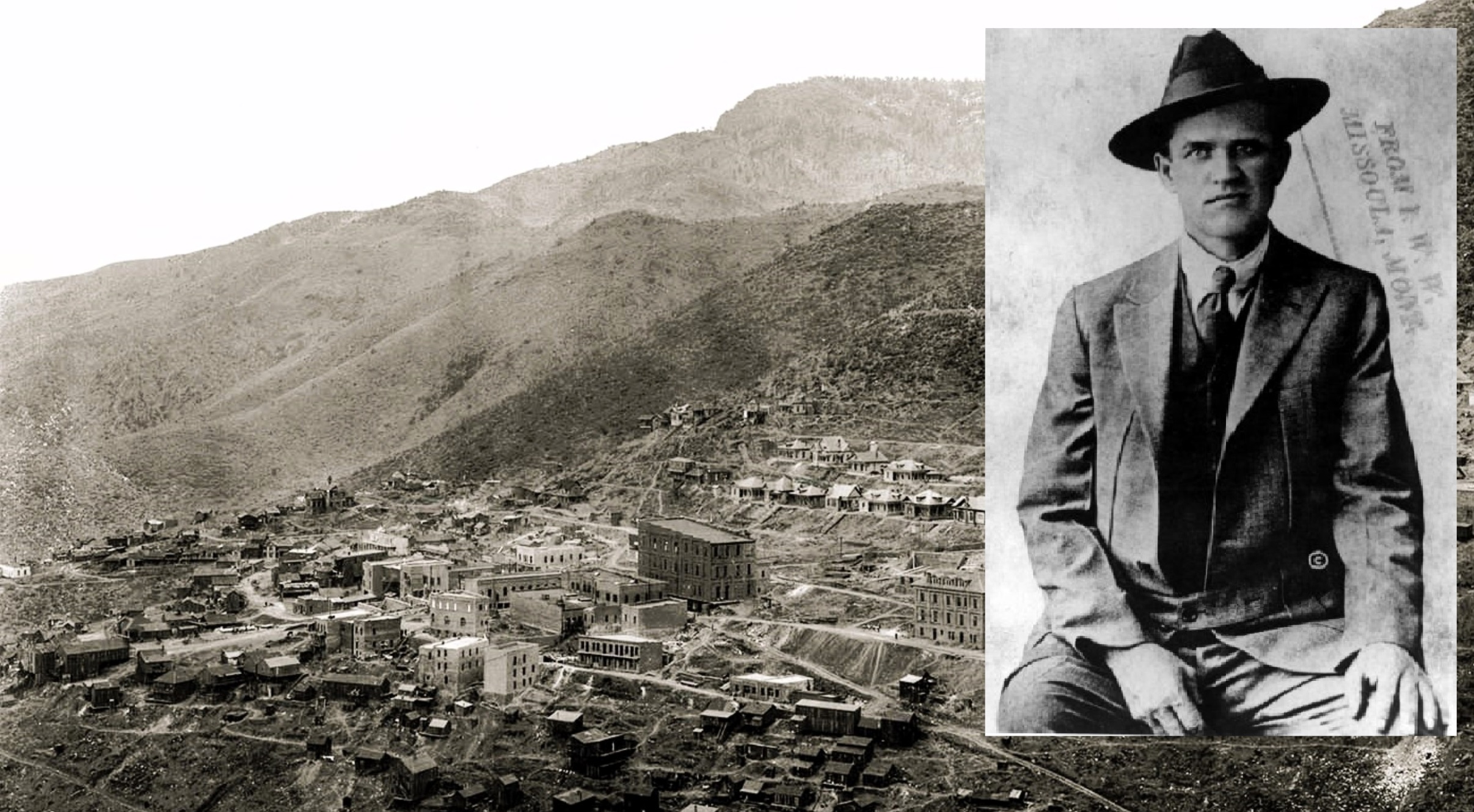
In the months before his August 1, 1917 murder in Butte, Montana Frank Little was organizing Arizona miners into Metal Mine Workers Industrial Union, No. 8. In this article he highlights the difference between the I.W.W. and the Western Federation of Miners. Shortly after this was written 60 wobblies were rounded up at gunpoint and driven from town into the desert.
‘Miners in Arizona Lining Up’ by Frank H. Little from Solidarity. Vol. 8 No. 380. April 21, 1917.
Western Mining Camps Strong for One Big Union.
Jerome, Ariz. The Metal Mine Workers Industrial Union, No. 8, the I.W.W. is forging ahead in the Western mining camps. The miners have come to the conclusion that the men who work in the mines, and smelters are the ones who should be benefited by unionism and not the boss or the labor-skate “union” official. In other words, the miners want a union that will look out for the interests of the WORKERS- an INDUSTRIAL union.
The I.W.W. is growing in this neck of the woods, while the old W.F. of M., the mine owners, bules men, Burns, and other detectives are working together to fight the onward march of the One Big Union. In spite of this crowd we will soon have full control of the mining camps. The miners are joining: that’s enough. The grafters don’t matter.
The I.W.W. program here is a six-hour workday, two men on a machine Instead of one (a thing the W.F. of M. in its twenty-four years of organization has not put into effect), and also the universal strike instead of the local strike. This means that when the miners of one locality strike the miners of other localities will not continue to dig ore to fill the orders of the strike-bound mines, but will strike in unison, closing ALL mines down at once, leaving no chance for scabs-union scabs at least.
The W.F. of M., when they demand shorter hours, or, rather, when they ask their friend, the boss, for a shorter workday, always seek to justify their request by stating that miners will do more work and better work in eight hours than they can in ten. And they have always proved that statement to be a fact. One man will do more work in eight hours than three could do in ten hours twenty years ago, BUT THE BOSS AND NOT THE MINERS IS THE ONE WHO HAS GAINED. The I.W.W. is out to better the conditions of the workers and the workers alone.
And the I.W.W. never tries to justify any demands made on the boss, because the workers is entitled to all that he has the power to take from the parasites of industry. We want the six-hour day in all mines, mills and smelters, not because we want to do more work in that time than before but LESS WORK. We want to put more men to work, want more time for rest and study; more time to agitate and strengthen our organization so that we can go after the four-hour day-and get it.
The W.F. of M., like the U.M.W. of A., ties up the miners with contract agreements that make them work hard for a certain period of time for a specific wage. In this way they are tied hand and foot, for if the miners of another district go on strike the contract bound union will have to scab on them in order to live up to the contracts. The I.W.W. makes no contracts, but holds that miners have a right to strike at any time they see a chance to better their conditions; and, furthermore, that the time to strike is when the boss most needs the workers.
At present the Industrial Pirates are preparing for war, but all class-conscious workingmen are determined to stay at home and fight their own battles with their own enemy- the boss. By so doing they will gain for themselves shorter hours, better wages and better conditions, which is a lot more than the “blocks” will get who go to Europe to fight the battles of the masterclass. Kick the bosses off your backs. Organize for industrial freedom. Don’t fight the bosses’ battles; join the I.W.W. and fight your own.
The most widely read of I.W.W. newspapers, Solidarity was published by the Industrial Workers of the World from 1909 until 1917. First produced in New Castle, Pennsylvania, and born during the McKees Rocks strike, Solidarity later moved to Cleveland, Ohio until 1917 then spent its last months in Chicago. With a circulation of around 12,000 and a readership many times that, Solidarity was instrumental in defining the Wobbly world-view at the height of their influence in the working class. It was edited over its life by A.M. Stirton, H.A. Goff, Ben H. Williams, Ralph Chaplin who also provided much of the paper’s color, and others. Like nearly all the left press it fell victim to federal repression in 1917.
PDF of full issue: https://www.marxists.org/history/usa/pubs/solidarity-iww/1917/v8-w380-apr-21-1917-solidarity.pdf
 Revolution's Newsstand