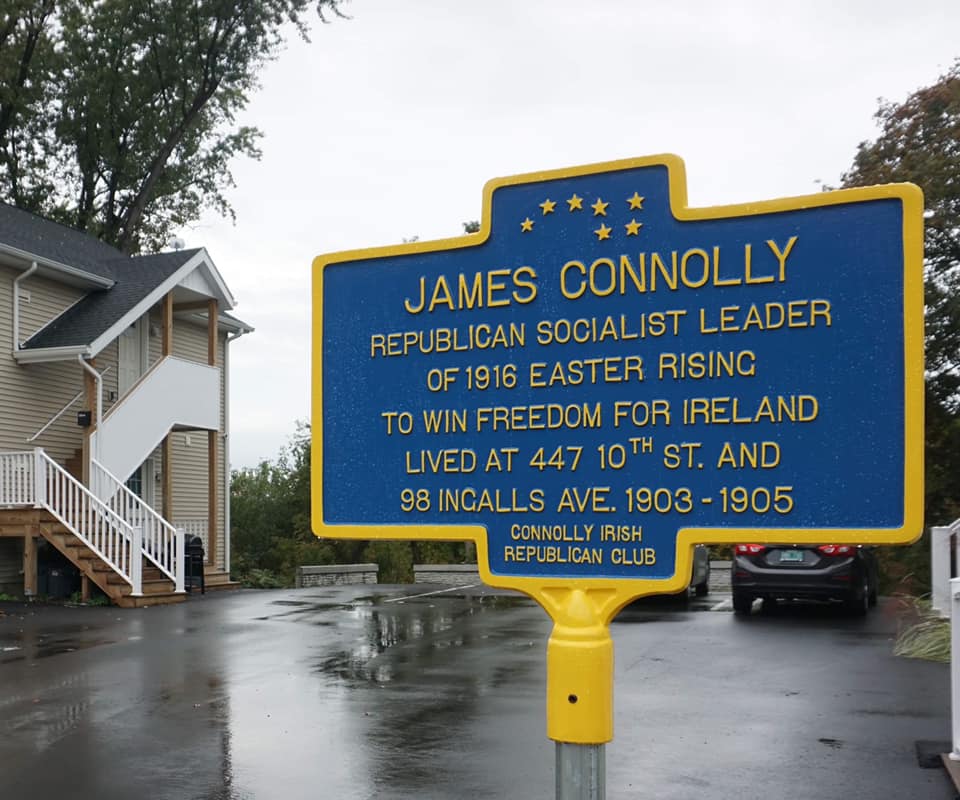
Report of a lecture it would have been a gift to attend on past peasant revolts given by James Connolly during a stormy Spring night in Troy, New York, where Connolly was then living and active with the Socialist Labor Party.
‘Revolts of the Poor-A Neglected Field of Human History’ by James Connolly from The People (S.L.P.). Vol. 14 No. 9. May 28, 1904.
A Troy Audience Learns Wherein Those Of the Past Differ From Those of The Present
Under the auspices of Section Troy, S.L.P., a lecture was delivered last Sunday evening, in Tibbet’s Hall, by James Connolly. Subject: “Revolts of the Poor-A Neglected Field of Human History.”
Comrade Boland was chosen chairman. After calling attention to the difference between the capitalist press and the official organ of the S.L.P., The People, Comrade Boland spoke briefly of the competition between the members of the working class, caused by the capitalist system, and defined the position of the Socialist Labor Party, as opposed to the Democratic and Republican parties. He urged the workers earnestly to interest themselves in the S.L.P., which party alone represents their class interest. He then presented the speaker of the evening.
Comrade Connolly said in part: I propose to deal briefly with a few of those great uprisings of the poor against their oppressors, which have marked the course of history; to show their significance, and to show also wherein they resembled the modern revolt of the working class, Socialism, and also wherein they differed from it. I propose to deal with certain social phenomena which the average historian dismisses, with as brief a notice as he can, but which every historian of repute chronicles in no matter how perfunctory a manner.
This means that it is recognized that there has been in all countries, in successive centuries, revolts against that established order of things in which the few benefit at the expense of the many. It means more. There is a common, old and oft repeated, saying, “Whatever is, is for the best.” Often used against the Socialists, it is pointless and useless even when accepted. Thus it says that the present order of rich and poor exists, therefore “it is for the best.” But then it is open to us to point out that the revolt against the existing order also exists; therefore, by the same line of reasoning, it also “is for the best.” When capitalism or social oppression is de- fended as the result of the growth of centuries, we can point out, if we know the things this lecture hopes to familiarize you with, that the revolt against social oppression was present at the birth of its opponent, and has kept even pace with him ever since.
Comrade Connolly said he preferred to discuss the revolts of the Middle Ages rather than those of earlier periods, as “the proofs were more easily obtained. To show that revolts of this kind occurred previous to the Middle Ages, he quoted an instance of a plebeian uprising in Ireland 2,000 years ago, and mentioned the fact that the ancient Gaelic historian, who wrote history in the interest of the ruling class, alluded to it as a rebellion of the common and rascally people of the kingdom; quite like the modern capitalist press account of a working class revolt in our own time.
Connolly cited the instance of the rising of the peasants of France in 1356, when the feudal class of that country was beaten by feudal England; as soon as the peasants revolted, the feudal class of both nations united and put down the peasant movement with every possible brutality.
The well planned and well organized revolt in England, headed by John Ball and Watt Tyler, was then analyzed to show that the people were not class-conscious, but depended upon a leader, who, when treacherously slain by King Richard, confidingly accepted their leader’s assassin as their ruler, and were by him reduced to a lower stage of servility than before.
The speaker then showed how in Bohemia, while Catholic and Protestant feudal factions were fighting for supremacy, the commons revolted, when the rival factions of feudalism united in exterminating the class who had dared to rise.
The Peasants War, which began in the latter portion of the fifteenth century, was ably handled, and, in closing his lecture, Connolly drew a sharp line between the objective point of these old revolutionists and the modern S.L.P., saying that the revolts of the past were in most instances inspired by a desire to go back to Bible times, if possible; practice living together, eating together, etc., etc., while the up-to-date S.L.P. means to advance far beyond the accumulated rubbish of the past, and create new conditions for a new race of men.
A stormy night was no doubt responsible for a small attendance, but the lecture was attentively listened to and thoroughly enjoyed by all present. Questions were answered satisfactorily, and one subscriber for the Weekly People was secured.
Press Committee Section Troy N.Y., S.L.P. May 16.
New York Labor News Company was the publishing house of the Socialist Labor Party and their paper The People. The People was the official paper of the Socialist Labor Party of America (SLP), established in New York City in 1891 as a weekly. The New York SLP, and The People, were dominated Daniel De Leon and his supporters, the dominant ideological leader of the SLP from the 1890s until the time of his death. The People became a daily in 1900. It’s first editor was the French socialist Lucien Sanial who was quickly replaced by De Leon who held the position until his death in 1914. Morris Hillquit and Henry Slobodin, future leaders of the Socialist Party of America were writers before their split from the SLP in 1899. For a while there were two SLPs and two Peoples, requiring a legal case to determine ownership. Eventual the anti-De Leonist produced what would become the New York Call and became the Social Democratic, later Socialist, Party. The De Leonist The People continued publishing until 2008.
PDF of full issue: https://www.marxists.org/history/usa/pubs/the-people-slp/040528-weeklypeople-v14n09.pdf
 Revolution's Newsstand