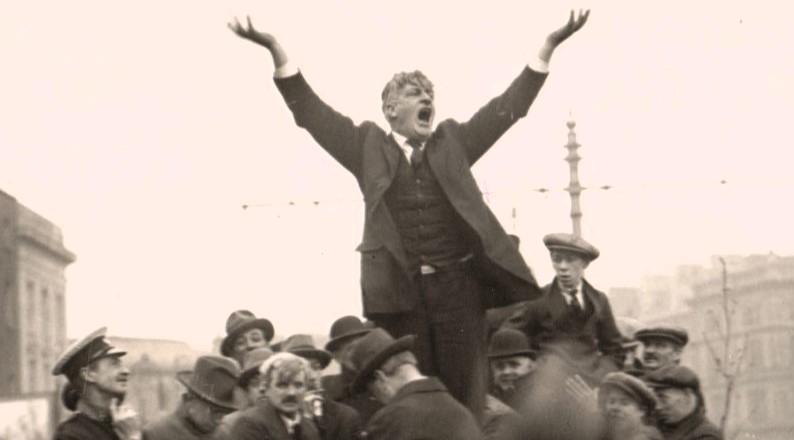
Alexander Tracthenberg welcomes the release of Jim Larkin and provides a useful biography of his work in the United States. After nearly four years serving in the Federal prison system for ‘criminal anarchism’ Jim Larkin was recently pardoned and shortly to return Ireland when this was written.
‘Jim Larkin the Militant’ by Alexander Trachtenberg from International Press Correspondence. Vol. 3 No. 26. March 15, 1923.
On January 17., Governor Smith of New York, set free by Executive pardon James Larkin, the militant leader of the Irish workers. The Governor’s act is considered an astute political move in view of the large Irish electorate in New York, among whom the freeing of Larkin was a popular issue. In addition, the demand for amnesty for political prisoners is constantly growing among the workers of the state and the newly elected Governor, already looking toward the next election, is anxious to appear as a progressive among the workers.
In explaining his pardon of Larkin, the Governor appeased his capitalist supporters, by condemning the views of the Irish labor leader which he thought were “abhorrent to American institutions”, and flirted with the liberals and the workers by declaring that Larkin’s conviction was “a political case, where a man has been punished for the statement of his beliefs, which were not in violation of any existing laws.”
On being freed, Larkin’s first thought was of the other imprisoned comrades. He said he was given to understand at the prison “that the Governor was releasing all prisoners under the Criminal Anarchy Law, or I would not have accepted a pardon. It is more important that these men and women be released than that I should be.”
Larkin was arrested together with other four Communists Gitlow, Winitzky, Ferguson and Ruthenberg during the raids in November, 1919 and was tried for publishing the Manifesto of the Left Wing of the Socialist Party. He acted as his own attorney during the trial, using the court as a tribune to reach the workers with the message of the class struggle and revolutionary Socialism. The picked jury of business men, still under the influence of war hysteria and scared by stories in capitalist newspapers about confiscation of property, should Larkin’s ideas triumph, found him guilty of being an Anarchist and opposed to organized government. Larkin’s insistence that he was a Marxist and that he stood for organized government proved of no avail. The court sentenced him to serve from 5 to 10 years.

The news of Larkin’s imprisonment in America, stirred the workers of Ireland in whose behalf he crossed the ocean. The Transport Workers Union, whose secretary he has been, declared a protest strike on July 21, 1920 demanding his immediate release. They wanted their leader freed and called upon American labor to fight for his liberation.
The largest portion of Larkin’s active life is bound up with the struggles of the Irish workers. After leading a strike of shipbuilders in Liverpool in 1905, Larkin was appointed organizer of the National Union of Dock laborers. He soon proved a valuable asset to the union, having gotten in 10 months 45,000 workers to join the union. In 1907 Larkin goes to Ireland to lead a strike of Dock workers in Belfast. From that time Larkin devotes himself to the building of a militant labor movement in Ireland. Dissatisfied with the reactionary policies of the British union to which the Irish dock workers belonged, Larkin forms a. independent union of Transport workers based on industrial lines. This union soon becomes the most militant labor organization in Ireland, setting an example to the other unions which were branches of the British Organizations. The reactionary labor leaders, fearing Larkin’s influence, cause his arrest on framed-up charges in order to discredit him with the workers. During that imprisonment, as on similar occasions in Ireland, the workers secure his release.
Upon the return of James Connolly, who foundered the Marxian Socialist movement in Ireland in 1897, Larkin joins him in carrying revolutionary Socialist propaganda to the broad Basses of Irish workers, in order to win them away from the influences of the reactionaries and nationalists. They organize many labor unions and separate others from the conservative British organizations. This period marks the real beginning of the Irish labor movement. Then came the historic struggle in 1913. The Dublin Transport Workers were locked out in an attempt to destroy their militant organization. For 8 months the struggle lasted with Larkin leading the gallant fight of the workers. The strike attracted the attention of the labor movement the world over. The English and Scottish workers poured in over 1,000,000 dollars to aid the brave Dublin strikers. The battle was drawn, but the workers won the right to belong to their industrial union.
After the strike the Transport workers union sent Larkin on a world tour, partly for a rest and partly to tell the story of their struggle to the workers of other lands, and also to collect funds among Irish emigrants for their organization and the Citizen’s Army which they organised to fight British Imperialism. The world war caught Larkin in the United States. He tried to go back to Ireland, but the British Secret Service, with which cooperated the American Department of Justice during the war, kept close watch on Larkin and all his attempts to leave the country were frustrated. In America, Larkin joins the Socialist Party and tours the country on behalf of the struggle in Ireland. Then comes the Easter uprising in 1916 and Connolly is shot by the British court martial for participating in the armed struggle. Larkin is anxious to return to his homeland to continue the work of Connolly, but he is now hounded and watched closer than ever.

After the Russian Revolution broke out, Larkin immediately became one of the enthusiastic adherents and supporters of the Bolshevik program. Similarly when the Left movement in the Socialist Party developed in 1919 Larkin joined it. His conviction and imprisonment came as a result of his affiliation with the Left Wing. The British and American governments, long before that, were seeking for an opportunity to wreak their vengeance upon him.
Larkin is now going back to Ireland which he has tried to reach for the last 8 years. During his absence great changes took place there. Ireland became a “free” State. The labor movement has fallen largely under the control of old time conservative leaders. The revolutionary vanguard of the Irish workers represented by the CP. of I., a direct descendant of the movement which he and Connolly organised, and the militants in the labor unions are waiting impatiently for him to lead them against the Irish and British bourgeoisie as he so valiantly led them before. The Transport Workers Union which he founded and which now has a membership of about 80,000, even under the present leadership, has kept open his place as Secretary of the union.
Nearly 300,000 workers are now organised in the Irish labor unions. They need Larkin to clean the Augean stables of their organizations and instill a new spirit in the labor movement. That he will answer the call of the militants in the labor movement, and lend his indomitable spirit and indefatigable energy to the task of lining up Irish labor with the revolutionary workers of the world, is expected by every one who knew him in Ireland and America. Although he has suffered much while a captive of the American plutocracy, and his large frame may not be physically as strong as before, his revolutionary ardor has not abated.
The militants of Ireland, working under the leadership of the Communist International and under the inspiration of the Russian Revolution for the same thing Larkin always believed in and fought for, will find him reporting for duty as soon as he sets foot on Irish soil.
The Communists of the world join with the revolutionists of Ireland in extending to Jim Larkin, freed from an American Bastille, a hearty welcome and bid him take his place among those who are working for the overthrow of capitalism everywhere and or the establishment of the International Workers Republic.
International Press Correspondence, widely known as”Inprecorr” was published by the Executive Committee of the Communist International (ECCI) regularly in German and English, occasionally in many other languages, beginning in 1921 and lasting in English until 1938. Inprecorr’s role was to supply translated articles to the English-speaking press of the International from the Comintern’s different sections, as well as news and statements from the ECCI. Many ‘Daily Worker’ and ‘Communist’ articles originated in Inprecorr, and it also published articles by American comrades for use in other countries. It was published at least weekly, and often thrice weekly.
PDF of full issue: https://www.marxists.org/history/international/comintern/inprecor/1923/v03n26-mar-15-1923-Inprecor-loc.pdf
 Revolution's Newsstand