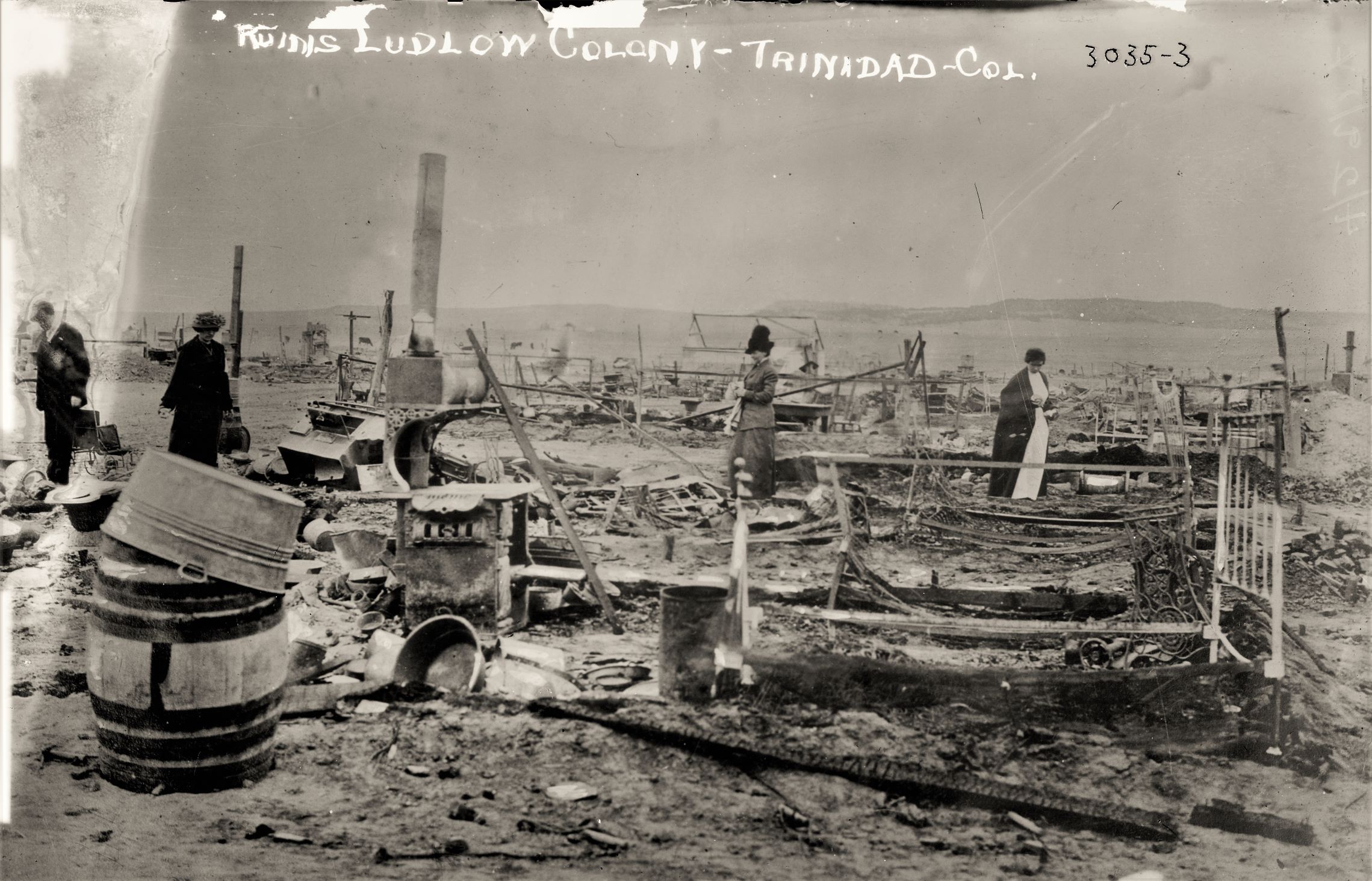
Frank Bohn absorbs the Ludlow Massacre and offers a scathing picture of petit-bourgeois Colorado in the process.
‘After Ludlow: Facts and Thoughts’ by Frank Bohn from The International Socialist Review. Vol. 15. No. 2. August, 1914.
IN the southern coal field there is a hardworking Socialist comrade — tried, true and well-informed. He is one of the many such who were misled into believing that a rebirth of anarchism really endangered the Socialist movement in 1912. So he voted for Article II, Section 6 of the present Socialist Party constitution. But during the big fight he put on his war paint. The miners were attacking the militia and mine guards and burning a tipple here and there. Yet our comrade, hitherto so fearful of the use of physical force, was not satisfied with the results. He demanded action which should be remembered for a while by the capitalists. Going to the officers of the U.M.W. of A. he asked for a force of thirty-five men : “What do you want to do with them?” “Here is a list of the devils we want to get,” he replied. “What’s the use of killing a few mine guards and letting the ‘men higher up* go untouched? Give me thirty-five men — good fighters — and I will hang this bunch to telephone poles. They are really responsible. That will have some effect. But I don’t want any quitters in my bunch.”
For some reason or other his plan was not endorsed. When I talked with him he was still angry about it. “They never do a job right,” he said to me.
Snodgrass is the mine superintendent at De Logua. He is a stocky, sharp-eyed, ruddy-faced, iron-limbed man of thirty-five — just the sort of man the big corporation chooses to drive three hundred slaves to dig the greatest possible amount of coal for the least pay. On the day we called, Max Eastman, John Reed and I, Snodgrass had orders from above to tell his side of the story “just as it happened.” So he entertained us for half an hour with tales of the wicked strikers and their evil works. “What caused the strike”? we asked.
“Those agitators from the East,” he replied. “They came from West Virginia. They have to stir up trouble somewhere to keep themselves in a job. The men were all right before they came on. They are a bad lot. John Mitchell wouldn’t have that kind in his day. They stir up the men so. Even the Socialists won’t stand for them. The Socialists are against violence.”
“Indeed, we thought that the Socialists were supporting the strikers,” one of us put in.
“Not at all! Not at all! Have you read that new Socialist book? It tells the truth about these labor agitators. It proves that they are all anarchists.”
“Who wrote it?”
“Why, that great Socialist leader. What’s his name? Oh! yes. Hunter, that’s it. Robert Hunter. He certainly goes after the anarchists and trouble breeders.”
“Is that book being much read about here?”
“You bet it is. Everybody is reading it. I wouldn’t have missed it for anything.”
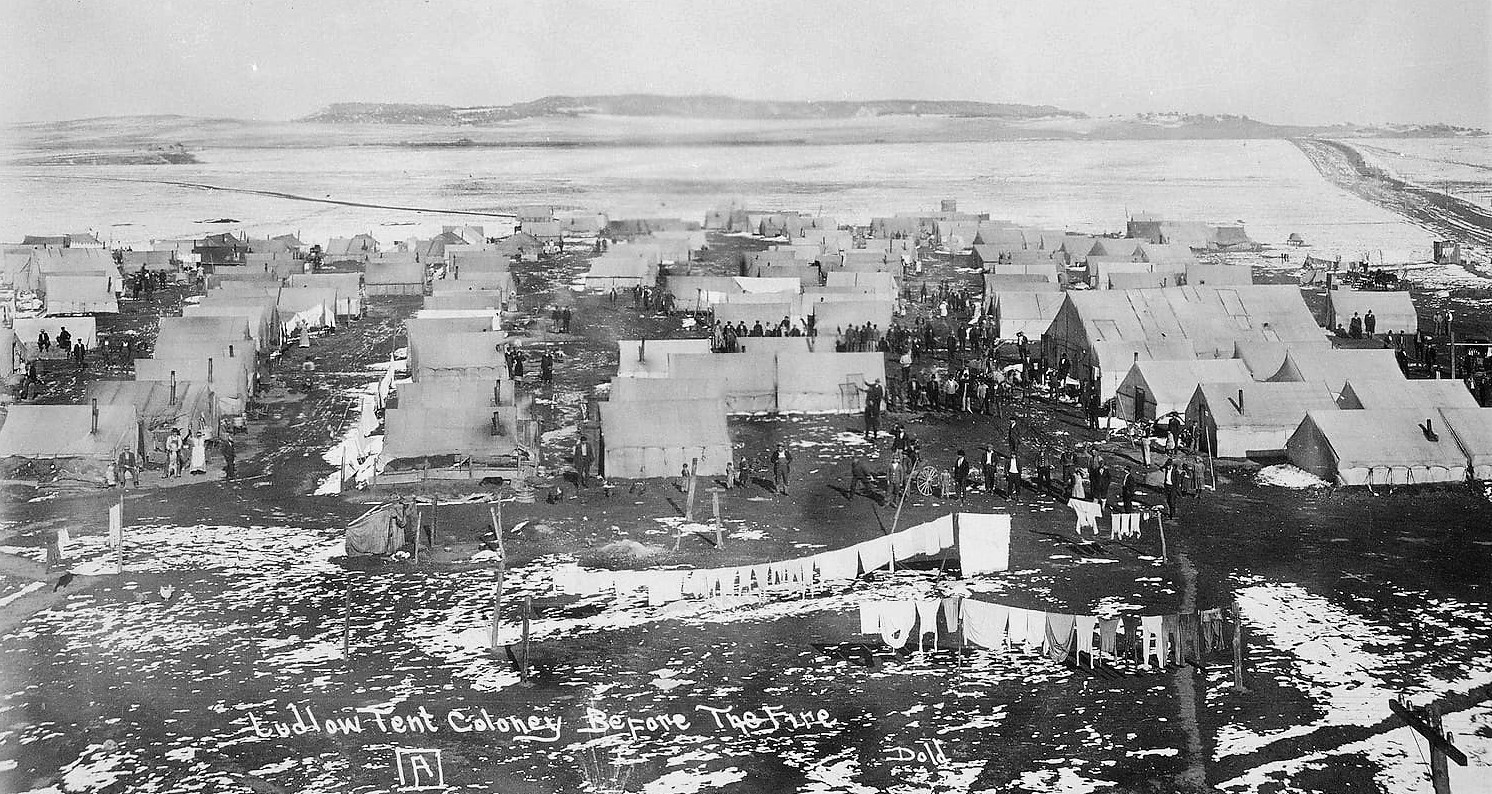
Wit and Humor in Pueblo.
Pueblo is John D’s own town. Its big mill is the steel plant of the Colorado Fuel & Iron Company. Pueblo has a population of 50,000 and looks, sounds and smells like Youngstown or New Castle. Of course all the respectables of Pueblo are bootlickers of the C.F. & I. Company. A threat to move the plant or lay off men brings the petty-larceny business men, the real estate sharks and the preachers to their knees in five minutes.
The small merchants and the high salaried clerks are organized into a Pueblo boosters’ league called the “Commerce Club.” Immediately after the Ludlow massacre this lovely bunch held a banquet. Whether or not this social occasion was to celebrate the “victory,” I do not know. At any rate, amid cheers and drunken laughter, the diners drank a toast to the dead women and children found in the black hole at Ludlow. This incident is by no means extraordinary in Colorado. It indicates the point at which capitalism here has arrived. Rotten to the core, the stench of this class rises on every hand in thick, nauseating fumes. It permeates the whole of life here. The greatest murderer of all, General John C. Chase, is in private life, a “respected citizen” of Denver. By profession he is a dentist and he teaches dentistry in the medical college of the State University. He is a faithful member of a Christian church.
The unspeakable Lieutenant Linderfelt, who murdered the unarmed Louis Tikas, was a student at Colorado College and his mother is a member of the Episcopal church at Colorado Springs.
The Rev. Mr. Pingree, pastor of one of the largest Methodist churches in Denver, is Chaplain of the Colorado State Militia. After he returned from Ludlow he made a public speech defending his charges. He declared that “the. only way to rule those ignorant foreigners is by force. They are ruled by force in Europe. We must apply force here. It is the only form of government they know enough to respect. Those who can’t behave themselves must be boxed up and sent back to where they came from.” Such is Colorado Christianity.
Two women members of the Presbyterian church at Trinidad, one of them the wife of the Presbyterian clergyman, told Max Eastman, Elsa Meland (representing the Independent) and me that “The only way to deal with those ignorant foreigners was to kill them off.” Of course it may be taken for granted that the parson’s wife is an active member of the Presbyterian Foreign Missionary Society. This “good woman” also told us that “The miners themselves killed the women and children because they didn’t want to feed them any longer. They were a drag on the Union.” Such is the modern capitalist version of “Go ye unto all nations and preach the Gospel.”
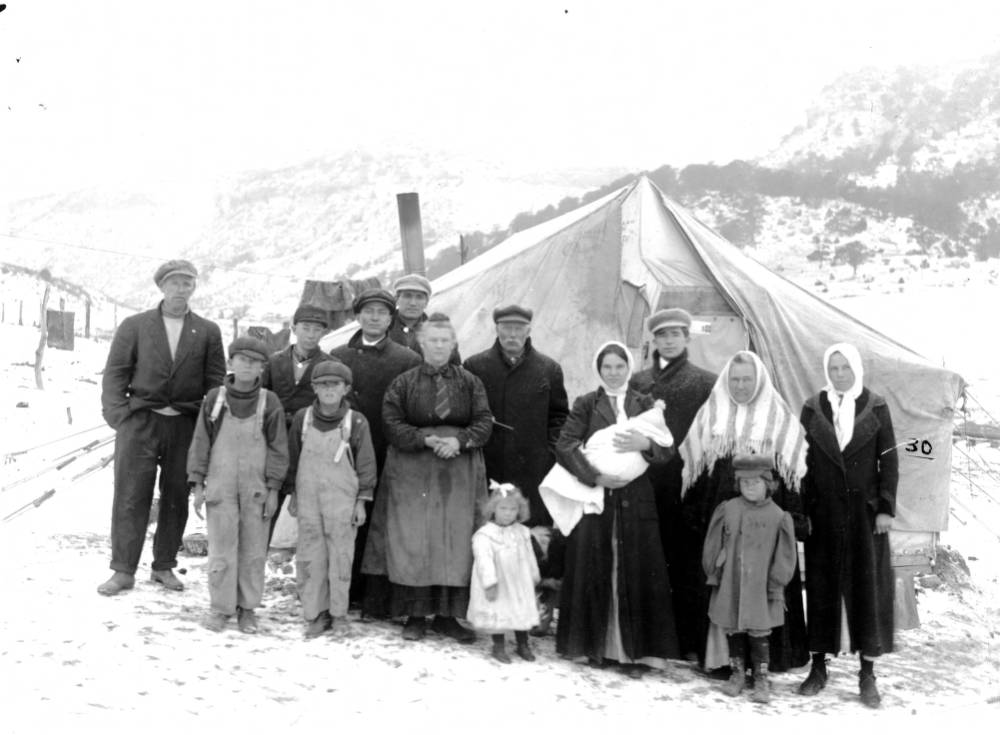
Where the Middle Class?
Ludlow could not have happened in Wisconsin or Ohio. Not that the capitalists in the middle west are any better, but the old fashioned middle class, the farmers and the city dwelling sons and daughters of farmers, is much stronger than in Colorado. In so far as there is a local “public sentiment” in Colorado it is but an outpouring of the soul of real estate. Everything in local life centers about this one matter. The real estate shark lives by grafting upon suckers from the East. An easterner cannot understand this type until he sees it in action. This is the most pernicious, lying, and utterly contemptible class of parasites in the whole world. Lately the unspeakable gang which infests and rules Colorado Springs sold thousands of acres of dry land to poor eastern farmers. In their advertising are shown pictures of the golden harvests which are garnered upon these dry farms. Last winter the snow covered the mud huts in which these poor “suckers” lived. Their stock died of exposure. People died of starvation. A few charitable persons from Colorado Springs made a trip through eastern El Paso county in the spring and found hundreds of these creatures so starved that they looked like pictures of Hindoo or Chinese famine victims. The visitors returned and called for contributions of food and clothing. The real estate sharks said it wasn’t so — it couldn’t be true, etc. The matter, of course, was hushed up — it never got into the papers.
A motion was introduced at a meeting of the Board of Aldermen in Colorado Springs providing for the muzzling of dogs through the summer months. The hardware merchants favored it. Owners of dogs opposed it, of course, and the proposition had little chance of being accepted. Then its sponsor thought of a telling: argument: “Mad dogs will bite tourists and when our guests for the summer are in the hospital they will spend no money seeing the sights. For Heaven’s sake protect the tourists. They will go away if dogs are unmuzzled.” The motion passed and became law.
This class, which controls the merchants, the smaller newspapers, the churches and the schools, are venomous against the strikers “because they injure the fair name of Colorado back East.” That is the secret of the whole aftermath of Ludlow. It was excused, covered up — forgotten. At Boulder, where I spoke at an open-air meeting of the Socialist Party, I told the story of the strike. I was mobbed by a well dressed crowd and eggs aplenty were thrown at me. In Boulder the citizens committee organized, a hundred strong, to go to Louisville and shoot strikers. This crowd of patriots included a professor of law in the State University, which is located at Boulder.
These murderers were prevented from glutting their appetites only because the railroad men absolutely refused to haul them to Louisville. Such is the middle class in Colorado — a greedy, gambling lot of money-grubbers, nine-tenths of them failures— who would stop at nothing in the game of getting rich quick.

The Progressive Party in Colorado.
This middle class divided into the Democratic and Progressive Parties constitute the “reform” element in Colorado public life.
The “Progressive” Party is today torn to shreds by factional fighting. It is composed, politically, of three distinct elements. On top is a crowd of reactionary Rockefeller politicians. The chief of these is State Chairman Clarence P. Dodge, owner and editor of the Colorado Springs Gazette. Mr. Dodge is one of the bunch who left the Republican state organization because they could not get it away from shrewder men. His attitude toward the striking miners is clearly indicated by what he did directly after Ludlow.
At that time the assistant editor of the Gazette was an intelligent and active young Progressive named McClintock. In the absence of his chief (gone to Oyster Bay to see Roosevelt), McClintock wrote an editorial expressing horror at the murders perpetrated by the State militia and suggesting a plan of action. This editorial was. calm, restrained and directly in line with the proclaimed policies of the “Progressive” Party. When State Chairman Dodge returned he “fired” McClintock. Since then the editorials of the Gazette have been given over almost wholly to boosting Colorado Springs real estate, suggestions for sponging on tourists, but the strike has not been mentioned except in a way insulting to the workers.
In Colorado Springs, also, the real Progressives organized a club for the study and discussion of their party platform. The members of this club wished to see the “social justice” planks of their platform actually put in operation. What happened?
The “Progressive” bosses appeared, dispersed the club, forbade it to meet again in the party headquarters and told the members that they “could reorganize after election day.”
This crowd of sore-headed Republican politicians would pay for the oil and matches for another Ludlow. They run the “Progressive” party and will continue to run it. They have the money. They have the newspapers. They are “It.”
The second element of the “Progressives” in Colorado is the deaf, dumb and blind following of Roosevelt. This crowd will go back to the Republican party if Teddy does. They don’t care much who runs the organization in Colorado or what it does. How many of these poor creatures are there in Colorado? We don’t know. We meet a few new ones every day.
The third element is composed of persons who will count in the long run. It is made up of sixty thousand dissatisfied wage-slaves, poor farmers and their wives. They are quite like the same number of the same class who call themselves Democrats. Talk with any of these and they will be found bitter at heart because of Ludlow and Rockefellerism generally in Colorado. Ignorant of economics and politics, this army will join any party which seems to promise immediate relief from the rule of the gunmen. Incoherent though they are, individually and collectively, they are moving. They are thinking. We must go to them with the crystallizing force of our Socialist propaganda and education. But of how many of these stumbling ones can we make Socialists during the present campaign? There is no other such fruitful field for our work as Colorado.

Solidarity in Action.
The one really encouraging feature about the whole strike — the one fact that will do credit to the whole working class — was the refusal of the railroad men to haul gunmen and militia into the strike districts. That was fine! It was promiseful! It makes us justly proud of our class! There IS hope for the workers!
Let all the miners act together as one, industrially and politically, and no fight can be really lost. It takes a long time to find this out, but the slaves are learning.
The International Socialist Review (ISR) was published monthly in Chicago from 1900 until 1918 by Charles H. Kerr and critically loyal to the Socialist Party of America. It is one of the essential publications in U.S. left history. During the editorship of A.M. Simons it was largely theoretical and moderate. In 1908, Charles H. Kerr took over as editor with strong influence from Mary E Marcy. The magazine became the foremost proponent of the SP’s left wing growing to tens of thousands of subscribers. It remained revolutionary in outlook and anti-militarist during World War One. It liberally used photographs and images, with news, theory, arts and organizing in its pages. It articles, reports and essays are an invaluable record of the U.S. class struggle and the development of Marxism in the decades before the Soviet experience. It was closed down in government repression in 1918.
PDF of full issue: https://www.marxists.org/history/usa/pubs/isr/v15n02-aug-1914-ISR-riaz-ocr.pdf
 Revolution's Newsstand