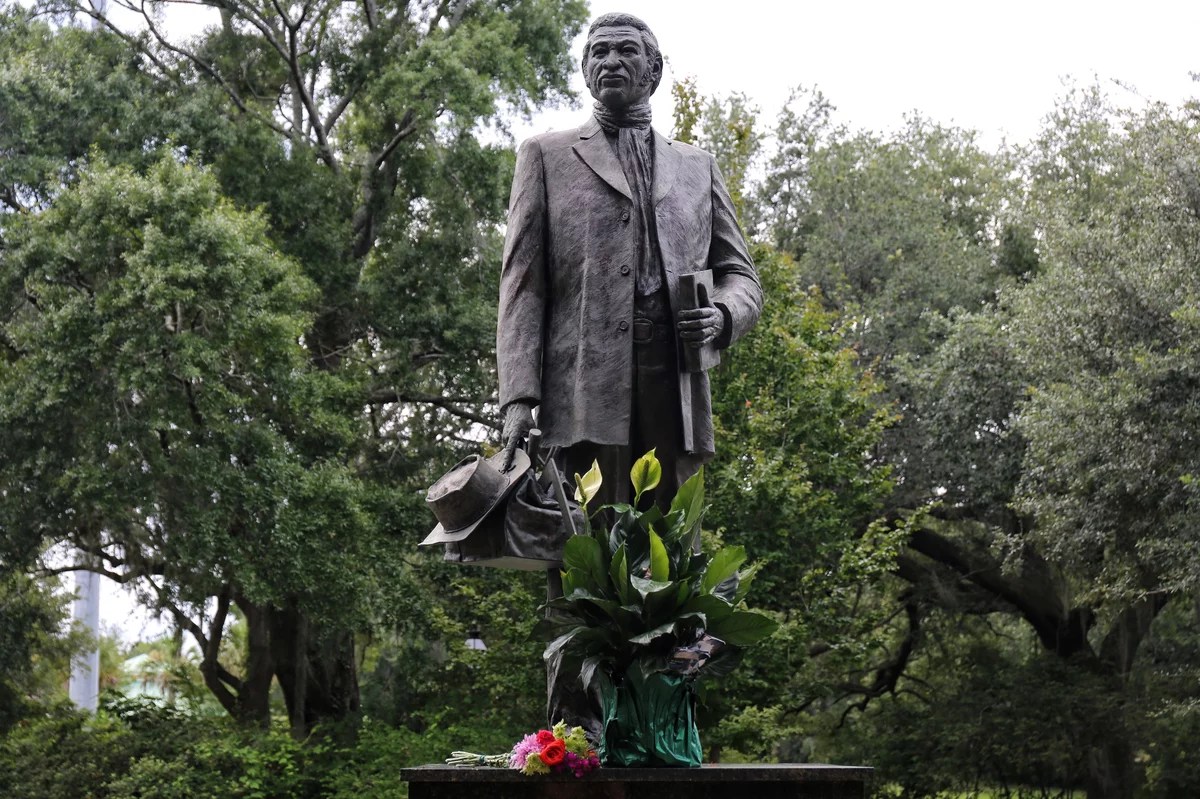
‘Denmark Vesey—A Lesson of Self Defense’ by Otto Hall from Labor Defender. Vol. 10. No. 2. February, 1934.
We will deal in this article, with one of the earliest instances in American history showing how a worker defended himself in a capitalist court. This episode is taken from a very conveniently forgotten chapter in the long history of the struggles waged by the Negro slaves against the system of chattel slavery which had held them in bondage on this continent for more than three centuries. It is of the utmost importance that American workers should become acquainted with the revolutionary struggles of the Negroes because they contain many valuable lessons that are useful to the entire working class today.
The Scottsboro frame-up, the wave of vicious lynch terror which is developing with increasing tempo almost daily, has placed the question of the unity of the working class as the first point on the order of the day. The ruling class has given the workers convincing proof that this wave of terror, while still directed in the main against the Negro toilers, is not limited to the Negroes alone but that the entire working class is included in the present phase of the “Roosevelt new deal.” But solidarity cannot be obtained by merely wishing it. Nor are the white workers going to be convinced of the need to struggle for Negro rights thru pity for the plight of the Negro. The workers must be shown that the Negroes have struggled against oppression ever since they were brought to America as slaves and have continued this struggle ever since. Also, tho many of the struggles of the Negroes were defeated and followed with vicious repression against them by the ruling class, the position of the working class as whole was bettered in the long run because these struggles were waged.
We have already indicated that there were many slave uprisings during the period of chattel slavery. The ingenuity with which they were organized and the heroism displayed by the leaders of these revolts are inspiring lessons for the workers today. Such a one was the attempted insurrection led by Denmark Vesey in Charleston, South Carolina in 1822. Denmark Vesey is said to have been born in Haiti and captured by slave traders while still a child and later sold to Captain Vesey, owner of a slave trading ship that had been engaged for some time in this business. He seems to have been a rather precocious youngster and soon became a favorite with the Captain who made him his cabin boy. He served in this capacity from the age of fourteen until he was about thirty three years old before an opportunity came to him to secure his freedom. Altho treated kindly by his master he was never satisfied with being a slave and was continually planning a way to secure his freedom. While in port in Charleston one day the opportunity came. He won a lottery prize and used part of the money to buy his freedom. He decided to live in Charleston, where he worked at his trade as carpenter. He spent his spare time studying and improving his education. It was said that he had great influence over the slaves and early showed qualities for leadership.
Denmark Vesey was constantly agitating among the slaves urging them to rise and throw off their yoke, telling them that it was much better to be dead than to be a slave. He inspired them with a feeling of self-respect by constantly advising them to assert their manhood. He was quick to rebuke any Negro he caught bowing to a white man on the street and when they attempted to excuse themselves by saying that they were slaves, he would answer, “you deserve to be.” When asked what they could do to better their condition, he advised them to get a spelling book and read the story of “Hercules and the Waggoner.” He repeatedly told them about the Haitian revolution, pointing out to them that if the Haitian Negroes could free themselves so could they. He conducted study groups among the Negroes in the city, and kept them in touch with the progress of the anti-slavery movement in the North.

It is evident that he planned the insurrection very carefully, for many years, before he attempted to take any slaves into his confidence. It is also worth noting that the more proletarian types among the slaves were the first recruits. These were the slaves that were hired out by their masters to firms or individuals in the city, as carpenters, masons, mechanics, blacksmiths, stevedores, ship caulkers, etc., of which there were considerable numbers in Charleston. These slaves worked away from the plantations and had considerable free time. He would not recruit drunkards or anyone given to loose talk. His chief lieutenant was Peter Poyas, a mechanic who was assigned to the Charleston area. Poyas is said to have recruited over six hundred slaves. Other lieutenants were Gullah Jack and Monday Gell, who made the arrangements for some of the weapons that were to be used. They secured the services of a local Negro blacksmith who forged bayonets and pike heads, and, in addition to this made over four hundred daggers. Lot Forrester and Frank Ferguson were the chief recruiting agents for the plantations outside of Charleston.
Peter Poyas emphatically advised his lieutenants not to recruit waiting men or house servants, because these elements who received gifts of old clothes etc. from their masters and who frequently acted as spies on the field hands would be more likely to betray them. Another factor that bound the house servants closer to the masters were that they were in many instances the sons and daughters of the masters by female slaves. He told his men that if they came across any slaves of this type to leave them to him, and that he would find out whether they were worth while bothering with. Precisely because a new recruit who had no authority to do any recruiting on his own, approached a house servant, the plot was finally given away. However Vesey and his assistants succeeded in organizing slaves in a territory surrounding Charleston for a radius of eight miles. Their plans were to annihilate the entire white ruling class population. Denmark warned his men not to spare man, woman or child, as the children were likely to grow up to be slave holders. Frequent meetings were held at which collections were taken in order to buy Charts drawn up by Vesey giving the location of all arsenals, powder magazines, and store houses for arms, were distributed to leaders of each group. The time set for the attack was to be the second Monday in June, 1822.
As we pointed out above, the plot was given away by a house servant who informed his master of the plans. The authorities were quickly notified, the whole country side aroused and a search made for the leaders. As soon as he realized that his plans were discovered, Denmark Vesey immediately destroyed all incriminating documents, sent warnings to all the slaves gathered at the different plantations, telling them to disband and not to make the attempt at this time. As evidence of the perfection of the plot, it should be stated that after a month of official investigation, only fifteen out of the thousands involved had been apprehended. Finally 131 slaves were arrested, 34 executed, and 43 shipped to the West Indies and Africa.
Altho several thousand Negroes were known to have been involved, one witness estimates the number to have been nine thousand, the authorities were unable to apprehend them due to the fortitude of their leaders who, despite terrible tortures, went to their death without making any confessions. Peter Poyas, Vesey’s chief lieutenant, told them, “Do not open your lips, but die silent as you see me do.” These leaders, according to the accounts of the authorities themselves, “were firm, resolute, Denmark and intelligent,” Vesey, according to the account in the Atlantic Monthly, acted as his own lawyer and defended himself very skillfully, giving the court no information that could be used against himself or anyone else involved. He cross examined the witness cleverly making them contradict themselves on more than one occasion. He actually succeeded in convincing the court that their witnesses knew very little about the details of the plot.
The account states: “Denmark Vesey, turning to the court, skillfully availed himself of the point which had so impressed the community, namely: The intrinsic improbability that a man in his position of freedom and prosperity should sacrifice everything to free other people. He said, if the court thought it so incredible, why not give him the benefit of this incredibility? The act being as they said, one of infatuation, why convict him of it on the base word of men, who by their own showing had not only shared the infatuation, but had been proven traitors to it?” According to the historian, he wound up by telling the court that, “Although they may kill him, in spite of this the insurrection would go on until every last slave on this Continent was freed. He went to the grave as one conscious of a noble sacrifice.” The ruling class was bound to respect such men as these. The account sums up thus: “The leaders of this attempt at insurrection died as bravely as they lived; and it was one of the marvels of this remarkable affair, that none of this class divulged any of its secrets to the court. The men who did the talking knew but little.” (Emphasis ours, O.H.)
Labor Defender was published monthly from 1926 until 1937 by the International Labor Defense (ILD), a Workers Party of America, and later Communist Party-led, non-partisan defense organization founded by James Cannon and William Haywood while in Moscow, 1925 to support prisoners of the class war, victims of racism and imperialism, and the struggle against fascism. It included, poetry, letters from prisoners, and was heavily illustrated with photos, images, and cartoons. Labor Defender was the central organ of the Scottsboro and Sacco and Vanzetti defense campaigns. Editors included T. J. O’ Flaherty, Max Shactman, Karl Reeve, J. Louis Engdahl, William L. Patterson, Sasha Small, and Sender Garlin.
PDF of full issue: https://www.marxists.org/history/usa/pubs/labordefender/1934/v10n02-feb-1934-lab-def.pdf
 Revolution's Newsstand