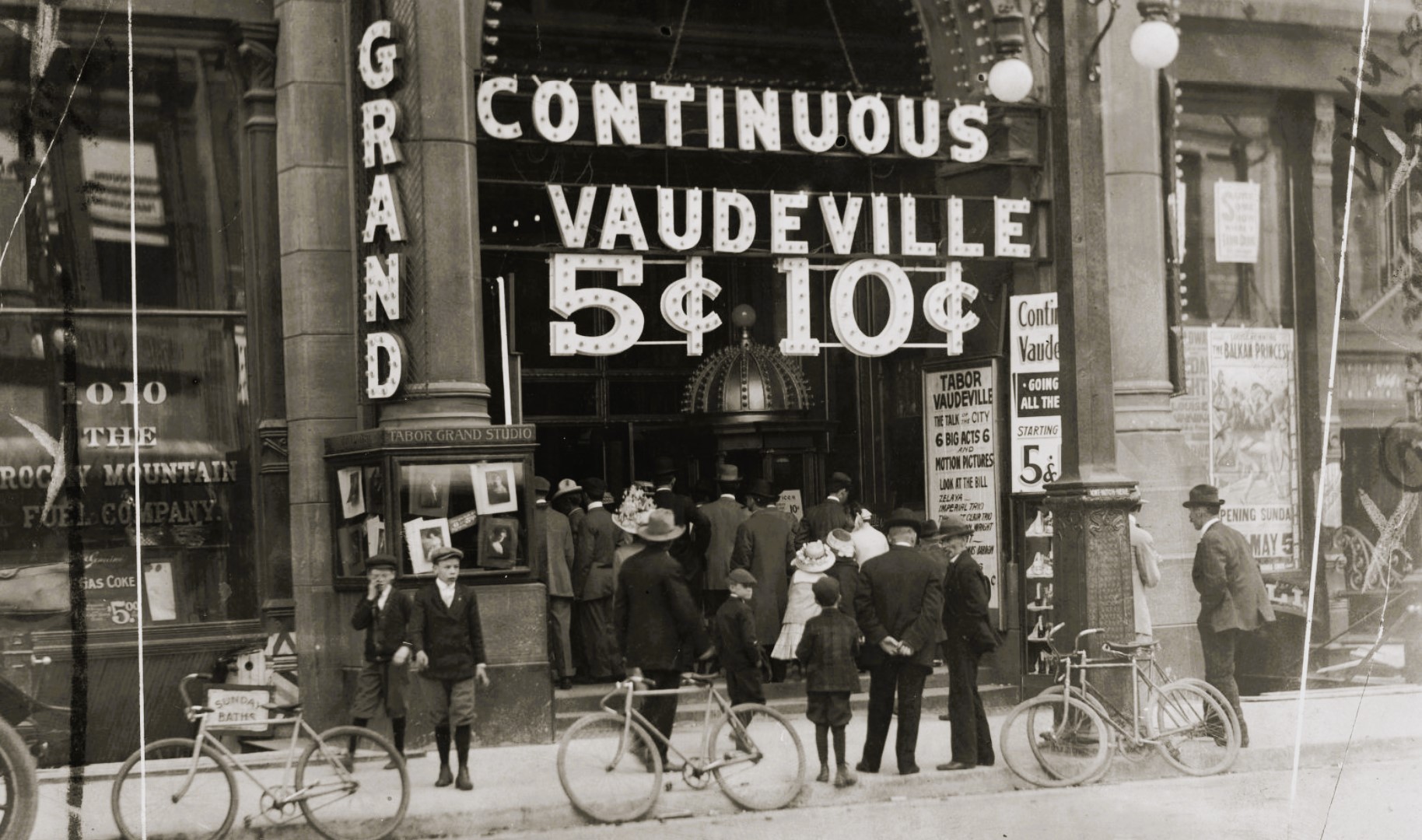
If you worked for a wage, the I.W.W. wanted to organize you.
‘Appeal to Theatrical Performers’ from Solidarity. Vol. 5 No. 216. February 28, 1914.
Organize One Big Union Of The Amusement Industry
To Performers Everywhere:
Fellow Workers-The time has arrived for us to act. We want better conditions. We want a better and more secure living. For years the theatrical industry has been without any organization that is worthy of the name. It is true that a few groups have been organized at different times, but they have been isolated and out of touch with the mass of the performers. The result is seen in the conditions that exist today.
We know that we are doing more work now and getting less in return than we ever did. From five to fifteen turns a day, and in addition we are preyed upon by the ten percenters, artists, representatives and other parasites, who rob us right and left. Cold dressing rooms, no conveniences, no respect is shown us and we have to stand for the insults and sneers of those who make a profit from our talents.
For us, lower wages, more work and physical breakdowns. For the managers, more dividends, more of the good things of life and increased arrogance when dealing with the performers.
What is the performer going to do to prevent the already unbearable conditions from getting worse?
What are we going to do to improve conditions?
Experience and common sense will tell us that there is only one reply to these questions.
The performers must organize. They must organize so that it will be possible for them to present a united front when dealing with the managers and agents.
Organizations in the past have failed because of a lack of solidarity among the various branches of the theatrical profession. The actors were separated from the stage hands, musicians, operators and others who contributed to make the successful operation of the amusement industry. The white rats failed because of the autocratic power bestowed upon the general officers.
In the past the actors have had to fight for better conditions independent of the operators, stage hands and musicians, who continued at work. It was the same with every other branch of the industry–they had to fight alone.
It is up to us to change this condition of affairs. It is time to quit looking to others on matters that concern us. Let us begin to look the situation squarely in the face. Let us work to build up an organization that will make it possible for us to present a united front to the employers in the amusement industry.
We can change conditions for the better any time we make up our mind to do so. This is written to help you make up your mind. We have nothing to lose and everything to gain in making the effort.
The Industrial Workers of the World offers a plan of organization that will give us a stronger power than the managers and agents. Organized in the one big union of the amusement workers the managers will be compelled to deal with us as an organization.
The theatres cannot run without performers and the managers do not make money unless the theatres run. We must organize so as to be able to say how long we shall work, how much we shall receive for our work and under what conditions we will work.
This is a big contract. But if the performers will each and every one do their share the work will be easy. Let every performer act as an organizer and induce those with whom they work to join the organization.
Get busy! Join the locals that are already organized in Chicago, Ill., and St. Louis, Mo. Help to complete the organization being formed in Detroit, Mich. Do what you can to interest your fellow workers at other points. Write to
Max L. Corrigan, 105 No. 14th Street, St. Louis, Mo. E.C. LeVyne, 510-184 W. Washington Street, Chicago, Ill. A.C. Christ, 1034 Field Avenue, Detroit, Mich.
Get busy, fellow workers, and see if we cannot convince Mr. Manager and Mr. Agent that the tail has been wagging the dog long enough.
PUBLICITY COMMITTEE, Local 526, Branch 2, Chicago, Ill.
The most widely read of I.W.W. newspapers, Solidarity was published by the Industrial Workers of the World from 1909 until 1917. First produced in New Castle, Pennsylvania, and born during the McKees Rocks strike, Solidarity later moved to Cleveland, Ohio until 1917 then spent its last months in Chicago. With a circulation of around 12,000 and a readership many times that, Solidarity was instrumental in defining the Wobbly world-view at the height of their influence in the working class. It was edited over its life by A.M. Stirton, H.A. Goff, Ben H. Williams, Ralph Chaplin who also provided much of the paper’s color, and others. Like nearly all the left press it fell victim to federal repression in 1917.
PDF of full issue: https://www.marxists.org/history/usa/pubs/solidarity-iww/1914/v05-w216-feb-28-1914-solidarity.pdf
 Revolution's Newsstand