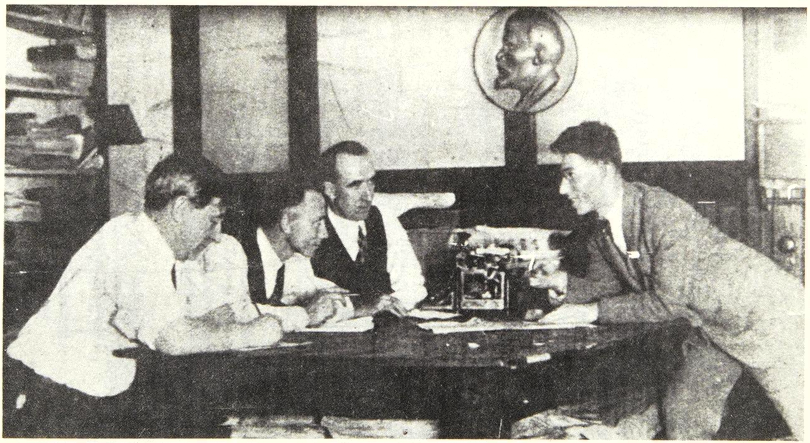
A summary of the early history of Canada’s Communist Party.
‘The Origin and Growth of the Canadian Communist Party’ by W. Moriarty from International Press Correspondence. Vol. 3 No. 36. May 9, 1923.
In the late Fall of 1921, Comrade Peel, then Editor of the Workers’ Guard, was besieged with requests that his paper be used to advocate a unified, revolutionary organization to replace those small, isolated groups then attempting to function as Communists. The idea took hold, and the comrades in charge of the paper saw in this expression, possibilities of establishing a Dominion-wide party which would break away from the old ideas prevailing among the scattered bands of reds. This move ended with the conference held in Toronto, December, 1921.
Early organizations.
Over fifty delegates attended, resulting in a Provisional Organization Committee being set up. This committee promptly sent Comrade MacDonald on a tour through the Pacific Coast. All along the line he met with sympathy for the tactics of the Communist International, and disagreement with the condition of the movement in Canada. This intensive period of organization work, financed only by individual donations and sparse returns from the organizations formed during this period, culminated in the National Convention of February, 1922, attended by comrades from Vancouver to Montreal.
First Convention.
This was an extremely interesting affair. The process of hammering out the differences of opinion, so as to get the right sense of direction, was productive of many difficulties. The attack of Delegate Russell of the O.B.U. upon the Labor Union policy adopted, only served to emphasize the correctness of the tactic. True, it caused confusion for some time, but we are more than ever satisfied that secessionism is, and ever will be, fatal to the working-class movement.
Early Organization.
The Convention adjourned, leaving in charge of the Party, an Executive without a great deal of experience, plus an alarmingly empty treasury. In the course of the past year, the Party experienced enough shocks to break almost any organization. Desperately attempting to satisfy the increasing demand for organizers, even at the expense of enjoying the thrills of bankruptcy time and time again, weakened by the desertion of some of the active spirits, the Party steadily extended its influence. The most gratifying feature of this extension was the response shown to the need for centralism. The process of planting the seed of centralized organization has been a difficult one, but efforts in this direction have provided the bedrock upon which any Party must be founded if it is to live and grow.
International Representation.
The action of the C.E.C. in sending delegates to Moscow was a bold one, again marking a definite step in the history of the Canadian movement. The reports presented to the Second Convention, the touring of Comrade Spector to carry the message of the Fourth Congress into all Party units possible, is all in keeping with the lessons obtained from the past methods of isolation and “purity”, which passed as “Marxism”.
Getting Down to Bedrock.
The feature of the Second Convention was the recognition of these facts. Lacking many of the dramatic touches which characterized the first gathering, yet the determination to fight and grow was more marked. Many new elements were in attendance, and past experiences with their many mistakes were checked up. Arising from it all was the evident necessity for expansion until we really become a mass Party. The chic hindrance in this direction is lack of money. The masses are there, ready and waiting, but we cannot get in touch because o impossible expenses connected with organization work. With more and more contact with the Trade Union movement becoming evident, the fact that we are now aligned with the Canada. Labor Party, all this is indicative of real progress.
“The Worker.”
A word in passing on the Party Press. The grow of The Worker has been an accomplishment of merit. The splendid assistance of the rank and file has made this possible. The success of the editorial policies is reflected in the ever-increasing circulation. Now being published weekly The Worker will soon be a factor in leading the thoughts of the workers towards Communism.
The Outlook.
Now for the outlook. The steadying up influence of the Second Convention is noticeable. More and more it is becoming apparent that the revolution is not “just round the corner”. The Party members have settled down in their stride and are fast familiarizing themselves with the theories and tactics of the Party which are those of the Communist International. The closer contact being established between the Comintern and the Party is also having a healthy influence. The endorsement of the policies of the W. P. of C. by the C.I., contained in its letter to our Second Convention, serves to increase the confidence necessary for results in the difficult task of building up a Communist movement in Canada.
But still we move, still we grow, and to-day but marks another opportunity for the proletariat to celebrate a further advance of class-consciousness. The Workers Party is taking a definite part in the world struggle for economic freedom under the leadership of the Communist International. As in the days of ’48, a spectre is haunting Europe-the World-today, and the rising tide of Communism is creeping, creeping, over the world’s surface.
International Press Correspondence, widely known as”Inprecor” was published by the Executive Committee of the Communist International (ECCI) regularly in German and English, occasionally in many other languages, beginning in 1921 and lasting in English until 1938. Inprecor’s role was to supply translated articles to the English-speaking press of the International from the Comintern’s different sections, as well as news and statements from the ECCI. Many ‘Daily Worker’ and ‘Communist’ articles originated in Inprecor, and it also published articles by American comrades for use in other countries. It was published at least weekly, and often thrice weekly. The ECCI also published the magazine ‘Communist International’ edited by Zinoviev and Karl Radek from 1919 until 1926 monthly in German, French, Russian, and English. Unlike, Inprecor, CI contained long-form articles by the leading figures of the International as well as proceedings, statements, and notices of the Comintern. No complete run of Communist International is available in English. Both were largely published outside of Soviet territory, with Communist International printed in London, to facilitate distribution and both were major contributors to the Communist press in the U.S. Communist International and Inprecor are an invaluable English-language source on the history of the Communist International and its sections.
PDF of full issue: https://www.marxists.org/history/international/comintern/inprecor/1923/v03n36[18]-may-09-Inprecor-loc.pdf
 Revolution's Newsstand