‘Italian I.W.W. News’ from Solidarity. Vol. 7 No. 360. December 2, 1916.
The macaroni workers’ strike, declared about a month ago in Greater New York by Locals Nos. 301 and 302 of the Industrial Workers of the World is over. The strike started in Long Island City, where 75 men employed by the Atlantic Macaroni Company went out as a protest against the attempt of the company to abolish the Union. In the space of one week 500 men in Brooklyn, N.Y.; and Jersey City had gone out in sympathy. All of these men asked an advance of twenty per cent in wages and the fifty-four hour week to be substituted for working week previously in effect, ranging from sixty to seventy-two hours a week.
The strike lasted three weeks, the resistance being most efficient and enthusiastic in Long Island City, where the organization had existed for over a year.
As a demonstration of economic power the strike was a complete success. All the stores in New York were beginning to run out of macaroni towards the end of the strike. The bosses merely held out in the hopes that the strike would collapse because of the inexperience of the workers in labor struggles. The workers would have won a complete victory had they been used to the discipline and habits of old time union men. As it stands the Macaroni Workers in New York were completely victorious. In Brooklyn advances in wages ranging from ten to twenty per cent were secured with a working week of fifty-seven hours.
When account is taken of the fact that similar strikes pulled this year in Philadelphia and Chicago without organization were complete and dismal failures it becomes evident that organized action and I.W.W. tactics are very useful in labor struggles.
Our attention from now on will be given to keeping the union on its feet so that when the next strike is called we shall have a group of workers. thoroughly trained in the spirit of solidarity and a more extended organisation of an industrial character which will make possible a general tie-up of the entire industry.
THE I.L.A. IN BROOKLYN
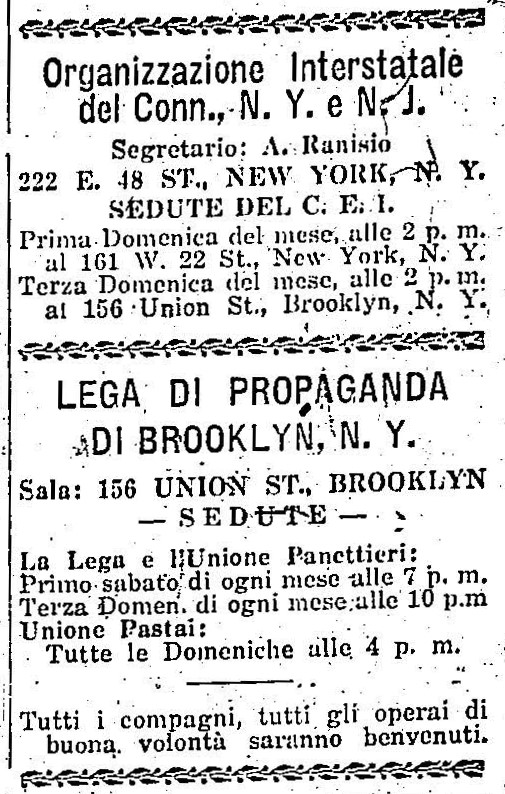
Sunday, November 12th, a meeting of the members of the Italian locals of the International Longshoremen’s Association in South Brooklyn was held as a protest against the discrimination of the English speaking members of the organization toward the Italians. Protests had already been sent to Samuel Gompers by these locals but he had refused to take them into consideration. This fact is illustrative of the system of political graft and favoritism existing in the A.F. of L, where many times the great majority of members, who, because foreigners or for other reasons cannot make their voices heard, are made the victims of repugnant methods of favoritism and injustice. The Italian members, of the I.L.A. asked the Brooklyn Propaganda League of the I.W.W. to furnish speakers for this meeting. We sent Fellow Worker N. Cuneo, who spoke, illustrating the inherent faults of the A.F. of L form of organization. The workers were very well satisfied although a good number of paid A.F. of L. delegates who were present could not conceal their discomfiture and disgust. These gentlemen were ready to start trouble but our men showed them that they were just as disposed to give as take after an un-Christian manner, so trouble was avoided. The workers decided to forward another protest to Gompers and in case he should refuse to remedy the present evils action of a more drastic nature will be taken.

The conditions on the docks in South Brooklyn, where over fifteen thousand men are organized in the I.L.A., are decent were it not for the usual systems of petty graft and abuse at the expense of the workers. Pay is 40 cents an hour for day work; 60 cents an hour for night work and 80 cents an hour for Sunday work. The admission fee to the I.L A. is $2.65. Any foot-loose Wobblies who are out of work might find it profitable to work on the docks for a living and for the I.W.W.
THE CARLO TRESCA AGITATION IN ITALY AND SWITZERLAND
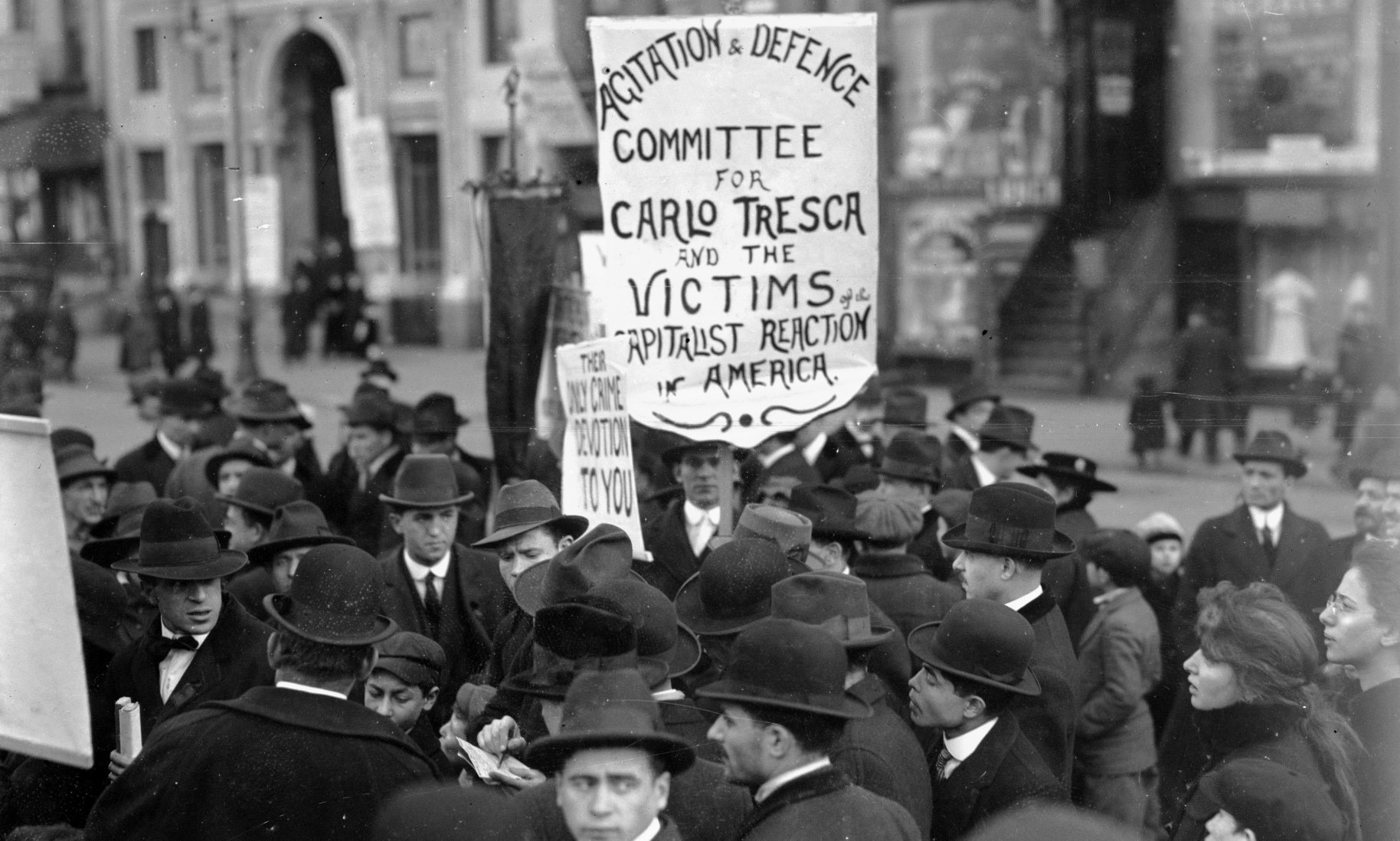
News has been received in this country of the agitation for the liberation of Carlo Tresca and other Minnesota prisoners in Italy and Switzerland. It seems that this agitation will be as enthusiastic and impressive as the Ettor-Giovannitti agitation movement of four years ago. All the labor and revolutionary organizations of the peninsula have voted their support; meetings are being held all over the country and pressure has been brought to bear upon the minister of the government to secure diplomatic action. Bissolati, a reformist socialist cabinet minister, has tried to escape the responsibilities which the agitation of the workers is placing upon his shoulders in the situation by basely insinuating that Carlo Tresca is an emissary of the German Government and that therefore His Majesty’s Government cannot interfere in the case. However, the vigor with which the agitation will be carried on may, force his excellency, Bissolati, to change his mind in the matter and take definite action.

In Switzerland the Federation of Socialist Clubs has launched an appeal in its newspaper to all its local groups to give themselves to the agitation with all the vigor that is in them. The Federation of Building Trades has issued a similar appeal to its local unions. The members of this anion are in great majority Italian immigrants who realize the position of the emigrant worker in America as well as that of the labor organizer or agitator who is forced to face the double menace of race prejudice and capitalist oppression. It was these workers who in 1912 proclaimed a twenty-four hour general strike in protest and assaulted the American consulate. There is reason to believe that the agitation, both in Italy and in Switzerland, will assume such an intense. and general character as to have an effect in this country.
G.C.
The most widely read of I.W.W. newspapers, Solidarity was published by the Industrial Workers of the World from 1909 until 1917. First produced in New Castle, Pennsylvania, and born during the McKees Rocks strike, Solidarity later moved to Cleveland, Ohio until 1917 then spent its last months in Chicago. With a circulation of around 12,000 and a readership many times that, Solidarity was instrumental in defining the Wobbly world-view at the height of their influence in the working class. It was edited over its life by A.M. Stirton, H.A. Goff, Ben H. Williams, Ralph Chaplin who also provided much of the paper’s color, and others. Like nearly all the left press it fell victim to federal repression in 1917.
PDF of full issue: https://www.marxists.org/history/usa/pubs/solidarity-iww/1916/v7-w360-dec-02-1916-solidarity.pdf
 Revolution's Newsstand