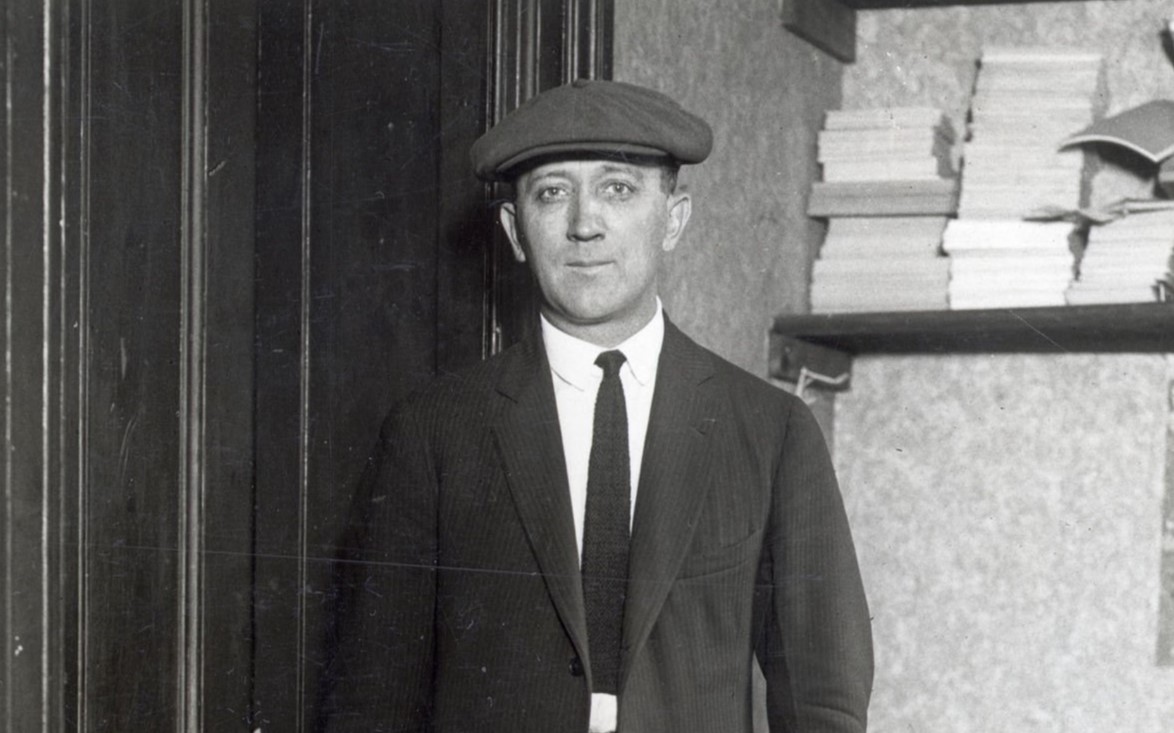
‘Company Unionism and Trade Unionism’ William Z. Foster from Workers Monthly. Vol. 5 No. 3. January, 1926.
THE trade union bureaucracy of this country are now and have long been most loyal servitors of the capitalist class. This fact is patent. They have always been ready to perform whatever services the employers may demand of them. They look upon their leadership in the unions simply as an easy, good-paying profession, in which success depends very largely upon their maintaining the good will of the bosses with whom, moreover, because of their petty bourgeois ideals and standards of living, they have much class sympathy and solidarity.
The Labor Lieutenants of the Bourgeoisie.
Following their masters’ policy, the trade union leaders are the most bitter opponents of Soviet Russia, often exceeding the capitalists themselves in their rabid hatred of the first workers’ government. The imperialist policy of the capitalist class of the United States is likewise the foreign policy of the trade union bureaucracy, lock, stock, and barrel, in China, in South America, in Europe, throughout the world. Wherever its malign influence extends at home or abroad, the A. F. of L. has been unsparing of its resources in tricking the workers into the imperialistic traps of the American capitalist class. It leaders have also systematically demoralized every effort of the workers to form a mass political party of their own and have kept the labor unions under the sway of the old parties; they have betrayed and sold out strikes whenever they became dangerous to the employers; they have defeated all efforts to consolidate the unions on an industrial basis and to organize the unorganized masses; they have relentlessly combatted every manifestation of class consciousness and revolutionary action in the unions. Insofar as it is in the power of the bureaucracy to hinder the advance of the labor movement they have done it willingly and militantly in their lickspittle service to the employers. It is with justification that such agents of the capitalist class as Ralph Easely can sing the praises of the A. F. of L. bureaucracy.
The Bosses’ Opposition to Unionism.
But for the bureaucrats there is a large fly in the ointment. Their services are not altogether appreciated by the employers. It is true that some of them are occasionally appointed to fat political positions and that many of them become rich through their capitalist connections. Nevertheless their lot is not entirely a happy one. This is because the employers as a class refuse to accept the trade union movement as at present constituted, even with the guarantees provided by the ultra-reactionary bureaucracy. The employers have their “open shop” program. Their plan has long been to break the unions altogether and to assume full charge of handling all the affairs of their workers. They consider the unions a menace, in spite of their conservative leadership, and their traditional policy has been to destroy them in every industry.
Such a policy on the part of the employers is of course incompatible with the interests of the bureaucrats. By killing the unions the employers destroy the base of the bureaucrats and make their very existence as a group impossible. The “open shop” policy is the bane of trade union leaders. It has sent many a dozen of them back to work in the dreaded shops. To overcome it and to get the employers to “recognize” the unions is a leading objective in the bureaucrats’ program. But very little success has attended these efforts since the war. Leaders like Lewis of the miners have tried in vain. Lewis has betrayed the miners flagrantly in every district in the country in his eagerness to do the bidding of the operators. Nevertheless the war of extinction against the union continues with unabated or even increased fury. The employers refuse to grant the Lewis bureaucrats the privilege of keeping up a fat dues-paying organization among their workers, despite the loyal efforts of these bureaucrats to prevent this organization from becoming of real service to the workers. They see a menace in the union. And so it is (or was until recently) in every industry. The employers plan to knife the unions to death, conservative though they are.
But of late new tendencies are manifesting themselves which indicate that the employees and the trade union bureaucrats are beginning to agree on a policy to allow the existence of some semblance of labor unionism in the industries and thus permit also the continuance of the labor bureaucracy. This drift towards an agreement comes from two directions. On the employers’ side it comes from the development of company unionism, and on the bureaucrats’ side from the degeneration of the trade unions through the B. & O. plan and other schemes of class collaboration. The tendency of these two converging lines of development is to culminate in some form of unionism between those of present-day company unionism and trade unionism. Let us trace these developments briefly.
As stated above, the traditional policy of the employing class in this country has been to ruthlessly eradicate trade unionism from all the industries. The employers aimed to be absolute masters in their own plants and to brook no interference whatever from their workers. In no country of high industrial development has the “open shop” campaign compared even remotely in intensity with that carried on in the United States. Here it went to the extent of eliminating very form of economic organization from amongst the workers and of reducing the latter to the arbitrary and ruthless sway of the employers, who carried on their exploitation under the rawest and most brutal forms.
The Efficiency Experts See the Need for “Organization.”
About 15 years ago the industrial efficiency engineers began to learn the futility of these methods and to appreciate the necessity of devising means to still the workers’ discontent. The enormous campaign which developed for stockselling, profit-sharing, “welfare work’, etc., designed to obscure the workings of capitalism, to smooth of some of its rough edges, and to check the growth of class consciousness, is the result of this change in policy. But had to go farther than such devices. They had to give their workers as such some form of economic organization in addition to that in the shops. Speaking recently before the Taylor Society, R. G. Valentine, an efficiency engineer, stated that Taylor overlooked two prime factors making for increased efficiency in production: 1) the workers’ consent, 2) their self-organization and discipline. It is with some realization of these necessities that the employers have built their great network of company unions in nearly all industries. The company union movement is a departure from the early policy of the employers, and its growth and expansion is one of the most striking and important developments in the United States in the past decade.
Company Unionism and the Bureaucrats.
Meanwhile the trade union bureaucracy looked with suspicion and hostility upon this whole development. Gompers himself denounced the rapidly spreading employers’ schemes of “welfare work”, group insurance, company unions, profitsharing, etc., as detrimental to the trade union movement, but characteristically the A. F. of L. did nothing to counteract the movement. The corrupt bureaucrats followed their own crude policy of class collaboration, as stated earlier. They sold out strikes, they clung to the policy of arbitration, and they militantly defended the capitalist system against the attacks of the left wing. But they were not yet prepared to go along with the new schemes of class collaboration being worked out by the efficiency engineers. Although gradually yielding to more advanced forms of class collaboration, they still maintained some shadow of independence from the employers.
The Bureaucrats Capitulate to Company Unionism.
But now they are rapidly and completely surrendering. They are adopting policies which, if unchecked by the revolt of the organized masses will degenerate the trade unions into an approximation of present day company unions. This development was greatly stimulated by the sweeping defeat suffered by the unions in nearly every industry in the great post-war struggle of 1919-23. After this disaster, the bureaucrats refused to adopt the measures necessary to strengthen the unions by consolidating them into industrial organizations and embarking upon a real campaign against the employers and to organize the unorganized. On the contrary, they raised still higher their yellow flag of class surrender. The class collaboration movement grew apace. Labor banking and all its co-related schemes of trade union capitalism flourished; the B. & O. plan spread its slimy growth upon the railroads. The El Paso convention of the A. F. of L. last year gave its blessing to labor banking, and to the B. & O. plan as in effect on the Baltimore and Ohio railroad. The Atlantic City convention this year went a long step farther, in its widely advertised new wage policy, by endorsing the B. & O. plan principle as the program of the whole labor movement. The trend in the direction of company unionism is unmistakable.
The Converging Development of Company and Trade Unionism.
Already the clearest heads among the employers and the trade union bureaucrats realize the converging development of company unionism and trade unionism, and are seeking the policies and organization forms which will unite the two. It is of real significance that recently the heads of the Pennsylvania, Lackawanna, Southern Pacific, and other railroads having company unions made application to the Interstate Commerce Commission for the drafting of a model scheme along the lines of the B. & O. plan for general application on the railroads. Such a scheme would be welcomed by the trade union leaders, not only on the railroads, but also in other industries. Their demands, as against the prevailing conception of company unionism, would be modest. Their principal demand would be for a type of organization enjoying at least a formal independence, which would be dues paying in character and which would furnish them control over sufficient funds to pay their fat salaries and to finance their many new schemes of trade union capitalism. It is significant that Wm. H. Johnston puts forth as his principal argument in favor of the B. & O. plan that it will give the unions an opportunity to exist, which means in plain English, that the bureaucrats will be able to prosper and flourish. Johnston and his cronies controlling the A. F. of L. see no farther than that.
The Boot and Shoe Workers’ Union—An Example of the Degenerated Trade Union.
How far the trade union leaders are willing to degenerate the trade unions in order to secure the employers’ permission to barely keep them in existence is evidenced by the Boot and Shoe Workers’ Union, This organization is only a few shades better than the ordinary company union. The shoe companies collect the dues, the locals have little power and seldom meet, the rank and file have no control, the union heads consider themselves and act practically as officials of the companies, and the union is bound up with iron-clad no-strike agreements. What the workers think of it as a union was shown by their long and desperate strike two years ago to be freed from its yoke. The trade union leaders will be willing to establish such unions as the Boot and Shoe Workers, or even worse, in the various industries if thereby they can win the permission of the employers to exist. In return for this concession they will agree to the most stringent prohibition against strikes and to co-operate with the employers to the fullest extent to increase production and to choke out all manifestations of class consciousness among the workers. The defense of the workers’ interests will, of course, be out of their program. In the near future we may expect the trade union leaders, if they can have their way, to intensify their policies more in the direction of company unionism. That is the meaning of the so called new wage policy of the A. F. of L.
Tasks of the Left Wing.
In this situation, where the workers are menaced, on the one hand, by the campaign of the employers to establish company unions and thus still further enslave their workers, and, on the other hand, by efforts of the bureaucracy to degenerate and devitalize the unions in order to win the favor of the employers, great tasks of leadership fall upon the left wing, which alone correctly analyses the situation and proposes the policies necessary for its solution. Against the company unions, the left wing must carry on a persistent and relentless warfare. This must aim at their complete destruction. In fighting the company unions, however, we cannot simply stand aside and fire criticism into them from a distance. Often we will find it necessary and possible, in spite of the employers’ opposition, to penetrate these organizations where they have a mass character. In such cases, our fight must be so conducted, by opposing the bosses’ candidates in the company union elections, by raising real demands in the company union committees, etc., as to completely expose the company unions as instruments of the employers and to utilize the accompanying agitation among the workers as the basis for real struggles against the employers. Experience with company unions teaches us that in many cases the workers, under left wing leadership, have actually been able to seize control of the company union committees and use them for the formation of real trade unions.
The Struggle Against Company Unionism.
The Workers Party and the Trade Union Educational League have devoted entirely too little attention to company unionism. This is a serious mistake which must be rectified. We must become the leaders in the struggle against this great and menacing development. Even the reactionary trade union leaders are becoming aroused to the necessity of a definite policy regarding the company unions. In the Workers Monthly for September, 1925, I wrote an article on Company Unionism in which I advocated the capture and transformation of the company unions into trade unions wherever favorable circumstances permitted. In the very next months’ issue of the American Federationist (October), “taking a leaf out of our book”, as The Nation put it, the leading editorial advocated the capture of company unions in the following words:
“Wage earners will do themselves and industries a great service when they capture company unions and convert them into real trade unions. The machinery of the company union offers a strategic advantage for such tactics. Use that machinery as a basis of a real organization.”
Our Trade Union Tasks.
As against the degeneration of the trade unions practically into company unions by the bureaucracy, the left wing must intensify its activities along the lines of our established policies. The Workers Party must carry on an extensive ideological campaign to awaken the membership to the great necessity for trade union work and to bring all the non-union members into the trade unions. Our party must thoroughly organize its fractions in the unions and the T.U.E.L. It must everywhere build the League into a broad, definitely organized left wing movement. We must stimulate the development of the so-called progressive bloc in the unions. We must make united fronts with the progressives on the basis of minimum programs of immediate needs of the unions. We must take advantage of the union elections to defeat the bureaucracy and to put progressives and revolutionists in key positions. We must redouble our agitation for the Labor Party, for the organization of the unorganized, and for amalgamation. We must relentlessly combat labor banking and the rest of the class collaboration movement. We must be the heart and the head of every struggle of the workers against their employers and the state. We must emphasize the struggle for world trade union unity, especially because at this time the A. F. of L. is maneuvering to enter the Amsterdam International to block the program of the Russian and British Unions.
Intensify Our Work In the Trade Unions!
There must be no talk of quitting or neglecting the trade unions. Despite their weakness and reactionary character these offer and will continue to offer a most valuable field in which our party can work. We must work more militantly and systematically within them than ever before, without, however, failing to support the formation of new unions in industries where no trade unions exist. The labor movement is confronted with the twin dangers of company unions and devitalized trade unions—the bureaucracy would make Siamese twins of these dangers by building a living bridge between them. But the left wing will not and cannot be discouraged by the difficult situation. The masses in the unions and outside are suffering from bitter exploitation. They are discontented. Our experiences among the masses demonstrates that clearly. Labor banking, the B. & O. plan, and the general rapprochement of the bureaucracy to company unionism will not allay this discontent, but increase it. Our program of revolutionary class struggle is the correct one. If we know how to apply it effectively the masses must and will continue to rally in greater numbers around our red banner.
The Workers Monthly began publishing in 1924 as a merger of the ‘Liberator’, the Trade Union Educational League magazine ‘Labor Herald’, and Friends of Soviet Russia’s monthly ‘Soviet Russia Pictorial’ as an explicitly Party publication. In 1927 Workers Monthly ceased and the Communist Party began publishing The Communist as its theoretical magazine. Editors included Earl Browder and Max Bedacht as the magazine continued the Liberator’s use of graphics and art.
PDF of full issue: https://www.marxists.org/history/usa/culture/pubs/wm/1926/v5n03-jan-1926-1B-WM.pdf
 Revolution's Newsstand