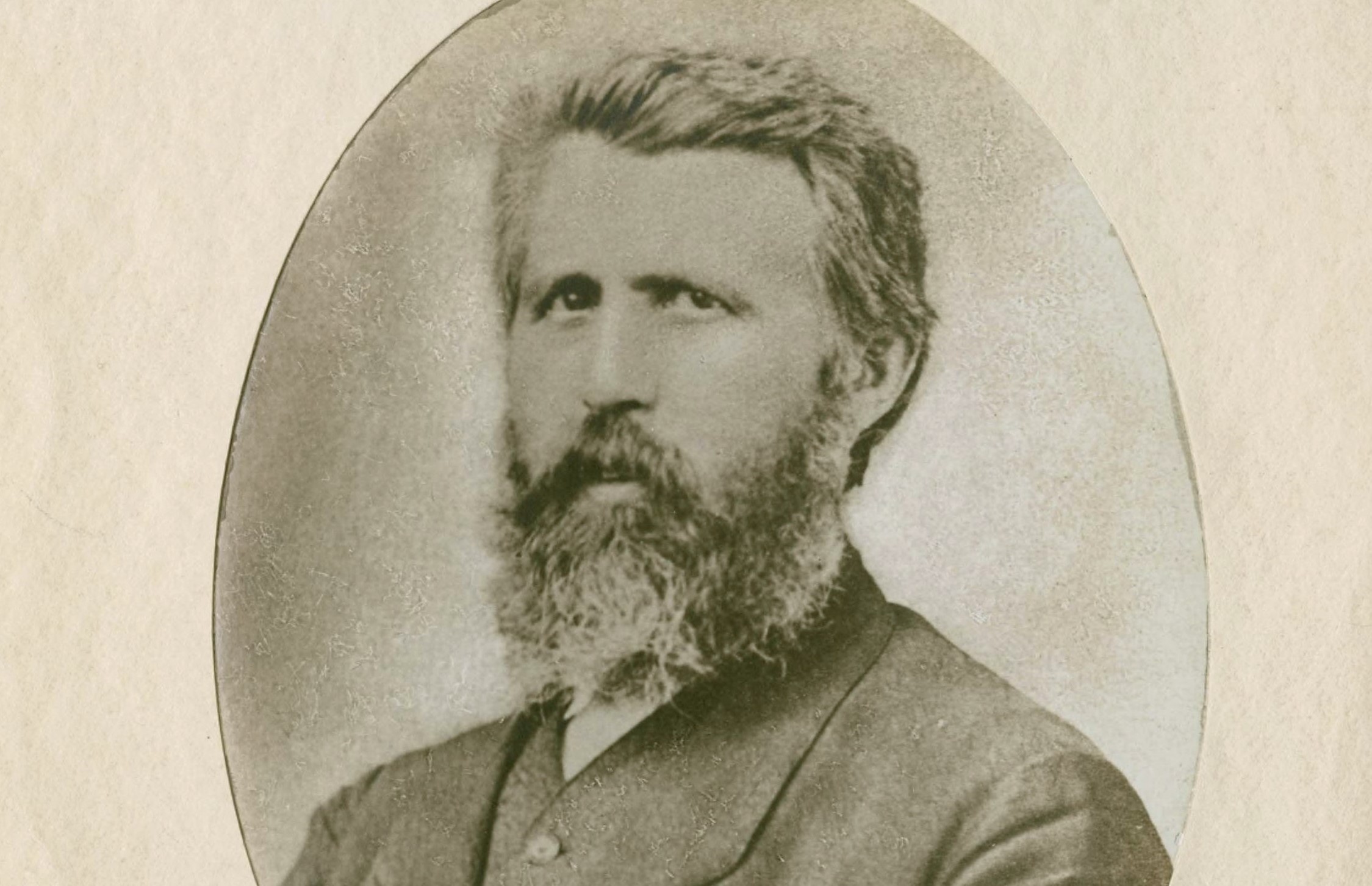
‘The Holy’ by Joseph Dietzgen from The Positive Outcome of Philosophy. International Library of Social Science. Charles H Kerr Publishers, Chicago. 1906.
In the well-known statement: The end sanctifies the means, the developed theory of morality finds its practical expression. This maxim, used in an ambiguous sense, may stand as a common reproach for us and for the Jesuits. The defenders of the society of Jesus make efforts to prove that it is a malignant attempt to discredit their clients. We shall not try to speak for either party to this dispute, but will devote ourselves to the subject matter itself, and seek to substantiate the truth and reasonableness of this maxim, to rehabilitate it in the public opinion.
It will be sufficient for the refutation of the most general opposition to understand that end and means are very relative terms, that all concrete ends are means and all means are ends. There is no more of a positive difference between great and small, right and wrong, virtue and vice, than there is between end and means. Considered as something integral by itself, every action has its own end and its means are the various moments of which even the shortest action is composed. Every concrete action is a means in relation to other actions which aim at the same common effect. But in themselves actions are neither ends nor means. Nothing is anything by itself. All being is relative. Things are what they are only within and by their interrelations. Circumstances alter cases. In so far as every action is accompanied by other actions, it is a means, and serves a common end which exceeds its own special end; but inasmuch as every action is complete in itself it is an end which includes its own means. We eat in order to live; but so far as we are living while we are eating, we are living in order to eat. As life to its functions, so the end is related to its means. Just as life is simply the sum of all life’s functions, so the end is the sum of all its means. The difference between means and end reduces itself to that between the concrete and the general. And all abstract differences reduce themselves to this difference, because the faculty of abstraction or distinction reduces itself to the faculty of distinguishing between the concrete and the general. But this distinction presupposes the existence of some material, some given objects, some circle of sense perceptions by which it manifests itself. If this circle is found in the field of actions or functions, in other words, if a previously defined number of different actions is the object of our study, then we refer to the general character of these objects as the general end and to every more or less extended part of them, or to every function, as a means. Whether any definite action is considered as an end or as a means, depends on the question whether we consider it as a whole in relation to its own parts, or as a part of some whole in which it is connected with other parts, with other actions. From a general point of view which has all human actions for the object of its study, and encompasses them all, there exists only one end, viz., the human welfare. This welfare is the end of all ends, is the final end, is the real, true, universal end compared to which all special ends are but means.
Now, our claim that the end sanctifies the means can have absolute validity only in regard to some absolute end. But all concrete ends are relative and finite. The one and sole absolute end is human welfare, and it is an end which sanctifies all rules and actions, all means, so long as they are subservient to it, but which reviles them as soon as they go their own way without serving it. The human weal is literally and historically the origin of the holy. That which is hale is holy. At the same time we must not ignore the fact that the weal, or hale, in general, the hale which sanctifies all means, is but an abstraction, the real content of which is as different as are the times, the nations, or persons which are seeking for their welfare. It must be remembered that the determination of that which is holy or for the human weal requires definite conditions, that no action, no means, is holy in itself, that each one of them is sanctified only by definite relations. It is not every end which sanctifies the means, but the holy end which sanctifies its own means. But since every real and concrete end is only relatively holy, it can sanctify its own means only relatively.
The opposition against our maxim is not so much directed against it, as against the wrong application of it. Recognition is denied and the socalled sanctified ends are accorded only limited means, because there is lurking in the background the consciousness that these ends have only a relative holiness. On the other hand our defense of the maxim does not imply that the various nominally holy means and ends are sanctified because some authority, some scriptural statement, some reason or conscience, has declared them to be so, but only in so far as they answer the common end of all ends, the human welfare. Our maxim of ends does not at all teach that we should sacrifice love and truths to sanctified faith, but neither does it demand that we should sacrifice faith for love and truth. It merely states the fact that, whenever some superior end has been determined by sense perceptions or circumstances, all means contrary to that end are unholy, and that on the other hand means which are generally unholy may become temporarily and individually sanctioned by their relation to some momentary or individual welfare. Wherever peacefulness is actually in favor as a sanctified means, war is unholy. When, on the other hand, man seeks his salvation in war, then murder and incendiarism are holy means. In other words, our reason requires for a valid determination of that which is sanctified certain definite material conditions or facts as premises; it cannot determine the holy in general, not a priori, not philosophically in the old speculative way, but only in concrete cases, a posteriori, only empirically.
If we understand that human welfare is the end of all ends, the ideal of all means; if we furthermore dispense with all special determinations of this welfare, with all personal ideas of it, and recognize that it is different under different circumstances, then we understand at the same time that no means is sanctified beyond the sanctity of its end. No means, no action, is positively sanctified or makes for human welfare under all circumstances. According to circumstances and relations one and the same means may be good or bad. A thing is good only to the extent that its results are good, only to the extent that there is good in its end. Lying and cheating are bad only because they result injuriously for ourselves, because we do not wish to be lied to or cheated. But whenever a sanctified end is in question, the deceptive means used in lying and cheating are called tricks of war. If any one is firmly rooted in the goodness of chastity because he thinks it was ordained by God, we cannot discuss the matter with him. But if one honors virtue for the sake of virtue and abhors vice for the sake of vice, in other words, for their consequences, he admits that he sacrifices the lust of the flesh to the end of good health. In short, he admits that the means are sanctified by the end.
In the Christian conception of the world, the commandments of its religion are absolutely good for all time, they are considered good because Christian revelation declares them to be so. This conception does not know that, for instance, its acme of virtue, the specifically Christian virtue of abstemiousness, received its value only by contrast with corrupt heathenish licentiousness, but that it is not a virtue when compared to reasonable and normal satisfaction of material needs. It deals with certain means which it calls indiscriminately good without any relation to their ends, and others which it calls indiscriminately bad in the same absolute way. And for this reason, it opposes the above named maxim.
But modern Christianity, modern civilization, has practically long done away with this faith. It does indeed call the soul the likeness of God and the body a putrid food for worms; but its deeds prove that it does not take its religious phrases seriously. It cares little for the better part of man and directs all its thoughts and actions toward the satisfaction of the despised body. It employs science and art, and the products of all climates, for the glorification of the body, clothing it sumptuously, feeding it luxuriously, caring for it tenderly, resting it on soft cushions. Although they speak slightingly of this earthly life in comparison to the eternal life beyond, yet in practice they cling for six days of the week to the uninterrupted pleasures of this body, while heaven is hardly considered worthy of careless attention for more than one short hour on Sundays. With the same thoughtless inconsistency the so-called Christian world also attacks our maxim with words, while in practical life it sanctifies the despised means by the end of its own welfare, going even so far as to demonstrate its inconsistency in its own life by subsidizing prostitution with state funds. The fact that the legislative bodies of our representative states keep down the enemies of their bourgeois order by courtmartials and exile, that they justify this course by the proverb, “Do unto others as you would that they should do unto you,” in the interest of “public” welfare, or that they defend their divorce codes by the plea of individual welfare, proves that the bourgeoisie also believes in the motto: The end sanctifies the means. And even though the citizens delegate rights to the state which they deny to themselves, also our opponents cannot but admit that in so doing the citizens are simply delegating their own rights to the superior authority of the state.
True, whoever employs lying and cheating in the bourgeois world for the end of gaining wealth, even though he may make it one of his ends to give to charity, or whoever steals leather, like Saint Chispinus, for the purpose of making shoes for poor people, does not sanctify his means by his end, because the end in that case is not sanctified, or only nominally so, only in general, but not in the concrete case quoted. For charity is an end of but inferior holiness which must not be more than a means compared to the main end of maintaining bourgeois society, and whenever it contravenes this main purpose, charity loses its character of a good end. And we have already seen that an end which is sanctified only under certain circumstances cannot sanctify its means beyond them. The indispensable condition of all good ends is that they must be subservient to human welfare, and whether this welfare is secured by Christian or pagan, by feudal or bourgeois means, it always demands that the things which are considered unessential and of lesser importance should be subordinated to the essential and necessary things, while in the above quoted cases the more salutary honesty and bourgeois respectability would be sacrificed to the less salutary charity.”The end sanctifies the means” signifies in other words that in ethics as well as in economics, the profit must justify the investment of the capital. Again, if we call the forcible conversion of infidels a good end, and an arbitrary police measure a bad means, this does not prove anything against the truth of the maxim, but only testifies to its wrong application. The means is not sanctified in the case, because the end is not, because a forced conversion is not a good end, but rather an evil one resulting in hypocrisy, and because such a conversion does not deserve this name, or because force is a means which is unworthy of this term. If it is true that a forcible conversion or wooden iron are senseless ideas, how is it that people will persist in fighting against universally recognized truths with such inconsistencies, such inane word plays, such tricks of rhetoric and sophistry? The means of the Jesuits, sly tricks and intrigues, poison and murder, appear unholy to us only because the Jesuitic purpose, for instance that of extending the wealth and influence and glorifying power of the order, is an inferior end which may make use of the innocent language of the pulpit, but is not an absolutely sanctified end, no supreme end, to which we would grant means that would deprive us of some essential end, for instance of our personal and public safety. Murder and manslaughter are considered immoral as individual actions because they are not means to accomplish our main end, because we incline not toward revenge or blood-thirstiness, nor toward arbitrariness and the wilful dispensation of justice by some judge, but toward lawful decisions and the more or less impartial decrees of the state. But do we not explicitly declare in favor of the maxim “The end sanctifies the means,” when we constitute ourselves into juries and render dangerous criminals powerless by the rope and the ax of the executioner?
The same people who boast of having dropped Aristotle, that is to say the belief in authority, for centuries, and who therefore replaced the dead traditional truth by living self-gained truth, are found to be completely at odds with their own development in the above cited cases. If we listen to the recital of some funny story, which may be told by even a reliable witness, we nevertheless remain loyal to the principles of free reason, that is to say we are free to regard as serious and regrettable any incident which the narrator may consider funny and ridiculous. People know how to distinguish between a story and the subjective impression its incidents created on the mind of the narrator, and which depends more on the personality of the witness than on the actual facts. But in the matter of good ends and bad means it is proposed to neglect the distinction between an object and its subjective end which is otherwise the point of all critique. Such ends as charity, the conversion of infidels, etc., are thoughtlessly, a priori, called good and holy, because they once were so under particular conditions, while now their effect in the cases above cited is just the opposite, and then people wonder that the unrighteous title carries with it unrighteous privileges.
Only that end is worthy of the predicate good or holy in practice which is itself a means, a servant, of the end of all purposes, of welfare. Whenever man seeks his welfare in bourgeois life, in production and commerce of commodities, and in the undisturbed enjoyment of his private property, he clips his long fingers by the commandment: “Thou shalt not steal.” But wherever, as among the Spartans, war is regarded as the supreme end and craftiness as a necessary quality of a warrior, there thieving is used as a means of acquiring craftiness and sanctioned as a means for the main end. To blame the Spartan for being a warrior instead of a sedate bourgeois would be to ignore the facts of reality, would be equivalent to overlooking that our brain is not designed to substitute imaginary pictures for the actual conditions of the world, but is organized to understand that a period, a nation, an individual is always that which it can and must be under given circumstances.
It is not from mere individual and unpraiseworthy fondness for the paradox that we subvert current views by defending the maxim “The end sanctifies the means,” but from a consistent application of the science of philosophy. Philosophy originated out of the belief in a dualist contrast between God and the world, between body and soul, between the flesh and the spirit, between brain and senses, between thinking and being, between the general and the concrete. The conciliation of this contrast represents the end, or the aggregate result, of philosophical research. Philosophy found its dissolution in the understanding that the divine is worldly and the worldly divine, that the soul is related to the body, the spirit to the flesh, thinking to being, the intellect to the senses, in the same way in which the unity is related to the multiplicity or the general to the concrete. Philosophy began with the erroneous supposition that the one, as the first thing, was the basis on which developed the two, three, four, and the entire multiplicity of things by succession. It has now arrived at the understanding that truth, or reality, turns this supposition upside down, that the reality with its multiplicity of forms, perceivable by the senses, is the first and foremost thing out of which the human brain gradually derived the conception of unity or generality.
No achievement of science can be compared with the amount of talent and intellectual energy consumed in harvesting this one little fruit from the field of speculative philosophy. But neither does any scientific novelty encounter so many deep-rooted obstacles to its recognition. All brains unfamiliar with the outcome of philosophy are dominated by the old belief in the reality of some genuine, true, absolutely universal panacea, the discovery of which would make all sham, false individual panaceas impossible. But we, on the other hand, have been taught by the understanding of the thought process that this coveted panacea is a product of the brain and that, since it is supposed to be a general and abstract panacea, it cannot be any real, perceptible, concrete panacea. In the belief in an absolute difference between true and false welfare, there is manifested an ignorance of the actual operations of brain work. Pythagoras made numbers the basis of things. If this Grecian philosopher could have realized that this basic nature was a thing of the mind, of the intellect,[2] and that numbers were the basis of reason, the common or abstract content of all intellectual activity, then we should have been spared all the disputes which have raged around the various forms of absolute truth, about “things in themselves.”
Space and time are the general forms of reality, or reality exists in time and space. Consequently all real welfare must be attached to space and time, and every welfare which exists in these dimensions must be real. The different welfares, in so far as their beneficent qualities are concerned, are to be distinguished only by their height and breadth, by the quantity of their dimensions, by their numeral relations. Every welfare, whether true or seeming, is perceived by the senses, by practices of life, not by abstract reason. But practice assigns the most contradictory things to different people at different times as means to their welfare. What is welfare in one place, is disaster in another, and vice versa. Understanding, or reason, has nothing else to do in the matter than to number these various welfares as they are made real by sense perceptions in various persons and times, and degrees of intensity, in the order in which they appear, and thus to distinguish the small from the great, the essential from the unessential, the concrete from the general. Reason cannot dictate to us autocratically in matters of some absolutely true welfare, it can only indicate the most frequent, most essential, and most universal welfare in a certain perceived number of welfares. But it must not be forgotten that the truth of such an understanding, or enumeration, depends on certain definite premises. It is therefore a vain endeavor to search for the true and absolute welfare. This search becomes practical and successful only when it limits itself to the understanding of a definite amount of welfare of some particular objects. The general welfare can be found only within definite boundaries. But the various determinations of welfare agree in this respect, that they all consider it well to sacrifice the little for the great, the unessential for the essential, and not vice versa. In so far as this principle is right, it is also right for us to employ for the good end of a great welfare some small means in the shape of a small evil and to endure it, and thus we see once more that the end sanctifies the means.
If people were liberal enough to permit every one to go to heaven in his or her own way, the opponents of our maxim would be easily convinced of its truth. But instead of doing this, people follow the usual course of shortsightedness and make their private standpoint a universal one. They call their own private welfare the only true welfare, and regard the welfare of other nations, times and conditions a mistake. So does every school of art declare its own subjective taste to be objective beauty, ignoring the fact that unity is but a matter of ideas, of thought, while reality is full of the most varied forms. The real welfare is manifold and the true welfare but a subjective choice which, like a funny story, may make an entirely different impression on others, and be a false welfare. Even though Kant, or Fichte, or some other particular philosopher, may discuss at length the purpose of mankind and solve the problem to his full satisfaction and to that of his audience, we nevertheless have learned enough today to know that one can define one’s own personal idea of the purpose of mankind by means of abstract speculation, but that one cannot discover any unknown and hidden object in this way. Thought, or reason, requires some object, and its work is that of measuring, of criticising. It may distinguish between true and false welfare, but will also remember that they have their limits, remember that it is itself personal and that its distinctions are likewise personal and cannot be generalized beyond the point where others receive the same impression of the same object.
Humanity is an idea, while man is always some special person who has his or her peculiar life in a definite environment and is therefore subservient to general principles only from motives of self-interest. The sacrifice of ethics, like that of religion, is only seemingly a self-denial and serves the ends of reasonable self-interest, an expenditure with a view to greater gains. A morality worthy of that name which is not better defined by the term obedience can be exercised only through the understanding of its worth, of its value for our welfare, of its usefulness. The variety of political parties is conditioned on the varieties of the interests concerned, and the difference in the means is conditioned on the difference in ends. In questions of less importance even the champions of absolute morality testify to this fact.
Thiers in his history of the French Revolution tells of a peculiar situation in the year 1796, when the patriots held the public power and the royalists carried on a revolutionary propaganda. It was then that the partisans of the revolution, who should have been the champions of unlimited liberty, demanded coercive measures, while the opposition, who secretly cared more for a monarchy than for a republic, voted for unlimited liberty. “To such an extent are parties governed by their self-interests,” comments Thiers, just as if this were an anomaly instead of being the natural, necessary and inevitable course of the world. When, on the other hand, it is a question of the fundamental laws of bourgeois order, then the moral representatives of the ruling classes are egotistic enough to deny the connection of their material interests with these laws and to claim that theirs are eternal, metaphysical world laws, that the pillars of their special class rule are the eternal pillars of humanity, and that their own means alone are holy ones and their end the final end of the universe.
It is a disastrous deception, a robbing of human liberty, an attempt to cause the stagnation of the historical development, if any age or class thus proclaims its own peculiar purposes and means to be for the absolute welfare of humanity. Morality originally reflects one’s interests just as fashion reflects one’s taste, and finally the action is moulded after the conceived pattern like the coat in dressing. In this process, force naturally is exerted for the maintenance and protection of one’s own life and those who resist are subdued. Interest and duty, though perhaps not entirely synonymous, are certainly closely related. Both of them are merged in the term welfare. Self-interest represents more nearly the concrete, immediate, tangible welfare, while duty concerns itself with the more remote and general welfare of the future also. While self-interest considers the present tangible metallic welfare of the purse, duty demands that we keep not only a part of welfare, but all welfare in mind, that we consider the future as well as the present, that we remember the spiritual welfare as well as the physical. Duty thinks also of the heart, of social needs, of the future, of the spiritual weal, in brief of interest in general and urges us to renounce the superfluous in order to secure and retain the necessary. Thus your duty is your self-interest and your self-interest your duty.
If our ideas are to adapt themselves to truth, or to reality, instead of reality or truth adapting itself to our notions or thoughts, we must understand that the mutability of that which is right, holy, moral, is a natural, necessary and true fact. And we must grant to an individual the theoretical freedom which cannot be taken from it in practice, we must admit that it is as free now as it has ever been, that laws must be adapted to the needs of the social individual and not to the vague, unreal, and impossible abstractions, such as justice or morality. What is justice? The embodiment of all that is considered right, an individual conception, which assumes different forms in different persons. In reality only individual, definite, concrete rights exist, and man simply comes along and abstracts from them the idea of justice, just as he abstracted from different kinds of wood the conception of wood in general, or from material things the conception of matter. It is just as far from the truth, to think that material things consist of, or are by virtue of, abstract matter, although this view is widely spread, as it is to believe that the moral or bourgeois laws were derived from the idea of justice.
The ethical loss caused by our realistic, or if you prefer, materialistic, conception of morality is not so great as it appears. We need not fear that through this conception social beings will become lawless cannibals or hermits. Freedom and lawfulness are closely allied by the need for association which compels us to permit others to live together with us. If a man is prevented by his conscience or by other spiritualistic or bourgeois ethics from committing unlawful actions – unlawful in the wider meaning of the term – he is either not exposed to very grave temptations, or he has a nature so tame that the natural or legal punishments fully suffice to keep him within prescribed bounds. But where these checks are ineffective, morality is likewise powerless. If it were otherwise, we should have to assume that morality exerts in secret the same influence on the faithful which is exerted by public opinion on the faithless. But we know from actual experience that there are more pious thieves than infidel robbers. That the world, which attributes so much value for social welfare to morality by word of mouth, actually shares this view of ours, is proven by the fact that bourgeois society gives more attention to the penal code and to the police than to the influence of morality.
Moreover, our fight is not directed against morality, not even against any special form of it, but only against the arrogance which assumes to stamp some concrete form of morality with the trade mark of absolute morality. We recognize that morality is eternally sacred, in so far as it refers to considerations which a man owes to himself and to his fellowmen in the interest of their common welfare. But the freedom of the individual demands that each one should be at liberty to determine the degree of consideration and the manner of giving it expression. Under these circumstances it is as inevitable that the ruling powers, classes or majorities should enforce their special needs under the form of a prescribed right, as it is that a man’s shirt should be closer to his skin than his coat. But it appears to us not merely very superfluous, but even detrimental to the energies required for the progress of the future, that some decreed right should be elevated to the position of absolute right and transformed into an insuperable barrier to the advance of humanity.
The Positive Outcome of Philosophy by Joseph Dietzgen. International Library of Social Science. Charles H Kerr Publishers, Chicago. 1906.
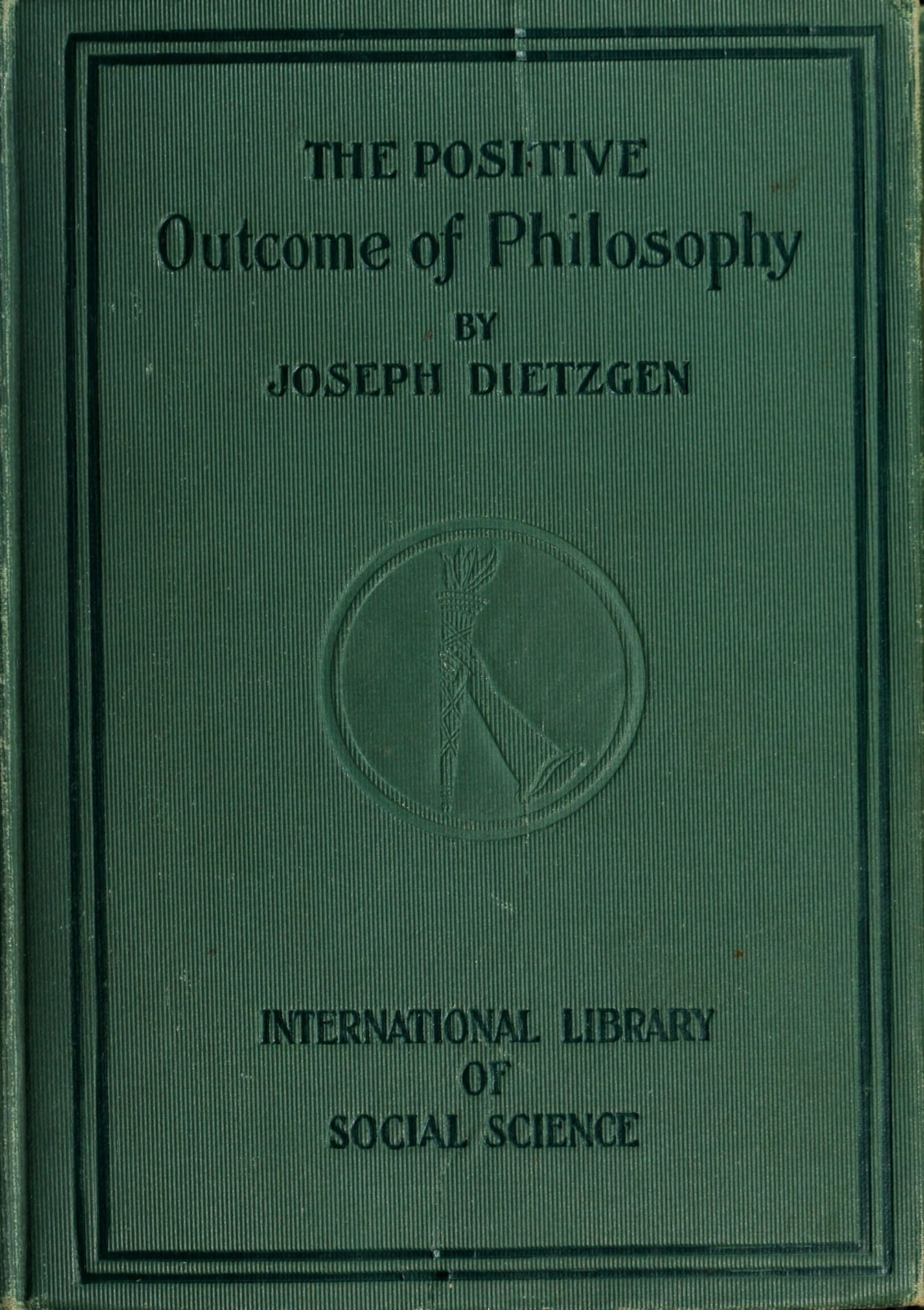
Contents: Introduction by Anton Pannekoek, PART ONE) The Nature of Human Brain Work (1869), Preface, Introduction, Pure Reason or the Faculty of Thought in General, The Nature of Things, The Practice of Reason in Physical Science, Cause and Effect, Matter and Mind, Force and Matter, “Practical Reason” or Morality, The Wise and Reasonable, Morality and Right, The Holy, PART TWO) Letters on Logic I-XXIV (1870s), PART THREE) The Positive Outcome of Philosophy (1887), Preface, Positive Knowledge as a Special Object, The Power of Perception Is Kin to the Universe, As to How the Intellect Is Limited and Unlimited, The Universality of Nature, The Understanding as a Part of the Human, Consciousness Is Endowed With the Faculty of Knowing as Well as With the Feeling of the Universality of All Nature, The Relationship or Identity of Spirit and Nature, Understanding Is Material, The Four Principles of Logic, The Function of Understanding on the Religious Field, The Distinction Between Cause and Effect Is only One of the Means to Facilitate Understanding, Mind and Matter: Which Primary Which Secondary?, The Extent to Which the Doubts of the Possibility of Clear and Accurate Understanding Have Been Overcome, Continuation of the Discussion on the Difference Between Doubtful and Evident Understanding, Conclusion. 440 pages.
The Charles H Kerr publishing house was responsible for some of the earliest translations and editions of Marx, Engels, and other leaders of the socialist movement in the United States. Publisher of the Socialist Party aligned International Socialist Review, the Charles H Kerr Co. was an exponent of the Party’s left wing and the most important left publisher of the pre-Communist US workers movement. It remains a left wing publisher today.
PDF of original book: https://archive.org/download/positiveoutcomeo00diet/positiveoutcomeo00diet.pdf
 Revolution's Newsstand