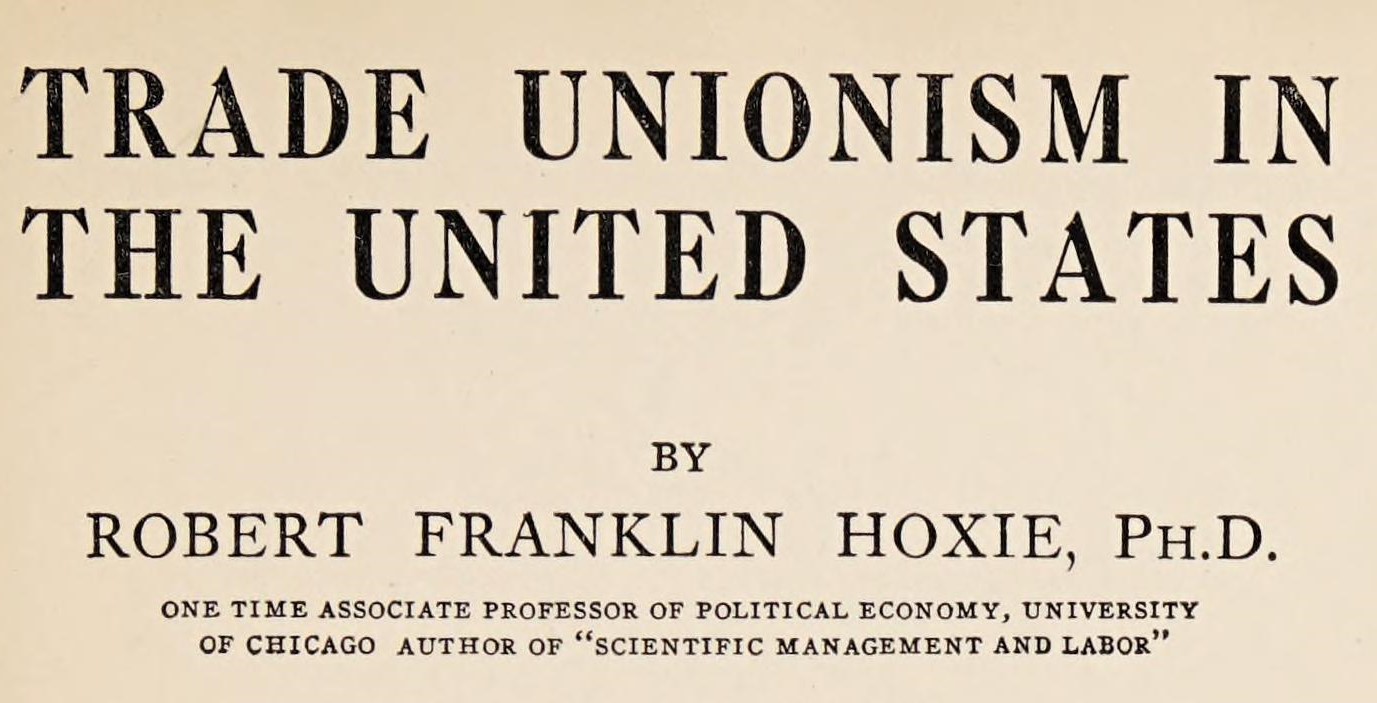
The heretic son of Daniel De Leon, Solon, was a prominent writer with the S.P.-aligned Rand School’s Labor Research Department during the 1920s, and quit with others, like Scott Nearing and Robert W. Dunn, to initiate the Communist Party’s Labor Research Association in the late 1920s. In this article, De Leon review’s Robert F. Hoxie’s classic academic text ‘Trade Unionism in the United States’ and offers advice in engaging with its ideas. A PDF of the book here.
‘What and How to Study Trade Unionism’ by Solon De Leon from the Daily Worker Saturday Supplement. Vol. 3 No. 303. January 8, 1927.
If I were deported as a Red and could take with me only one book on American trade unions, I would want that book to be “Trade Unionism in the United States,” by Robert F. Hoxie. No other single volume gives so clear a picture of the motives, structure, control, and history of organized labor.
Let us then set out with this excellent guide to study trade unionism. But, Hoxie asks at once, have we only one kind of unionism? Do all unions want the same thing? Clearly not. An analysis of what particular unions want is therefore necessary before we can decide whether unionism is good or bad for the workers.
Beginning with the easy question of structure, Hoxie shows that unions are not even all built alike. Some are well, what is a local union? A national craft union? A city central body? A state federation? A national or international federation? An Industrial union? A general labor union?
Next comes an analysis of union laws, which are more important than the way a union is constructed. Hoxie was the first to apply psychological principles to the study of trade unions. He divided labor organizations into four “functional” types-business unions, friendly or uplift unions, revolutionary unions, and predatory or hold-up unions. Why did each of these spring up? What are examples of each? Which are the most common? Which have advanced the cause of labor, and which have not? Are violence and disregard of the existing law ever justified in union activity?
The next section takes up the historical causes which led to the growth of different union structures and different kinds of activity. The first unions, formed shortly after the American revolution, were naturally local in area and craft in form. Why? Why did unionism develop just then and not earlier? How many workers realize that the legal right to organize was won only after forty years of bitter struggle? During that time the employers repeatedly attacked the unions in court, and had them declared illegal conspiracies. The story of this struggle is well told by Hoxie.
Hoxie advances the idea that union forms tend to follow the structure of industry and of capitalist organization. Does this idea seem reasonable? On that basis, how can you explain the gradual joining of craft unions into city central bodies, state federations, national federations, and finally a federation of national craft unions? The spurt in union organization which took place during the Civil War led to the formation of the Knights of Labor. What sort of body was the Knights? How did it come that the American Federation of Labor, a much later body, was able to overthrow the Knights and assume leadership of the American union movement? Growing dissatisfaction with the Federation led to the organization of the I.W.W. Why did the I.W.W. fail?
Though the unions aim at more democracy in industry, Hoxie points out that in their own affairs they are likely to be controlled by officers and leaders. What influences cause leaders to lose touch and sympathy with their own rank and file? Can you tell from your own experience why the rank and file do not exercise more control? No doubt the membership should secure more voice in union affairs-but how try to get it? Without strong left- wing criticism and organization a union is likely to drift into more and more conservative policies. How can left-wing activity be strengthened and improved? The part dealing with employers’ organizations is especially keen and helpful. Most employers are “open shoppers.” They seize every opportunity to smash the workers’ organizations. Yet Hoxie shows that they have their own organizations and find them very useful in the class struggle. Hoxie vividly describes the methods used by “American plan” employers’ associations in fighting unionism. It is well to learn these methods and be prepared to defeat them. On the other hand, some employers prefer to make business deals with business unions. Can you see any advantage to the bosses in this? Another brilliant section of the book takes up the question of labor and the law. The capitalist state, always the guardian of the interests of the capitalist class, has written enormous volumes of legislation controlling the activities of workers, individually and in their unions. Do these laws recognize that society is in constant change, or do they assume that what was right or wrong in the past must always be right or wrong? Do they emphasize the individualistic or the social point of view? Do they place property rights above personal and social rights, or just the opposite? Are the laws adjustable to new conditions, or are they rigid and inflexible? Are they clear, or contradictory and confusing? Answer these questions from your own knowledge, and then see what Hoxie says about them.
When unionists and employers agree on wages, hours, and conditions of labor, the procedure is called “collective bargaining.” Hoxie clearly shows why the employers’ bargaining power is greater than that of the workers. How can the workers increase their bargaining power? Should unions favor or oppose standardization of conditions? How far is it wise for unions to make concessions to employers for the sake of making agreements? Business unions frequently enter into deals with monopolistic employers, to force higher prices for their product. Is this wise union tactics? Then there is the whole question of state intervention in labor disputes. Is government mediation or conciliation ever of benefit to the workers? Would you agree to voluntary arbitration of a dispute in which you were interested, if you were bound beforehand to accept the arbitrator’s decision? How do you feel about the growing demand of employers to make arbitration compulsory?
Under union programs Hoxie compares a number of different union demands. He shows that these demands are drawn up on immediate considerations, as practical means of improving the conditions of workers in that particular union. He raises a number of interesting tactical questions. Should unions seek to increase output in the hope of getting more wages? Are the unions justified in limiting output? Should unions resist or encourage the introduction of new machinery? See whether you agree with Hoxie’s answers.
Scientific management, under capitalism, has two objects to squeeze more profits out of the workers, and to break up trade unions. Hoxie, who wrote another valuable book on this subject alone, shows how motion study and the stop-watch aid in subdividing processes and destroying the workers’ craft skill, Hence arises the question, can the unions Co-operate in time study and scientific management plans without endangering their own existence? On the other hand-and this is a point which Hoxie fails to raise-could not scientific management be used to great advantage by the toilers themselves under workers’ control of industry?
The Saturday Supplement, later changed to a Sunday Supplement, of the Daily Worker was a place for longer articles with debate, international focus, literature, and documents presented. The Daily Worker began in 1924 and was published in New York City by the Communist Party US and its predecessor organizations. Among the most long-lasting and important left publications in US history, it had a circulation of 35,000 at its peak. The Daily Worker came from The Ohio Socialist, published by the Left Wing-dominated Socialist Party of Ohio in Cleveland from 1917 to November 1919, when it became became The Toiler, paper of the Communist Labor Party. In December 1921 the above-ground Workers Party of America merged the Toiler with the paper Workers Council to found The Worker, which became The Daily Worker beginning January 13, 1924.
PDF of full issue: https://www.marxists.org/history/usa/pubs/dailyworker/1927/1927-ny/v03-n303-supplement-jan-08-1927-DW-LOC.pdf
 Revolution's Newsstand