While never faced with global climatic catastrophe, it is untrue that past Marxists did not address ecological crises. As the editorial from 1907 posits succinctly, the exploitation of workers and of nature are a part of the same process, and intrinsic to the rule of capital.
‘Preservation of Common Resources’ from The People (S.L.P.). Vol. 17 No. 7. September 28, 1907.
The American Forestry Association, whose headquarters is at Washington, and whose president is James Wilson, Secretary of Agriculture, is sending out a circular letter, the opening paragraphs of which read as follows:
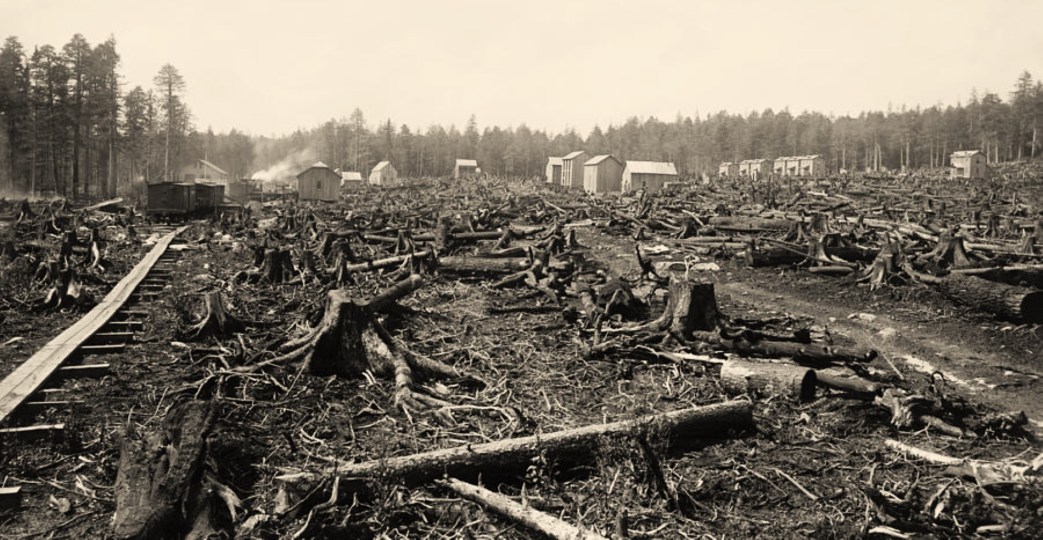
“Between New Orleans and New Brunswick almost every important river flowing into the Gulf or the Atlantic rises in the Appalachian-White Mountain system. Upon the equal flow of these streams depends largely the success of vast industries and the welfare of millions.
“Regular streamflow depends upon the preservation of the forests upon these mountains. But, before axe and fire, these forests are vanishing. They can be saved only by immediate National action. Congress must establish National forests in these mountains.
“But Congress must first be convinced. This necessitates a campaign of education.”
The picture which these announcements from Washington conjure up is a picture of the capitalist class pouncing upon, plundering and wasting everything that is common property. Time was when the American continent was bounteously stocked with game, whose flesh and furs were a reserve supply of food and clothing of untold vastness. But, dominated by the spirit of capitalism, people wastefully, and often wantonly and thoughtless of the future, set upon and slaughtered this common resource almost to the point of its complete extermination. Finally, after this ravage had done its worst, agitation for the protection of wild animals and birds was begun, resulting in game laws an effort of society to restrain the plundering spirit of capitalism.
The same tale can be told of the natural, common resource of American fisheries, and it can be again repeated as to the sperm-whales. In a like manner did wasteful capitalist individualism assert itself as to the lands, and likewise as to the waters of the streams where irrigation was found practical. It has been the universal rule of capitalist conduct that, thoughtless of the future, and of economy, there has been a rush to privately appropriate every common American resource. Greedily, wantonly, the appropriation has been carried on, the capitalist spirit of individualism revealing itself as the wasteful spirit of plunder. In identical temper have American capitalists set themselves to the exploitation of the American working class. The workers not being private chattel slaves, they are looked upon by the capitalist class, as, and in truth they are, but a COMMON RESOURCE which every individual capitalist is free to plunder according to his facilities or means. In other words, the working class exists for each capitalist to exploit to the extent that he may own. machinery to put wage-slaves to work. And as with the game, the fisheries, the forests and streams, so with ferocious fury it is that the capitalists set themselves to the exploitation of this common resource, the wage-working class.
The American worker is so generally worked with an abnormal intensity, and so usually carried away long before his time, that sparse indeed are the gray heads seen among a crowd of workingmen. And so wastefully and recklessly are the workers exploited that the gory statistics of injury and fatality due to want of precautionary measures in industrial institutions is appalling beyond expression.
Then, turning to a consideration of the young of the working class, the capitalist spirit of ravage and plunder is seen teeming in the mills, where the minds and bodies of over two million children of both sexes, below fifteen years of age, are being withered away by long tedious hours of labor and attention upon the milling processes. With the plundering spirit standing out so glaringly as the dominating tendency in the attitude of capitalists toward every other common resource, it is but weakly and vainly that the defender of capitalism can attempt to deny the like spirit of plunder, which characterizes capitalist exploitation of the working class.
But, yet an answer they have: “Hasn’t society stepped in and restrained the wasteful capitalist spirit of plunder by the passage of game and fish preserve laws, homestead, pre-emption and other land laws, laws for forest preservation, and laws as to irrigation and water rights? So likewise,” it may be argued, “as to the ravages upon the working class, finally there will be an awakening to the waste of this common resource, and this waste also will thenceforth be restrained by laws for the preservation of the working class.” Doubtless this would come true if capitalism were to last. But the feature to be noted is that this restraint would operate only to the point of eliminating waste, viewing the workers from the standpoint of a common capitalist resource, and not to the point of realizing an improvement for the workers themselves. In this light it is seen that the withering exploitation of children in cotton mills, glass factories and sweat shops will not be restrained, for the reason that the exploiting of these children accomplishes very economical manufacture. The capitalist silk producer, therefore, who raises the silk worms only to kill them the moment they have spun their web, and the capitalist meat packer who raises the little calves for veal, will hardly be able to make an argument against the mill-owner who exploits the children or against the capitalist who drives the adult worker to work with inhuman intensity, or against him who forces his employees to risk their lives because precautionary measures would be more expensive.
It was years ago that Karl Marx observed that a rapid succession of intensely overworked short generations makes a cheaper working class than a succession of generations which are longer because their work is less intensified; and that is the explanation why the ravaging plunder of the working class has not up to now, and, under capitalism, never will be abated.
PDF of full issue: https://www.marxists.org/history/usa/pubs/the-people-slp/070928-weeklypeople-v17n27-iww3rdconvention.pdf
 Revolution's Newsstand