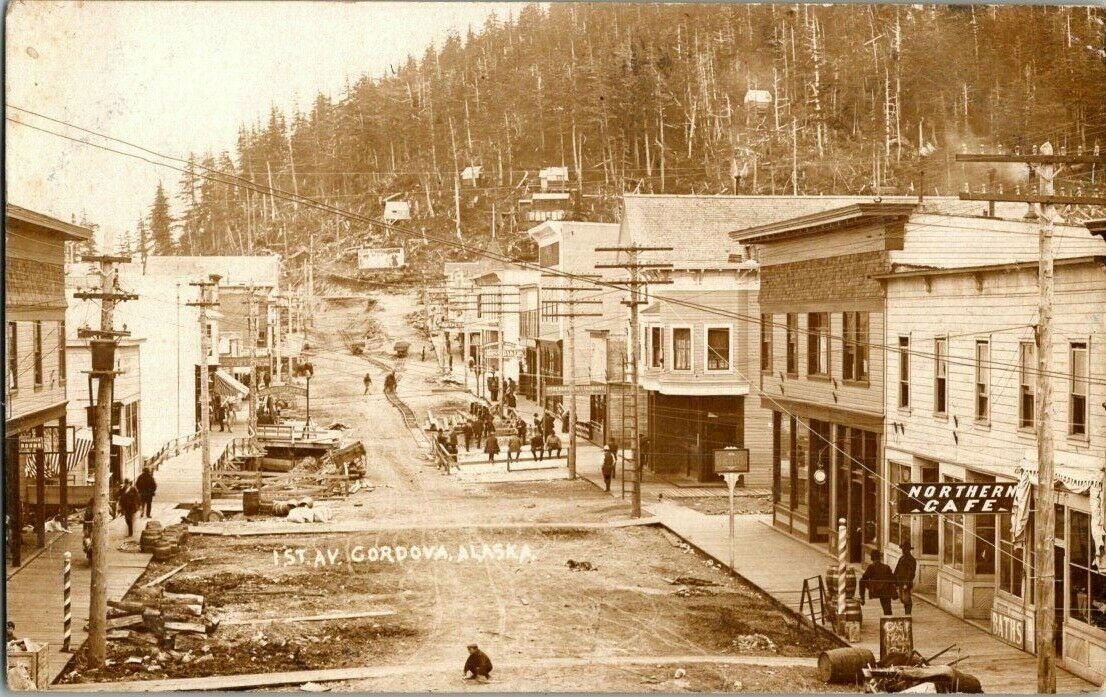
The adventures of radical workers, the Labor Theory of Value, and their dashed dreams of making a claim in Alaska.
‘The Golden Land of Work in ‘Our’ Alaska’ by Cliff Hughes from Industrial Worker. Vol. 1 No. 17. July 8, 1909.
Cordova, Alaska, June 21, 1909.
I am sending you some information that you may be able to use for the Industrial Worker. Fellow Worker J.D. Smith and four other I.W.W. men, with two members of the S.L.P. and a W.F. of M. man, had a pipe dream in Seattle in which we dreamed that we were going to make a winter stake in Alaska. Now to let you know how the dream panned out. First, a man by the name of Walkington, of the Standard Building company, hired us to go to a place called Hinchenbrook Point or Hinchenbrook Island, sixty miles from Cordova, to build a lighthouse at $3.00 per day of eight hours. We understood it was mostly concrete work (I might add that he tried to hire us for $2.75 at first, but we, refused this munificent sum, so agreed to $3.00). Now comes the interesting part: After a trip on the good ship Bertha of nine days, we reached a place called English Bay. a distance of 4 or 5 miles from Hinchenrook Point, where the lighthouse site is. The weather was so bad (rain and wind) that they could not land us, so we were transferred to the ship Jeanie, which had reached there five days previously with lighthouse supplies. They kept us on this boat five days doing nothing, and when we received our statement at the end of the month he had us charged with board while on this boat, and this is what proved the downfall of our pipe-dream. But this is anticipating. The first trouble after we landed at the Point was with the boss in charge, a carpenter who thought it necessary to holler when he had anything that he wanted. He got balled out right away.
Union Indians.
There were several more carpenters who had been there for some weeks previously fixing (?) up the camp. They were receiving $4.50 and paying board. Also, there were some Indians who had been working for $2.00 and board for eight hours and straight time for overtime, but they had just had a strike, and won, for 30 cents for overtime. A peculiar trait of these. Indians (which the boss did not like) was to take an alarm clock and set it on a convenient rock or stump, and when through work they would show it to the boss and stick up their fingers to show him they knew how many hours they had worked. The boss said the clock gained 10 or 15 minutes every day. Now the next thing is, we found that we had to do longshore work; that is, whenever the surf was not too rough, we unloaded material from scows or boats into the beach-a wet job. This did not look good to us at the rate of 37 cents at hour, so we got together and demanded, on the morning of the 17th of May, 50 cents an hour for all longshore work, and Contractor Abernethy (the partner on the works) had to come through, as he was up against it. I will add that there was a painter who came at the same time as we did from Seattle, who stood with us in the strike, although it did not make any difference in his wages, he receiving $4.50 and board: but he was all right: he did not suffer from jobitis. The carpenters, of course, stayed with the boss and helped to scab on the laborers (usual craft style). Now the next thing on the programme was: The contractor sent the launch (of which he had three hired) to Cordova for more men, and in the course of a few days the launch brought back ten more laborers. Now here is where the boss received an other jolt. The same night that they arrived and lodged in a new dry bunk-house (not an old leaky affair like the one we were in). The boss came and stuck his head into our bunk-house and informed us that when he agreed to give us the 50 cents for longshore work that we had him in a pinch, but now this was all over, as it had ten new men, and we would have to go back to the old scale of 37 ½ cents straight.
Union Wins.
Then all our bunch went straight to the new men and put the case before them (some of them were W.F.M. miners), and these men Immediately lined up with us before the boss’s house and gave him to understand no old scale went. You ought to have seen his face: it was a picture, and he was trembling like a leaf. He not only agreed to take it all back but he told us he would give 50 cents for all over tie. Well, after this, things went fairly smoothly until the end of the month when the grub began to get rocky. “from bad to worse,” no fresh neat, no spuds, nothing but canned goods. Any how, to draw a long story short, after we got our statements for the month of May, we found, “as previously stated,” that he had charged us with board while on the boat at the rate of 75. cents per day (instead of $5.00 per week as per agreement), and also tried to steal time from us. Our bunch again interviewed him and told him that we would not work any until it was rectified. He said, either take it as it was or quit. Of course we quit, and made him fix the statements to our satisfaction.
The Last Act.
His launch came to Hinchenbrook Point two days after and we were told to go aboard for Cordova. He having given us orders on a store keeper there by the name of Joe Diggs, for our money. But instead of this the launch went only so far as English Bay and landed us there, “as they said,” until the weather cleared. This was expected to happen the next day, but they did not return, for two days. After landing we found there was nothing to eat but spuds (bad ones), onions and canned milk in the storm house there. J.D. Smith and another went out to a U.S. government survey boat that was anchored in the channel and bummed two loaves of bread (open-hearted, was not it?), and another fellow shot four sea gulls of which they made a mulligan.

On the 19th we landed in Cordova, with orders on Joe Diggs, at 12 o’clock at night. He would not cash them till morning, but we obtained $10.00 on account that night. The next morning we had an interview with him and Walkington, the man who hired us, he being on his way to Seattle. We were then informed that old Abernethy (the contractor in charge at the Point) had written in for Joe Diggs to hold out $5.00 for fare on his launch for bringing us to Cordova to get our money. We promptly informed him that we would not pay any fare. So he went off to a lawyer, got a written statement to the effect that he had the right to charge such fare. We laughed at him, and told him that we could hire a lawyer to write out a statement just the reverse; in fact, to write most any old thing for a fee. Anyhow, to close he paid us in full and here we are in Cordova, our pipe-dream evaporated and ready to look for another master. Yours for industrial free dom. CLIFF HUGHES. P.S.-Have received six copies of the Industrial Worker while here and they are all to the good.
The Industrial Union Bulletin, and the Industrial Worker were newspapers published by the Industrial Workers of the World (IWW) from 1907 until 1913. First printed in Joliet, Illinois, IUB incorporated The Voice of Labor, the newspaper of the American Labor Union which had joined the IWW, and another IWW affiliate, International Metal Worker.The Trautmann-DeLeon faction issued its weekly from March 1907. Soon after, De Leon would be expelled and Trautmann would continue IUB until March 1909. It was edited by A. S. Edwards. 1909, production moved to Spokane, Washington and became The Industrial Worker, “the voice of revolutionary industrial unionism.”
PDF of full issue: https://www.marxists.org/history/usa/pubs/industrialworker/iw/v1n17-jul-08-1909-IW.pdf
 Revolution's Newsstand