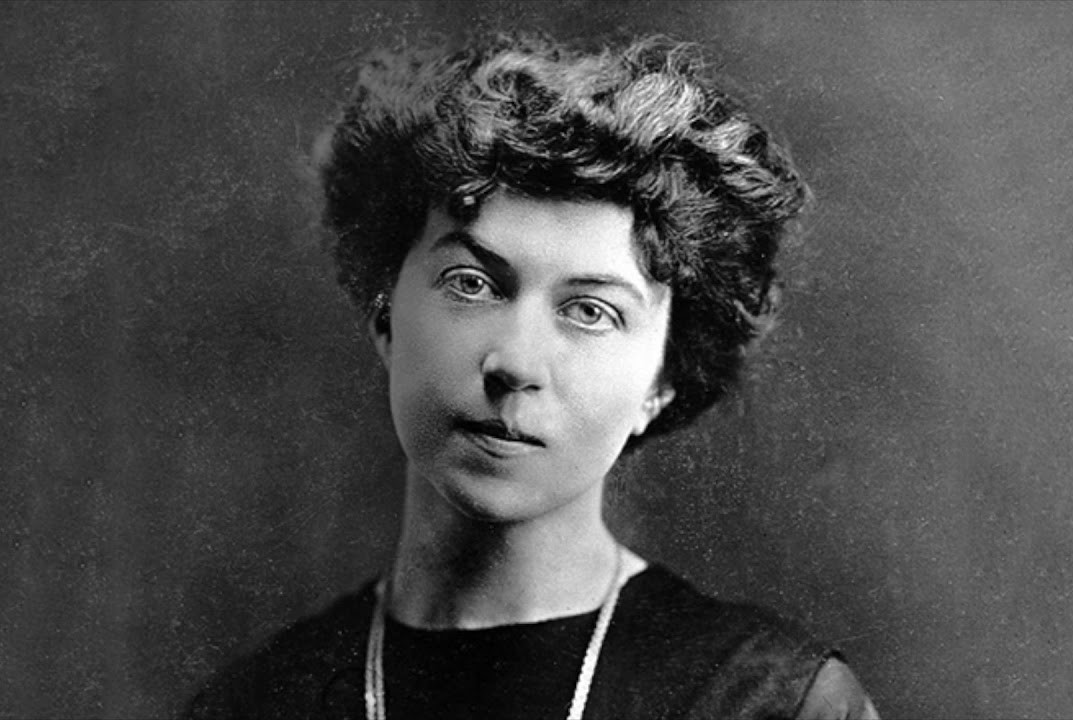
Alexandra Kollontai, had broken with the Mensheviks in 1915 over their social-patriotic position, was in the United States twice for two extended stays. Invited by Ludwig Lore and the German Socialist Federation of the Socialist Party of America to come to the U.S. to speak against the war, she also had her own agenda making contacts for Lenin and Zimmerwald Left. She arrived in September, 1915 and for three and a half months, until early 1916, toured the country from coast to coast. In late 1916, she returned to New York indefinitely. To renew relations and act as Bolshevik envoy, but more importantly and see her son Misha, living in Patterson, New Jersey. In addition, her former lover Alexander Shliapnikov was living in New York, as was Nikolai Bukharin, with Trotsky soon to arrive. All would return to Russia with the fall of the Tsar and the opening of the Revolution in March, 1917. Here she echoes an increasing call for a new, third, International.
‘The Third International’ by Alexandra Kollantay from The American Socialist. Vol. 2 No. 15. October 23, 1915.
NOTE.—Alexandra Kollontay has just arrived in this country from war-torn Europe and is now touring the nation under the direction of the German Federation of the National Socialist Party In this article she gives some of her ideas on the reorganization of the international forces of Socialism.
WHEN in the distant future some historian shall picture the bloody year of horror, and describe the shattering crisis in the labor movement and the division and dissolution of the Socialist International, he will be compelled to declare: “In the depths, in spite of all the wavering of faith and pessimism, in spite of the despair and ruling distrust of one another, there arose during this time the fresh and vital germ of a new international of labor, that international that has fulfilled the great work of releasing the proletariat from the yoke of capitalism.”
The third international is no utopia, no “baseless vision” of incorrigible optimism. The elements from which it is to be built are already in our midst, and have been called into life by the existing crisis. The new international of labor is made up of such men as Karl Liebknecht, the members of the Russian duma languishing in Siberia, of the ever-growing “left” of the German and Russian Social-Democratic parties that have remained true to the principles of the class struggle and Socialism.
THE NEW ELEMENTS.
The third international of labor includes the brave Italian comrades who have protested to the last against the murder of the people. In the new international are the few French Socialists and unions and the numerous English party members of the Independent Labor Party and the British Socialist Party, who have fought for the fundamental principles of the working class, who have raised their protest against the war and who will have nothing to do with “civil peace.” The new, coming international is composed. of those workers who have met the compulsory “civil peace” with strikes and uprisings.
But the real, the firm basis of the new international must be formed of the Socialist youths. Youth, the bearer of the future-youth, that cares so little for the past and expects everything from the coming life and the future. Youth, whose heart is not contaminated with the little bourgeoise mentality and whose mind can not be misled by the ideology of a bygone age. The fresh, brave, revolutionary, sacrificing youth of labor, that presses forward, ever forward.
ALL CHILDREN OF AGE.
It is no accident that in the decisive historical moment, it was just the “great” and the “old” men in all the parties who sacrificed the ideals of the future to the past, to ancient, outgrown principles. A person may be ever so great as a thinker and fighter, he still is and must remain only the child of his age. And every age has its own ideology and its own progressive tasks. When, our “great men,” leaders, laid the cornerstones of the second international, the principle of the “defense of the fatherland,” was a progressive and democratic principle, closely bound up with the struggle of the third estate to establish the modern capitalist state. “Defense of the fatherland” belongs to the time of the defense of democracy against the last attacks of feudalism, when to stand for the national state was to create the indispensable foundation for the class movement of the proletariat.
Is it to be wondered at that it is just the “old comrades,” the “great men” whose services to the movement remain invaluable that look upon the “defense of the fatherland” as the highest duty of the proletariat, and that appear to overlook the fact that the maintenance of the class solidarity of the proletariat of the world has now supplanted this old duty? The anarchist Kropotkin and the Marxist Plekanaw, the orthodox Kautsky and the wavering Vandervelde, Adler and Vaillant, all can join hands, all are agreed upon the fatal, false and absolute principle: first, “fatherland,” then the party…
HOPE IS IN YOUTH.
It lies in the hands of the youth of labor to put an end to this false idea and to attack with fresh courage the new tasks of the labor movement.
It is the youth of labor that must weld together the shattered links of the international. But while the new international corresponds to the new conditions of life and conducts an effective and vital battle against the enemy, this new and third international must have three cornerstones as its foundation. The first cornerstone must be the organic organized unity of the labor international. No purely formal, no purely external alliance of national parties can constitute the center of the world proletariat. Its task must be to replace jingoism and narrow patriotism with the feeling of international solidarity and supplant allegiance to the fatherland with allegiance to class. What have laborers to defend in a capitalistic state? Their outlawry? Their exploitation? Their fetters? The watchword of the new international must be: No war of defense in the conflict of capitalist states but an aggressive war of conquest of the working class against the entire capitalist world.
REVOLUTIONARY TACTICS.
The second cornerstone must be the revolutionary tactics and methods of fighting, of the organized proletariat. We stand on the eve of tremendous, unavoidable, revolutionary struggles. The capitalist method of production has reached its zenith; private property and national boundaries stand in the road of its further development. Conditions are ripe to call into life the last decisive battle. The second great task of the new international must be to equip the proletariat of all nations for this decisive struggle.
There remains the third cornerstone: the decisive, and relentless battle to the bitter end against war between nations and peoples and against the domination of militarism. War between nations and peoples robs the proletariat of its strongest and only irresistible weapon-class solidarity. War weakens the class feeling and brings with it “civil peace,” the highest aspiration of the capitalist world. Therefore it is the first duty of the youth of labor to use every energy to meet every threat of war between nations with the only effective reply–to call the “red terror” into life.
It is the power of youth to take up all these splendid tasks. The building of the new international depends upon them. Make way for the Socialist youths, the bearers of the future! In all reverence we bare our heads to the veterans of the movement, but it is only thru the anti-reform, anti-military, revolution-minded and internationally organized youth of labor that a new, strong, creative international of labor can be erected.
The American Socialist, edited by J. Louis Engdahl, was the official Party newspaper of the Socialist Party of America in the years before World War One. Published in Chicago starting in 1914, the Appeal continued the semi-internal Socialist Party Official Bulletin founded in 1904 which became Party Builder in1913. The American Socialist closely followed the SP’s electoral challenges, Engdahl was often an SP candidate in Chicago as he edited the paper, and took an early and prominent anti-war position. With a circulation of around 60,000 the paper was one of the leading anti-war voices in the run up to US entry into World War One. The paper was suppressed by Federal authorities, along with much of the anti-war left, in 1917.
PDF of full issue: https://www.marxists.org/history/usa/pubs/american-socialist/v2n15-oct-23-1915-TAS.pdf
 Revolution's Newsstand