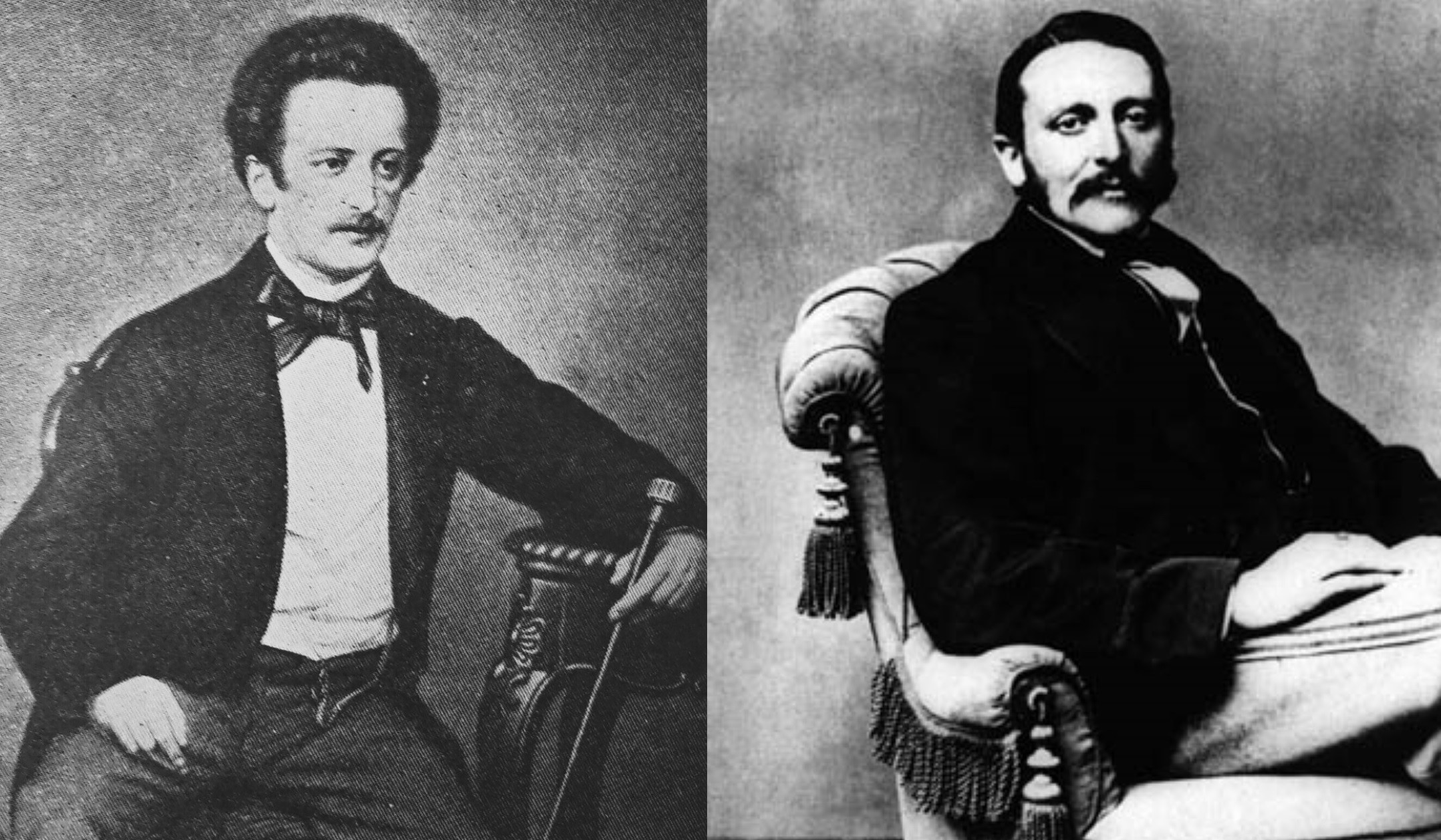
A noteworthy intervention from Louis B. Boudin in this New York Call editorial attacking the culture of the Socialist Party in refusing to tackle anti-Black racism by claiming that ‘Socialism would solve race prejudice.’ Quite the opposite says Boudin, and gives the remarkable example of Ferdinand Lassalle’s literal embrace of gay comrade Jean Baptista von Schweitzer (coiner of the term ‘democratic centralism,’ incidentally) in the face of ridicule, including from Marx and Engels, and widespread opposition in the workers movement, as the proper approach approach for white Socialists to take towards Black workers in the U.S.
”The Easiest Way’: As To Race Prejudice’ by Louis B. Boudin from The New York Call. Vol. 4 No. 60. March 1, 1911.
The discussion now going on in The Call on the negro problem is very instructive. It certainly proves Comrade Wetmore’s proposition that “socialists and race prejudice” may “walk arm in arm together,” and do to a large extent. At least in this country. So do Socialists, in this country, “walk arm in arm together” with many other prejudices, as can be easily seen from many letters in The Call on different topics, as well as from many actions of Socialists, big and small, all over the country.
It is none the less true, however, that Socialism and race prejudice cannot “walk arm in arm together.” Nor does Socialism enjoy the company of any other prejudice. In fact, Socialism and prejudice abhor each other’s company. Wherever one flourishes the other cannot thrive. Prejudices of any kind, and race prejudice foremost among them, are a sure preventive against the dread malady of Socialism. That’s why the guardians of the present order double their energies in the work of developing “patriotism”–which is only another form of race prejudice–wherever the Socialist propaganda makes its appearance. So is Socialism a well known specific against all sorts of prejudices, race prejudice among others. And experience has shown that wherever the Socialist propaganda takes root it scatters all prejudices to the winds. The growth or survival of any prejudice is therefore taken by Socialists all over the world as proof positive of the weakness of the Socialist movement.
The question of our relation to prejudices therefore presents an important problem. Shall we, who are interested in the growth of the Socialist propaganda, attack boldly all prejudices encountered in our way, or shall we inoculate the patients, whom we intend to treat, with the anti-prejudice of Socialism, thereby driving the prejudice germs out of their systems, without letting them know anything about it?
The latter method is advocated by Comrade Putnam in a recent communication to The Call, at least as far as that specific variety of the genus race prejudice known as “negro prejudice in the South” is concerned. And in a moment of weakness the otherwise militant editor of The Call seems to have given this plan his qualified approval.
This seems to me a mistake. It is perfectly true that if we succeed in making good Socialists of the prejudiced ones their prejudices will disappear. For good Socialists never “walk arm in arm together” with race prejudice, nor even on the same road. But the trouble is that we shall never succeed in making Socialists of these people without attacking their prejudices, except, perhaps, Socialists who “would walk arm in arm together” with race prejudice, which means no Socialists at all. To attempt to make Socialists of such people by circumventing their prejudices is just as good tactics as to circumvent a fort which an invading army finds in its way, when the only result would be to leave the guns of the fort trained on its rear.
The “line of least resistance” argument is no argument when it comes to fundamentals. For the line of least resistance” always turns out to be the line of last resistance. The “least” part of it is a deceptive appearance: its temporary success a snare and a delusion.
The “line of least resistance” is in fact almost never the road to lasting success. It is sometimes imposed by necessity and weakness: when immediate success is wanted and the strength or skill to surmount obstacles is wanting. The makeshifts along the “line of last resistance” are always abandoned whenever the necessary strength and skill are acquired. And lasting success is then achieved by attacking and surmounting the obstacles, not by fighting shy of them. Ask any competent engineer or good road builder and he will tell you as to the experience of mankind and the teaching of science in that “line.”
Such also is the experience of the Socialist movement, and the opinion of its most competent engineers and road builders. An incident from the history of the movement will illustrate the point.
If ever there was one “born statesman” or born politician” (in the good sense of the word) in the Socialist movement, it certainly was Ferdinand Lassalle. When Lassalle began his great agitation, which was the foundation of the great Socialist movement in Germany, there lived in Frankfort a young man, Johann Baptist von Schweitzer, who wished to join his ranks. Von Schweitzer was a brilliant man and his joining “the ranks” meant, of course, to play an important part in the movement, as the event proved. But to this there were great objections–insurmountable obstacles: Von Schweitzer had been convicted by a regularly constituted court of justice to imprisonment for an alleged sexual offense. This made him “impossible” in good society, and the “moral sense” of the workingmen of the good town of Frankfort revolted at the idea that a man like Schweitzer should be one of their leaders. They, therefore, warned Lassalle against having anything to do with Schweitzer.
But Lassalle evidently concluded that their “moral sense” was a mere “moral prejudice.” And having come to that conclusion, he attacked it boldly by receiving Schweitzer with open arms. That was, of course, “bad politics,” from the standpoint of the peanut politicians of the labor movement. The “line of least resistance” evidently lay in the direction of first making Socialists of the workingmen and then have them accept Schweitzer. But Lassalle would have none of the peanut politicians, and none of their “line of least resistance.” He always attacked boldly and without equivocation every prejudice that he encountered, as behooves a man who is out to upset all established order and usher in a new social system.
Of the great immediate success of Lassalle’s agitation, a success which was, no doubt, contributed to by those very rare qualities which made him defy all prejudices, we all know. But that’s another story. What is of more importance is the great lasting result of that, bold attack–the laying of the foundation for one of the finest organized movements the world has ever seen: a movement the success of which has been attained in no small degree by an emulation of the fine example which Lassalle set in courageously attacking prejudice.
The New York Call was the first English-language Socialist daily paper in New York City and the second in the US after the Chicago Daily Socialist. The paper was the center of the Socialist Party and under the influence of Morris Hillquit, Charles Ervin, Julius Gerber, and William Butscher. The paper was opposed to World War One, and, unsurprising given the era’s fluidity, ambivalent on the Russian Revolution even after the expulsion of the SP’s Left Wing. The paper is an invaluable resource for information on the city’s workers movement and history and one of the most important papers in the history of US socialism. The paper ran from 1908 until 1923.
PDF of full issue: https://www.marxists.org/history/usa/pubs/the-new-york-call/1911/110301-newyorkcall-v04n060.pdf
 Revolution's Newsstand