
A fascinating look at how Socialists experienced and responded to the San Francisco Earthquake of 1906. Includes personal observations of the destruction and efforts to save the I.W.W. hall, indiscriminate killings by drunken patrols of soldiers during curfew, the much worse effects on the working class and proletarian districts, a letter from Jack London, the political changes wrought by the catastrophe, and an appeal by the Socialist Party to send funds to aid members, rebuild a hall, and be able to meet the opportunities capitalist rebuilding opened for Socialist opposition.
‘Socialists in the Earthquake’ from The Worker (New York). Vol. 16 No. 6. May 12, 1906.
No Comrades Reported Killed So Far–Altho Destruction of Life Was Greatest In Flimsy Dwellings of the Poor–Wanton Killing by Drunken Soldiers–Jack London Rushes for the Danger Spot While Others Are Fleeing
The last number of the “Socialist Voice” of Oakland, Cal., gives a long list of comrades who have registered at the Oakland relief headquarters of the Socialist Party, I.W.W., and S.L.P. organizations, with the following cheering statement: “We have not yet had reports from all the San Francisco members of the S.P. or the I.W.W. or S.L.P. Perhaps we shall never know the fate of some of our comrades and brothers. But we rejoice in the fact that, so far, no one of our members has been reported as killed or even seriously injured. This is a wonderful and almost inexplicable fact.”
The same paper contains an interview with a United States marine describing the wanton slaughter of citizens by militiamen, brutalized by militarism and inflamed by drink.
“It is no impeachment of the moral fibre or sentimentality of the Socialists,” writes J. Edward Morgan in the “Socialist Voice”, “to acknowledge that they were the coolest-bended, most collected of the many thousands who witnessed and suffered from the late calamity, viewing the general distress from a philosophic as well as sentimental and moral standpoint, adding emphasis to the established fact of the healthy poise of the Socialist mind.
“The general, every-day calamity of capitalism, toward which they grow more and more rebellious, and their determination to conquer it, has made them proof against every other calamity; for capitalism is to them the most horrible calamity known to man.
What Socialists Thought Of.
“A world-wide continuous earthquake with belching craters over every square mile of its hideous domain. And in this hour of general distress, when rich and poor, master and slave, leveled for the moment, are forced to line up side by side and reach the needy hand for the bread of charity, and drink from the same tin can or ditch, is shown the depth of the deep tap root of Socialist conviction and devotion. Side by side with dejected property owners brooding over their misfortune and seeing in dame and smoke and debris only their personal loss in dollars and therefore their every earthly hope, stood groups of wage workers sorrowing over the loss of jobs and masters, and all their earthly hopes; and besides them both stood groups of Socialists, wondering. philosophizing, speculating as to what effect this awful catastrophe shall have on the Socialist movement. Wondering, hoping and fearing, in the midst of general distress, with the flames closing in around them, whether the business of the country and the public mind shall be so affected as to delay the Socialist Republic.
“Will such a calamity, or others that might follow, prolong by a fortnight the more horrible capitalist system? Will it check our propaganda? Will it arrest the concentration of capital to a degree? Will the capitalists of Idaho take advantage of the paralysis of the public mind and do away with our beloved comrades of Colorado now In the hands of the enemies of Socialism?
“Such were some of the actual expressions of Socialists gathered in little groups coolly philosophizing an hour or so after the terrible shock that laid San Francisco in ruins and made 350,000 of her people homeless.
“This spectacle of homeless comrades, many injured in the wreck of buildings, coolly speculating on the moral and political aspect of the calamity and planning for the future of the Socialist movement in the midst of a burning city without food or water and under martial law, but reveals the depths of the Socialist’s conviction and devotion to the great cause to which if need be he will one day give his life.”
Holmes’ Experience.
Geo. S. Holmes writes in the same Issue of our Oakland organ as follows: “The great fire and earthquake which in a couple of days changed San Francisco from a great commercial center to a heap of ashes and in which the lives of several thousand human beings were lost, most of whom lived in the poorer districts south of Market street, demonstrates only too clearly the historic class struggle, the impassable gulf between the proletarian and the capitalist.
“The writer was awakened about 5:15 in the morning by a terrific shock which lasted for about 30 seconds. The house rocked to and fro and great masses of plaster fell upon me as I lay in bed. Dressing quickly, I rushed outside and saw chaos and destruction all around me. Half nude men and women rushed wildly hither and thither; houses were collapsing or bad already fallen. Pandemonium reigned. went into the house again and got on a few more clothes. While going up to the I.W.W. headquarters, blazing buildings, telegraph poles, and live wires were all around me. The headquarters was in a horrible condition, the sidewalk had fallen in and the building had a lean toward the street. I with some other comrades managed to secure the metal workers charter of the I.W.W. together with a few books of the organization. By this time I had met a few comrades. The fire are had spread everywhere south Market, Howard, Folsom and other nearby streets. The earthquake had caused the collapse of the Brunswick Hotel, corner Sixth and Howard. It caught fire and the screams of the imprisoned people, who were roasting to death, were heart rending. A few were chopped out, but about 80 were cremated. The fire was by this time in full possession of the I.W.W., S.P. and S.L.P. headquarters. At St. Patrick’s church on Mission, between Third and Fourth, fell on a lodging house, causing the death of 150 people. But two persons, a man and wife, were saved from another rooming house on Folsom street. The earthquake had caused the bursting of the water mains so that not a drop could be obtained to fight the fire, or for drinking. Fumes of escaping gas filled the air.
Capitalist Brutality.
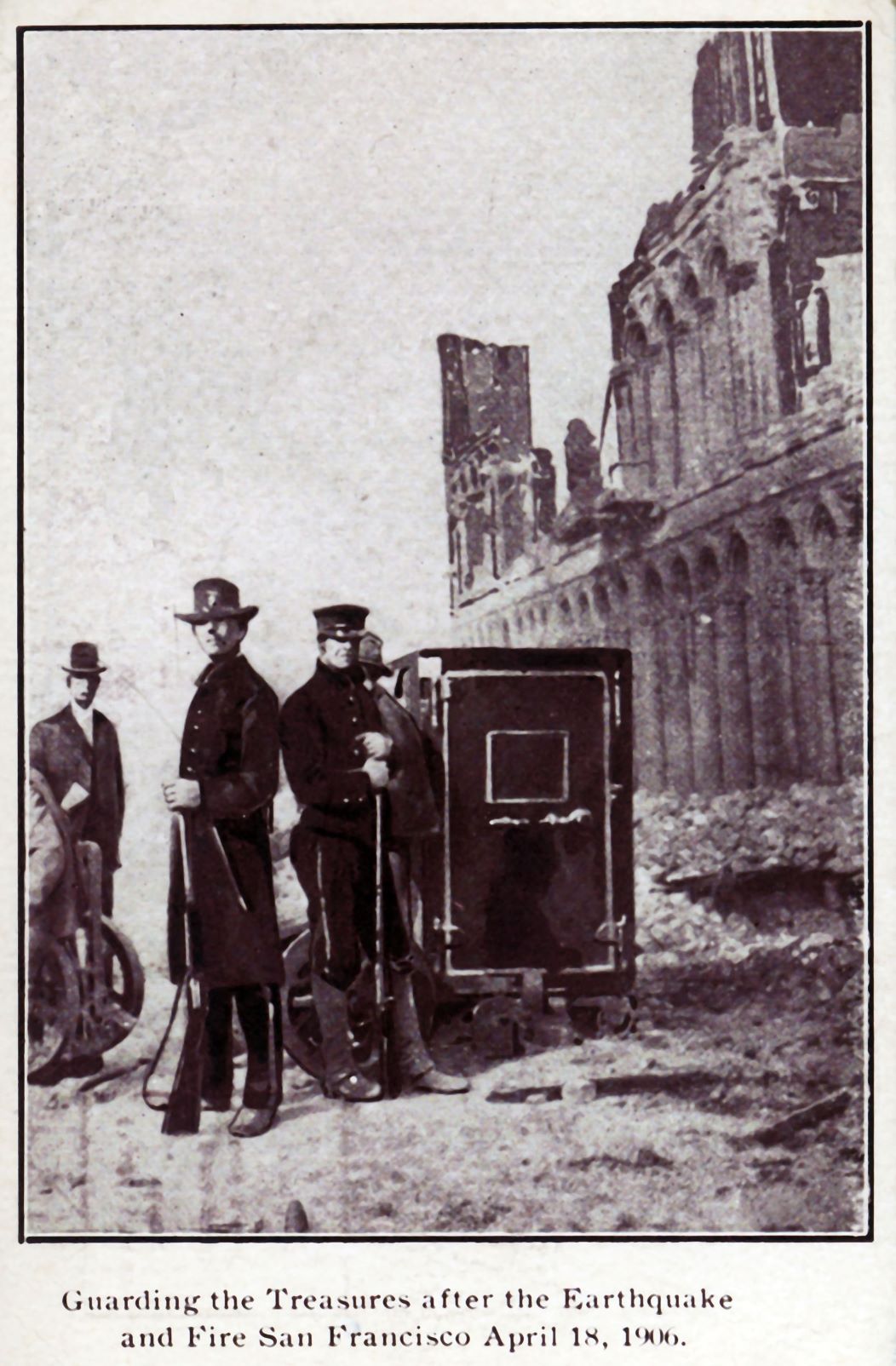
“The regular army was ordered from the Presidio and martial law proclaimed. Then ensued some brutal scenes. Men were assaulted and in many cases shot without provocation.
“One case that merits notice was when a soldier shot four men for carrying away provisions a grocery had given them. The so-called guardians of the people proved themselves incompetent and worthless and three thousand organized workmen could have kept order and run things in a thousand-fold better manner. In Jefferson Park, which I reached that evening, about four thousand people were congregated. The soldiers followed men and women about taking from families flasks of whisky needed for medicinal purposes.
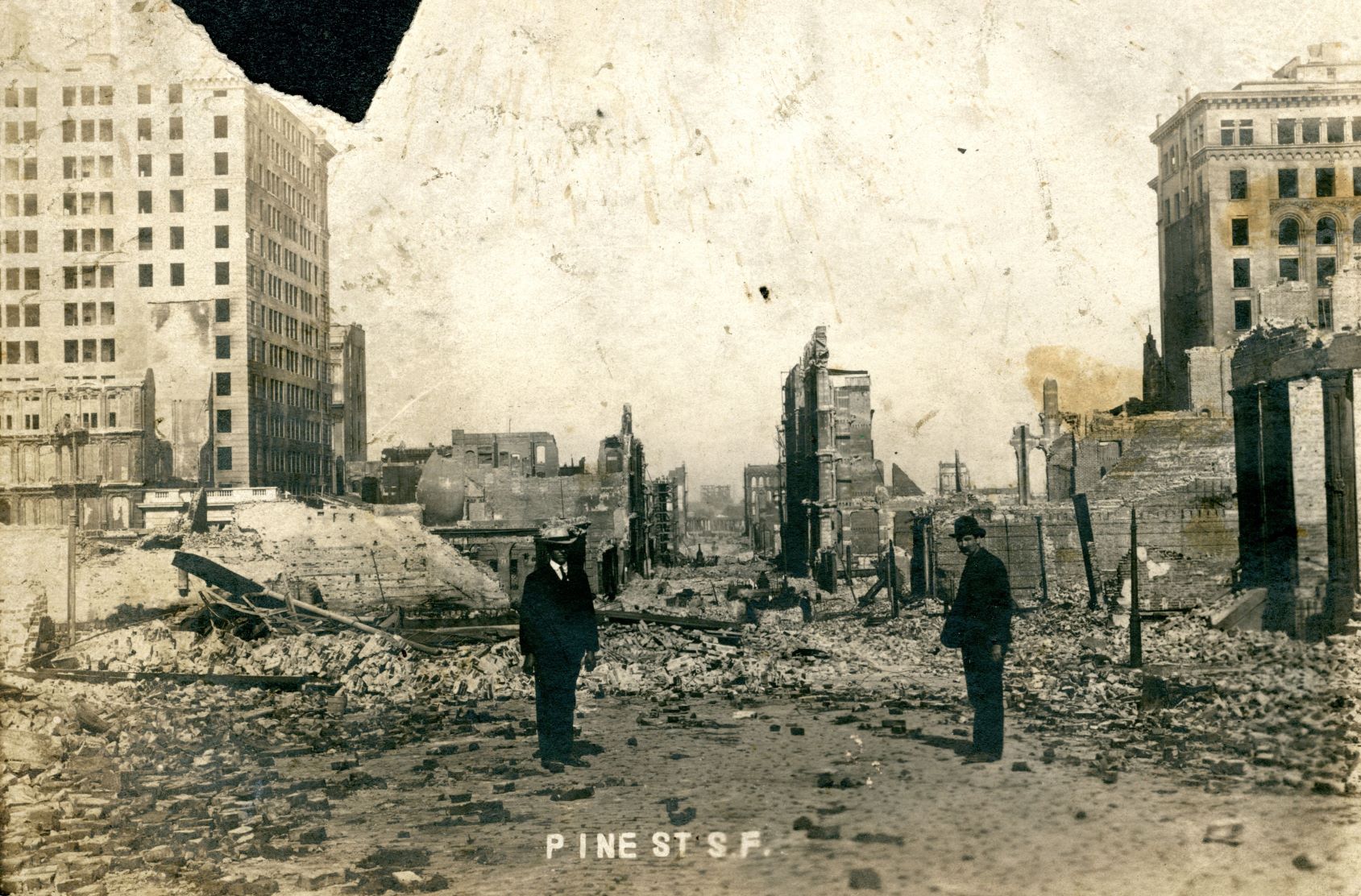
“Night added to the horrors of the scene. The blaze from the burning city reflected the parched and agonized faces of thousands of homeless sufferers. Dynamite explosions resounded from all directions; a sleepless and miserable night was passed. The gray dawn of morning brought a slight relief to our nerves, altho the horror had not abated. Food was almost unobtainable-some of our nice charitable business people demanding from 50 cents to $1 for a loaf of bread. Water was a forbidden luxury and with thousands of people herded together the fear of epidemics prevailed. On making our way with extreme difficulty to the ferry, preparatory to reaching Oakland, the old appeal came to my mind: Workmen, why do you build palaces and live in hovels? And I thought of the loss of life of the proletarians who lived in the miserable shacks south of Market street–lives sacrificed thru the greed of the proprietors of these dens and then of the comparatively small death rate in the bourgeois quarter. My blood-boiled and I could scarce refrain from crying aloud: Workingmen, unite! You have a common enemy to fight and. nothing to lose but your chains!
Jack on the Spot.
With characteristic love of adventure, and perhaps with the writer’s natural love of copy, our author comrade, Jack London, rushed to the scene of the disaster which others were fleeing from. Gaylord Wilshire received last week the following letter from Comrade London:
“Heartiest thanks for yours of the 20th. Frisco was wiped out. I inclose herewith some snaps showing you how Santa Rosa was wiped out. My own Alms of the Santa Rosa ruins have not yet been developed. These prints were sent me by a friend, so please return them at your earliest convenience. Charmian (London’s wife) and I were at Glen Ellen when the earthquake came. It ruined the walls of my new stone. We jumped up to Santa Rosa and saw the destruction there, and Inside of twelve hours after the earthquake, were in San Francisco, Charmian and I spent all of Wednesday night in the path of the flames, and on Thursday crept down thru the smouldering ruins to the ferries, and got over to Oakland. Frisco is gone. There is never a place you were ever in with the exception of Golden Gate Park, that is now standing in San Francisco. I am afraid so enormous a destruction of capital will somewhat retard the Socialist movement here, especially in San Fran cisco. If an equal destruction of property had occurred all over the United States I doubt not that Socialism would have been retarded a generation. Thanks for the inside line of Gorky, and the knocking of the “World”. Thank God that the one thing I am not, is BOURGEOIS. Many comrades will be interested to know that Joseph Spero, formerly of Boston and New York, who has been in San Francisco for some months, left that city just two days before the catastrophe and is now back in Boston.”
AN APPEAL FROM LOCAL SAN FRANCISCO.
The following appeal is addressed thru the Socialist press to all comrades and sympathizers:
Comrades of the Socialist Party: The Socialists of San Francisco have suffered very severely in the terrible calamity that has befallen this city. We are therefore compelled to appeal to you for aid. Devastation and ruin, complete destruction and disorganization have come to local industry. The entire business district, wholesale and retail, and almost all the manufacturing establishments have been entirely obliterated. There is no light, no power, no electricity, no telephones, street cars, few laundries, practically restaurants or hotels. None of the thousands of offices, stores, and shops proletarians found employment are We are therefore face to face with a situation in which many of our members have extreme difficulty in maintaining themselves and their families. Being residents of the proletarian quarters, which, as usual, have suffered most heavily, by far the greater number of our members themselves destitute even of those personal belongings which ordinarily comprise the all the belongings of wage earners.
Earthquake and fire have deprived us of shelter, food, and even employment by which we might replace our losses.
While at present the general relief work is preventing physical suffering, there are already alarming signs of exhaustion of food and supplies. If this is precipitated on us before there is an adjustment of business and a resumption of employment, there will be a great deal of acute distress.
We are loath to ask of others for aid for our personal relief. We shall do our best to maintain our personal independence. But for the next year or two only day laborers and mechanics connected with building operations will be able to find adequate employment. Some of our members therefore must depend on comradely help to tide them over a period of unemployment. We must have funds to aid them.
The disastrous conflagration and the general impoverishment have badly crippled our organization and that at the beginning of a critical campaign. Our headquarters have been totally destroyed. We have lost all our records. Our furniture, our fine library, our large stock of books and other literature were consumed by the flames. These were worth over a thousand dollars and are now a total loss. In addition, we are now losing our income from propaganda meetings, collections, and literature sales, averaging $250 a month, and which has been continually returned into propaganda. In dues, too, we will inevitably suffer severe decline for some months, and must regain the proud position we have heretofore held of paying one-fourth the dues in the state which ranks third in the Union. The capitalists, undaunted by their losses, have banded together to build bigger and busier San Francisco. They will draw funds from all the money centers world to finance the reconstruction. We Socialists, the true exponents of working class interests, stand ready to build a bigger and better local. We appeal Comrades thruout the country to aid us in keeping pace with our inveterate antagonists. We must have funds to continue effective existence and properly utilize the opportunity which is now offered to us.
In the general destruction nearly all the theaters and halls were swept away. The few that remain are charging exorbitant rentals and thus we are confronted at once by an obstacle and an opportunity. Land rentals in the burnt district are reasonable, labor volunteered, and the erection of a hall will be cheap and profitable. If we can proceed immediately to its construction it will become a revenue producer and a visible sign of Socialist vitality. It will put us more solidly on our feet than ever in a financial way, and enable us to look after our own members. It will make us an integral part of the new San Francisco, respected and feared by our opponents.
The political situation is changing marvelously. In this crisis Schmits has fraternized with the capitalists and new political alignments loom large just ahead. The barrier to our progress, offered by the Union Labor Party, is being disrupted and the situation demands the most strenuous exertion on our part to meet the crisis with a powerful force and turn events our advantage. A gubernatorial campaign is on this year, and a public ownership movement must be headed off by active propaganda. The utmost aid is of greatest importance to us.
San Francisco has contributed most generously to every fund for the party’s in the past, and we now ask the comrades to do their best by us.
We appeal to comrades, each and all, to exert every effort to raise all possible funds for us, to dig deeply in your pockets to help us care for our destitute, homeless and workless, to repair our losses, and seize the golden opportunity which promises great things for the cause in California. It is imperative that we get every cent you can give, and quickly.
Send all money to George Williams, Organizer of Local San Francisco, Socialist Party. 1012 Minnesota St.
The Worker, and its predecessor The People, emerged from the 1899 split in the Socialist Labor Party of America led by Henry Slobodin and Morris Hillquit, who published their own edition of the SLP’s paper in Springfield, Massachusetts. Their ‘The People’ had the same banner, format, and numbering as their rival De Leon’s. The new group emerged as the Social Democratic Party and with a Chicago group of the same name these two Social Democratic Parties would become the Socialist Party of America at a 1901 conference. That same year the paper’s name was changed from The People to The Worker with publishing moved to New York City. The Worker continued as a weekly until December 1908 when it was folded into the socialist daily, The New York Call.
PDF of full issue: https://www.marxists.org/history/usa/pubs/the-people-the-worker/060512-worker-v16n06-DAMAGED.pdf
 Revolution's Newsstand