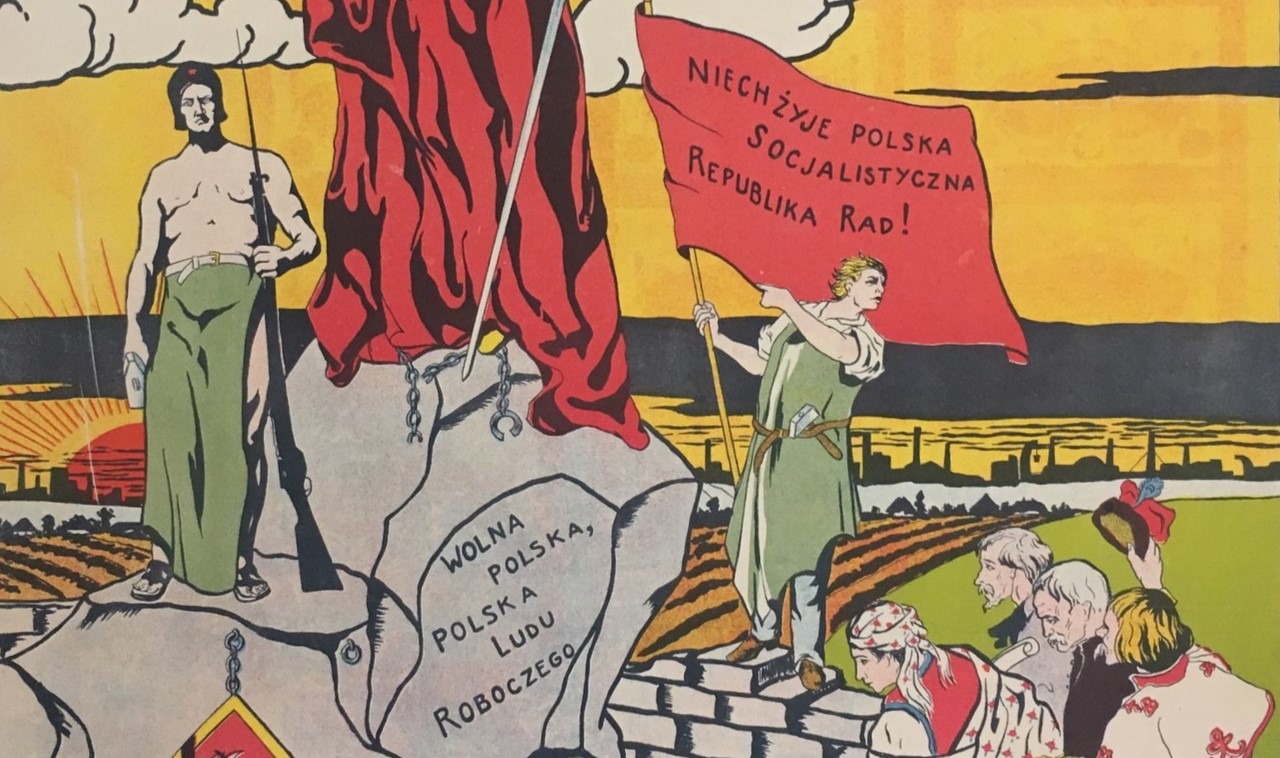
The meeting of the Polish Communist Party in conditions of illegality following the Polish-Soviet War had a distinct majority and minority with the Left, led by Domski, rejecting many of the Comintern’s United Front policies as related to Poland as well as lingering disagreements over the war.
‘The Communist Party Convention in Poland’ by L. Domski from International Press Correspondence. Vol. 2 No. 44. June 2, 1922.
The Convention of the Communist Party of Poland took place a few weeks ago. Of course it met illegally, since all Communist activity in Poland can only be carried on underground.
In spite of this difficult situation, however, the very organization of the party convention showed clearly to what extent Communism in Poland has grown. This convention, the third one since the creation of the party, was attended as no other of the former conventions was. While the first party convention had only the delegates from the regions of former Congress Poland, and at the second one, the other Polish districts were little represented. at this third convention the delegates from Posen, Galicia, Upper Silesia, Teschen Silesia and Polish Lithuania constituted one-fourth of the entire convention representation, namely, 11 out of 41. The members of the Central Committee, the central editors and the sections of the Central Committee were present with advisory votes, namely: 1. The trade union section, 2. The railwaymen, 3. The Jewish section, 4. The agrarians, 5. The technical and 6. The youth sections. A representative of the so-called Communist Bund, the Communist wing of the Jewish Labor Bund, was also present at the convention.
The agenda included the following: 1. The political situation in Poland and internationally, with particular emphasis on the question of the united front, 2. The political and organization reports by the Central Committee, 3. The agrarian question, 4. Trade union work, 5. The national question.
Because of lack of time the national question and that of trade union work had to be left untouched, for it was considered unsafe unduly to prolong the convention. The united front question and the agrarian question gave rise, however, to lively discussions.
On the question of the united front, there were two diametrically opposed views represented at the convention, with a third conciliatory group between them. Those opposed to the united front tactics brought up the well-known arguments that had been voiced in other countries. This group feared that the raising of the united front idea and the formulation of the so-called partial demands would blur the goal of the Communist movement and would lead to the actual abandonment of the more far-reaching issues of the social revolution and proletarian dictatorship. The proponents of the center position argued on the line of the united front opponents in France. They accepted the united front idea only as far as the International was concerned, but as to Poland, they argued these tactics were inapplicable because of the extraordinary intensification of inter-party relations and of the unprecedented infamy of the Polish social patriots.

Both of these groups were in the minority, and the majority of the convention accepted the tactics of the united front. The theses on the international situation already defined the attitude of the convention towards the united front. The special resolution on the united front question dwelt upon these tactics in detail.
Otherwise the theses on the international situation differed in no essentials from those of the Communist International and of the Communist Party of Germany. The theses on the political situation in Poland are however extremely interesting.
First of all, it is pointed out that at the time of the birth of the Polish Republic, the Polish bourgeoisie occupied a more favorable position than the possessing classes in other countries. The greater part of Poland was no real participant in the world war; for this reason it did not suffer much from demobilization. At that time Polish militarism began to develop, and it served as a safety-valve in that it absorbed the most active part of the unemployed masses. The revolutionary movement in Poland was then more of an echo of the revolutionary movements outside of Poland, but chiefly an echo of the victorious Russian and the German Revolutions. The defeat of the German Revolution led directly to the victory of Polish reaction.
It was only later that the development of the revolutionary elements in Poland took place. The enslavement of Poland in the interest of French imperialism did bring Poland territorial gains, but only at the expense of Polish economic life, all of whose natural treasures (Galician petroleum, Polish coal, Upper Silesian ore) are now the property of foreign capital. At the same time Poland must keep up a huge military machine that is bringing Poland to financial ruin. The burdens and the destructive forces of the long war rendered Polish industry incapable of competing not only in foreign markets but even within the country, in spite of the depreciation of the Polish mark. As a result we find Poland suffering from chronic unemployment, continual rise of the cost of living, wage struggles and he employers’ offensive against the working class.
In the country, the peasant masses are disappointed with the agrarian reforms so pompously passed by the Sejm. Only the large landowners benefited by it, a fact that again intensifies the class conflict in the rural districts.
As far as the working class is concerned, Poland is dominated by a policy of the most ruthless and tyrannical oppression, that assumed the form of the White Terror at the time of the Ukrainian campaign. The growing militarism that is overrunning Poland serves as a weapon of oppression in the hands of the ruling classes, and the financial bankruptcy of the state brings about the most cruel exploitation and suppression of the working masses. The agrarian workers are particularly sharply suppressed.
If we add to this the nationalist policy of oppression applied by the Polish bourgeoisie against foreign nationalities in the border regions, the complicated colonization policy in the Eastern regions where it is being applied at the expense of the White Ruthenians and the Ukrainian peasantry, and which reaches its climax in shameless anti-semitism, we get an idea of the factors at work responsible for the continuous revolutionary ferment which are systematically undermining the present class-rule in Poland.
The demonstrative resolutions adopt at the beginning of the convention reveal the situation in the Polish party in its full light. In them we read the protest against the assassination of Comrade Josef Krzos, member of the Party Committee in Starachovice, and treasurer of the Metal Workers’ Union. Without a trace of legality, the police authorities arrested this comrade, and when he refused to furnish the desired “information at the “trial”, he was tortured to death. The party convention also sent its greetings to those comrades languishing in prison for the cause of the proletariat. Finally we must mention the resolution rendering homage to the fighters of Soviet Russia.
International Press Correspondence, widely known as”Inprecorr” was published by the Executive Committee of the Communist International (ECCI) regularly in German and English, occasionally in many other languages, beginning in 1921 and lasting in English until 1938. Inprecorr’s role was to supply translated articles to the English-speaking press of the International from the Comintern’s different sections, as well as news and statements from the ECCI. Many ‘Daily Worker’ and ‘Communist’ articles originated in Inprecorr, and it also published articles by American comrades for use in other countries. It was published at least weekly, and often thrice weekly.
PDF of full issue: https://www.marxists.org/history/international/comintern/inprecor/1922/v02n044-jun-02-1922-Inprecor-yivo.pdf
 Revolution's Newsstand