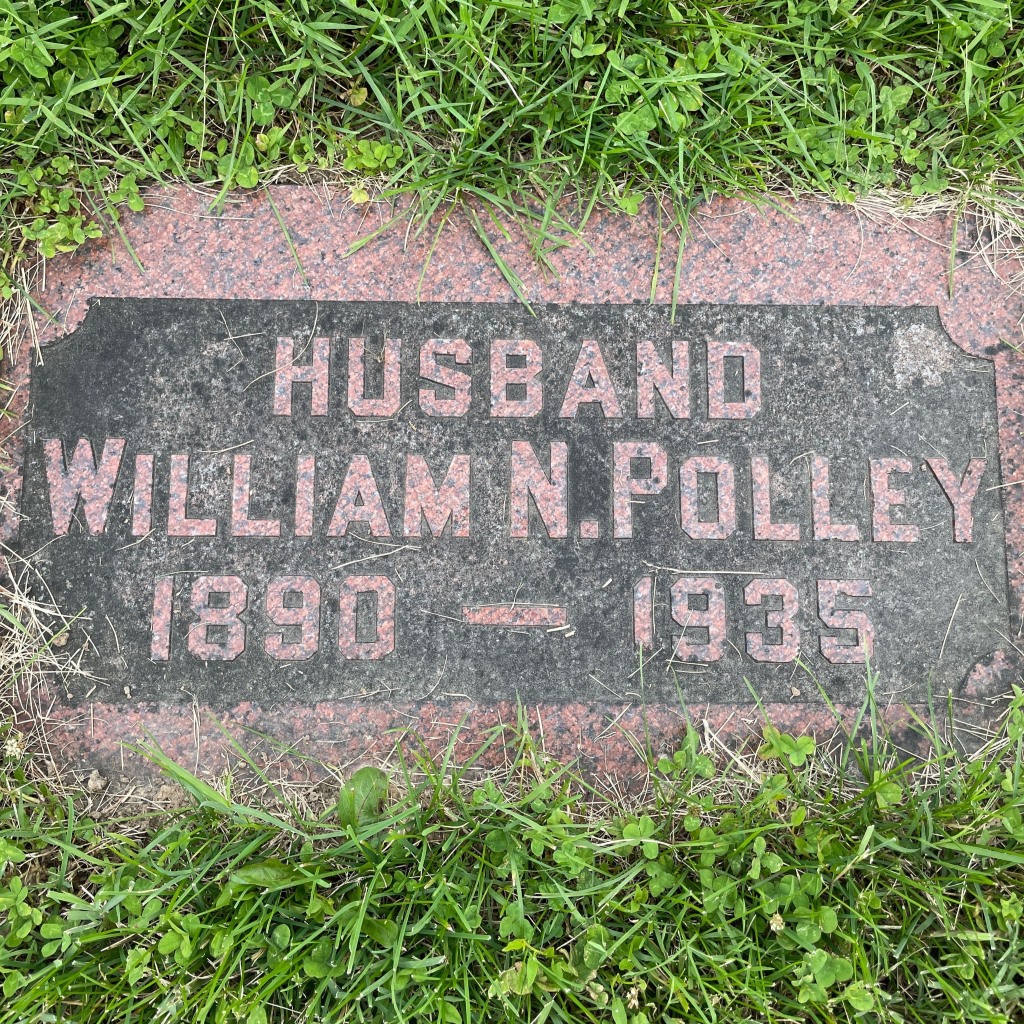
William ‘Bill’ N. Polley was a Socialist activist and business agent for the Teamsters in Kansas City when his union militancy and refusal to accept bribes made him the fourth labor activist in the city to be murdered in five years. In the face of police intransigence, labor organizations and the Socialist Party raised a reward of $15,000 to help find the killers. All four murdered remained unsolved.
‘Murder Kansas City Socialist’ from Socialist Call. Vol. 1 No. 33. November 2, 1935.
Gangsters Go Free When Police Make No Murder Arrests.
KANSAS CITY, Kans. (Special)-Realizing by the attitude of the police that no real effort will be made to arrest the murders of William L. Polley, militant Socialist union leader, organized labor in Kansas City has set for itself the task of 100 per cent union organization as the most effective reply to the brutal killing.
Polley, business agent for the truck drivers, was ruthlessly put on the spot by hired gangsters while on the way home from a union meeting. Finding him incorruptible, the bosses resorted to murder to remove him from the scene where he gave freely of time and talent not only to build up his own union to more than 2,500 members but also in aiding the organization drives in the automobile and clothing industries,
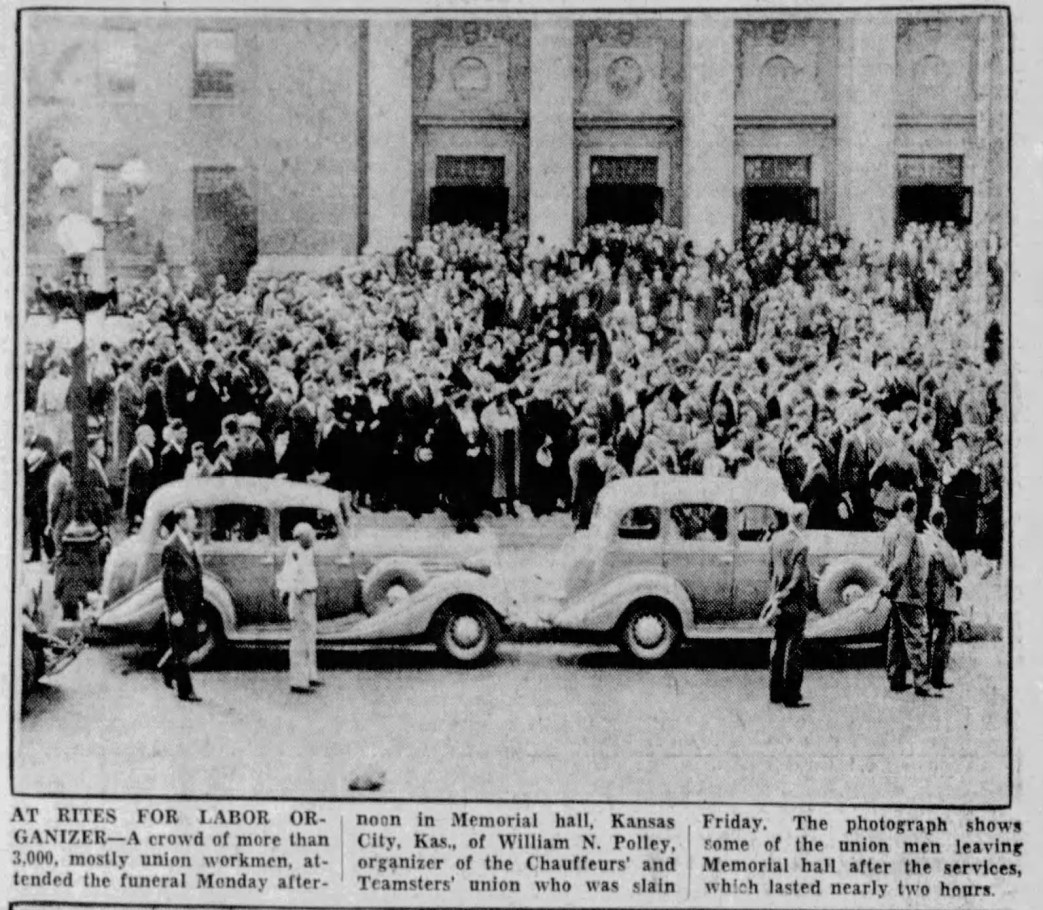
3,000 at Funeral
More than 3,000 of his fellow-unionists and Socialists attended Polley’s funeral, where they heard Homer Martin, vice-president of the Kansas City local of the United Automobile Workers of America and noted Socialist leader, pay high tribute to the martyred unionist as a man who personified the highest ideals of Socialism and labor. On the casket lay a large spray of red roses with. the word “Comrade” in gold letters sent by the Socialist Party: a memorial service was held over the radio.
Polley was a fearless leader and forced several of the large trucking firms to recognize his union in spite of the powerful association the employers have The members of the organization have been ruthless in their treatment of labor and warned Polley many times that they would “get him” if he did not curb his activities.
Refused Enormous Bribe
He told friends a short while before he was murdered that he had been offered $15,000 and good pay for the rest of his life if he left the labor movement and moved to some other state. Apparently this was the last offer of the association, and when he refused, they hired gunmen to kill him.
Although there are many clues as to who did the job, local trade unionists are doubtful whether they will be followed up by the police. Kansas City Socialists are starting to raise a fund to investigate and fight to bring the real culprits to justice.
‘Offer $5,000 Reward in Union Murder’ from Socialist Call. Vol. 1 No. 34. November 9, 1935.
KANSAS CITY, Kansas (Special) A reward of five thousand dollars was posted by the Socialist Party of Kansas City last week for information leading to the arrest and conviction of the murderers of William L. Polley, militant Socialist labor leader who was put on the spot by hired thugs here three weeks ago.
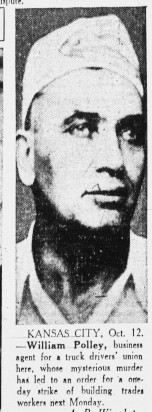
Polley’s murder has revealed the entire history of a vicious anti- labor terror that has existed in this city for many months. Union leaders have been cajoled, threatened, kidnaped and slugged in an effort to stop the wave of union organization which has swept this city. The bosses’ offensive has been directed particularly against the International Ladies’ Garment Workers’ Union and its intensive drive to band together the garment workers here for their own protection and benefit.
No Weapon Discarded
No weapon was discarded by the clothing bosses in their anti-union fight. Four gangsters kidnaped Sol Goldberg, business agent of the ILG, Local 118, leader of a strike against the Rosenberg Dress Company, and beat him up so badly that the union sent him to a hospital in California to recover.
When Virginia Monk, ILG organizer from Dallas, Texas, was sent here to replace Goldberg, she was attacked by some thugs and beaten up, necessitating hospital aid. Since then, Mrs. Monk has been accompanied by a bodyguard when going around the city.
Slain for Strike Call
Polley, who was business agent for the Teamsters union, was murdered after he had decided to call a strike of truck drivers when preliminary negotiations with the employers failed. Less than an hour after he had left the negotiation conferences announcing that he would call the strike immediately, he was shot down in cold blood on the open street. Polley had been threatened at various times and was once offered a $15,000 bribe “to leave town.”
The murder has spurred both the Socialist Party and the organized labor movement to unprecedented activity. Realizing that the police, controlled by a political machine in direct alliance with the manufacturers, would make no effort to arrest Polley’s murderers, Socialists are conducting their own investigation, meanwhile offering the $5,000 reward as an aid to other private investigation.
‘Three To Go’ Killers Tell Kansas City Cops’ from Socialist Call. Vol. 1 No. 35. November 16, 1935.
KANSAS CITY (Special). Three more active Socialists are on the list to follow William N. Polley, murdered Socialist and union leader, but the local police are doing nothing about it.
It was revealed here this week that some time after Polley was brutally murdered by hired gangsters, the police received a letter which declared “there were three to go.” Police, however, are continuing their “investigation” which, according to local reporters, will become another of Kansas City’s unsolved labor murders.
Polley, a business agent of the teamsters and truck drivers’ union, was shot as he was going home from a negotiations conference with employers. At that conference, he had spurned further offers of delay and had walked out after delivering a strike ultimatum. He was killed less than an hour afterward.
Raise $15,000
The organized labor movement. represented by the Central Labor Council of Kansas City, Missouri, has raised $15,000 to be used in an effort to bring the murderers to trial. Five thousand dollars has been set aside as a reward for information leading to the conviction of the gangsters and the other $10,000 will be used for independent investigation.
The Socialist Party labor committee has also hired an independent investigator. Little dependence is placed on the police because of the political power of the north side gangster element, suspected of the murder.
Is Fourth Murder
Polley’s murder marks the fourth killing of a unionist in five years. The first was Peter McKay, a union carpenter, who was shot to death in June, 1930. On January 16, 1935, J.M. Stubblefield, a leader in the carpenters’ union, was ambushed at the union hall and killed. He was followed by Ray Fixley, a brother of Robert P. Fixley, active unionist, in February, 1934.
None of these murders were ever solved.
Thousands turned out to the Polley funeral, one of the largest ever held in the Southwest. The Building Trades Department of the AFL issued a call for a one-day ‘holiday’ so union members could attend.
Socialist Call began as a weekly newspaper in New York in early 1935 by supporters of the Socialist Party’s Militant Faction Samuel DeWitt, Herbert Zam, Max Delson, Amicus Most, and Haim Kantorovitch, with others to rival the Old Guard’s ‘New Leader’. The Call Education Institute was also inaugurated as a rival to the right’s Rand School. In 1937, the Call as the Militant voice would fall victim to Party turmoil, becoming a paper of the Socialist Party leading bodies as it moved to Chicago in 1938, to Milwaukee in 1939, where it was renamed “The Call” and back to New York in 1940 where it eventually resumed the “Socialist Call” name and was published until 1954.
PDF of full issue: https://www.marxists.org/history/usa/pubs/socialist-call/v1n33-nov-2-1935.pdf
PDF of full issue 2: https://www.marxists.org/history/usa/pubs/socialist-call/Call%201-35.pdf
PDF of full issue 3: https://www.marxists.org/history/usa/pubs/socialist-call/v1n36-nov-23-1935.pdf
 Revolution's Newsstand