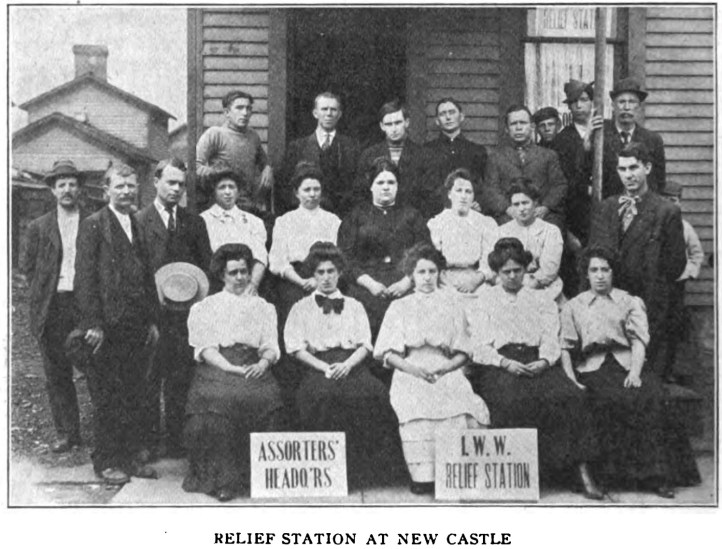
Arguably, no strike led by the I.W.W. in the East was more important than the massive, bloody, and eventually victorious conflict with the U.S. Pressed Steel Company outside of Pittsburgh at MkKees Rocks, Pennsylvania. Here Joseph Ettor reports on the efforts unite the industries diverse workers, the role of ‘American’ workers, company unions, and the notorious Pennsylvania cossack.
‘I.W.W. Organization N0. 296, McKees Rocks’ by Joseph Ettor from Industrial Worker. Vol. 1 No. 31. October 20, 1909.
The actual paid-up membership of the I.W.W. of McKees Rocks for the present is 2000. The applications we have on hand number over 4000. The reason that we have only one-half paid up is due to no fault of the men, but is to be understood by the fact that all those that have not as yet paid any fees or dues are not counted in this statement, although most of them are allowed to participate in the business of the organization. The reason that only about 2000 have paid up is to be explained, not in the lack of interest in the organization by the men, but to the fact that last Saturday, October 9, was really the first payday of the men since the early part of July.
Without doubt the greatest proportion of the membership are Polish, and next come the Slavonians.
The races and nationalities represented are: Germans, Czechs, Austrians, Hungarians, Magyars, Slavonians, Croations, Roumanians, Greeks, Poles, Lithuanians, Russians, Italians and Americans, also Irish, Welsh and English. The branches of Industrial Union No. 296 so far organized are:
No. 1, American.
No. 2, German-Hungarian-Austrian-Roumanian-Bohemian.
No. 3, Russian Polish-Lithuanian-Ruthenian.
No. 4, Slavonian-Croatian.
No. 5, Italians.
No. 6, Greeks.
It may be said in this connection that the biggest branch of them all is No. 3. The smallest are first the Italian and then the American. The reason that the Italian branch is not very numerous as yet is not only due to the small number of the Italians employed in the Pressed Steel plant, but also due to the fact that very few, indeed, work at anything except as laborers, but the 200 or so that are employed will in a short time be in line. The reason that the American branch is about the last on the list is due to various facts, but I will only enumerate a few. First, they are few in number, and thus believe themselves a sort of privileged part of the employes; second, they have not as yet quite rid themselves of the C.A. Wise virus. But we may rest assured, and all present indications tend to clinch the idea, that in a very short time they will–those that are wage workers–get rid of that disease and line up with the rest.
The name of the secretary for the combined branches can not be given for the present, as the branches are now getting down to business and are having an election for secretary and a treasurer. For the present Fellow Worker Frank Morris is acting in this capacity with unusual distinction.
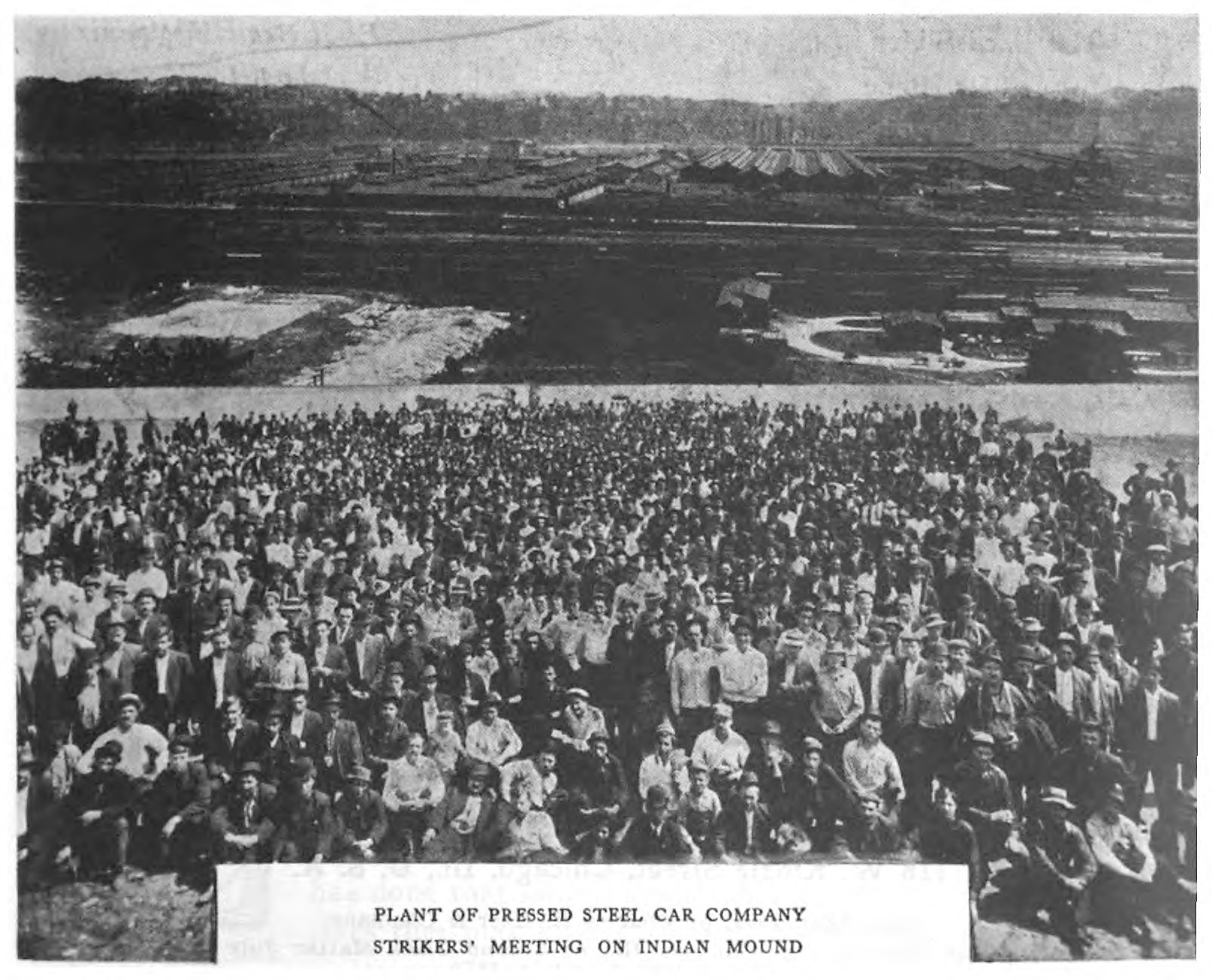
The Central Committee has been organized and is doing business. It is composed of representatives of the diverse defined languages, and representatives are elected proportionately from all branches.
There are very few scabs in the shops now. It must be explained that on September 15 they were all compelled to leave, but due to the dirty work of the company man and tools, under the leadership of C.A. Wise, they managed very few at that to get back when the second strike was declared off.
Wise, the Traitor.
C.A. Wise, the labor faker, is still around town. A few words about this gent may not be out of place about this time.
He and his committee, that were deposed on the first day of the second strike, are still claiming to be the “Executive Strike Commit-tee” and have made a move in the direction of organizing an outfit called “The United Car Workers of the World Benevolent Association,” a coffin outfit for fair. That the organization would have a short life there was very little doubt, but it was not expected that it really could be as short-lived as it is panning out. The latest developments are that the so-called “Bix Six” has split in two parts, from the fact that the expenses to keep the outfit going were too much. The expense for salaries alone is about $100 or more a week. The most they had was 200 members, which meant an income of $200 a month!
Wise’s game for the bosses was played too raw to fool the most gullible of wage slaves. He was the chairman of the strikers, but after the second strike he went into the shops with the bosses and pointed out “the dangerous men,” which, of course, mean the most active fighters during the strike. That was too much, and it is a treat to read the letters that are published in the Pittsburg “Leader” from time’ to time by former strikers, under the headline “Letters From the People.” They tear the hide of this labor faker for fair. We have the proof that the gent is captain of the “Zouaves Company,” a military organization in this state, must also be stated that this fellow was not one of the first that walked out in the general strike. In fact, he and his pals scabbed it for nearly two days before they went out, and then they didn’t go out voluntarily, either. He worked in the department that was ordered to go home because the bosses feared that the “foreigners” were going to blow up the shop in order to drive them out, so they were told to go home and thus avoid trouble.
There is no A. F. of L. organization of any kind whatsoever in the plant. The hours of work are 10 hours for five days and a half-day on Saturday. The company did not grant the half-day holiday on Saturday, but the men took it, and so the bosses can’t help themselves. In this connection a flashlight may be thrown on Wise. At a meeting held by the Wise’s coffin society, where he spoke, it is reliably reported that he delivered himself of the following gem on unionism: “Last Saturday the company, in order to finish a rush order, asked that the men work the rest of the day till 4 o’clock. But these I.W.W. fellows passed around the word ‘that any one who would work after dinner would be hanged.’ I would have liked to have been working there, and I would have given them an opportunity to hang me.” Great words, indeed! But let me say, Captain of the Zouaves, that it was probably a good thing that you were not working, for though you have made a failure of everything that you have undertaken, in this case you would probably have made a triumphant but sorrowful success.
There can be no detailed account as to the wage scale, as it would require a too lengthy statement for publication.
Cossacks Gone.
The gun men that were here, that is, the Cossacks and deputy sheriffs, have all taken their leave, with the exception of those who have been rewarded by the company by being put on as police on the police force of the company. For be it known that this great, law abiding, patriotic, capitalist crowd has a complete police force of its own, with its own chief, etc.
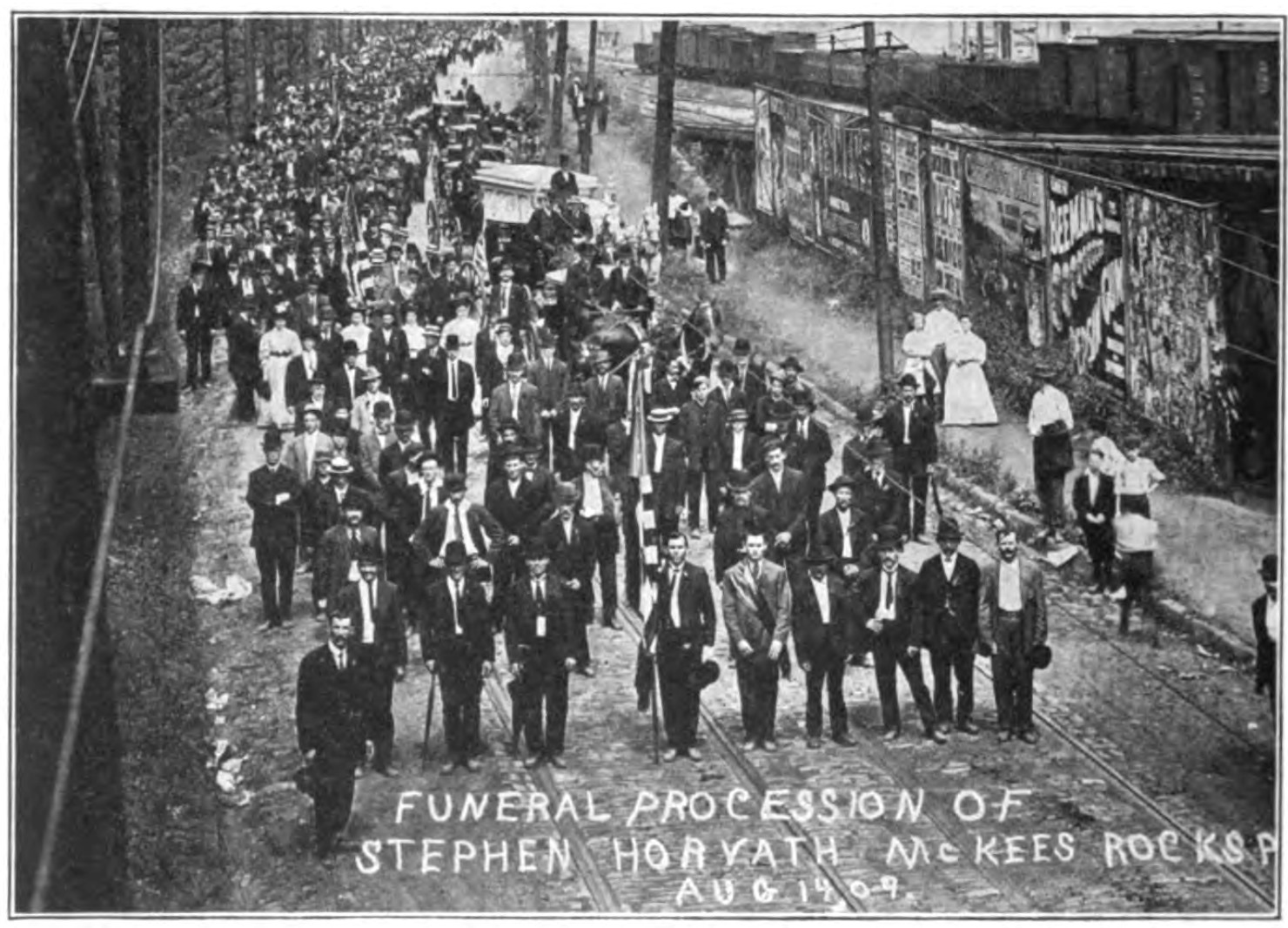
The Cossacks and deputy sheriffs that were doing duty on the morning that the men returned to work after the second strike, which was called by Wise, were at the plant were at the plant when they saw the 200 or so “brave and patriotic Americans (?)” salute their comrades with all military honors.
As far as the Separation of Labor organizers are concerned around here, they have met with a sorry disappointment all along the line. During the last week P.F. Richardson, president of the A.F. of L. car workers’ international, was here in an effort to organize a local of Separationists, but he met with failure indeed. He held a meeting of his own apart from the Wise crowd on last Saturday (payday), and in spite of the great galaxy of general organizers of the A.F. of L., including the notorious J.D. Pierce of scab record against the brewery workers and A.L.U., and T.H. Flynn of the boilermakers, who furnished the scabs to take the places of the striking Youngstown I.W.W. men in 1906. The workers turned out en masse, yes, about 20 in all, outside of the organizers (?); of these 20, 18 were I.W.W. members. The “organizers” contented themselves with an attack on Fellow Worker Trautman, and Flynn went so far as accusing Trautman of furnishing the Youngstown scabs against the striking tin workers; that is, he attempted to shift his own notorious crimes on the I.W.W. representative. That will give to the workers a fair idea of how far these “riding delegates” will go in order to keep on riding on the back of Labor. In this immediate vicinity, and even afar, there is no other organization that is looked upon with greater respect than the Industrial Workers of the World. Everywhere the workers are eager to hear the message of the “One Big Union for All,” as they express it.
District I.W.W. Convention.
Last Sunday (October 10) the convention of the local unions in this district was held. Seven locals were represented by 20 delegates. The best of hope and enthusiasm prevailed throughout the half-day session. It was decided to establish the Pittsburg-New Castle, Pa., District Industrial Council, with headquarters in Pittsburg. An official publication will make its appearance about the middle of next month, by name of “Solidarity.” The headquarters of the paper will be in New Castle; there also will be the seat of the Press and Educational Bureau of the district organization.
At the convention were represented the workers of the leading industries of this immediate vicinity, car builders, steel and tin plate mill workers, miners and railroad workers. No long speeches on theories were indulged in, but it was a business proposition from the first tap of the same historic gavel that was wielded by St. John during the days of the fourth annual convention, clear to the last. An executive committee of five was elect ed to manage and direct the organization work, In conjunction with the organizer, your humble servant.
From now on, if I am not mistaken, things and men will move around here. History will be made, and, let us hope, so fast that we shall have no time to write it.
To the membership of the I.W.W. throughout this land, and to all the rest of the rebellious slaves in the country, who have borne misery and slavery untold, the appeal is sent out and it is hoped that you will not turn a deaf ear. Buckle on your armor and fall to! Let there be more action and less discussion.
“Se divisi slam canaglia,
Stretti in fascio slam potenti;
Sono il nerbo delle genti,
Quel che han braccio e quel che han cor.”
Or, in plain English:
“If divided we are canaille,
United en masse we are potent;
They are the life of the people,
Those that have the arm and heart.”
Yours for industrial solidarity, JOSEPH J. ETTOR.
The Industrial Union Bulletin, and the Industrial Worker were newspapers published by the Industrial Workers of the World (IWW) from 1907 until 1913. First printed in Joliet, Illinois, IUB incorporated The Voice of Labor, the newspaper of the American Labor Union which had joined the IWW, and another IWW affiliate, International Metal Worker.The Trautmann-DeLeon faction issued its weekly from March 1907. Soon after, De Leon would be expelled and Trautmann would continue IUB until March 1909. It was edited by A. S. Edwards. 1909, production moved to Spokane, Washington and became The Industrial Worker, “the voice of revolutionary industrial unionism.”
PDF of full issue: https://www.marxists.org/history/usa/pubs/industrialworker/iw/v1n31-oct-20-1909-IW.pdf
 Revolution's Newsstand