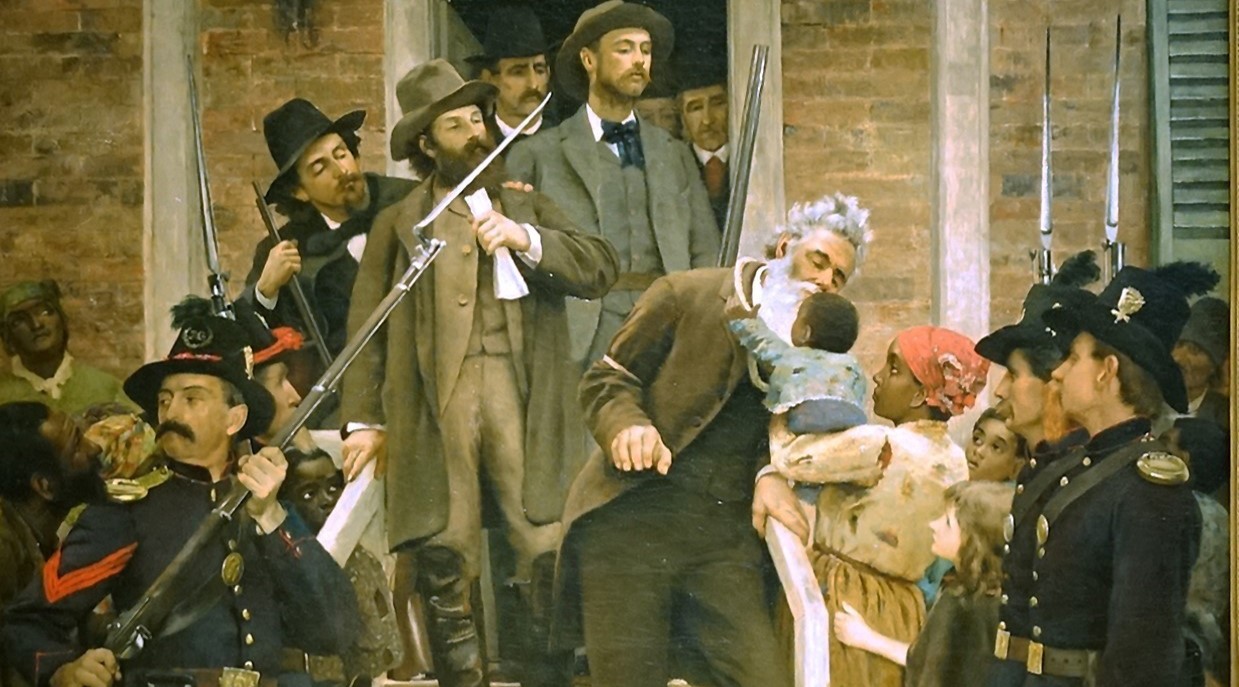
John Brown has been embraced by the left in this country since he first won notoriety in Kansas during the 1850s. Even more so, in many ways, 1859 is the birth of the modern U.S. left as Harper’s Ferry forced the question of slavery and impelled the best of the workers movement to take up the cause. Michael Gold’s influential biography was the first ‘modern’ telling of the John Brown story. Originally serialized in the Daily Worker in 1924 and printed in this pamphlet shortly after. This is its first online transcription. Gold re-introduced Brown to the generation of the Russian Revolution. Over a decade later, and in different political circumstances, Gold would co-pen the ‘Battle Hymn,’ a W.P.A.-produced play about Brown that later made it to Broadway. Whatever its history faults (much research has been done since), Gold’s book remains a valuable marker in our understanding of John Brown, who will ever remain an inspiration to the oppressed in their freedom struggle. Because of the length this will be presented in three parts. In this section: The Great Plan Evolves, The Eve of the Tragedy, The Arsenal is Captured, John Brown’s Men, The Trial at Charlestown, The Agitator in Jail, His Soul is Marching On. Part one, part two.
‘The Life of John Brown’ Part Three by Michael Gold. Haldeman-Julius Company, Girard, 1924.
THE GREAT PLAN EVOLVES
Much more can be written of this Kansas period in John Brown’s life; a large bibliography of Robin Hood literature has gathered about it. John Brown, and other men like him, hastened the solution of the slavery question by their firm stand in Kansas. If the South had been allowed to add Kansas to the roster of slave states, it would have crept further north, until perhaps there would have been slavery up to Canada. It is easy for any institution to become permanent; man is a creature of conventions. Slavery, like cannibalism among savages, would have in time become a matter-of-fact doctrine with all America, had not the Kansas abolitionists challenged it.
John Brown left Kansas in 1857, and made a trip through New England, gathering friends, money, arms and recruits for a new great plan that was working in his mind.
He saw that the abolitionists would be successful in making Kansas a free state. The job was already half done; but when it was completed, what next? There would still be the vast groaning empire of slavery in the South; there would still be five million black folk bought and sold like cattle; beaten, raped, murdered as if they were lower than cattle. The South would still be in the saddle at the White House; the fugitive slave law would still be enforced; and churches, business men, newspapers, mobs, and United States troops, all would join in upholding the devil’s doctrine that slavery was respectable, the law of the land.
The Abolitionists, with their few journals, were ever agitating against this infamy that was being protected by the United States flag. But John Brown knew that only a bold deed could shake the union; could make men see clearly what slavery was.
Slavery had become so firmly settled into the national life that the few thousand abolitionists only seemed like gadflies biting at the hide of a rhinoceros. John Brown saw that a pick-axe was needed to draw the blood. The pocket-books of the slave-holders must be attacked. Slavery must be sabotaged, and made unprofitable. It was such a safe and sane business now; it must be made dangerous. John Brown planned to go boldly into Virginia, with a band of men, and start there a large movement of runaway slaves. When slaves were no longer meek and submissive, when every slave became a potential runaway and rebel, slavery would cease to be a paying business. Thus reasoned John Brown.
In December, 1858, with things at last peaceful in Kansas Territory, and a Free State almost assured, John Brown made a last stirring raid into Missouri. A Negro slave named Jim Daniels had come to one of Brown’s men with a pathetic tale. He and his wife and babies were to be sold at auction in a few weeks, and perhaps separated forever. was a fine-looking, intelligent mulatto, and he wept as he told the story. John Brown and ten of his men rescued Daniels’ little family and carried off to freedom eleven other slave of the vicinity. At dawn the next day the caravan of freedom set forth on its long journey to the Northern Star–to Canada, where slaves were free. It was a perilous and arduous undertaking. The party had to sleep by stealth in barns and icy fields, with armed sentinels posted all night. The Governor of Missouri wired to Washington; money rewards were offered for Brown, armed posses were sent searching for him, the Federal troops combed the state. There were prairie snowstorms, and there were little provisions. But the old lion brought his charges through to Canada.
One incident of the trip is worth repeating. It shows what a terror the mere name of John Brown had become in Kansas.
At one place, the ford of a river, Brown’s party learned there was a posse of 80 armed slavery ruffians waiting to capture him. The old man did not turn back, though he had only 22 men, black and white. He marched down on the ruffians. “They had as good a position as 80 men could wish,” wrote one of Brown’s men, “they could have defeated a thousand opponents, but the closer we got to the ford, the farther they got from it. We found some of their horses, for they were in such haste to fly that some of them mounted two on a saddle, and we gave chase and took three or four prisoners, whom we later released. The marshal who led them went so fast one would think he feared the fate of Lot’s wife.”
“Old Captain Brown is not to be taken by boys,” said the Leavenworth Times, now Free State, “and he invites cordially all pro-slavery men to try their hands at arresting him.”
On March 12th the slaves were safe in Canada, rejoicing in their happy fortune, after having been brought in the dead of winter, through hostile country, some 1,100 miles in 82 days. One of the slave women had had six masters, and four of the party had served sixteen owners in all. Now they were free. And their little children were free, and would never be whipped by a Southern gentleman, or stood on the auction block like a horse or cow. The outlaw John Brown had done what was forbidden by the Supreme Court and the President of the United States; and now he was planning greater deeds.
THE EVE OF THE TRAGEDY
John Brown was now fifty-nine years old, and in the last year of his life. He had been disciplined in a terrible school in Kansas, but what he was about to attempt seemed so mad, so reckless, and so suicidally brave that many men of the South claimed, after the attempt, that he was but an insane man, and many of his conservative friends chose to take this view of the case, also.
Yet John Brown was not insane. Cooly, rationally, like a clearheaded strategist, he had figured out the situation. He was an Abolitionist, and was determined to do anything to end the brutal slave-system. Peaceful agitation had been going on for decades, but the North was still apathetic, and the South was only more inflamed and settled in its ideas.
What John Brown felt was needed now, was to make the men of the North and the South realize that there would be no peace in the land while slavery endured. What they must see was that men like himself would rise to break that loathsome peace. He would go to the South, capture the arsenal at Harper’s Ferry, in Virginia, and run off all the slaves he could find. He would take the hills about the Ferry, and with a guerrilla band move through the countryside, making slavery a shaky institution.
If he failed, he could but lose his life. He would at least stir the nation on the issue of slavery, and force men to take sides. There was too much neutrality and silence in the land on this issue, this institution that to him was a bloody crime against God and humanity. He could not fail, he felt; success or failure would achieve the same results. Events proved that he was right.
John Brown spent that winter and spring in New England, giving occasional lectures, and meeting all the leading men of the Abolition movement, who collected money for him, though he did not fully reveal his plans to anyone.
George L. Stearns, Gerrit Smith, the philanthropist, Frank B. Sanborn, the Concord schoolmaster and author; Thomas Wentworth Higginson, a brave, noble commander in the Civil War, and a charming man of letters afterward; Theodore Parker, one of the greatest and most sincere Christian clergymen produced in America; Samuel G. Howe, and others were among John Brown’s supporters. Thoreau and Emerson he also met at various times, and both were passionate admirers of the stern, pure soldier of liberty.
While their Captain was gathering arms and money for the raid, some of Brown’s men were quartered in a farm-house near Harper’s Ferry, while others were studying the region, and mapping out routes for the attack and the retreat to the hills.
It was a cool fall night, the 16th of October, 1859, when Captain John Brown gave the command his men had been impatiently awaiting for months: “Men, get on your arms; we will proceed to the Ferry.” Says Mr. Villard, at times an eloquent chronicler:
“It took but a minute to bring the horse and wagon to the door, to place in it some pikes, fagots, a sledge hammer, and a crow-bar. The men had been in readiness for hours; they had but to buckle on their arms and throw over their shoulders, like army blankets, the long gray shawls which served some for a few brief hours in lieu of overcoats, and then became their winding sheets. In a moment more, the commander-in-chief donned his old battle-worn Kansas cap, mounted the wagon, and began the solemn march through the chill night to the bridge into Harper’s Ferry, nearly six miles away.
“Tremendous as the relief of action was, there was no thought of cheering or demonstration. As the eighteen men with John Brown swung down the little lane to the road from the farmhouse that had been their prison for so many weary weeks, they bade farewell to Captain Owen Brown, and Privates Barclay Coppoc and F.J. Meriam, who remained as rear-guard in charge of the arms and supplies. The brothers Coppoc read the future correctly, for they embraced and parted as men do who know they are to meet no more on earth. The damp, lonely night, too, added to the solemnity of it all, as they passed through its gloom. As if to intensify the sombreness, they met not a living soul on the road to question their purpose, or to start with fright at the sight of eighteen soldierly men coming two by two through the darkness as though risen from the grave.
“There was not a sound but the tramping of the men and the creaking of the wagon, before which, in accordance with a general order, drawn up and carefully read to all, walked Captains Cook and Tidd, their Sharp’s rifles hung from their shoulders, their commission, duly signed by John Brown, and officially sealed, in their pockets. They were detailed to destroy the telegraph wire on the Maryland side, and then on the Virginian, while Captains John H. Kagi and Aaron D. Stevens, bravest of the brave, were to take the bridge watchman and so strike the first blow for liberty. But as they and their comrades marched rapidly over the rough road, Death himself moved by their side.”
THE ARSENAL IS CAPTURED
Events flashed sharp and terrible and swift as lightning after this sombre opening of the storm. The telegraph wires were cut, the watchman at the bridge captured, guards were placed at the two bridges leading out of the town, and many citizens were taken from the streets and held as prisoners in the Arsenal.
Perhaps the most distinguished prisoner was Colonel Lewis W. Washington, a great-grand-nephew of the first President, and like him, a gentleman farmer and slave-owner. He lived five miles from the Ferry, and with the instinct of a dramatist, John Brown seized him and freed his slaves as a means of impressing on the American imagination that a new revolution for human rights was being ushered in.
The little town was peaceful and unprepared for this sudden attack, as unprepared as it would be today for a similar raid. By morning, however, the alarm had been spread; the church bells rang, military companies from Charlestown and other neighboring towns began pouring in, the saloons were crowded with nervous and hard-drinking men, and there was the clamor and furor of thousands of awe-struck Southerners. No one knew how many men were in the Arsenal. No one knew whether the whole South was not being attacked by abolitionists, or whether or not all the slaves had armed and risen against their masters, as they had attempted to years before in Nat Turner’s and other rebellions.
By noon the Southerners had begun the attack. They killed or drove out all the guards John Brown had stationed at various strategic points in the town; they murdered two of Brown’s men they had taken prisoners, and tortured another. They managed to cut off all of Brown’s paths of retreat, and by nightfall, he and the few survivors of his men were in a trap.
His young son Oliver, only twenty years old, and recently married, died in the night. He had been painfully wounded, and begged, in his agony, that his father shoot him and relieve him from pain. But the old Spartan held his boy’s hand, and told him to be calm, and to die like a man. Another young son, Watson, had been killed earlier in the fighting. John Brown had now given three sons to freedom, and was soon himself to be a sacrifice.
There were left alive and unwounded but five of Brown’s men. The Virginia militia, numbering, with the civilians in the town, up to the thousands, seemed afraid to attack this little group of desperate men. In the dawn of the next morning, however, United States marines, under the famous commander, Robert E. Lee, then a Colonel in the Federal forces, attacked the arsenal and captured it easily. John Brown refused to surrender to the last; and he stood waiting proudly for the marines when they broke down the door and came raging like tigers at him.
A fierce young Southern officer ran at him with a sword, that bent double as it pierced to the old man’s breast-bone. The young Southerner then took the bent weapon in his hands and beat Brown’s head unmercifully with the hilt, bringing the blood, and knocking senseless the old unselfish and tender champion of poor Negro men and women. Those near him thought John Brown was dead; but he was still alive; he had still his greatest work to do.
JOHN BROWN’S MEN
I have written almost entirely of John Brown, and because of necessities of space I have given little attention to the brave youths who fought under him at Harper’s Ferry. Yet here I must stop and with only the facts, paint some portrait of the men who followed John Brown. It will be seen that they were no ordinary ruffians, no bandits, adventurers or madmen, as the South called them at the time. They were young crusaders, thoughtful, sensitive and brave. They had a philosophy of life; and they were filled with passion for social justice. One may disagree with such men, but one must not fail to respect them.
There were twenty-one men with John Brown at Harper’s Ferry, sixteen of whom were white and five colored. Only one was of foreign birth; nearly all were of old American pioneer stock.
John Henry Kagi was the best educated of the raiders, largely self-taught, a fine debater and speaker, and an able correspondent for the New York Tribune and the New York Evening Post. He had been a school-teacher in Virginia, and had come to know and hate slavery there, protesting so vigorously that he was finally run out of the State. He practised law in Nebraska, but left this to join John Brown in the Kansas fighting. He was killed at Harper’s Ferry.
Aaron Dwight Stevens was in many ways the most attractive and interesting of the personalities about John Brown. He ran away from his home in Massachusetts at the age of sixteen, and joined the United States army, serving in Mexico during the Mexican War. Later he was sentenced to death for leading a soldiers’ mutiny against an offensive pro-slavery Major at Taos, New Mexico. President Pierce commuted the sentence to three years at hard labor in Fort Leavenworth. Stevens escaped from this prison, and joined the Free State forces in Kansas, for he had always been a firm abolitionist. Stevens came of old Puritan stock, his great-grandfather having been a captain in the Revolutionary War. He was a man of superb bravery and of wonderful physique; well over six feet, handsome, with black penetrating eyes and a fine brow. He had a charming sense of humor, and a beautiful baritone voice, with which he sang in camp and in prison. He was hung soon after John Brown for the Harper’s Ferry raid.
John E. Cook was a young law student of Brooklyn, New York, a reckless, impulsive and rather indiscreet youth, to whom much was forgiven because of his genial smile and generous nature.
Charles Plummer Tidd escaped after the raid, and died a First Sergeant in one of the battles of the Civil War. He had not much education, but good common sense, and was always reading and studying in an attempt to repair his lack of training. Quick-tempered, but kind-hearted, a fine singer and with strong family affections.
Jeremiah Goldsmith Anderson, killed at Harper’s Ferry in his 27th year, was also of Revolutionary American stock. A sworn abolitionist, he wrote in a letter three months before his death: “Millions of fellow-beings require it of us; their cries for help go out to the universe daily and hourly. Whose duty is it to help them? Is it yours? Is it mine? It is every man’s, but how few there are to help. But there are a few to answer this call, and dare to answer it in a manner that shall make this land of liberty and equality shake to the center.”
Albert Hazlett, executed after Brown, was a Pennsylvania farm worker, “a good-sized, fine-looking fellow, overflowing with good nature and social feelings.”
Edwin Coppoc, also one of those captured and hung, was well-liked even by the Southerners who saw him in jail, and some of them hoped to get him pardoned. He came of Quaker farmer stock.
Barclay Coppoc, his brother, was not yet twenty-one when he fought at the Arsenal. He es- caped after the raid, but was killed in the Civil War. After the raid he had returned to Kansas, and had nearly lost his life in an attempt to free some slaves in Missouri.
William Thompson, a neighbor of the Browns at North Elba, in New York, was killed at Harper’s Ferry, in his 26th year. He was full of fun and good nature, and bore himself unflinchingly when face to face with death.
Dauphin Osgood Thompson, his brother, was only twenty years old, when he met the same fate for the cause of freedom. Dauphin was a handsome, inexperienced country boy, “more like a shy young girl than a warrior, quiet and good,” said one of the Brown women later.
Oliver Brown, John Brown’s youngest son, was also twenty years old when he died at Harper’s Ferry. His girl-wife and her baby died early the next year. “Oliver developed rather slowly,” says Miss Sarah Brown. “In his earlier teens he was always pre-occupied, absent-minded-always reading, and then it was impossible to catch his attention. But in his last few years he came out very fast. His awkwardness left him. He read every solid book that he could find, and was especially fond of Theodore Parker’s writings, as was his father. Had Oliver lived, and not killed himself with over-study, he would have made his mark. By his exertions the sale of liquor was stopped at North Elba.”
John Anthony Copeland, a free colored man, 25 years old, was educated at Oberlin College. He was dignified and manly, and in jail there were prominent Southerners who were forced to admit his fine qualities. He was hung for the raid.
Stewart Taylor, the only one of the raiders not of American birth, was a young Canadian wagon-maker, 23 years old. He was fond of history and debating, and heart and soul in the abolition cause. Killed in the Arsenal.
William H. Leeman, the youngest of the raiders, killed in his 19th year. He had gone to work in a shoe factory at Haverhill, Mass., when only 14 years old, and though with little education, “had a good intellect and great ingenuity.” He was the “wildest” of Brown’s men, for he smoked and drank occasionally, but the Old Puritan captain liked him, nevertheless, for he was boyish, handsome, and brave.
Osborn Perry Anderson was also a Negro. He escaped after the raid, and fought through the Civil War.
Francis Jackson Meriam, was a wealthy, young abolitionist who put all his fortune into the cause, and came from New England to join John Brown in the raid. He escaped also, and died in 1865, after having been the captain of a Negro company in the Civil War.
Lewis Sheridan Leary, colored, left a wife and a six-months-old baby at Oberlin, Ohio, to go to Harper’s Ferry. He was a harness maker by trade, and descended on one side from an Irishman, Jeremiah O’Leary, who fought in the Revolution. Leary was 25 years old when he died of his terrible wounds in the Arsenal fighting.
Owen Brown, another of John Brown’s sons, was stalwart and reliable, and is reported original in expression and thought, like all the Browns. He is also said to have been quite humorous. He survived the raid, and died in Pasadena, Calif., in 1891.
Watson Brown, another son, 24 years old when killed at the Ferry, was tall and rather fair, very strong. and a man of marked ability and sterling character.
Dangerfield Newby was born a slave in Virginia, but his father, a Scotchman, freed him with other mulatto children. Newby had a wife and seven children still in slavery, and he was trying to raise money to buy them, for they were to be sold further south. He failed at this; and joined John Brown in desperation. He was killed at the Ferry, and so failed to free his poor family, as he had dreamed.
Shields Green, colored, was also born a slave, but escaped, leaving a little son in slavery. He met Brown through Frederick Douglass, the great Negro orator, and joined in the raid, though many warned him it would mean his death. He was uneducated, but deeply emotional, and deeply attached to the “ole man,” as he called John Brown. He was hung after the raid; his age 23.
They were all young men; the average age of the band was 25 years and five months. They were all strong, intelligent, in love with life and eager for the future; but they chose to attempt this mad, dangerous deed rather than consent any longer to the lie and to the power of black slavery.
John Brown they followed and loved as one would a strong and kindly father. There was always something patriarchal about John Brown and his soldiers, many observers said. It made his deed seem like some story out of the Bible, the swift and terrible justice of the Lord of Hosts.
THE “N***R-THIEF”
When the South heard of John Brown’s raid, there was a wave of immediate fury. Men poured by the thousands into the little Virginia town, and the bars were filled with savage, half-drunk men, who talked of lynching the “old n***r-thief.” Governor Wise had come down from the capital, and he and others prevented any such disgraceful procedure. He himself was mystified by the raid. It seemed an incredible performance, for these Southerners I could not understand the moral passion that animated the Abolitionists. To the south Negroes were property-private property. And an attempt to free slaves was to them insane, illegal and criminal. When men came with arms for this purpose and Southerners were killed in defending slavery, the crime became doubly damnable.
John Brown, after his capture, was taken with Aaron Stevens to a room nearby. Lying on a cot, his head bandaged, his hair clotted and tangled, hands and clothing powder-stained and blood-smeared, the old lion was questioned by Governor Wise and a party of officials, who included Robert E. Lee, Colonel J.E.B. Stuart, Senator Mason, Congressman Vallandigham of Ohio, and other pro-slaveryites.
Their questions were a summary of the attitude of the South to such as he. And John Brown, though he was wounded and a prisoner, though everywhere enemies surrounded him, and the gallows stared him full in the face, answered their questions calmly and courteously, without the slightest show of fear.
“Who sent you here?” one official asked. They were trying to worm out the names of Northerners who had given Brown money for the raid, so as to prosecute them for conspiracy in murder.
“No man sent me here,” John Brown answered calmly. “It was my own prompting, and that of my Maker, or that of the devil, which ever you please. I acknowledge no man in human form.”
“What was your object in coming?”
“I came to free the slaves.”
“And you think you were acting righteously?”
“Yes. I think, my friends, you are guilty of a great wrong against God and humanity. I think it right to interfere with you to free those you hold in bondage. I hold that the Golden Rule applies to the slaves, too.”
“And do you mean to say you believe in the Bible?” some one said, incredulously. They could not understand this man; they only saw a wild, mad “n***r-thief” in him.
“Certainly I do,” John Brown said with dignity.
“Don’t you know you are a seditionist, a traitor, and that you have taken up arms against the United States government?”
“I was trying to free the slaves. I have tried moral suasion for this purpose, but I don’t think the people in the slave states will ever be convinced they are wrong.”
“You are mad and fanatical.”
“And I think you people of the South are mad and fanatical. Is it sane to keep five million men in slavery? Is it sane to think such a system can last? Is it sane to suppress all who would speak against this system, and to murder all who would interfere with it? Is it sane to talk of war rather than give it up?” Thus John Brown uttered his challenge to the South; but they failed to understand.
THE TRIAL AT CHARLESTOWN
And they failed to understand that it was not he who was on trial at the Charlestown courthouse a month later, but the whole slavery system.
Every moment of that trial was reported in the newspapers of the nation. Every reader in America knew of the wonderful strength and majesty of John Brown in the courtroom. The North began thinking about slavery as it had never thought before. John Brown was so manifestly pure in his intentions; manifestly a crusader, and people were forced to try to understand why an old, gray-haired farmer should have taken up arms at the age of sixty, after a life spent in useful occupations.
His dignity, his piety, his reputation as a terrible fighter, and the Biblical sublimity of the picture of this white-bearded patriarch surrounded by his seven sons, all of them armed with rifles, all of them ready to die for the cause of abolition-these. had their powerful effect on the imagination of the North. Hosts of new friends rose up in Brown’s defense; legislatures passed resolutions asking for his pardon, Congressmen began speaking out, newspapers suddenly found themselves in danger of losing their subscribers if they spoke against John Brown; everywhere in the North men found themselves waking from a dream, and coming into the clear, white vision of John Brown. They saw slavery as if for the first time in all its horrors; they could not help taking sides. And the South became more and more inflamed with rage as the trial progressed, and those reverberations reached it from the North.
John Brown was tried on three charges, murder, treason, and inciting the slaves to rebel- lion. The trial was quickly over; it was but a formality. The jury, of course, returned the verdict of guilty, and John Brown, lying on his cot in the courtroom, said not a word, but turned quietly over on his side, when he heard it.
A few days later, Judge Parker pronounced the sentence of death, and this time John Brown rose from his cot, and drawing himself up to his full stature, with flashing eagle eyes, and calm, clear and distinct tones, he addressed the citizens of America. He said many things that they were soon to understand clearly on the battlefields of the Civil War.
“Had I taken up arms in behalf of the rich, the powerful, the intelligent, the so-called great, or in behalf of any of their friends, or any of their class, every man in this court would have deemed it an act worthy of reward rather than of punishment. But this Court acknowledges the validity of the law of God. I see a book kissed here which is the Bible, and which teaches me that all things that I would have men do unto me, so must I do unto them. I endeavored to act up to that instruction. I fought for the poor; and I say it was right, for they are as good as any of you; God is no respecter of persons.
“I believe that to have interfered as I have done, as I have always freely admitted I have done, in behalf of His despised poor, I did no wrong, but right. Now, if it is deemed necessary that I should forfeit my life for the furtherance of the ends of justice, and mingle my blood further with the blood of my children, and with the blood of millions in this slave country whose rights are disregarded by wicked, cruel and unjust enactments, I say, let it be done.”
Judge Parker fixed the date for hanging on December 2nd, 1859, a month away. It was a fatal mistake for the South, and John Brown’s finest gift at the hands of the God he believed in.
THE AGITATOR IN JAIL
For in that month, John Brown accomplished more for abolition than even the stern deeds of Kansas had effected. He had put by the sword forever, and now for a month took up the pen and made it as powerful a weapon. He wrote innumerable letters to Northern friends and they were published and read everywhere. Their tone was Christ-like; no longer was Brown the militant Captain in the field, but the sweet, patient martyr waiting for his end in tranquil joy. In many letters he repeats the statement that he is glad to die; that his death is of more value to the cause than ever his life could have been. This was no vainglorious hysterical gesture with John Brown; he was calmly certain of it; he slept peacefully as a child at night, and wrote his letters by day, secure in his tranquil wisdom. Friends were planning an attempt to rescue him, but he for- bade them to try, for he really felt that his death was necessary. “I am worth now infinitely more to die, than to live,” he said.
And in his letters he gave Americans his last warning on the slavery question. He told them it must be settled; it could not go on. His letters were so strong, manly, and yet so touching, that even the jailor wept as he censored them in the course of his duties. As Wendell Phillips said, the million hearts of his country- men had been melted by that old Puritan soul.
With absolute equanimity, John Brown wrote his will, wrote his last few letters to his family, determined the coffin in which he was to be buried, and the inscription on the family monument, said farewell to his fellow-prisoners and jail-keepers. On the morning of December 2nd he stood calmly on the steps of the scaffold and gazed about him. Before leaving his cell he had handed to another prisoner the following last and uncompleted message:
“I, John Brown, am now quite certain that the crimes of this guilty land will never be purged away but with blood. I had, as I now think, vainly flattered myself that without much bloodshed it might be done.”
Now, as he looked about, he could see massed beyond the fifteen hundred soldiers Virginia had felt necessary for this execution, the hazy outlines of the Blue Ridge mountains. The sun was shining; the sky was blue, and his heart was at peace. “This is a beautiful country,” he said, “I never had the pleasure of really seeing it before.” He walked with perfect composure up the steps, watched by the eyes of the soldiery and officialdom of slave-holding Virginia. They saw not a tremor in his face or body; not even when the cap was drawn over his head, his arms pinioned at the elbows, the noose slipped around his neck. He had refused to have the solace of any ministers, for they believed in slavery, and he told them he did not regard them as Christians. He needed no man’s solace; he was braver than any one there. “Shall I give you the signal when the trap is to be sprung?” said a friendly sheriff. “No, no,” the serene old man answered, “just get it over quickly.”
And quickly enough, it was all over for John Brown. The trap was sprung; his body hung between heaven and earth. In the painful silence that followed, the voice of Colonel Preston declaimed solemnly, the official epitaph, “So perish all such enemies of Virginia! All such enemies of the Union! All such foes of the human race!”
That was the verdict of the South, still infatuated and blinded by its slave system. But on the other side of the Mason-Dixon line men were pronouncing a different verdict on John Brown, and on the other side of the Atlantic, the greatest man of letters in Europe, Victor Hugo, was saying:
“In killing Brown, the Southern States have committed a crime which will take its place among the calamities of history. The rupture of the Union will fatally follow the assassination of Brown. As for John Brown, he was an apostle and a hero. The gibbet has only increased his glory, and made him a martyr.”
HIS SOUL GOES MARCHING ON
John Brown was hung on December 2, 1859. Exactly eleven months later Abraham Lincoln was elected President of the United States. Exactly eight months after that, Northern troops were marching southward, to put down the rebellion of the slave states that had hung Brown.
No one at the time believed events would march so swiftly after Brown’s death. There were many who knew that some sort of conflict between the North and South was inevitable; it had been brewing for decades. But there were as many more who were confident that slavery would win its legal fight, and would spread over the whole continent. And the great mass of Americans just faintly understood the issues involved; to most of them, John Brown seemed some kind of mad fanatic.
President Lincoln’s election undoubtedly provoked the Civil War. And his election was undoubtedly due to the discussion on slavery that raged after John Brown’s deed. Lincoln was the first Northerner to be elected in forty years; the South had always carried things before it, and would have done so again had not John Brown roused the entire North to a consciousness of what slavery meant.
He did more than all the abolitionists had been able to do in their fifty years of agitation.
And yet even most of his friends thought him mad at the time of the deed. Abraham Lincoln, in a campaign speech at Cooper Union, in New York, said: “Old John Brown has been executed for treason against a state. We cannot object, even though he agreed with us in thinking slavery wrong. That cannot excuse violence, bloodshed and treason.”
Only men of the stamp of Wendell Phillips fully understood what John Brown had done. His funeral. oration at the last resting place of John Brown’s body had all the vision of the prophets:
“Marvelous old man!…He has abolished slavery in Virginia. You may say that this is too much. Our neighbors are the very last men we know. The hours that pass us are the ones we appreciate the least. Men walked Boston streets, when night fell on Bunker Hill, and pitied Warren, saying, Foolish man! Thrown away his life! Why didn’t he measure his means better? Now we see him standing colossal on that blood-stained sod, and severing that day the tie which bound Boston to Great Britain. That night George III ceased to rule in New England. History will date Southern emancipation from Harper’s Ferry. True, the slave is still there. So, when the tempest uproots a pine in your hills, it looks green for months, for a year. Still, it is timber, not a tree. John Brown has loosened the roots of the slave system; it only breathes–it does not live–hereafter.”
Wendell Phillips was a prophet; and even men of wide vision like Lincoln could not attain his lofty view. At first there was a rush of Northern politicians to disavow and condemn John Brown’s deed. Later, there was approval; still later understanding; still later, worship.
Yes, the old man seemed mad, as all pioneers are mad. Gorky has called it the madness of the brave. But such madness seems necessary to the world; the world would sink into a bog of respectable tyranny and stagnation were there not these fresh, strong, ruthless tempests to keep the waters of life in motion.
Who knows but that some time in America the John Browns of today will be worshipped in like manner? The outlaws of today, the unknown soldiers of freedom.
“And his soul goes marching on.”
PDF of full book: https://hdl.handle.net/2027/dul1.ark:/13960/s24541z1bsw
 Revolution's Newsstand