
J. Louis Engdahl reports on the changes in the Italian Socialist Federation. An Italian-Language Socialist Federation formed 1902, with G.M. Serrati the principal organizer and initially affiliated with the Socialist Labor Party. It withdrew in 1903, became an independent organization and began publishing lI Proletario with Carlo Tresca as editor in Philadelphia and as a daily paper. In 1906 it became a weekly publication and moved to Chicago . In 1906, the ISF claimed over 40 branches and 1200 members in good-standing and remained independent of both the SLP and SP. After suffering a split in which some members would joined the Socialist Party, others the SLP, the bulk joined the Industrial Workers of the World. Tresca quit as editor to publish his own paper and lI Proletario became the Italian-language paper of the I.W.W. While the S.P. had many Italian branches, a formal Italian Federation of the Socialist Party was not constituted in December 1910 at a Congress in West Hoboken, New Jersey. The following year the Italian Federation had 28 branches with less than 660 members. The vast majority of Italian speaking radicals and Socialists were active outside the structure of the S.P., which was considered somewhat hostile to immigrants, and Italian immigrants in particular. The Translator-Secretary was Joseph Corti with offices in in Chicago. The early Federation had three papers; La Parola Del Socialisti, the official published in Chicago with a circulation of 3,000; La Fiaccola published in Buffalo, NY, with a circulation of 1,500; and La Flamma, published in Camden, NJ, with a circulation of 2,000. L’Avanti! would become the Federation’s official paper in the fall of 1918. Most of the Italian Federation, unlike many of the other language federations, remained loyal to the S.P. following the 1919 split, though the New York City Italian branch joined the Communist Labor Party. The Socialist Party continued to have an Italian Federation affiliated with it throughout the decade the 1920s, holding about 3% of the party’s membership. L’Avanti! was edited by G. Valenti and Giuseppe Bertelli with the name returning to La Parola del Popolo in 1922.
‘Italian Socialists in This Country Organizing Rapidly’ by J. Louis Engdahl from The New York Call. Vol. 5 No. 1. January 1, 1912.
National Convention Will Hear Good Reports Concerning Work of Enrolling Foreign Speaking Workers in the Ranks of Their Political Party.
CHICAGO, Dec. 30.-Delegates to the National Convention of the Socialist party, which will open in Oklahoma City on May 12, representing the foreign speaking organizations, will have a definite program to present to the convention dealing with the work of the foreign language organizations within the party.
This program will be drawn at a meeting of these delegates just previous to the opening of the National Socialist Convention.
The foreign delegates held a meeting similar to the one contemplated Just previous to the National Socialist Congress in May, 1910, and laid the foundation for the successful work that was done at that meeting.
“Such a meeting is imperative in order that the foreign speaking organizations may be able to decide upon and agree among themselves to support a definite policy before the convention,” says Joseph Corti, national translator-secretary of the Italian section of the Socialist party.
Corti disagrees with Polish Translator-Secretary Hipolit Gluski on the question of whether the dues stamps are to be bought direct from the English speaking local organizations or from the translator-secretaries.
Corti wants the foreign locals to get their dues stamps from the translator-secretaries, while Gluski is in favor of the foreign locals getting them from the English county or State organizations.
State Autonomy to Figure.
The matter, it seems, will finally center about the struggle for State autonomy, which is now recognized by the National Socialist party organization. Corti claims that it is a simple matter for the translator-secretary to make a report to the State or county organizations on the dues stamps that have been bought from him by the foreign language locals, while Gluski, for the Poles, says he is satisfied with the foreign language locals reporting on the number of stamps they have bought from the English speaking locals, and that the National Socialist party organization could keep in touch with the situation equally well under this plan.
In Illinois a referendum has just been planned providing that the foreign locals be compelled to pay 2 cents to the county, and the same amount to the English speaking State organizations, thus putting them on an equal footing with the English speaking locals, while saving 5 cents with the situation equally well under national organization.
“This reduction in dues to the foreign local amounts to very little,” declares J.O. Bentall, State secretary for Illinois, but it is admitted that as the foreign organizations grow there will be quite a little amount turned over to each of the foreign national organizations to carry on an agitation among their own people.
It is expected that under this plan all the foreign locals in Illinois will get their dues stamps direct from the regular county and State organizations, which seems to be the best workable proposition.
The Illinois referendum goes into effect with the new year, creating a condition for the foreign language locals that already exists in Massachusetts, Vermont and Connecticut.
Italian Movement Growing Fast.
In spite of the handicaps that confront it, the Italian Section of the National Socialist party, like the Polish Section, is another revelation of the progress that can be brought about once an organized attempt is made to bring the foreign speaking people into the Socialist movement.
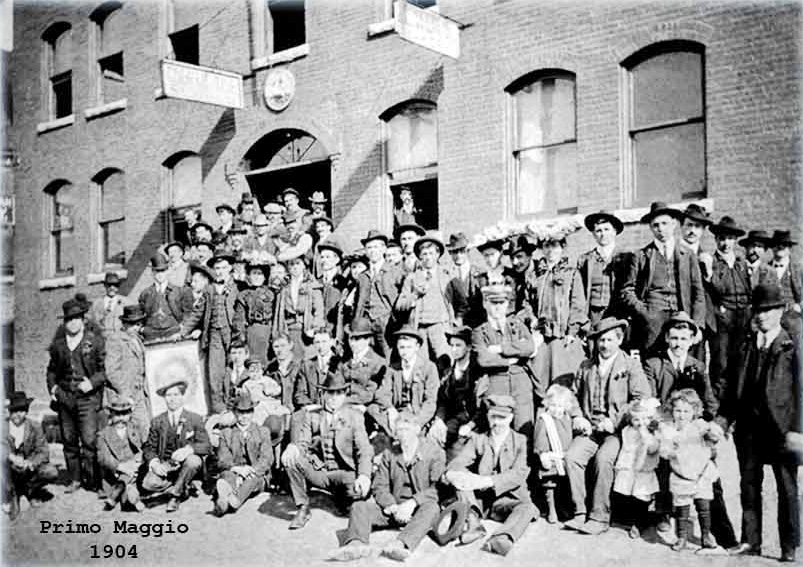
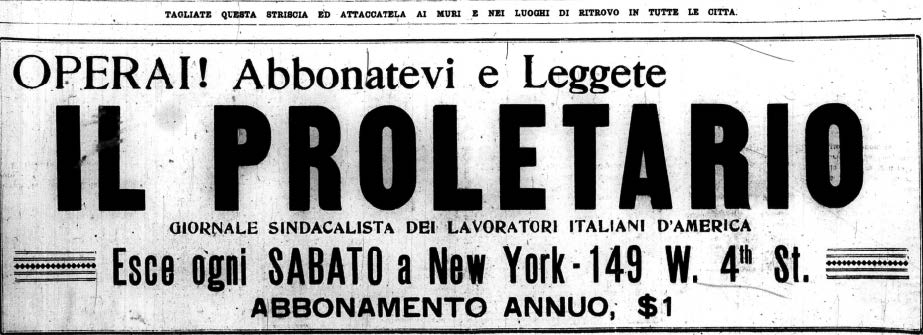
The Italian Socialist movement started in this country in 1900, with the establishment of Il Proletario, an Italian publication in New York, with Joseph Bertelli as its editor.
In 1903 there was organized a Federation of Italian Socialist Branches affiliated with the S.L.P. In the following year this federation withdrew from the S.L.P. and held a neutral position in its relation toward the Socialist Party and S.L.P. This condition continued up to the Boston convention in December of 1906, when the organization contained about eighty-four branches with about 2,000 members.
The Socialist party sent a delegate to the Boston convention to take up the matter of affiliation with it, but the federation still seemed to be split in its ideas and nothing resulted. In 1907 Bertelli resigned the editorship of Il Proletario, in New York, and came to Chicago, where he later started the La Parola Dei Socialisti, the Italian Socialist weekly of this city. During 1908 Bertelli made a tour of the United States, many branches springing up as a result, these being like those of the Finnish and Polish federations.
The Federation of Italian Socialist branches was finally organized in December of 1910, as a result of the National Socialist Congress of May, in that year, taking action and providing for National Translator Secretaries for foreign speaking organizations.
Organization by Referendum
The work of organization was done by referendum, twelve branches coming into the fold, some of these being: West Hoboken, N.J.; Paterson, N.J.: New York Branches Nos. 1 and 2: Chicago, Twelfth and Twenty-second Wards: Ybor City, Fla.: Boston, Mass.; Rochester and Buffalo, N.Y.
Victoria Licel was chosen as the first translator-secretary for the Italians, being succeeded on September; 12, of 1911 by Joseph Corti.
It is now estimated that there are fifty branches directly affiliated with the Italian section; with a membership of over 1,000. In addition there a fifty more Italian branches that buy the dues stamps directly from the national office, fearing to join the Italian Section because of the uncertainty that surrounds the action taken by the 1910 Congress in relation to the foreign organizations.
This is being overcome gradually and it is believed that if action at all favorable is taken at Oklahoma City next May, all the Italians paying dues into the Socialist party, numbering over 100 branches, with a membership of over 2,000, will be unified in the Italian national section. During the last few years there has been a general exodus of branches from the Italian Socialist Federation, so that this organization now has only about 25 branches, with about 700 members.
The Italian Socialist Federation has adopted syndicalist tendencies, renouncing political action, even to an extent where it has been unable to reconcile its ideas with the S.L.P.
Italian Socialist Federation Changing.
This has been largely due to the influence of M. Kiovanitti, an ex-Episcopalian priest, who is the editor of Il Proletariat. His influence seems to be waning, however, and with the progress of organization of the Italian Socialist party it is believed that the membership of the Italian Socialist Federation, which believes in political action, will soon be in the Socialist party.
It is significant that the S.L.P. has not been able to organize a single Italian branch. The problem of organization is brought forth in a startling manner by the action of the branches at Tuloca and Granville, Ill., and Washington, D.C.
These branches, as a result of the confusion existing in this country, joined the Italian Socialist party in the mother country, this action being against all the dictums of the International Socialist Bureau.
This condition is being remedied, however, the Tuloca branch already having affiliated itself with the Italian Section in this country, while the Granville branch will join the Socialist movement in this country as soon as its membership expires in the old. The Washington, D.C., local has disbanded for the time being.
The Italian Socialist press shows a steady growth. In addition to the La Piarola de Socialisti in Chicago, the Italian Socialists also have La Fiaccola, (The Torch), the weekly organ of the Italian Socialist branch in Buffalo, N.Y.
There are also a number of private owned Italian publications that show Socialist tendencies to a greater or less degree. Among them are: Il Lavoratore (the Workingman) of Kansas City, Mo.; La Flamma (the Flame), of Camden, N.J.: L’Operaio Italiano (the Italian Workingman), of Altoona, Pa.: L’Avenire (the Future), of Pittsburg, Pa.
The Italian Socialists of New York are planning to start L’Avanti, (Forward), with the opening of the new year. The Chicago Socialists are also planning to improve their weekly. It is planned to issue it very soon in the form in which the Coming Nation now appears, and to contain 16 pages.
Little Agitation Among Italian Women.
There has been but very little agitation and education among the Italian women. There is an Italian Socialist branch of Socialist Women in the Twelfth Ward of Chicago, the only one in the country. The woman’s movement is also backward in the mother country.
This can be accounted for to a great extent owing to the fact that only one-third of the people of Italy are able to read or write, while religious prejudice holds the people, especially the women, in its grasp.
Big plans for agitation among the Italian workers of the land, both men and women, however, are now under consideration by the Italian section of the Socialist party.
It is planned to get out a monthly leaflet from now until the Presidential election next year. An organizer, Antonio Carvello, is now touring Kansas and Oklahoma. He is on a four month’s tour, only three weeks of which have been completed. Leone Mucci starts a tour of the Eastern States on Jan. 12.
It is estimated that there are 3,000,000 Italians in the United States. Only about half of the Italians coming to this country intend to stay, most of them intending to return as soon as possible. As a result of this, most of them do not trouble themselves about becoming naturalized, and are difficult material to handle for a political organization.
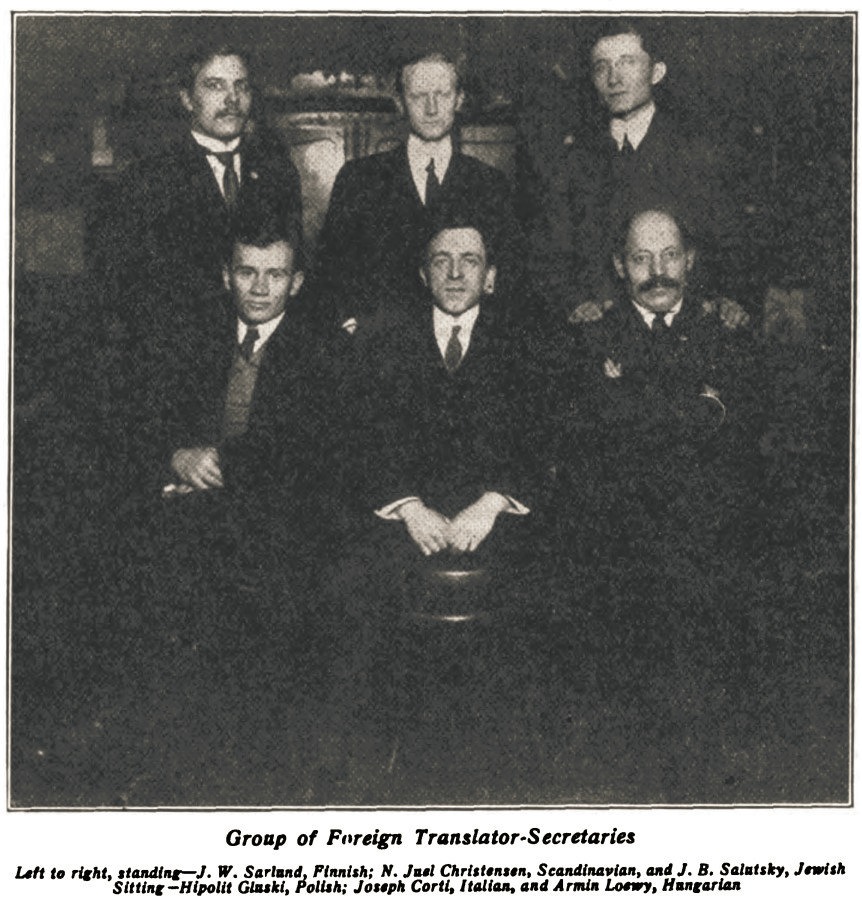
Translator-Secretary Corti believes that with the annexation of Tripoli by Italy, as a result of the present war between Italy and Turkey, the tide of the Italian immigration will be turned toward Africa, resulting in a stemming of the flow toward this country. This will be due to the fact, he says, that most of the Italians now coming to this country are from Sicily, which Is near the African coast.
The Italian Socialists of New York and New Jersey are planning a joint State convention to be held during February, 1912, the date and place to be decided by referendum. It is thought that the meeting will go to Schenectady, N.Y. New York State has proven the best field for Italian organization.
The next Italian National Section convention is supposed to be held in September of 1921. The section will have but one delegate at the National Socialist Convention in Oklahoma City next May, whereas it had three delegates at the National Socialist Congress, in Chicago, 1910. This is due to the added expense.
PDF of original issue: https://www.marxists.org/history/usa/pubs/the-new-york-call/1912/120101-newyorkcall-v05n001.pdf
 Revolution's Newsstand