‘The Moscow Insurrection of 1905’ (1906) by N. Lenin from International Press Correspondence. Vol. 3 No. 51. July 10, 1923.
We here reprint the interesting observations made by Comrade Lenin in the Moscow Proletariej (of August 29. 1906) on the lessons of the Moscow Rising of December 1905. (Ed.)
The December rising in Moscow mainly took the form of a peaceful strike with demonstrations. The overwhelming majority of the working masses only took active part in this form of struggle. But the December action in Moscow proved with the greatest clearness that the general strike, as an independent and leading form of struggle, has been rendered obsolete by events, and that the movement overflows these narrow confines and creates a higher form of struggle, the insurrection.
All revolutionary parties, and all trade unions in Moscow, felt, from the beginning of the strike, that it must inevitably turn into a rising. On the 6th of December the council of labor deputies passed a resolution that they would “endeavour to convert the strike into an armed rising”. As a matter of fact, however, all the organizations were not prepared for this; even the Central Committee of the fighting troops spoke (on the 6th of December) of an uprising as of some remote possibility, and the street fighting undoubtedly took place without the agreement and participation of this body. The organizations lagged behind the movement both in extent and driving force.
The strike developed into an uprising under the pressure of the objective conditions arising after October. The Government could no longer be taken by surprise by a general strike, for it had already organized a counter-revolution prepared for military action. The general course taken by the Russian revolution after October, as well as the logical consequence of the events in Moscow in December, confirmed with surprising accuracy one of Marx’s profoundest theses: Revolution advances by means of creating a determined and firm counter-revolution, that is, by forcing the enemy to resort to more and more rigorous means of defence, and thus evoking means of attack of ever-increasing powerfulness.
The events pursued the following course: On the 7th and 8th of October: peaceful strike, peaceful demonstrations by the masses.

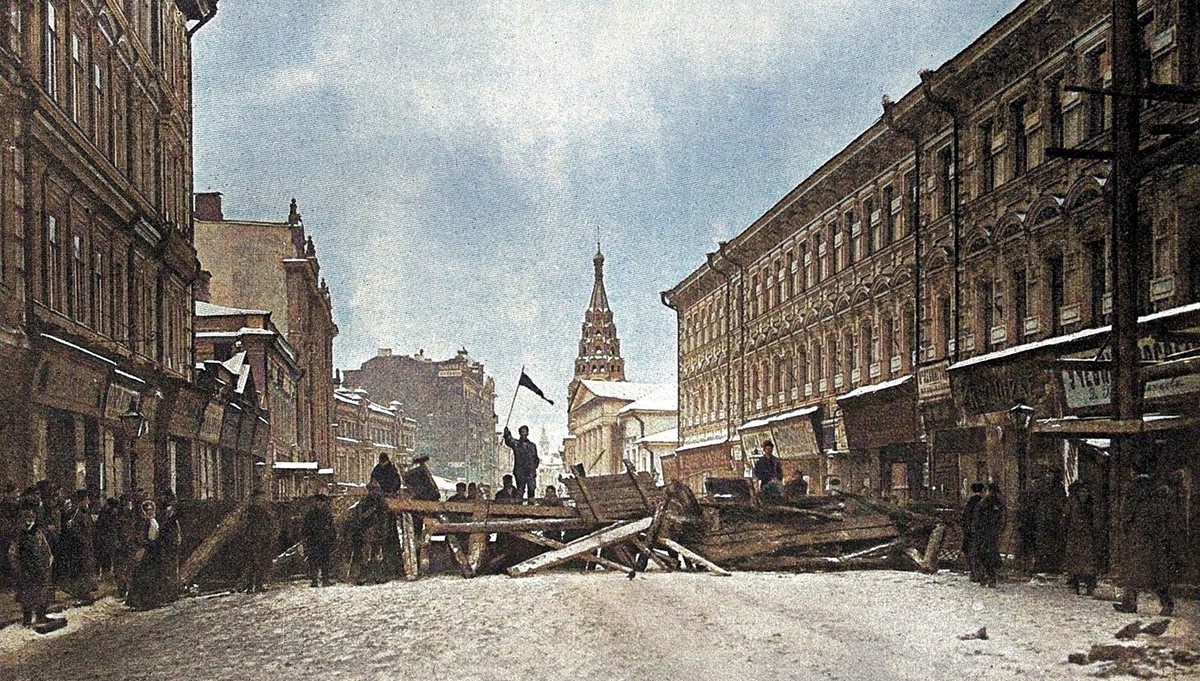
On the evening of the 8th: siege of the Aquarium; on the 9th during the day: attack by the dragoons on the crowd in the Strastnoy Square; in the evening: destruction of Fiedler’s House. The atmosphere became charged with excitement. The unorganized crowds in the streets began to erect the first barricades, quite spontaneously and without plan.
On the 10th: Commencement of the artillery bombardment against the barricades and the crowds in the streets. The construction of barricades now took a more purposeful form, no longer scattered, but now possessing an undoubtedly mass character. The whole population was in the streets; the whole town was intersected by a network of barricades at its most important points. For some days there was severe skirmishing between the fighting groups and the soldiery, a struggle so exhausting for the military forces that Dubasoff begged for reinforcements. It was not until December 5 that the preponderance of the government troops became apparent, and on the 17th the Semyoneff regiment mastered the Pressya district–the last support of the rising.
From strike and demonstrations to separate barricades. From separate barricades to mass barricade construction and to street fighting against the troops. The proletarian mass struggle proceeded, over the heads of the organizations, from strike to rising. Here lies the gigantic historical success attained by the Russian Revolution in December 1905–a success entailing many sacrifices, as earlier ones have also done. The movement beginning with the general political strike, rose to the highest point of development. It forced reaction to resort to the most ruthless measures of resistance, and thus enormously accelerated the moment at which the revolution too grasped the uttermost weapons of attack. Reaction can go no further than bombarding the barricades, houses, and crowds in the streets with its artillery. But revolution can go much further than the formation of Moscow fighting troops, it possesses many possibilities of expanding and deepening its action. And since December the revolution has greatly developed. The basis of the revolutionary crisis has become inevitably broader, the edge of the sword must now be sharpened.
The changes taking place in the objective conditions of the struggle, and requiring the transition from strike to rising, have been sooner grasped by the proletariat than by the leaders. Here, as always, practice has preceded theory. Peaceful strikes and demonstrations suddenly ceased to satisfy the workers, they asked: What is to be done further? and demanded more energetic action. The instructions to erect barricades were received after great delay, and after barricades had already been erected in the center of the city. The workers participated in great masses in this work, but it did not satisfy them, they again asked: What next? and demanded still more energetic action. We leaders of the social-democratic proletariat were in December, like that general who arranged his regiments in such a foolish manner that the majority of the troops could not take active part in the battle. The working masses sought for mass action, and found none.
Thus there is nothing more short-sighted than the opinion expressed by Plechanov, and seized upon by all opportunists, that it was futile to begin so untimely a strike, and that there should have been “no resort to weapons”. On the contrary, weapons should have been resorted to much more determinedly, energetically, and offensively; it should have been made clear to the masses that a mere peaceful strike was impossible, and that a determined and merciless struggle was necessary.
This is the first lesson taught by the events of December. The second lesson concerns the character of the rising, the manner of its leadership, and the conditions for winning over the troops to the side of the people.
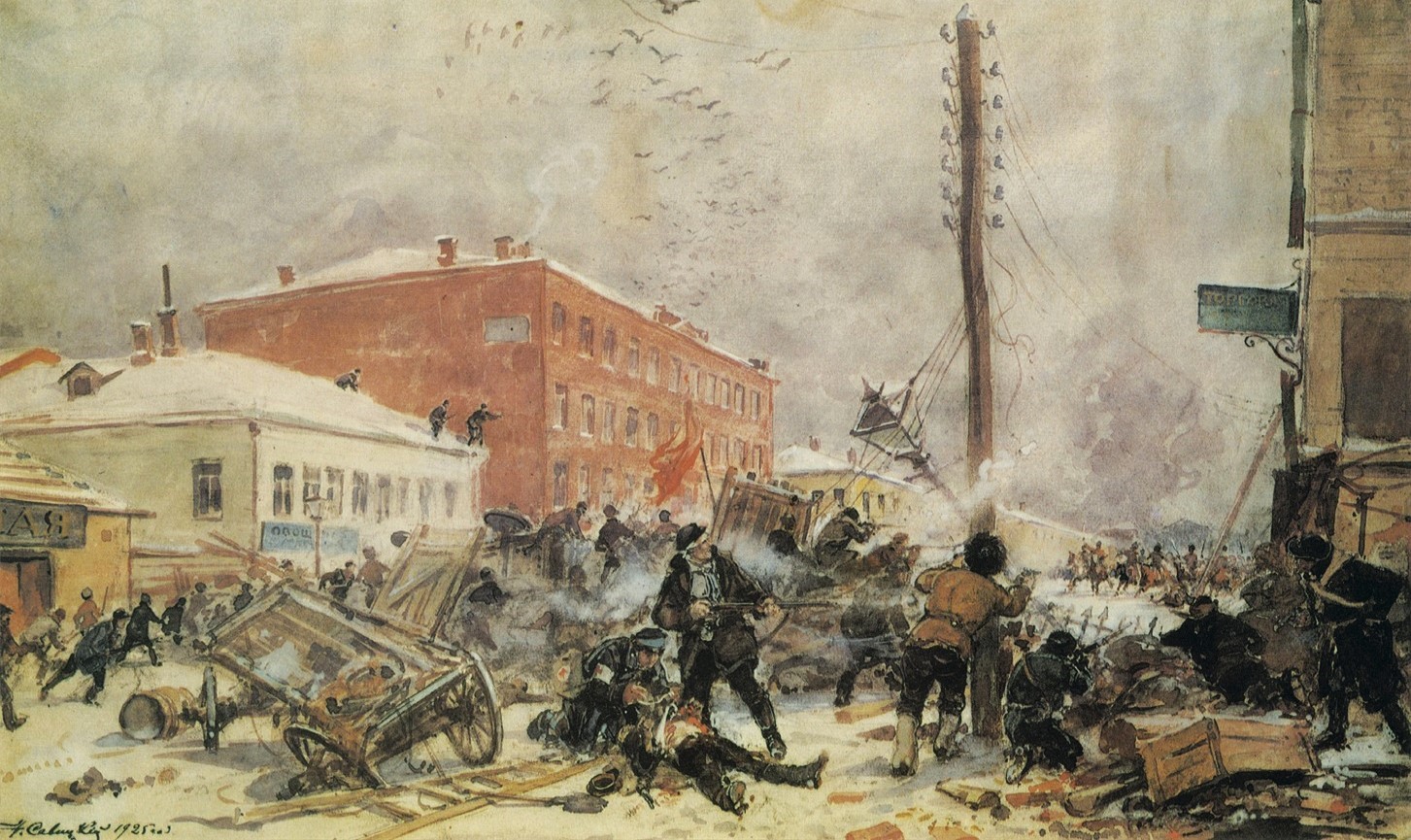
With regard to the last, an extraordinary one-sided opinion is very prevalent in the right wing of the party. It is impossible, according to the holders of this opinion, to fight against the military of today, but it is necessary to revolutionize the military. It goes without saying that if the revolution does not become a revolution of the masses, and does not spread to the military itself, there can be no thought of a serious struggle. Work among the troops is naturally an imperative necessity, but the bringing over of the soldiery is not to be imagined as one single simple action, the result of persuasion on the one hand and conviction on the other. The Moscow rising plainly showed how empty and mechanical such an idea is. The inevitable vacillations among the troops in every real people’s movement lead to an actual struggle for the soldiery when the revolutionary struggle becomes so acute as to involve actual fighting. The Moscow rising shows a graphic picture of the most furious and desperate struggle between reaction and revolution for the allegiance of the soldiery. Dubasoff himself declared that out of the 15,000 soldiers in the Moscow garrison, only 5,000 were reliable. The government retained its hold over the vacillating elements only by the most varied and desperate measures; by persuasion, flattery, bribery, distribution of watches, money, etc. The soldiers were given liquor; they were deceived, intimidated, confined to barracks, disarmed; the soldiers considered particularly unreliable were isolated from the others. And we must have sufficient courage to admit that it is precisely in this regard that we have been behind the government. We have not made full use of the powers at our disposal for carrying on precisely such an active, courageous, enterprising, and offensive struggle for the vacillating soldiery, as the government has done. We had prepared ourselves for the ideological “preparation” of the soldiery, and shall continue this with the utmost perseverance. But we should prove ourselves miserable pedants should we forget that at the moment of an uprising a physical fight for the soldiery is an equal necessity.
The Moscow proletariat in December gave us excellent lessons on the ideological “preparation” of the troops-thus, for instance, on the 8th December in Strastnoy Square, when the crowd mingled with the cossacks, surrounded them, entered into friendly speech with them, and succeeded in inducing them to withdraw. Or on December 10 in the Pressnja district, when two young women workers, bearing the red flag at the head of a crowd of 10,000, rushed forward to meet the cossacks with the cry: “Strike us dead, for living we shall not surrender the flag to you!” The cossacks were confused, and galloped away among the cries of the crowd: “Long live the cossacks!” These examples of courage and heroism must leave a lasting impression on the consciousness of the proletariat.
But here we have the following examples of our backwardness as compared with Dubarsoff. On December 9. soldiers passed along Bolsaiya Serpuchovskaya, singing the Marseillaise, ready to join the rebels. The workers sent delegates to them. Malachoff himself galloped to the spot in the utmost haste. The workers came too late, Malachoff was there in good time. He delivered an enthusiastic address, rendered the soldiers irresolute, surrounded them by dragoons, conducted them back to barracks and there shut them up. Malachoff arrived in good time, and we did not, although 150,000 people responded to our appeal in 2 days, and these could and should have organized, patrol service in the streets. Matachoff surrounded the soldiers with dragoons, but we did not surround Malachoff with bomb-throwers. We could and should have done this, and the social-democratic press (the old Iskra) had long emphasized that the ruthless extermination of the bourgeois and military leaders was our duty at the time of the rising. That which happened in the Bolsaya Serpuchovskaya appears to have happened on similar lines before the Neshvisk barracks and the Krutizi barracks; during the attempt made by the proletariat to “remove” the soldiery of the Jekaterinoslav regiment; when delegates were sent to the sappers at Alexandrov; on the return of the Rostov artillery sent to Moscow; when the sappers were disarmed at Kolumna, and on other occasions. At the moment of the rising we were not adequately prepared for our main task, the struggle for the hesitating soldiery.

The December events have also proved the correctness of another profound thesis of Marx, one forgotten by the opportunists. Marx wrote that rebellion is an act, and that the main rules of this act lie in desperate, reckless and ruthlessly determined attack. We have not assimilated this truth sufficiently, we have not learned this art, this rule of assuming the offensive at any price, and we have not taught this rule to the masses. Now we must make up for this negligence with all energy. It is not sufficient to form groups around political slogans; another grouping is necessary according to the attitude to be adopted with regard to armed rebellion. All who are not in favor of uprisings, all who do not prepare for them, must be mercilessly expelled from the ranks of the followers of revolution. They may go over to the camp of the counter-revolutionists, to the traitors and cowards, for the day is not far distant when the conditions of the struggle will compel us to recognize our friends and our enemies by this standard. We must not proclaim a gospel of passivity, of mere “waiting” for the moment when the soldiery “comes over” to us-no, we must ring out from every steeple the necessity of a courageous offensive, of attack with the weapon in the hand, of the necessity of exterminating the leaders of the troops when this attack is made, and of exerting the utmost endeavor in the struggle for the vacillating soldiery.
The third lesson which we may learn from Moscow relates to the tactics and the organization of the forces for an uprising. War tactics are dependent on the level of war technics, this truth was put into the mouths of the Marxists by Engels. War technics today are no longer those of the middle of the 19th century. It would be arrant foolishness to throw a mass of human beings against artillery, or to defend barricades with revolvers. Kautsky was right when he wrote that after the events of Moscow it was time to revise Engels’ theses, and that Moscow had created new barricade tactics. These tactics were the tactics of a partisan war. The organization required by such tactics must consists of mobile and very small detachments: groups of ten, of three, of even two. Here we often come across social democrats who snigger scornfully when one speaks of groups of five or three. But such cheap sneers are only made by those who do not want to recognize the fact that present day war technics render fresh tactics and organization necessary for street fighting. If you will attentively peruse the narrative of the Moscow rebellion, gentlemen, you will perceive that there is a connection between the groups of five” and the question of the “new barricade tactics”.
Moscow employed these tactics, but in a by no means developed form, and not on a really mass scale. There were but few defence units (“Druschinniki”), the masses of the workers had received no slogan for courageous attack and applied none, the character of the party detachments was much too uniform, their equipment and their knowledge were insufficient, and their understanding of how to lead the masses almost entirely undeveloped. We must remedy all this, and we shall do so, for we have learnt the lessons taught by the Moscow rising, we shall spread this knowledge among the masses, and call forth a creative activity among the masses themselves. That partisan war, that mass terror, which has prevailed everywhere in Russia almost uninterruptedly since December, will doubtless help us to instruct the masses in the right tactics to be adopted at the moment of rebellion. Social democracy has to recognize this mass terror and include it in its tactics, must subordinate it, must of course organize and control it in the interests and conditions of the labor movement and of the revolutionary struggle in general, and must ruthlessly sweep away that “vagrant” distortion of this partisan war which the Moscow fighters so mercilessly put an end to during the days of the rising, and the Letts equally mercilessly during the days of the famous Latvian republics.
War technics have made further progress of late. The Japanese war has taught the use of the hand grenade. The armament factories have put the automatic gun on the market. Use is already beginning to be made of both weapons in the Russian revolution, but by no means to an adequate extent. We can and must utilize the achievements gained by technics; we must teach the workers’ detachments the mass manufacture of bombs; we must help them and our fighting groups to provide themselves with explosives, fuses, and automatic guns. When the working masses take part in a city uprising, when there is a mass attack on the enemy, when a skillful and decisive struggle is being made for the soldiery, now more irresolute than ever after the Duma, after Sveaborg and Cronstadt, when the villages determinedly participate in the general struggle, when the next All Russian armed rebellion comes the victory will be ours!

Therefore we want to extend our work on a still broader basis, to tackle our tasks more courageously, and to utilize the lessons taught by the great days of the Russian revolution. Our work is founded on the correct estimation of class interests and of the needs involved by the development of the whole people at a given moment. Around the slogan: Overthrow of Czarist power and convocation of a constitutional assembly by the revolutionary government, we group, and will continue to group, an ever-increasing section of the proletariat and soldiery. The development of the consciousness of the masses remains the foundation and main object of our whole work. But we must not forget that such moments as are now being experienced in Russia add fresh and special tasks to this general and permanent one. We do not want to become pedants and Philistines, we do not want to set aside these special tasks of the present moment, to ignore the form of struggle given by the present circumstances, and content ourselves with empty phrases on the tasks incumbent on us at all times and under all conditions.
We must not forget that a great mass struggle is impending. It will be an armed uprising. This uprising must be a simultaneous one as far as possible. The masses must know that they are starting on a bloody and desperate struggle. Scorn of the fear of death must be spread among the masses, and will assure our victory. The attack on the enemy must be carried out with the utmost energy; attack and not defence must be the slogan of the masses; ruthless extermination of the enemy is to be their task; a mobile and flexible fighting organisation will be formed; the vacillating elements among the soldiery will be drawn into the active struggle. The party of the class conscious proletariat must fulfill its duty in this great struggle. (Proletarij. No. 2. August 1906.)
International Press Correspondence, widely known as”Inprecorr” was published by the Executive Committee of the Communist International (ECCI) regularly in German and English, occasionally in many other languages, beginning in 1921 and lasting in English until 1938. Inprecorr’s role was to supply translated articles to the English-speaking press of the International from the Comintern’s different sections, as well as news and statements from the ECCI. Many ‘Daily Worker’ and ‘Communist’ articles originated in Inprecorr, and it also published articles by American comrades for use in other countries. It was published at least weekly, and often thrice weekly. The ECCI also published the magazine ‘Communist International’ edited by Zinoviev and Karl Radek from 1919 until 1926 monthly in German, French, Russian, and English. Unlike, Inprecorr, CI contained long-form articles by the leading figures of the International as well as proceedings, statements, and notices of the Comintern. No complete run of Communist International is available in English. Both were largely published outside of Soviet territory, with Communist International printed in London, to facilitate distribution and both were major contributors to the Communist press in the U.S. Communist International and Inprecorr are an invaluable English-language source on the history of the Communist International and its sections.
PDF of full issue: https://www.marxists.org/history/international/comintern/inprecor/1923/v03n51[30]-jul-19-1923-Inprecor-loc.pdf
 Revolution's Newsstand