I have no idea about the veracity of the science in this article, though I would love to hear from those that do. However, it is both unsurprising, and remarkable, that the International Socialist Review, the finest U.S. Marxist journal of its time, would host such an essay in 1909. ISR’s mission in educating the U.S. working class in Marxism consciously included making general knowledge of modern science, technology, and the arts accessible to workers, as their publications attest.
‘A Dissertation on “Space of the Fourth Dimension”’ by James W. Hughes from The International Socialist Review. Vol. 10 No. 5. November, 1909.
DOUBTLESS the reader, on observing the title of this article, will ask himself the question, “What has Space of the Fourth Dimension to do with the subject of Scientific Socialism or the economic question?” A close consideration of the matter, however, will clearly show that the economic question is related and interrelated, directly or indirectly, to almost every scientific subject known to man.
Especially does this apply to the subject we have here under consideration, and far more so than it would at first appear on the surface of the thing.
In the first place, it must be borne in mind that the strength of the present Socialist movement lies in the fact that it rests on a materialistic basis—that it is a real, and a materialistic struggle of the working class to better its material conditions. In a word, it is a material struggle for a material existence where a good understanding of material things is of vastly more importance than the gewgaw and gush of the mythical and metaphysical or the spiritual and supernatural. But a good understanding of material things requires a good understanding of matter, and the more we know of force and matter the better we understand the materialistic. In the study of matter man has met with multitudes of enigmas and phenomena from his earliest existence, which he could not at first explain, and when he could not explain them, he immediately drew on his imagination for his facts, and began to dream. And such dreams; of gods and glory to satisfy his personal longings for rest and reward—and such dreams; of hells and horrors, to satisfy his brutal thirst for revenge and retribution, while he neglected his duty to himself and fellow man, in the way of bettering his material existence on earth,—such have been the great stumbling blocks in the paths of progress since the earliest forms of savagery to the present day, and they will continue to be the stumbling blocks as long as we meet phenomena we can’t explain. Many are the phenomena to-day that we can not explain, and this is doubtlessly due to our deficiency in perceptive faculties, for that which we cannot perceive, we cannot conceive, and that which we cannot conceive we cannot explain.
Some day the human race may, and no doubt will, develop a number of senses of perception, which we do not now possess, i.e., senses other than the senses of seeing, hearing, tasting, smelling and feeling as now ordinarily used. Under such conditions it will be easy to explain many phenomena that now so much bewilder and puzzle us today.
The development of such senses will depend largely upon our pursuance and study of space of a higher order than that in which we really exist.
We exist in, and thoroughly understand, space of three (3) dimensions only, that is, space of length, breadth and thickness, which we can deal with mathematically in every conceivable way.
In higher mathematics it is necessary in order to elucidate certain problems to consider space of four dimensions, that is, space of length, breadth, thickness and something else of which we cannot conceive, yet can demonstrate mathematically to our satisfaction, if not to a certainty. And while we cannot conceive of it clearly, yet it enables us to explain many mathematical and physical phenomena that would otherwise remain as enigmas.
For the benefit of those who wish to give this subject a little serious thought, and perhaps clear up many delusions, I will try to set forth here a short explanation of “Space of the Fourth Dimension,” steering as clear of mathematics as I possibly can.
While “Space of the Fourth Dimension” is quite easily explained to a well trained mathematician, it is by no means an easy proposition to write a treatise on this subject, and make it clear to the average lay reader, for as the inventors express it, “It is an easy matter to make an invention for an expert to handle, but simply hell to make it fool-proof for public use.”
Before plunging headlong into the subject of “Space of Four Dimensions,” had we not better first try to ascertain what space really is? Have you a proper conception of space? Can you conceive of anything in the universe without thinking of space? And the most important of all, can you really define space? In fact can you define it any better than the college student who said: “Space—space— well, I have it in my head all right, Professor, but I just can’t quite explain it.” If you ask the average man to define space he will most likely answer you by giving you some synonym for the word “space” and think he has given you a definition. “But what he thinks, doesn’t alter facts,” nor does it make a synonym a definition. He might for instance tell you that space is room and when you ask him what is room he would most likely answer you like a vest pocket dictionary, and say that “room is space” and thus get himself into a “most vicious — circle” that reminds one for all of the story of the eel and the swan.
As a proper understanding of terms is an absolute necessity in a scientific discussion, we must here ascertain first of all the difference between a definition and a synonym.
A synonym in the first place is merely a substitution of one word for another, which means exactly the same thing, while a definition is a form of classification, that is to say, when we define a word we point out those characteristics which distinguish a thing from the other things in the class of things to which it belongs.
The greatest care should be exercised, however, in ascertaining the proper characteristics, for science demands that every characterization shall be a known and proven fact.
Hence to assume a characteristic, in defining a word, is most dangerous and unscientific.
Now it will be further seen on close examination that the defining of all words is but a great classification of all the words known to man, in which the words “space” and “matter” are the initial trunk words.
As an illustration of the above, we are asked to define the word “negro”, and we say that a negro is a certain kind of a man (giving his peculiar characteristics), and then we are asked: “What is a man?” A man is a certain kind of an animal. And what is an animal? An animal is a certain kind of organism. And what is an organism? An organism is a certain kind of active condition of matter. And what is matter? Matter is anything that occupies space, or more briefly, matter is occupied space. And what is space? And here we are “stuck,” because space embraces everything, and is not one of a class of things to be characterized, in order to distinguish it from similar things of the same class.
Now, therefore, I hold that while space in general is conceivable to the brain and perceptible to the senses, it is not definable by words. Space in general, however, is subdivided into several kinds of spaces, each one having its peculiar characteristics that distinguish it from all the other kinds, and can therefore be defined in words.
Mathematically characterized we have here to deal with the following kinds of space:
1st. Space of no dimensions commonly called a point.
2nd. Space of one dimension commonly called a line.
3rd. Space of two dimensions commonly called a plane.
4th. Space of three dimensions commonly called a solid.
5th. Space of four dimensions which might be called energy.
For sake of illustration and clearness we will consider all the spaces with which we have to deal, as occupied space, e.g., occupied by matter. In the first place a point is a particle of matter that is infinitely small, or, as the mathematicians would say, “infinitesimal,” which means immeasurably small, and of course imperceptible to all our senses. In other words, since a point only occupies space of infinitesimal length, breadth, and thickness, it must be imperceptible to all our senses though conceivable to the brain and definable in words.
In the second instance we may consider space of one dimension (which we call a line) as composed of an infinite number of points placed side by side or tangent, but in the true sense it is better to consider a line as generated by a moving point. For instance, suppose we imagine that the point “A” (in figure 1) is moving or vibrating from A to B with an infinite velocity so that it occupies every point of space between A and B at the same time.

The result would be a straight line, or a space of one dimension, which is length. But since the point in the first place had neither finite breadth nor thickness a true line would have neither finite breadth nor thickness and would therefore be as imperceptible to our senses as the point which generates it. Hence, space of one dimension, known as a line, which is generated by the movement of space of no dimensions, known as a point, like the point itself is imperceptible to our senses though conceivable to the brain and definable in words.
In the third instance we may consider space of two dimensions (known as the plane) to be composed of an infinite number of lines placed side by side or tangent to each other, but like the line, it is better to consider it as generated by a moving line as follows:

Suppose the line A-B (in figure 2) to be moving or vibrating at right angles to and along the line C-D from C to D with an infinite velocity or speed, till it occupies every point of space from C to D at the same instant. Then the result would be a plane represented by A, B, E, F, or space of two dimensions, viz., length and breadth.
Hence space of two dimensions (known as the plane) is the result of a vibrating line, is conceivable to the brain and definable in words, yet it has neither thickness nor mass.
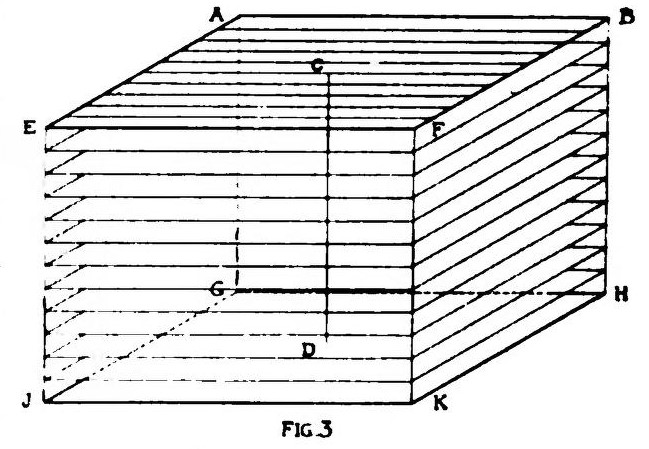
Next let us consider the fourth case or space of three dimensions, commonly known as the solid, which, like the above cases, in its turn might be considered as made up of an infinite number of planes of infinitesimal thickness, but like the line and the plane, we will consider the solid as a product of generation, being generated by a plane in motion as follows: Let A, B, E, F, (in figure 3) represent a plane vibrating between -the points, C and D rising to an infinite speed until the plane A, B, E, F, occupies every position between A, B, E, F, and G, H, J, K at the same instant, then the result would be a solid (represented by the outlines A, B, E, F— G, H, J, K), or space of three dimensions, viz.: length, breadth and thickness. Hence space of three dimensions (known as the solid) is generated by a moving plane, is perceptible to all the senses, 1s perfectly conceivable to the brain and quite easily defined in words.
Next, we will consider the fifth case or space of the “fourth dimensions,” and here comes the “rub.”
Now we have considered how a certain movement of a point generates a line or space of one dimension, and how a similar movement of a line generates a plane or space of two dimensions, and how a similar movement of a plane generates a solid or space of three dimensions, then will not a similar movement of a solid generate space of the “fourth dimension?” We know if we know anything that any kind of a movement of a solid, generates energy, which energy is proportional to the speed times the mass.
Now we have seen how a plane or “space of two dimensions” is the result of a line vibrating at an infinite speed, and how a solid or space of three dimensions, is the result of a plane vibrating at an infinite speed, then why is not “space of the four dimensions” the result of a solid vibrating at an infinite speed, and since energy is equal to mass times the speed, why is not “space of four dimensions” infinite energy itself? “But ah!” you say, “this is inconceivable,” because, it does not manifest itself to any of our senses. And why does it not manifest itself to any of our senses? Because, unfortunately our senses are only quintuple, that is to say five in number, had we more, then, space of the “fourth dimension” might become perceptible to our senses and in such a case it would also doubtless become very easy to conceive of in the brain.
The question naturally arises, does “space of the ‘fourth dimension” manifest itself in any way in nature? To which I would reply, yes, while it does not manifest itself in any way on our senses, directly, yet it manifests itself by its action on various things in every branch of science, and when we meet with one of these manifestations and are unable to explain it, we simply “translate our ignorance into Greek” and call it a “phenomenon.”
The space here allotted will not permit us to go as thoroughly into this branch of the discussion as I should like to, while furthermore, a clear presentation of this subject pre-supposes a reader not only well up in mathematics, but also more or less familiar with every branch of science known to man.
Under the circumstances, therefore, we can only, as the French would say, “effleurer la question,” touch upon the main points. To illustrate how many actions are taking place all around us, that do not and can not manifest themselves to any of our limited number of senses, two recent and well known discoveries will serve as good examples. I mean the X-rays and the Hertz-rays, both of which result from the passage of a high potential electric spark through a partially vacuumized tube properly constructed for the requirement. in the first instance the X-rays do not manifest themselves in any way to any of our senses, i.e., we can neither see, hear, taste, smell, nor feel them, but when they fall on certain substances, such for instance, as tungstate of calcium, the ‘tungstate will become “fluorescent,” that is to say, it is made to glow and give off light, which is visible to the eye. Hence while the X-rays themselves are invisible to the human eye, they do act upon the calcium tungstate as to make the tungstate visible in total darkness.

Likewise the Hertz-rays (which is the basis of wireless telegraphy) are also imperceptible to any of our senses, but may be detected by their manifestation upon the following arrangement: Let an electric circuit be formed, as in Figure 4, in which B represents a battery, T is a telephone receiver, and P a glass tube filled with platinum filings, sufficient in number to offer a considerable resistance to the flow of the current, so that under ordinary conditions, the current flowing through the circuit will not be sufficient to exert a strong pull on the diaphragm in the receiver. Now if a small quantity of “Hertz-rays,” emanating from any place whatsoever, should strike upon the platinum filings in the glass tube, P, the filings will at once cling together in such a way as to offer less resistance to the passage of the electric current, which will at once “build up” and strengthen the magnet in the receiver, which in its turn will pull down harder on the diaphragm and give a perceptible “click.”
The above illustrations are simply described in order to bring out some of the many things in nature that do not manifest themselves on any of our limited number of senses, yet play a most wonderful part in the universe.
There are numerous other things such as “molecular” and “atomic action,” gravitation, etc., that might be gone into had we the space here to do so, but being limited in space we will have to omit discussing many interesting phenomena, which on account of their non-tangibility to our five senses, have given rise to the vaguest notions, the wildest theories and the grossest superstitions.
Consequently I will have to conclude by adding a few remarks to the foregoing vibratory theory we have just discussed.
Now I do not wish to be understood as maintaining that a solid of any kind (strictly speaking) is the result of a vibrating plane, or that a plane is the result of a vibrating line, for in the first place a plane, as well as a line or a point, is (strictly speaking) a nonentity, and was simply used for illustration. It can be readily seen that while the point vibrates to generate a line, the line at the same time can be vibrating to form a plane, and at the plane at the same time can be vibrating to form a solid, etc. Hence a solid is the result of a vibrating point, made up of three component vibrations, which need not be of such perfect rectilinear character as to describe lines, planes, etc., but on the contrary slight variations are necessary to account for the various materials in existence.
That all matter is made up of vibrating points or parts, none can deny. As a matter of fact, who can deny that all matter is composed of vibrating points of space itself made up of three component vibrations? And furthermore who is prepared to say that a fourth component vibration, would not produce matter or space of the “fourth dimension,” that would be non-tangible to all our senses?
(1) In conclusion we might say that two theories of “space of the fourth dimension” stand side by side; one we might call, the “vibratory” theory, the other; the “static” or “geometric” theory. The vibratory theory briefly stated holds this: That all matter tangible to our senses is the result of innumerable vibrating points of space, composed of three component vibrations, while the non-tangible activities that we know are at work are the result of innumerable vibrating points of space composed of four or even more component vibrations.
(2) The “static” or “geometric” theory might be demonstrated by the following example: Figure 5 represents two isometric triangles, A, B, C, and A’, B’, C’, formed by dividing an isosceles triangle in two equal parts.

As long as the two triangles remain in the same plane, that is, space of two dimensions, although they are equal, they cannot be made to coincide, because they are equal and isometrical instead of equal and symmetrical. But if we pick up the triangle A’ B’ C’ and turn it over, by revolving it through space of three dimensions, it will be clearly seen that the triangles will then become symmetrical and can be made to coincide, that is, A’ can be placed on A, with B’ on B, and C’ on C.
Now let us consider two isometric solids, such as one’s right hand and left hand; though they are equal in volume and proportion, yet on account of them being isometrical instead of symmetrical, the right hand cannot be put in the same space that the left hand can, and vice versa. But could we only revolve the right through space of four dimensions, the right hand could then be put into the left hand glove and vice versa. To illustrate this, if the right hand glove, which is merely a complex warped plane or space of two dimensions be turned wrong side out, it can then be put on the left hand, or the left hand glove can be turned wrong side out and put on the right hand. This last illustration is merely given to show an application of the theory to solid geometry, where it is very valuable, yet the first, or what I call the “vibratory” theory, is of far more importance to science.
While the theory as a whole cannot be perfectly analyzed on account of our deficiencies in perceptive faculties, it unquestionably offers a most beautiful field of unlimited investigation in every line of science.
The International Socialist Review (ISR) was published monthly in Chicago from 1900 until 1918 by Charles H. Kerr and critically loyal to the Socialist Party of America. It is one of the essential publications in U.S. left history. During the editorship of A.M. Simons it was largely theoretical and moderate. In 1908, Charles H. Kerr took over as editor with strong influence from Mary E Marcy. The magazine became the foremost proponent of the SP’s left wing growing to tens of thousands of subscribers. It remained revolutionary in outlook and anti-militarist during World War One. It liberally used photographs and images, with news, theory, arts and organizing in its pages. It articles, reports and essays are an invaluable record of the U.S. class struggle and the development of Marxism in the decades before the Soviet experience. It was closed down in government repression in 1918.
PDF of full issue: https://www.marxists.org/history/usa/pubs/isr/v10n05-nov-1909-ISR-gog-LB-cov.pdf
 Revolution's Newsstand