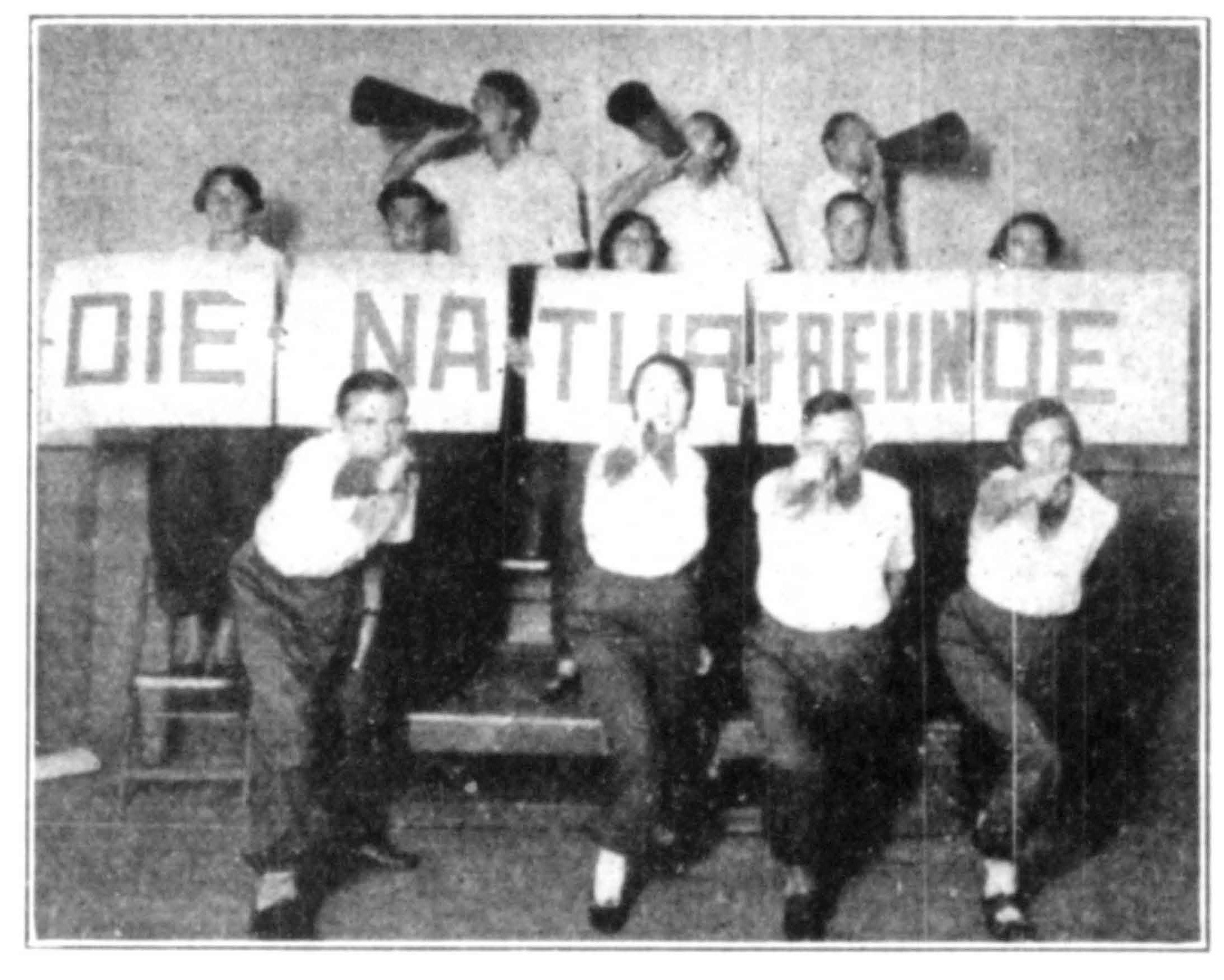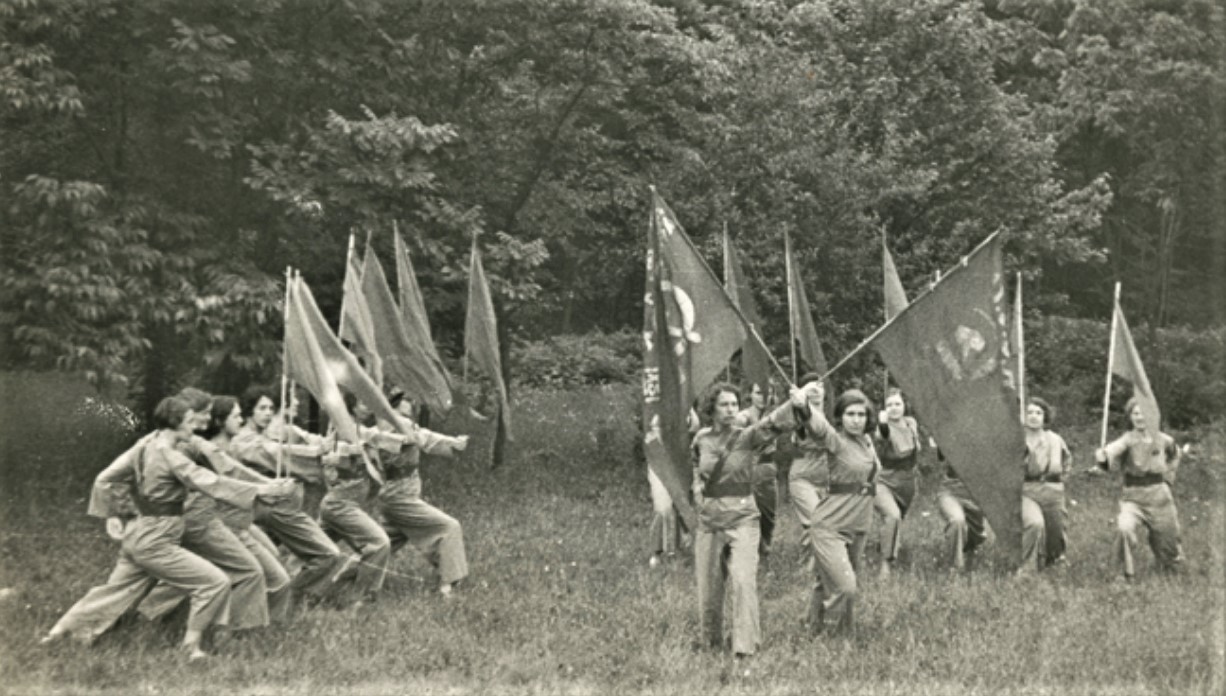
Nature Friends was a working class outdoors social movement begun in Germany in the 1890s and transplanted to the States early on, where it continued for decades. A fine tradition worthy of resurrecting.
‘Nature Friends: Hiking for Workers’ Health and Recreation’ from Health and Hygiene. Vol. 8. No. 1. July-August, 1938.
The joys of the open road are not only for rural dwellers. Nature also offers much within easy distance of the larger cities.
FREEDOM of the open air! The contrast between this freedom and the confinement that is the lot of the city dwelling worker sometimes makes it hard to visualize the pleasures of fresh air and sunshine that may, nevertheless, be enjoyed by such workers without going very far from the city itself. Work too often means long hours spent indoors with poor ventilation, in drab and squalid surroundings, and exposed to the hazards of dust, chemical fumes, and other unhealthful factors. And too often the hours after work mean equally confining meetings, moving pictures, dances, and visits at homes, with exposure to smoke and noise.
Health for Workers! Communion with Nature! These were the slogans of a workers’ organization founded in Austria and Germany over forty years ago under the name of the Nature Friends. Of course, since the Nazis have come to power in these countries such an organization has become illegal, but in other countries, including the United States, the Nature Friends are carrying on.
Health, good health, means so much to workers. The purpose of the Nature Friends is to bring to workers. the pleasures and joys of nature, as well as the physical and mental benefits that are to be obtained through outdoor activity, hiking, and camping.
To most city dwellers the term “hiking” has an unfamiliar ring. Yet an introduction to this readily available sport promises unparalleled enjoyment at little expense. It is in all truth the sport of workers as well as kings. Hiking is a universal activity–for all nations, all people, all ages. It can be lazy, relaxing, recreational, or it can be vigorous, exciting, and competitive a battle against the weather, distance, altitude, or time.
The Nature Friends have been active in promoting this sport in many nations of the world. The parent organizations in Germany and Austria, as stated above, have come under the Nazi pall but France, Switzerland, Holland, Belgium, Palestine, Czechoslovakia, the United States, and several other countries have their national groups today.
ROCKIES TO THE RAMAPOS
The growing popularity of hiking and camping in the United States is due in no small measure to the work of the Nature Friends of America.

This organization, with its central office in New York City is represented in sixteen cities of the United States, from California to New York, and even has a branch. in Alaska. Its sixteen camps dot the continent from the Sierra Madre in the Rockies to the Catskills and Ramapos in the Appalachian chain.
Nature Friends Branches: New York City, N.Y., Rochester, N.Y., Syracuse, N.Y., Bridgeport, Conn., Stamford, Conn., Jersey City, N.J., Newark, N.J., Passaic, N.J., Paterson, N.J., Allentown, Pa., Philadelphia, Pa., Chicago, Ill., Milwaukee, Wisc., Los Angeles, Calif., Oakland, Calif., San Francisco, Calif., Salt Lake City, Utah. For further information write to the Nature Friends, 11 West 18th Street, New York City.
In all these places stress is placed upon the opportunities that hiking and camping offer in off-setting the unhealthful and monotonous confinement of work, and in getting the hiker out into the healthful sunshine and unadulterated air. The members are shown how to make full use of the opportunities for hiking that exist in the particular locality. Hikes are arranged regularly for weekends or longer periods–short ones for the beginners or those who cannot afford the expense of longer trips, and more difficult or extended ones for the veterans and those whose circumstances permit them to wander farther afield.
Ready to go places.
To take only one example, let us examine very briefly some of the wholesome and varied hiking facilities that New York City has to offer, facilities that the Nature Friends will be glad to show you, practically at your door step for a few cents in car fare. Special equipment is not needed; ordinary clothes with stout, low-heeled shoes will suffice in most cases.
A ferry ride to Staten Island brings woodland trails and forest views as beautiful as those in the depths of the hinterlands. From St. George, where the ferry lands, you go along Victory Boulevard, past Silver Lake reservoir, through Clove Lake Park, and back is a route that is full of the beauties of nature. Along this trail the hiker will see rocky grottos, wild and luxurious plant and tree life, and lakes and ponds–all within easy distance of New York City.
The Palisades, that stately wall of cliffs rising along the west bank of the Hudson, are familiar to many by name but they are really exciting when explored. They offer delightful shore paths, wooded walks, ravines and chasms, a multitude of types of trees and a variety of birds overhead in the sky and in the branches of the trees. The walk from the Jersey landing of the Dyckman Street ferry, six miles north to Alpine is a good day’s workout. From Alpine north to Forest View is also an interesting hike.
There are many more excellent hiking tours in the immediate vicinity of New York. Pelham Bay with its shore life, rich marshes, beautiful islands, and secluded paths is one of the most interesting locales, combining as it does the beauties of land and water. Forest Park in Queens, with its cool woodland depths is an inviting spot. Van Cortlandt Park with its dense wooded land, abundant wild life–there are even wild foxes—will be a surprise to many New Yorkers who think of it as part of the city. Near Van Cortlandt Park is Tibbets Brook Park with its large swimming pool. There is also Nepera Park, a trolley ride’s distance from Van Cortlandt Park. Almost as near is Woodlands Park. In both of these there are beautiful ponds which are located in the midst of wooded fields and hills.
Other cities, too, offer characteristic hiking opportunities of their own. These shorter hikes train one to venture forth on longer and more difficult ones, and for these who want to go into the sport more seriously the Nature Friends offer a variety of well-planned weekends throughout the year. The weekly schedules of the activities of all the Nature Friends local organizations in the sixteen cities of the United States where they are represented can be found in the monthly magazine entitled The Nature Friend. This magazine also contains articles on hiking, sports, science, nature, and working-class culture.
Sports are an integral part of the hike. After the luncheon there is a rest period, usually followed by songs and discussion; then sports according to the season: swimming, wading, or boating in the summer; ice-skating or skiing in the winter.
The recreation offered by hiking is more than mere physical exercise. Both individual independence and group cooperation is fostered. There is also a unique opportunity for the enjoyment of that fraternity and fellowship that binds workers together in democracies. Hiking cultivates the habit of inquiry into the surrounding world, natural, political, and cultural. These inquiries are continued by the Nature Friends in their group activities during the week in the city. These activities consist of dancing, dramatics, photography, and various discussions and lectures. Certain members are experts in botany, bird lore, astronomy, and other subjects, and they impart their special knowledge to others who are interested.

Supplementing its hiking tours, the Nature Friends have a number of permanent camps. Near New York City there are four such camps, three in the Catskills and one in the Ramapos in New Jersey. The nearest and most popular is the latter at Midvale, New Jersey, forty miles from New York. It is ideally located in a valley nestled between wooded hills. There will be found forest trails to the full satisfaction of any hiker. The camp has a large swimming pool, tennis courts, and facilities for soccer, baseball, volleyball, and fist ball. A dormitory houses over 240 people and there are many separate bungalows. The entire camp, as is the case of all Nature Friend camps, was built by the cooperative labor of its own members. Weekends and summer vacations in camp are inexpensive. Indeed, it is a true workers’ country club!
One of the Catskill camps is used as a skiing camp in the winter. The rolling hills and slopes present skiing facilities which compare favorably with any in the East.
The entire organization of the Nature Friends of America offers itself to the workers of America as a rallying point around which to build a progressive program of workers’ health and recreation. The many Americans of all creeds and races who are now swelling the ranks of the Nature Friends are proud to carry forward the democratic ideals of its founders and to make the benefits of outdoor activities available to a larger percentage of the American working people.
Health was the precursor to Health and Hygiene and the creation of Dr. Paul Luttinger. Only three issues were published before Health and Hygiene was published monthly under the direction of the Communist Party USA’s ‘Daily Worker Medical Advisory Board Panel’ in New York City between 1934 and 1939. An invaluable resource for those interested in the history history of medicine, occupational health and safety, advertising, socialized health, etc.
PDF of full issue: https://www.marxists.org/history/usa/pubs/health/v8n1-jul-aug-1938-health-hygiene-n.pdf
 Revolution's Newsstand