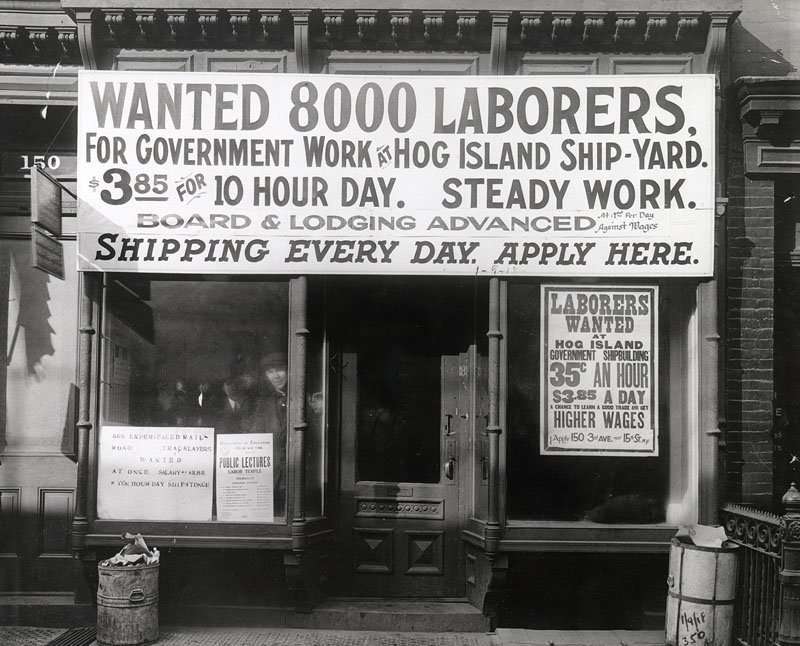
A glimpse at the difficulty in organizing the Party in Virginia, where racism and war industries defined much of working class life. Added to the challenge was the long-debated semi-autonomy of the Language Federations; which led to Party meeting in Norfolk being held in Yiddish by a largely middle-class membership, a situation unconducive to recruiting Black workers.
‘Communist Organizing in Virginia’ by Irving Keith from The Daily Worker. Vol. 6 No. 50. May 6, 1929.
Low Wages; Race War Always Imminent; Nuclei of Communist Part Can Be Built in Shops.
The rapid industrialization of Virginia calls for an expansion of Communist activity and a concentration of Communist forces in the state. In the Tidewater district of Virginia, which embraces Norfolk and that part of the state immediately surrounding it, are quite a number of large manufacturing plants. In these plants working conditions are miserable, wages are very small and the average working day is ten hours.
General Conditions.
As a direct result of the very low wage scale living conditions are almost unbearable. For the Negro workers particularly, is this true. They are forced to live in rambling shanties which have no means for either lighting or heating.
For the white workers conditions are slightly better, and since the general tendency is to compare their standard of living with that of the poorest class of workers, i.e., the masses of Negro workers, they do not consider themselves in as poor a condition as they really are.
No attempt has been made to establish nuclei in any of these mills. It is of the utmost importance that our Party take up immediately the task of organizing nuclei in these factories and mills.
The War Danger.
In the Tidewater district of Virginia are several bases for the manufacture and storage of war materials. In Norfolk and Portsmouth are the Navy Yards and Naval and marine bases, in Newport News and Hampton Roads, the shipyards and naval bases as well as warehouses for the storage of munitions. Virginia has several airports and is now preparing for the building of several more. Throughout the state are scattered military academies of various sizes. The two largest are the Virginia Military Institute and the Virginia Polytechnic Institute.
Thus we see Virginia as a center of preparation for the coming imperialist war. At this time when we are bending every effort to fight militarism and the preparations for this next imperialist war these places become important centers and as a result Virginia becomes one of the most strategic points in the country.
In the Navy Yard at Portsmouth there is a strong group of militant workers. This militant element has not been developed, nor has there been any attempt made to develop it. This militant group in the Navy Yard is of the utmost importance and cannot be allowed to go its own way and result in its being lost to our Party. With the proper leadership it must be turned into an active shop nucleus, embracing the best elements among Negro and white workers. It is also of the utmost importance that nuclei be established immediately in all of these bases and military schools.
Negro Question.
The Negro question in Virginia is acute. Discrimination, segregation and Jim-Crowism are everywhere prevalent. The Negro, although exploited even more than the white worker, is not outwardly revolutionary. The Negro masses now working in the mills are the same masses who a few years ago were engaged solely in agricultural pursuits.
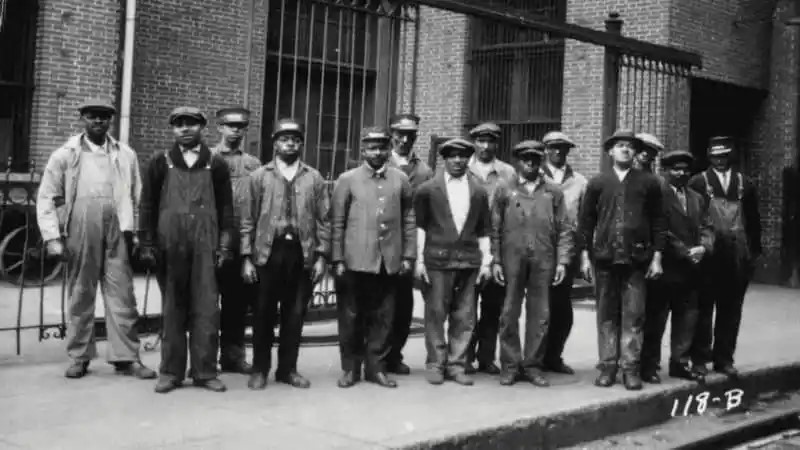
Now employed in factories and mills, and getting a slight bit more, in the way of wages, than when he was agrarian, the Negro has become, outwardly at least, quite passive. The attitude of the masses of white workers toward the Negro is, generally, that hatred which has been instilled in them by bourgeois propaganda and teaching. There are several groups of militant Negro workers in both Norfolk and Richmond. These, like the Navy Yard group, have not been touched.
These groups are now ready for development. They must not be allowed to go on in their own way or they too will be lost to the Party. It is of the utmost importance that the members of these militant groups be drawn into the revolutionary struggle. The masses of Negro workers in Virginia are readers of the reactionary “Negro World” and the “Norfolk Journal and Guide.” It is urgent that the “Negro Champion” conduct a campaign and secure as readers the masses of Negro workers in Virginia. It is also important that a special publication, dealing with the vital problems of the southern industrial workers, agrarian laborers and tenant farmers, be issued and distributed. Composition of Norfolk Unit. There has been practically no work done in Norfolk. The Navy Yard, the Naval and Marine bases and the various factories and mills have not been touched. The problem of the organization of the masses of Negro workers has gone by almost unnoticed in Norfolk.
The social composition of the Norfolk unit of the Party is extremely bad. There is not a real proletarian element in the unit. It is for this reason, primarily, that the Norfolk unit of our Party is utterly unable to cope with the problems of organization or to do necessary work.
The Norfolk unit of the Party is a Jewish-speaking one. This, as we can readily see, may be responsible for the loss of American working class elements, especially the Negro workers, who are entirely English- peaking. To cite an example; the one worker whom the unit could claim as a member was non-Jewish and had to stop coming to meetings because he could not understand what was going on about him at the few meetings which he attended.
The Party unit in Norfolk has adopted a white chauvinist attitude towards the race question and has fought all moves toward the organization of Negro workers into nuclei and units. It follows the course of least resistance and makes no effort to give the Party’s stand on the Negro question to the masses of workers. This can be attributed to the following reason: since taking leadership in a movement to organize the Negroes and advocating equality of the races would bring notoriety to most of the members of the unit, and since all of these are in business and notoriety is bad for business, they are fearful of the outcome of an open policy on the Negro question.
It is my contention that the unit members cannot go about the task of organizing the Negro, conscientiously, because of the fact that they are now, in their businesses exploiting the Negro workers. For illustration: most of the business done in Norfolk is installment-plan selling. The Negro masses are the primary source of business for the installment houses. The Negro, with no knowledge of values or prices, knows only that he must pay so much each week or his belongings will be taken as payment for the merchandise purchased. He, in many cases, continues to pay for as long as two and sometimes even three years. Since most of the Norfolk Party members run installment houses, the reason for this chauvinism on their part can be readily seen.
The Party’s invasion of Virginia in the last election campaign did not give rise to any organizational gains. In Norfolk there were three campaign meetings. Two of these were arranged by the National office of the Party and the third by the district office at Philadelphia. The Norfolk section of the Party did very little towards the success of these meetings. The same, I believe, is true of Richmond.
Proposals.
Our Party must undertake the complete reorganization of the Norfolk and Richmond units. It must inaugurate an extensive campaign to organize real proletarian elements into units and nuclei, and in line with the general situation in the South, of which Virginia is partly typical, it is my opinion that the Party must pay particular attention to the immediate organization of a Southern district with all the functioning departments, such as Women’s, Negro, Youth, and Pioneer.
The Trade Union Educational League must establish itself in the South in order to draw the great masses of unorganized workers into the struggle on the industrial field. More attention must be paid to the organization of the Southern workers into the new industrial unions. Our Party must analyze the conditions of the agrarian laborers and tenant farmers with a view towards laying out a program around which we must rally these agrarian laborers and tenant farmers to the standard of our Party.
EDITOR’S NOTE: The Norfolk unit has already been reorganized because of white chauvinism. The District Committee is now engaged in building a real Party unit from among the workers in the basic industries, concentrating among the workers of the Navy Yard.
The condition described by Comrade Keith existed and to an extent still exists in other Party units in the South. The Party is now giving attention to these units in reorganizing them and orientating itself on the Negro proletarians and the workers in the basic industries generally.
The Daily Worker began in 1924 and was published in New York City by the Communist Party US and its predecessor organizations. Among the most long-lasting and important left publications in US history, it had a circulation of 35,000 at its peak. The Daily Worker came from The Ohio Socialist, published by the Left Wing-dominated Socialist Party of Ohio in Cleveland from 1917 to November 1919, when it became became The Toiler, paper of the Communist Labor Party. In December 1921 the above-ground Workers Party of America merged the Toiler with the paper Workers Council to found The Worker, which became The Daily Worker beginning January 13, 1924. National and City (New York and environs) editions exist.
PDF of full issue: https://www.marxists.org/history/usa/pubs/dailyworker/1929/1929-ny/v06-n050-NY-may-06-1929-DW-LOC.pdf
 Revolution's Newsstand