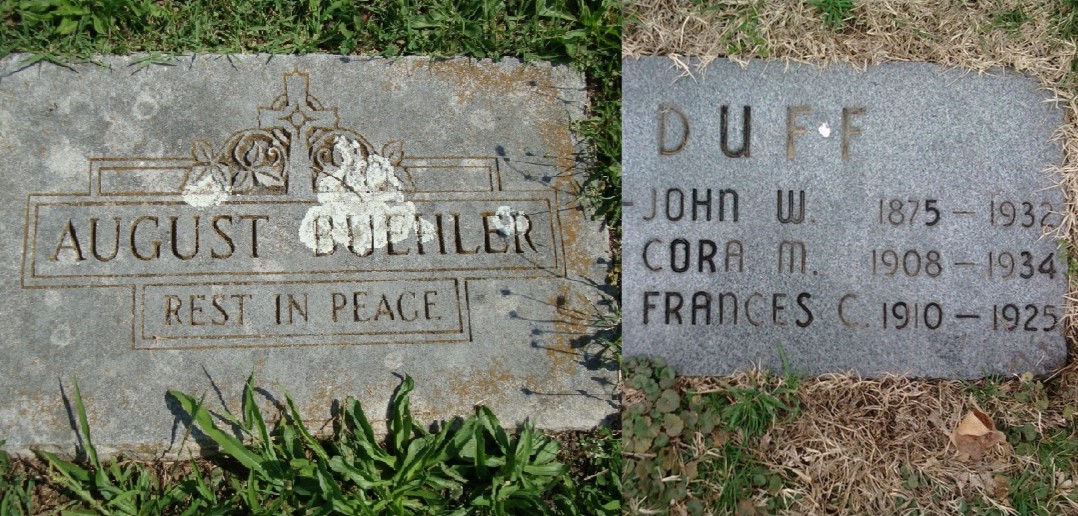
Within days of each other August Buehler and Cora Duff, two leading comrades of the Communist League (forerunner of the Socialist Workers Party) in Kansas City, representing two different generations died. George Clarke remembers them.
‘On “Shorty” Buehler and Cora Duff’ by George Clarke from The Militant. Vol. 7 No. 19. May 12, 1934.
Com. Cora Duff Dead. Kansas City, Missouri, April 23. Comrade Cora Duff, aged 25, died early this morning at the Research Hospital. Her death came as the end of nearly six months’ suffering from an inflammatory condition of the arteries. Throughout her long and very painful illness Comrade Duff fought bravely and uncomplainingly. Comrade Duff was secretary of the Kansas City Branch of the Communist League of America and organizer of the Kansas City Young Spartacus Club. The revolutionary movement suffers an irreparable loss in the, death of Comrade Duff She was a leader of young and old.” Her mind was keenly active. She had an artistic appreciation of life; she had a warm, affectionate nature;) she was courageous, optimistic, and militant. To the last she was steadfast in her principles and convictions and in her devotion to the high cause of social revolution.
SUDDEN DEATH OF A.A. BUEHLER. Just as this issue of the MILITANT went to press we received a telegram with the shocking news of the sudden death at Kansas City of comrade A. A. Buehler, the beloved veteran of the American Communist movement, one of the foundation members of the Communist Party and an active member of the Communist League since its inception. The death of comrade Buehler is a heavy blow to our cause. Coming on top of the death last week of comrade Cora Dut the passing of comrade Buehler inflicts a particularly severe loss on the Kansas City Branch. The laconic telegram of the Kansas City Branch comrades: “We are grief-stricken but will carry on”, gives a true expression of the spirit of comrade Buehler.
‘On “Shorty” Buehler and Cora Duff’ by George Clarke.
Death has taken a heavy toll among the fighters for revolutionary internationalism in our growing outpost in Kansas City. The grim reaper has swept from the scene of battle without regard to age and service two of our staunchest warriors in that plucky band in the Middle West. Cora Duff a symbol of the new generation that will hold high our banner and Shorty BuehIer the steadfast old-guard devoted to our ideas and sacrificing in service have been snatched from our midst, creating a chasm that will not easy or soon be filled. We salute them as they pass from the struggle and promise to carry on. We cannot but pause a while to grieve for them, so true were they’ to our ideals, so dear to us as comrades.
August A. Buehler, better known to us as “Shorty” for his diminutive size, was a landmark for the revolutionary movement in the Middle West. For almost twenty-five years there has been no “Jimmie Higgins” east or west of Kansas City who carried on his work so splendidly and unstintingly as Shorty.
A Revolutionist Since 1913
Shorty joined the revolutionary movement during a “free speech” fight in Kansas City in 1913. From that time until his death the untiring efforts of Shorty have contributed heavily to the propagation and perpetuation of the ideas of Marxism in that Mid-Western American city.
Shorty was one of the active spirits in one of the first post-war left wing groups that helped lift the socialist movement out of the bog of reaction and which gathered around the Workers World, edited by Comrade James P. Cannon and the Workers Educational League which spread the message of the Russian revolution and Lenin to the workers of the Mid-West.
Together with others Shorty helped to swing the entire Kansas City branch of the Socialist Party over into the Communist Labor Party. From that time up till 1928, when he was expelled from the Communist Party for holding true to the ideas which had motivated his life-struggle, Shorty was an inspiring persevering member of the Communist Party.
Moving Spirit of Kansas City Branch
It is to comrade Buehler more than any other single comrade that we owe our rapidly growing branch of the Communist League in Kansas City. Arranging meetings, distributing leaflets, visiting contacts, soliciting subs for the Militant, no task was too menial, or too big for Shorty.
Sometime in 1927 Shorty opened his bookstore in Kansas City as a means of earning a livelihood. Buehler’s bookstore was an oasis for revolutionists in the years when reaction and Stalinist persecution and slander held sway. Buehler’s Book Store was not only a place to purchase Marxian literature, it was a beehive of revolutionary discussion and congregation. More than one young recruit received his first lesson in Communism in the Bookstore on West 12th Street.
The sudden, shocking death of Shorty Buehler is an irreparable loss to the Communist League and the revolutionary movement. The star of Buehler will take its place in the firmament of proletarian fighters, among the immortal Jimmie Higgins’ without whom the cause of Communism, the advance of the proletarian revolution would be impossible.
“Don’t Mourn But Organize” With these inspiring words from a poem by Joe Hill, I.W.W. songster, Comrade Buehler concluded his letter to the writer on the death of Cora Duff who passed away but two short weeks before him.
Cora died young. Her life in the revolutionary movement was all too brief. But in the short space of time that was allotted her she earned a monument for her courage energy and devotion. It was under her guidance and leadership that the Young Spartacus Club of Kansas City was formed and took on flesh and blood as the only Communist youth movement in Kansas City.
The names of those women who have come to the fore as outstanding advocates of the cause of the working class are few. We must agree with Shorty who stated in his last letter that Comrade Duff had the stuff out of which leaders are, made. Pretension, artificiality, petty-bourgeois caprices were all alien, to her. For earnestly and sincerity Cora Duff took first place. She possessed that proletarian intelligence and insight, undeveloped though it was, which is so uncommon among the men and women in the ranks of labor’s vanguard.
Comrade Duff’s death has robbed us of another of our valiant soldiers in our young army. We salute her even as Shorty did and pass on to the order of the day.
“Don’t Mourn But Organize”.
The Militant was a weekly newspaper begun by supporters of the International Left Opposition recently expelled from the Communist Party in 1928 and published in New York City. Led by James P Cannon, Max Schacthman, Martin Abern, and others, the new organization called itself the Communist League of America (Opposition) and saw itself as an outside faction of both the Communist Party and the Comintern. After 1933, the group dropped ‘Opposition’ and advocated a new party and International. When the CLA fused with AJ Muste’s American Workers Party in late 1934, the paper became the New Militant as the organ of the newly formed Workers Party of the United States.
PDF of full issue: https://www.marxists.org/history/etol/newspape/themilitant/1934/may-12-1934.pdf
 Revolution's Newsstand