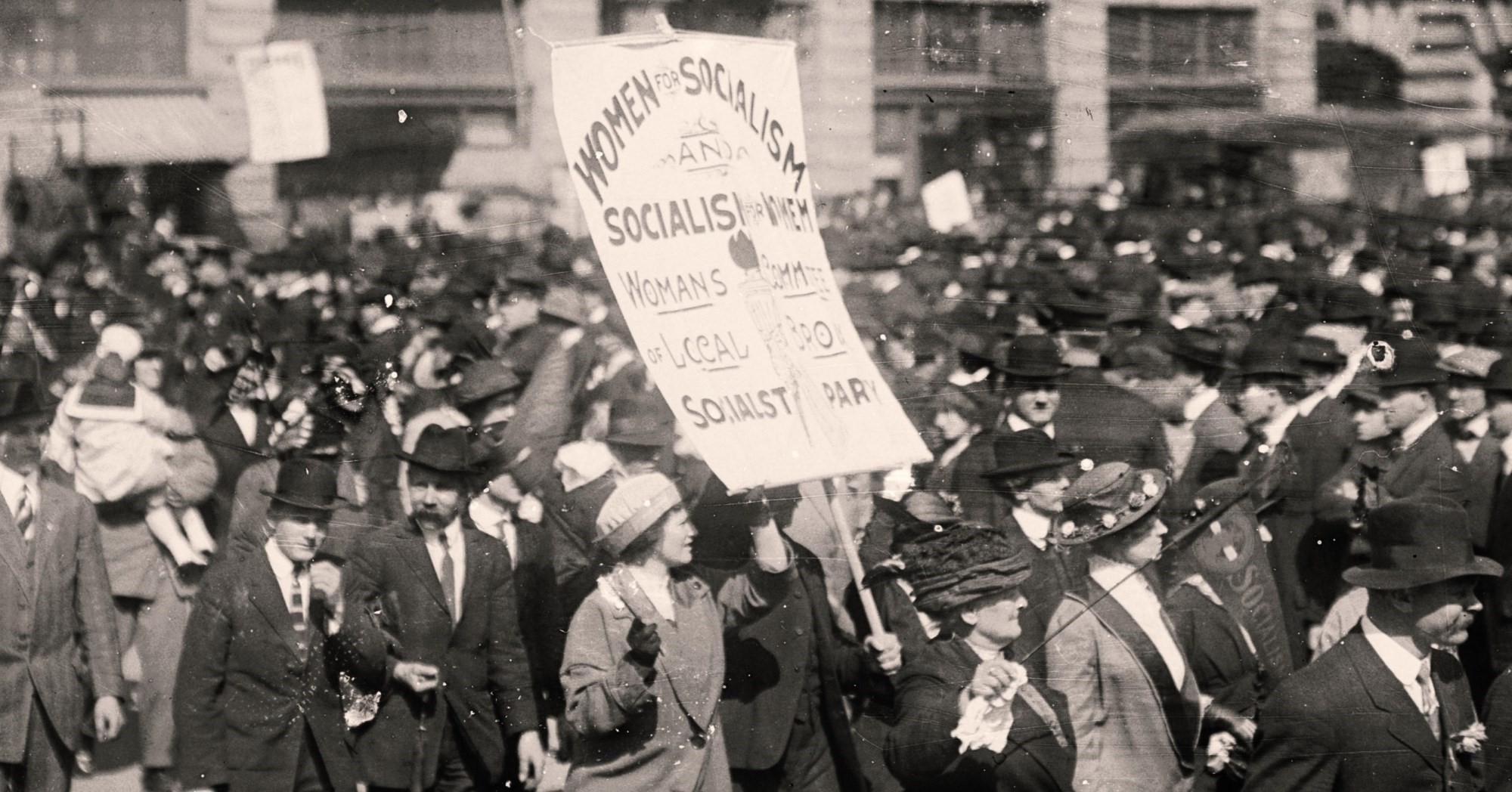
‘Some Impressions of the New York Socialist Women’s Conference’ by Theresa Malkiel from The Socialist Woman. Vol. 2 No. 15. August, 1908.
For sometime past the Socialist women of New York State, especially those of New York City, have been preoccupied with the coming conference. Though of different opinions as to the work it was going to perform, they, nevertheless, all welcomed its approach. The party gained many new members among the women, who hoped and wished for the possibility of being delegates to the conference. While most of the women looked forward to the conference as a serious event in the history of the Socialist movement, and especially in the woman’s movement, the majority of the men laughed at it.
At last the eventful day arrived and, as the doors of the large hall hired for the purpose by the state committee opened, the women came from all parts of the city and state.
There were three generations present, all enthusiastic, tired of their positions as official cake-bakers and money collectors of the party, and ready to do some active work.
The attention which they gave to the able opening speech of Comrade Anna Maley at once marked them as a body of serious-minded women. The convention opened and proceedings began in an orderly manner that would have done credit to a more experienced delegate body. The addresses of Comrades Mrs. Kennon, Kirkpatrick and Lewis were received with great enthusiasm; still the delegation did not show its power. It was only after recess when the question of organization came up for discussion that our comrades warmed up, standing firm for what each of them thought was the only and best solution of the problem. Delegates of long standing in the party, tired of the place in the background, which women as a rule were allotted in the locals, fought hard for the organization of a new body, realizing that this was the only way of reaching the thousands of wage-earning women whom our party, as such, failed to reach. They argued that for the very sake of the Socialist party it was necessary to organize a body in the nature of a preparatory school, whose aim it would be to awaken the women workers and teach them that their only salvation will come with the abolition of classes under a Socialist regime, and that their place is within the ranks of the Socialist party. On the other hand, the younger and less experienced delegates, imbued with the spirit of equality of sex, thought it a sacrilege to work for anything else, or anywhere else, than within the four walls of the locals. Both sides were equally sincere and earnest, each standing up for what they thought was right. It did one’s heart good to see that animated body of women, and it was clear from the very first that no matter at what decision the conference might arrive its coming into life marked a new era in the propaganda of Social- ism among women, and was really the beginning of the awakening of the female proletariat. For six long hours the comrades disputed among themselves, each new speaker trying to outdo her predecessor, motion upon motion was made, spoken for and against, voted upon only to be lost like its forerunner. Finally the original motion offered by Comrade Bertha Mailly “That the body assembled organize into a state organization of women, whose object shall be the education of the working women of the State of New York,” was adopted with a slight amendment made by Mrs. Meta Stern. Both sides breathed freely, and joyously seconded the motion to adjourn for the day, so as to give the standing committees a chance to proceed with their work.
The room became a bedlam of voices; women talked, disputed, compared notes and gleefully greeted one another. This one day has brought them together closer than the years of membership in the locals. There was not a sign of animosity among them, the differences of the day were quickly forgotten. On the morrow they came again, neither the holiday spirit that reigned without, nor the close atmosphere within, could keep them away. There was still a great task before them. Briefly, without much discussion, they adopted the resolutions as presented by the resolutions committee, as every one of them clearly expressed their sentiment. Some of the resolutions adopted were sent upstairs to the state convention for approval. The constitution, too, did not bring forth much discussion, as it is almost a facsimile of the state constitution of the Socialist party. Like the day before the delegates were saving their strength for the afternoon. After recess the question of Socialist Sunday schools was taken up. Miss Cristal, Mrs. Fraser, Miss Dutcher and Comrade Vacx, who are all Socialist Sunday school teachers, ably pleaded their cause. They clearly showed the delegates that the easier way to gain converts for Socialism is to begin with the child before the teachers of the public school have imbued it with the spirit of false pride and cheap patriotism. Here, during this discussion, the delegates showed their intelligence by patiently giving preference to those speakers who had practical experience while the majority were only attentive listeners. In the midst of the discussion word was sent from upstairs that the state convention was having a heated argument over the woman’s decision to maintain a separate organization. The delegates then adjourned for a half an hour to plead their cause before their male comrades.
Miss Anna Maley and Anita Block were able exponents of our right, and the necessity to organize for the purpose of education and agitation among women. It is sad to remark that two of our own sex, who happened to be delegates to the state convention, were among the bitterest opponents of the woman’s cause; they were satisfied to leave their sisters where they stand today. The confusion among the delegates was such that, after passing a substitute on all the motions and amendments which indorsed the formation of educational clubs for women, they immediately passed another motion not to concur in the decision of the women’s conference and that the locals should remain the only field of work and propaganda. It is impossible to describe the disappointment of the female delegates at the failure of the convention to indorse their action; this, however, subsided very soon, and before very long the women were again ready for work, determined more than ever to pursue the methods adopted the previous day. The interest which they took in the discussion on the suffrage question clearly indicated that on this one point they were unanimous, all desired the ballot, claiming as their right the right of every adult being. It was pointed out that it is high time that the Socialist women took an active part in the suffrage movement, aside from the middle class women. That the time is not far off when the capitalist government will grant the ballot to women, and it is, therefore, the Socialist’s duty to go forward among the female wage earners and teach them how to use it intelligently for their own instead of their employer’s benefit. Though tired and exhausted from the heat and the two days’ strain, the delegates kept their seats, taking as lively interest in the proceedings as they did during the first hour of the conference. Finally a tired voice from the back of the hall called out meekly:
“Comrade Chairwoman, I move we adjourn.” There were numerous voices eager to second. The motion passed, the delegates grouped together, bidding each other hearty farewells, women who did not know one another before the conference kissed at parting, made appointments to meet socially, and hoped to be delegates once more, when the conference meets again next year. All spoke enthusiastically of the conference and the experience gained through it. It was an eventful gathering which will live forever in the hearts of those who participated in it.
Progressive Woman replaced The Socialist Woman. The Socialist Woman was a monthly magazine edited by Josephine Conger-Kaneko from 1907 with this aim: “The Socialist Woman exists for the sole purpose of bringing women into touch with the Socialist idea. We intend to make this paper a forum for the discussion of problems that lie closest to women’s lives, from the Socialist standpoint”. In 1908, Conger-Kaneko and her husband Japanese socialist Kiichi Kaneko moved to Girard, Kansas home of Appeal to Reason, which would print Socialist Woman. In 1909 it was renamed The Progressive Woman, and The Coming Nation in 1913. Its contributors included Socialist Party activist Kate Richards O’Hare, Alice Stone Blackwell, Eugene V. Debs, Ella Wheeler Wilcox, and others. A treat of the journal was the For Kiddies in Socialist Homes column by Elizabeth Vincent.The Progressive Woman lasted until 1916.
PDF of full issue: https://www.marxists.org/history/usa/pubs/socialist-woman/080800-socialistwoman-v2w15.pdf
 Revolution's Newsstand