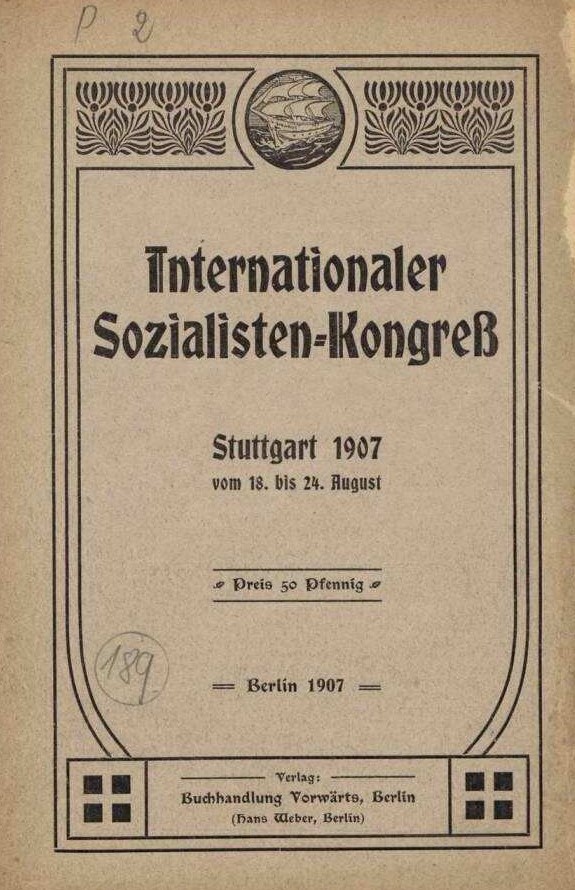
An important document from the history of our movement. The report of the General Executive Board of the I.W.W. (William E. Trautmann, Michael P. Haggerty, Vincent St. John, August Maichele, Fred W. Heslewood, T.J. Cole, and Eugene Fischer) to the Congress of the Socialist International in Stuttgart detailing the first two years of their existence. The report, given by delegate Fred Heslewood, comes from after the split with the ‘Sherman’ wing, but before the exit of the Socialist Labor Party the following year.
‘Report Of The I.W.W. to The Stuttgart Congress’ by the General Executive Board from The Weekly People. Vol. 17 No. 22. August 24, 1907.
TO THE DELEGATES TO THE INTERNATIONAL LABOR AND SOCIALIST CONGRESS:
“Only the economic organization is capable “of setting on foot a true political party of “Labor, and thus raise a bulwark against “the power of Capital.” MARX
Comrades and Fellow Workers:
Strange, we presume, will it appear to you as representing apparently powerful economic and political organizations of the working class of the European continent; to you who have looked upon the New World as not counting at all in the war between the master and the servant class (this term is extracted from a speech delivered by Mr. J. Davenport, representing the Manufacturing and Anti-Boycott Association, at Cincinnati in 1904) that representatives of a socialist economic organization of America should come before you and assert: “That it will be in North America, the land in which capitalist production and consequently capitalist exploitation of the working class has reached its highest development, where the working class industrially organized and intellectually equipped to continue the most highly developed operations for the sole enjoyment of all wealth produced by those who toil and moil, will be able to take possession of the means of production and distribution, and usher in the co-operative commonwealth in this part of the globe, so that in rapid succession the workers of all other nations will throw off the yoke of capitalist exploitation and exterminate forever the rulership of a few over the many.”
This prediction may sound bombastic. The backwardness of the American working class movement often furnished reasons for adverse comment among the proletarians, who had been kept in darkness as to the real conditions prevailing in this country. Wise doctrinaires from abroad, glancing superficially at conditions during visits of a few weeks’ duration, had condemned the working class as not being able to work out and to accomplish the ends sought by all Socialists throughout the world.
There are many, looking to Germany as the classic land of socialism, who aver that the revolutionary propaganda must follow the lines of countries industrially less developed than the United States and Canada, and they are pointing continually to Europe for plans upon which the destructive propaganda against capitalist class institutions, and the constructive work for the Socialist Republic should necessarily be conducted.
You men and women, delegates to this congress, will again have to hear the declaration that each land has to cope with its own industrial conditions, and that the workers of the northern part of the American continent have worked out the plans, fully consistent with conditions for the battle for economic freedom. You heard their voice twice before, representatives from economic organizations, delivering to the proletarians of the world the message of industrial solidarity at the international labor congress in Paris, 1889.
The idea of an international labor day on May first was born in America, the International Labor Congress held in Paris in the year 1889 enthusiastically heralded the thought throughout the civilized world; millions of workers, in increasing numbers every year, to-day greet that day of international demonstration of working class solidarity on the economic and the political field. But the sponsors renounced their child one year after its birth, the capitalist class substituted a Labor Day of their origin, in September every year. This was the first time that the “New World” set the path–the second time in 1895, other economic organizations of workers of North America, qualified under the rules of the congress to speak for workers of this continent, were represented, but there the conflict between two opposing principles was manifested in the contradictory actions of these representatives, one representing the Socialist Trades and Labor Alliance, the other the United Brewery Workers of America, both organizations claiming to be socialist economic organizations. The first was organized on the right lines; it had the soul, but amounted to little in numbers, and was therefore not able to withstand capitalist persecution; the other was just used, unknown though to its membership, to shield another organization and to act as buffer, which was then and is now only an adjunct to the capitalist class and was then bolstered up to obscure the real issue and convey the impression that the formation of a socialist trades union movement in the American continent was a result of personal animosities, caused by the differences among a few who were looked upon as trying to control and direct the movements of the working class. The basic differences were not understood then, because at that London congress the representatives of both factions of the economic organization claimed to have the qualifications of economic organizations based on the recognition of the class conflict in society.
Socialists of European countries, who are prone to measure the strength of working class solidarity by the number of votes cast on every recurring election day, would ridicule the idea that in a country with universal suffrage for all male citizens the ballot should not be regarded as a criterion of work done and advances made in the incessant propaganda for socialist aims and ends. Those again who would weigh the chances of winning the conflict with the capitalist class by the number of heads periodically tabulated as being bound together in trades unions for a common purpose, usually fail to draw the distinction between trades unions which are regarded by them as temporary make-shifts only, and such economic organizations as are organized for the most important functions in a social fabric founded on a co-operative basis. In the opinion of the former, unions would pass out of existence with the day of labor’s triumph in the revolution.
No organization of laboring people can be recognized as a working class institution except its motive force is the desire to reach the complete emancipation of the working class; benefiting from the lessons presented in the evolutionary process in the modes of production and the shifting change in the ownership of the implements for the creation of marketable wealth, such organizations must continually press on towards the consummation of the Socialist program. It is, therefore, incumbent upon all such organizations of labor, on the political as well as on the economic field, that they constitute fighting, militant organizations, organized for the every day experiences and the final conflict with the master class. Being militant in character, they cannot be drifted into the troubled waters of compromise, else they would lose their character, would cease to be institutions of the working class, organized on the recognition of the irresistible class conflict in present day society.
If these premises are not correct, why then did the International Socialist Bureau, in mapping out the program for this congress, refuse to strike out from the qualifications of representatives the words, “such trade unions organized on the recognition of the class struggle. Consistent with Socialist principles as this decision is, it becomes more significant, supremely important, for the formulation of an international program of action for the preparation of the workers for a successful fulfilment of their historic mission.
Under this construction, laid down by many of the International Congresses of Labor, any one pretending to speak for and to work for the emancipation of labor from the bondage of wage slavery who defends, promotes and supports such trades unions as are founded on the false theory of harmonizing interests between the capitalist and wage slave class, may not lay claim to the right to call himself a revolutionary socialist, and if he speaks on behalf of a political party reflecting the misleading and corrupting doctrines of such capitalist unionism, he most assuredly attempts to conceal the fact that the capitalist class in all countries when revolutionary propaganda began to circulate its life blood, protected itself behind a wall of sham Socialist propaganda, thus temporarily thwarting the efforts of those who are striving and laboring at the undermining of all capitalist-class institutions and the construction of real working class organizations, on the economic as the most essential field, and the political as the true expression of revolutionary thought and activity.
You in European countries have had your experience in the stormy days of the movement with the manifold fake socialist organizations, devised and called into being by agents of the employing class; you have felt how those who advocate no compromise, no political bargaining, were persecuted and vilified, haunted and slandered by all the pseudo-socialist professors, lawyers, clergymen and yellow-back unionists.
Look backward now, recall those days of bitter conflict and heroic sacrifice, and you will no longer wonder, when weighing cause and effect, that the same unscrupulous capitalistic class element makes history on the same lines in a land where the proletarians are now beginning to see the truth of socialist teachings, and are raising the banner of working class revolt against the master class and the manifold institutions organized for the protection of capitalist interests.
The proletarians of European countries, who in the first place are entitled to learn about the true condition of affairs, will therefore not be surprised to hear and see representatives of reactionary, capitalist unionism, although sailing under the name of political party Socialists, assail the Industrial Workers of the World at this congress. But you will not permit, when reviewing the past of the movement in your native countries, that misrepresentation and false hood presented in print by emissaries of a corrupted, decaying pure and simple union movement of America, and its political reflex, be used to separate you from the struggling, vilified and persecuted Socialist Industrial Unionists of the United States and Canada.
Twofold are our reasons for being represented at this congress: First: To destroy the erroneous delusion that the forces making for the industrial revolution in the northern part of the American continent have not produced sufficiently strong material and organized efforts to accomplish the change in the ownership of the means of production and distribution. Second: To establish the necessary international relations with the workers of Europe, Asia and other continents, when ready, so that they cease to be the supply houses of human labor for the American capitalists, through which the latter are able to use worker against worker, the emigrant against the natives and settled proletarians, and to turn them into supply houses of emigrant-soldiers for the social revolution upon the American continent.
With the advent of capitalist production in the States and recently in Canada, American working class resistance manifested itself in typical American style. The Knights of Labor organization was the result. Conspiracy to “do the weaker” was the bourgeois class maxim; conspiracy to work secretly against the evil influences of capitalist class supremacy, in all states of social and industrial activity, was the key to the quick-fire of the Knights of Labor. The conspiracy features of the organization caused its downfall; the employers got their own conspirators into the secret chambers, and they worked the plans for the destruction of the once powerful organization. The Knights of Labor, once 1,000,000 strong, are lost and forgotten.
The American Federation of Labor was born under a fire of attack. Open unions were its component parts, or supposed to be. When organized twenty-seven years ago in the city of Pittsburg, Pa., the capitalist press was unanimous in condemnation of the “Un-American Invasion.” and the fact that many of the first delegates to the first convention were foreign born, served as a subterfuge to assail the new organization and its pronounced principles.
But immediately after its formation the grappling between the progressive and conservative elements began, the capitalists again succeeding in getting their agents dominant in shaping the policies of the organization.
The American Federation of Labor did not evolve into a real labor organization. It did not accommodate itself in forms to the ever-changing structure of capitalist society; it did not grasp the higher, most important mission of a trade-union movement. The agents of the capitalist class, in gaining accession and obtaining control in the shaping of affairs and mapping out of the policies and tactics of the organization, prostituted that organization and transformed it, as it is to-day, into an auxiliary to the capitalist class, insomuch that the Wall Street Journal, mouthpiece of the corporation magnates, defiantly could proclaim “That the American Federation of Labor is to-day the strongest bulwark against the dangerous tide of socialism.”
The arbitrary defining of demarcation lines between trades that industrial evolution has really eliminated, marked the beginning of a bitter warfare of craft unions against other craft unions; the struggle for the keeping of the job at the expense of universal working class interests became the supreme issue; much to the rejoicing of the employing class, and at their behest. Strike breaking, under the subterfuge of “jurisdiction rights,” became a rule, not an exception. There is not one solitary trades union that can vindicate itself against the charge of strike-breaking; hatred of workers against workers was engendered, the lust for retaliation of one set for alleged injustice done by another set, is ever more be- coming the inspiring force for a disintegrating activity on trades union lines; thousands disgusted with the betrayals by labor fakirs have been driven into the army of disorganized, despairing opponents to working class unity. Mr. Samuel Gompers, the President of the American Federation of Labor, aware of the evil results of these “jurisdiction love quarrels,” when asked for a remedy, declared in an address delivered before the convention of the National Brotherhood of Stationary Firemen, held in Washington, D.C., in 1904, in substance as follows:
“That these jurisdiction conflicts tend to increase the efficiency of the trade unionist at his work, because of the competition among the various craft anions to gain control over a particular craft in an industry.” Efficiency at work for the benefit of the capitalist exploiter! In this maxim is embodied the whole functionary program of such organizations upon the American continent as are connected with either the American Federation of Labor or the seven different Brotherhoods of Railway Employes.
Higher efficiency of the workers for the benefit of the exploiter and the perpetuation of the capitalist system of society! Actuated by such principles, it is small wonder that the two millions of craft unionists constitute rather a protection than a menace to the prevailing order of things.
A National Civic Federation, with an educational bureau attached, could only exist with the consent of an organized part of the working class, if that part is accessible to the preachings dealt out by the supporters of capitalism. With but two exceptions, the trades union official journals are parts of that Educational Bureau and the workers are thus made to believe that their station in life as exploited wage workers is justified by eternal laws, formulated by the defenders of capitalist society.
High initiation fees, up to $500.00, rigid examination of “undesirables,” excessive fines, check-off systems, are only the results of such false forms and systems of unionism.
Division upon the political field is not even the worst feature of the evil results of such unionism; in attempts, often successful, to distract the attention from the burning issue, the workers are told that unity on election day alone would suffice to banish the evil; workers divided and in each other’s hair during 364 days of the year are reminded that the coming together on one day would eliminate all disputes resulting from false teachings, and that the triumph on the political arena would tend to unite the workers on the economic field also.
False as are the conclusions, they are nevertheless in accord with the premises from which they flow.
Unity on the political field, as an expression of the will power and the concomitant might organized in preparation for coming events, can only be achieved and demonstrated when the solidarity on the economic battle ground is assured. A united political party of the working class of the United States and Canada must find its base and support in a working class organized on the industrial field, in such an organization that will not barter or compromise f with the enemies of the working class. Political action is not a revolution, but only a measure in a slight degree to determine when the final act should be inaugurated,
THE INDUSTRIAL WORKERS OF THE WORLD.
This conception of a true working class organization prompted the calling of a preliminary conference of a few men, in January, 1905. The opening arguments presented by the callers emphasized the necessity of establishing a common ground for the bringing together of the workers on the industrial as well as on the political field. We see that such eminent gentlemen as Mr. Mahlon Barnes and Lawyer Morris Hillquit, have embodied in their report to this congress the manifesto, issued in January, 1905. But the Socialist Party for which these two gentlemen speak was not invited, nor was the Socialist Labor Party. True to the Karl Marx saying quoted at the head of this report, it was conceived that the economic organization founded on the recognition of socialist principles had to be formed before a political reflex of the augmented strength of working class unity could be expected. The American Labor Union, the Western Federation of Miners, and the Socialist Trades and Labor Alliance were represented in that conference. The Socialist Trades and Labor Alliance had preceded, but had nearly succumbed under the fierce fire centered on it by the capitalist class and their labor lieutenants. By reason of the fact that the Alliance was considered an attachment to a specific socialist political party it could not enlist the support of those workingmen who admitted the correctness of the position of the Alliance as an economic organization, yet knew that the policy of the organization was dependent on the mandates of that particular party.
The American Labor Union had repeatedly endorsed the Socialist Party, but that endorsement in no way made the organization map out its policy in accordance with socialist principles. This was brought out in that conference. The Western Federation of Miners, however, was gradually and against huge obstacles, both from within and without, clearing the road for an industrial progressive unionism. All these elements brought together recognized the fact that American industrial conditions demanded an organization that would be able to cope with them, and reassure the workers whose courage had been broken and hopes shattered by the many defeats and betrayals in the past.
The program promulgated in the Manifesto aroused the workers. However, advocates of purely political action, under the pretext of being promoters of the program outlined, had gained admission to the meetings of that conference. It developed later that the ambition of these intruders was the possible prevention of what the conference had principally been called for. Working class unity on the economic and also on the political field, meant death to the political schemes of parliamentarians. Neither Mr. Mahlon Barnes, nor Mr. Hillquit, both submitting to this congress a report filled with perversions of truth, and vilification of individuals who alone have a right to speak for the Industrial Workers of the World, have knowledge of the underlying forces making the formation of the organization essential in the battle of the working class for a higher form of civilization.
Neither of them knows of the gigantic struggles the I.W.W. had to go through in the endeavor to carry out the program agreed upon in the January preliminary conference.
Profiting from evil experiences in all preceding organizations, it was to be the mission of the Industrial Workers of the World to prepare the workers of Northern America through the dissemination of sound literature for the work of construction. Never was it intended to cater for the support of large bodies organized in trades unions to increase the number of enlisted workers at the cost of abandoning the basic principles and blurring the lines of the class struggle. Clear and distinct as was the program promulgated, it precluded the chances of the agents of the master class from holding on to their jobs of prey upon the working class. This was the reason that the many delegates attending the first convention as representatives of already organized bodies of workers, immediately discouraged the workers from connecting themselves in large numbers with the newly formed body.
The danger of having the organization swamped by the enlistment of large bodies, with all the elements of corruption and decay inherent in them, was thus averted, temporarily at least. As a result of this the workers of North America gained new confidence, because they found that the Industrial Workers of the World with its program was repulsive to the labor leaders of the craft union movement; the newly formed body was, therefore, able to make great headway immediately after its formation. Such was the interest shown in the movement among the working class that the capitalists got alarmed. They had succeeded in thwarting the efforts of the proletarians before, by getting their pliant tools, to work, and on the same plan they thought to either get control of the organization and thus stifle its activity, or destroy it in its infancy. Those who had surveyed the field and had learned from the object lessons of the past, could see the cunning work of the master class at every turn of affairs.
The coming events enacted at the second convention of the I.W.W. cast their shadows several months before. The capitalist press, supported by a parasitic press owned by individuals whose connection with the socialist movement emanates from selfish motives, announced four months in advance of the convention that the dominating influence of the “Revolutionary Socialists” in the I.W.W. would be broken in the second convention and the Industrial Workers of the World would then have the good will of some employers of labor and grow rapidly in numbers. The capitalist agents tried their best to carry out the wishes of their silent instructors. But for the first time in the history of the American labor movement did the proletarians destroy the plans of the capitalist class. The supporters of capitalist unionism were thrown out; for their last resort of delivering the goods to their masters they used the brutal force of hired assassins to slug and if possible murder those who stood loyal to the working class. Supported also by such elements as are characterized in the report of Barnes and Lawyer Hillquit to this congress, the capitalists and their tools thought that vilifications, slander and abuse against a few in the movement would accomplish what by other methods they were unable to see consummated.
You will be told that there are two factions now. The one repudiated by the intelligent working class is not founded and conducted in its work by Socialist principles, and no real workingmen are connected with it; the other, however, has grown strong and powerful under the fierce fire of persecution and attack from the fortress of capitalism and the outposts protecting capitalist class institutions and interests. Starting out with only 2,000 members in 1905, the Western Federation of Miners not included, the organization has now 362 industrial unions and branches organized in thirty-seven States of the Union and three Provinces of Canada; individual members will be found already in Central and South America; the propaganda with literature and lectures by fifteen organizers, all well trained and equipped intellectually, may give a scant idea to our comrades in other parts of the world what great work for the dissemination of socialist ideas is being performed and constructive propaganda carried on.
The capitalist class and its servants were defeated in the second convention and that alone serves as a measure in some degrees showing how deeply socialist thought and consequent action is rooted among the proletarians of the United States and Canada.
The Industrial Workers of the World is proud of the fact that the most advanced workers for the socialist cause are members of the organization, and most active in the propaganda for the principles espoused, working incessantly and without regard to slander and vilification for the purification of the working class on the industrial and political field, and for action as dictated by American conditions and social and industrial developments.
The organization embraces now 28,000 militant workers, and although the Western Federation of Miners, at the last convention could not as yet rid itself completely from the withering hands of the capitalist agents, and is not now a part of the I.W.W., the majority of the members of that organization virtually support and stand together with the Industrial Workers of the World in the battle for industrial freedom.
The organization has established its own weekly journal, “The Industrial Union Bulletin,” which has since May 1, 1907, attained a paid circulation of 7,000 copies; its official literature has been translated in seven languages and many of these documents have, since the 1906 convention, circulated to the extent of hundreds of thousands.
Such is the fear of the capitalists against the growing power of the organization that they openly invited at different occasions the American Federation of Labor and other organizations to help them in the war of extermination, but to the eternal credit of the workers of America be it said that more and more of them refuse to do the bidding of the capitalists and the unscrupulous labor fakirs any longer.
The onslaught in Goldfield, Nev., which caused even the intervention of the President of the United States in ordering the discharging of a lady Postmaster because she was a member of the I.W.W., whilst if she would have joined the American Federation of Labor she would have retained her position, shows clearly that the capitalist masters and their emissaries on the political field look with alarm upon the growing influence of the principles advocated by the Industrial Workers of the World, and it is safe to predict that they will make use of all powers at their command to fight an unrelenting war against this socialist economic organization, because they know that the organization will measure swords also on the political arena, as soon as a true political reflex of working class solidarity on the industrial field is established.
It was the Industrial Workers of the World that raised the first voice when Haywood, one of its founders, was arrested on February 17, 1906; when Moyer and Pettibone were kidnapped together with the former, it was this organization, the I.W.W., that issued the first call, “Shall Our Brothers Be Murdered?” on February 19, 1906; it was the Industrial Workers of the World that, after appealing to the various working class associations to “bury the hatchet” and combine its strength for the one purpose of se- curing liberty for the persecuted spokesman, found that the proletariat was ready to respond, while self-styled leaders everywhere blocked the efforts at unity of action in the crucial epoch. Yet, undisturbed by all these obstacles, the organization is marching on, is at work preparing the necessary groundwork upon which will be builded a true political expression of the aims, aspirations and wishes of the working class, and through which capitalist government will pass out of existence and the workers’ republic be established. With the passing of the capitalist government, a medium for the protection of class rule, and private ownership of all implements of production and distribution, will be ushered in the industrial government prepared and organized within the capitalist structure of society, founded on pillars erected before the old are razed, which will stand as a lasting monument of the final triumph of the organized proletariat of the world.
We want the workers of Europe to hear of the gigantic strides made, we want them to join hands with us, so that the emigrant workers will know that there is organized a union upon the American continent that will really unite them with their fellow workers in the various industries; we want them to be our comrades in the fight for industrial freedom, and our purpose in being represented in this International Congress is to emphasize our declaration that with the co-operation of the working class the world over, the proletariat of North America will soon be ready to carry out successfully, by the use of all civilized methods, the historic mission of the working class in this part of the globe.
The bulwark against the power of capital has been raised, industrial solidarity of the working class will beget solidarity on all other lines of action, the Co-operative Commonwealth in our day will mark the hour of triumph and of victory gained by the wealth producers united on the industrial and political field.
It is necessary for the enlightenment of the delegates and the workers of other lands to refute false statements made in the report submitted by a certain Morris Hillquit, anent the affairs in the Industrial Workers of the World. It is not true that the so-called “Sherman faction” has the bulk of the membership, in fact, that fragment of a thing which was expected to do the stifling act, has virtually passed out of existence; its convention was not held, and who- ever pretends to represent that nonentity surely does it for some ulterior motive. Mr. Hillquit perverts the truth again when he says that the actions of the second convention were not submitted to the
membership for approval, the report sheets of the referendum taken is attached as evidence of the falsity of Mr. Hillquit’s statements, together with other information relating to the I. W. W. Either Mr. Hillquit deliberately falsifies or reports concerning matters of which he is deplorably ignorant. But as he and those for whom he speaks reflect only capitalist unionism, you are to judge on the question of veracity between us.
Submitted, with international greetings, by order of the General Executive Board.
WM. E. TRAUTMANN, M.P. HAGGERTY, General Secretaries. VINCENT ST. JOHN, A. MAICHELE, F.W. HESLEWOOD, T.J. COLE, EUGENE FISCHER, General Executive Board.
Chicago, Illinois, U. S., July 25, 1907.
New York Labor News Company was the publishing house of the Socialist Labor Party and their paper The People. The People was the official paper of the Socialist Labor Party of America (SLP), established in New York City in 1891 as a weekly. The New York SLP, and The People, were dominated Daniel De Leon and his supporters, the dominant ideological leader of the SLP from the 1890s until the time of his death. The People became a daily in 1900. It’s first editor was the French socialist Lucien Sanial who was quickly replaced by De Leon who held the position until his death in 1914. Morris Hillquit and Henry Slobodin, future leaders of the Socialist Party of America were writers before their split from the SLP in 1899. For a while there were two SLPs and two Peoples, requiring a legal case to determine ownership. Eventual the anti-De Leonist produced what would become the New York Call and became the Social Democratic, later Socialist, Party. The De Leonist The People continued publishing until 2008.
PDF of full issue: https://www.marxists.org/history/usa/pubs/the-people-slp/070824-weeklypeople-v17n22-iwwreportstuttgart.pdf
 Revolution's Newsstand