
Crystal Eastman, editor of The Liberator, seems to have been everywhere in 1919, to the benefit of future historians and radicals. A witness to Europe’s post-war revolutionary ferment, Eastman was in Glasgow for the ‘Revolt on the Clyde’ led by the likes of John Maclean, Willie Gallacher, David Kirkwood, and Arthur MacManus and wrote this marvelous account of those events and personalities. A classic.
‘The Workers of the Clyde’ by Crystal Eastman from The Liberator. Vol. 2 No. 10. October, 1919.
“WELL, Wullie Gallacher’s cam oot. And they’re sayin’ the treaty is signed and they’re going to have peace, but they’re not. Wullie Gallacher’s not goin’ to let ’em have peace!”
Thus spoke John Maclean, on Thursday, July 3d, 1919, in the Paisley Town Hall, where three thousand Clyde workers had gathered to welcome the chief hero of the 40-hour strike after his three months in Edinburgh jail. “Our annual meeting to celebrate William Gallacher’s release from prison,” the Chairman called it. And there on the front row of the platform beside his beaming wife sat the hero–a trim, square-shouldered young light- weight with a red rose in his button-hole, healthy rosy-cheeked and smiling, like a boy home from school. Through six long speeches of tribute he sat with downcast eyes, quietly blushing, and never looked up. It may be an annual performance, but Gallacher isn’t used to it yet. Surrounding him were the chief figures in the great strike, behind him a socialist chorus, girls all in white, below him rows upon rows of hard-headed Scotch machinists, munition makers and shipbuilders, all in their working clothes with caps on, typical Clyde workers, the sort of men that kept Glasgow, despite all governmental blandishments, an anti-war city throughout the five years. This meeting was the final chapter of the story of the first general strike in Scotland.
The Clyde is a muddy, uninteresting river 100 miles long, which rises fifteen hundred feet up in the hills of Lanarkshire, and flows west across the narrow part of Scotland into the sea. Fourteen miles up from its mouth lies Glasgow. The history of Glasgow and the Clyde is the history of the industrial revolution. For along the valley of this river lie the largest coal fields and the richest iron-ore mines in all the British Isles. It happens It happens that Fulton, Bell and Watt were all originally Clyde men. After the invention of machinery, Glasgow which had been a thriving little seaport of 14,000, serving an agricultural and wool-producing hinterland, became in one short century a great dark smoky city of a million people, surrounded by a dozen ugly industrial suburbs. And half a century later, when men learned to make ships of steel, the Clyde became the greatest shipbuilding river in the world. The Pittsburg worker must bring his iron-ore from some place away up in the Great Lakes region, a thousand miles away, and he must send his finished steel to far-off harbors to be made into ships. But the Clyde worker finds iron-ore, coal, and a 200-acre harbor right at hand. No wonder that more ships were built on the banks of the Clyde before the war than in England, Germany and America put together.
But the Clyde workers do not all build ships. The kindred trades flourish there. They make boilers, locomotives, bridges, machinery, tools. And thousands of them are miners. Bob Smillie, a Lanarkshire miner, is a Clyde man. Keir Hardie, too, worked in the coal-fields area of the Clyde valley. But the Clyde worker about whom this story is written, works in the shops and is called an “engineer.”
Well, during the war, of course Glasgow became one of the greatest munition-making centers in the Empire. Yes, the Clyde made munitions and sent thousands of kilted bare-kneed lads to the front, but the Clyde never gave its heart to the war. From the great Keir Hardie Memorial meeting in 1915 when Robert Smillie said, “Fellow workers, this war which has killed Keir Hardie is a capitalist war,” to the day of the armistice, there wasn’t an hour when it wasn’t safer to hold a peace meeting than a war meeting in Glasgow. Night after night John Maclean and James MacDougal held their peace meetings right opposite the recruiting office. The crowd grew and they were unmolested. In 1917 Helen Crawfurd of the Women’s International League conducted an out-and-out peace crusade, with processions, banners, street meetings and all, after the fashion of suffrage days, and no one dared interfere with her. In fact there were 4,000 shop-stewards organized to protect peace meetings. A certain number of these, each one with 18 inches of lead pipe under his coat, would be detailed to attend whenever trouble was expected. Glasgow was ready for anything.
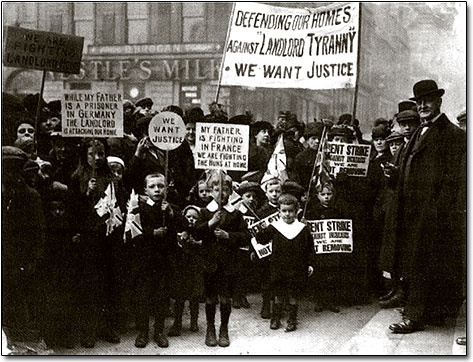
The rent strike was typical. In 1915 when munition workers began to stream into the city, there was an attempt to raise rents. But the women, wives of soldiers and munition workers, wouldn’t hear of it. They refused to pay more rent and when ordered out of their flats they refused to move. Suddenly, within six hours, there appeared in windows all over the city, placards announcing in big red letters their calm defiance of law and authority, “RENT STRIKE. WE ARE NOT REMOVING.” They meant what they said. In each house one woman would be stationed as a picket to watch for trouble. On the approach of landlord, sheriff or rent collector, she would give the warning and twenty or thirty angry women would run out of their apartments and meet him on the stairs, sometimes armed with flour, sometimes with water, sometimes just with words. In any case he retired. It looked as though it would take machine guns to get any of these women out of their apartments. Finally, however, ten were arrested. When word was carried to the engineers in the shops that these women were on trial before the Sheriff for refusing to be evicted, they dropped their tools and came running in thousands to the Sheriff’s office. They gathered on the square outside, a great threatening determined mob, with John Maclean standing up somewhere, exhorting them, “Now you’re out, let the war go to hell!” The Sheriff telephoned in haste to London, and then adjourned the case.
In two days the old rents were restored–and a Bill enacted preventing eviction except after a court trial. Then the engineers went back to work.
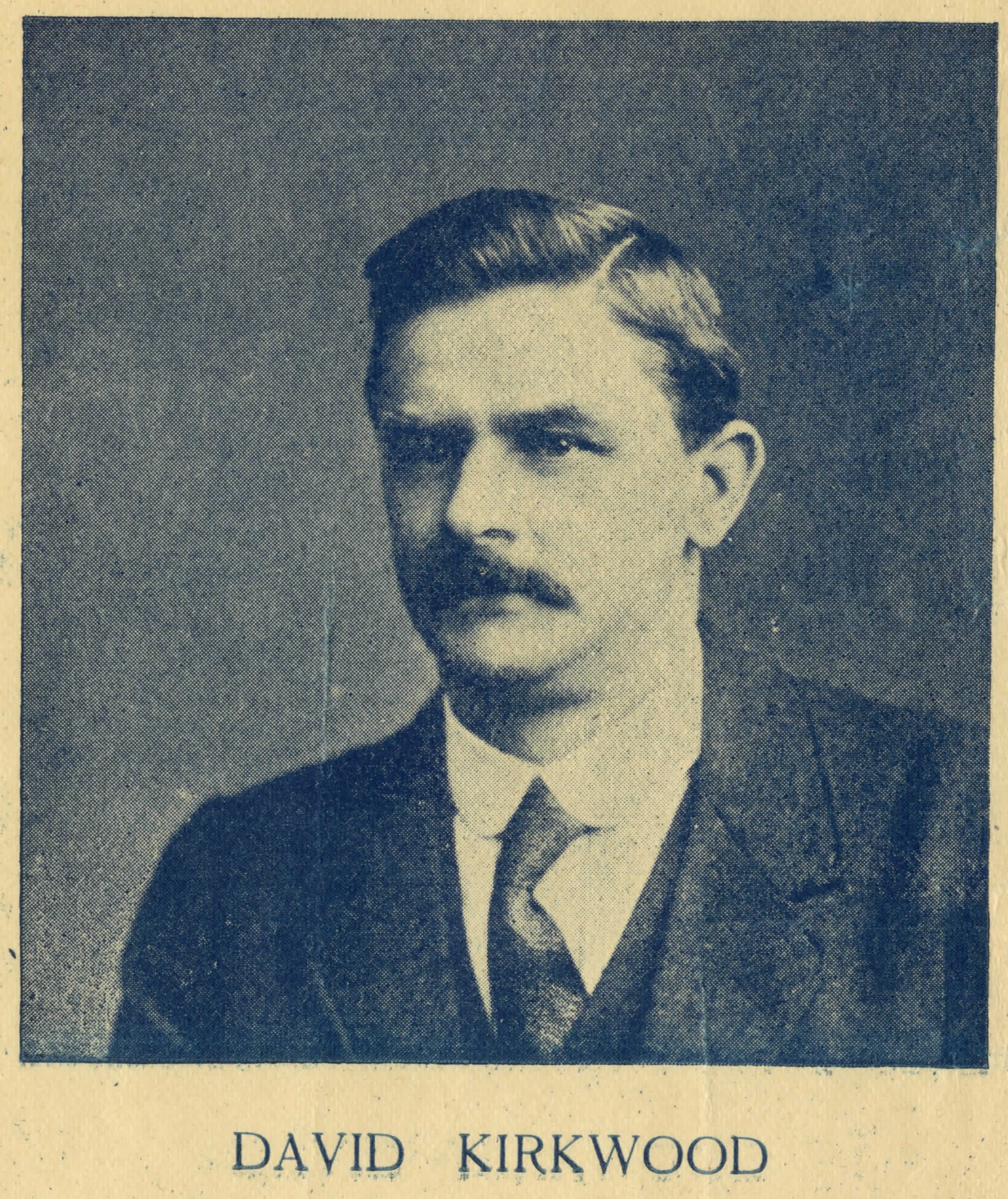
But the most characteristic demonstration of Glasgow temper was on the night when Lloyd George and Arthur Henderson came up to explain the government’s plan for introducing unskilled labor into the munition shops for the duration of the War, contrary to union rules. The Clyde Workers’ support for their scheme, known as ‘dilution of labor,’ was so vital to the government that Lloyd George came up there himself. Thousands gathered in the largest hall of Glasgow to hear what he had to say. As a diplomatic stroke, David Kirkwood, one of the leading shop-stewards, was chosen to introduce the Prime Minister, and carefully instructed beforehand to speak of him as the “Right Honourable David Lloyd George.” Kirkwood is a plainspoken man, and no respecter of persons. “Fellow-workers, this is Lloyd George,” he began, and turning to the Prime Minister, went on, “and I may say to you, Sir, that we view every word that comes from your mouth with suspicion. We’ve had your ‘ninepence for four-pence’ bill, and we’ve had your Munitions Act, and now you’re bringing us your dilution of labor scheme, and we don’t trust you. But, fellow-workers, I beg you to listen to the man and give him a fair hearing.”
The meeting never got far beyond that introduction. The men sat in grim silence while the Premier staggered through a few sentences of patriotic eloquence, but when he came to “our boys in the trenches,” one old fellow called out, “We’re not here to talk about boys in the trenches. We’ve boys in the trenches ourselves. We’re here to listen to your dilution of labor scheme.” After that the interruptions were continuous, until a man in the back of the room began to speak so powerfully that the whole audience turned round to listen to him, and Lloyd George had to give up and sit down. Then pretty soon the meeting got up and went home.
This blessed British custom of heckling public speakers, even the high and mighty, certainly develops character and keeps the soul alive.
Kirkwood, Maclean, Gallacher and Arthur McManus–those are the names I heard oftenest in Glasgow. They are all engineers except Maclean, and all are Socialists, but each one represents a slightly different group. David Kirkwood, whom I met at the Labour Party Conference
in Southport, is on the Executive of the Independent Labour Party. He stood for Parliament in the last election, and claims that he got more votes than any other I.L.P. candidate in Great Britain. His fame rests, however, on his industrial activities. During an earlier strike, in 1916, he and nine other engineers were “deported” from Glasgow and “interned” in Edinburgh for 14 months. For some time Kirkwood was kept under guard. One night his soldier guard turned on him and said: “God! I hope I’ll have a chance to shoot you.” When Kirkwood asked him why, the soldier said: “Why, we hate you worse than the Germans. You’re the fellow that brought the men out on the Clyde, and let us down over there. We’d like nothing better than to kill you and your kind. You’re enemies.” They argued through the night, but the soldier held to his convictions. Last June, two and a half years later, a man came up to Kirkwood after one of his speeches, and said: “Do you remember me? I’m the soldier that wanted to Shoot you in Edinburgh jail. Well, I just wanted to tell you I was wrong and you were right. I’ve found it out now.”
That’s a true story. I know the soldier’s name and address. Kirkwood is one of these quiet-looking, apparently commonplace individuals who is continually having adventures. He sees his life as a series of dramatic events, and that is what it is. Kirkwood is no good in a strike, they say–excitable, sentimental, always “striking an attitude.” But no one–surely no one speaking the English tongue–can tell the story of a strike with more warmth and color, with a more perfect narrative art, and with more fire and passion and purpose, than Kirkwood can. If he never has any more adventures, and just goes around to labor meetings telling the story of those he has had, he’ll play a big part.
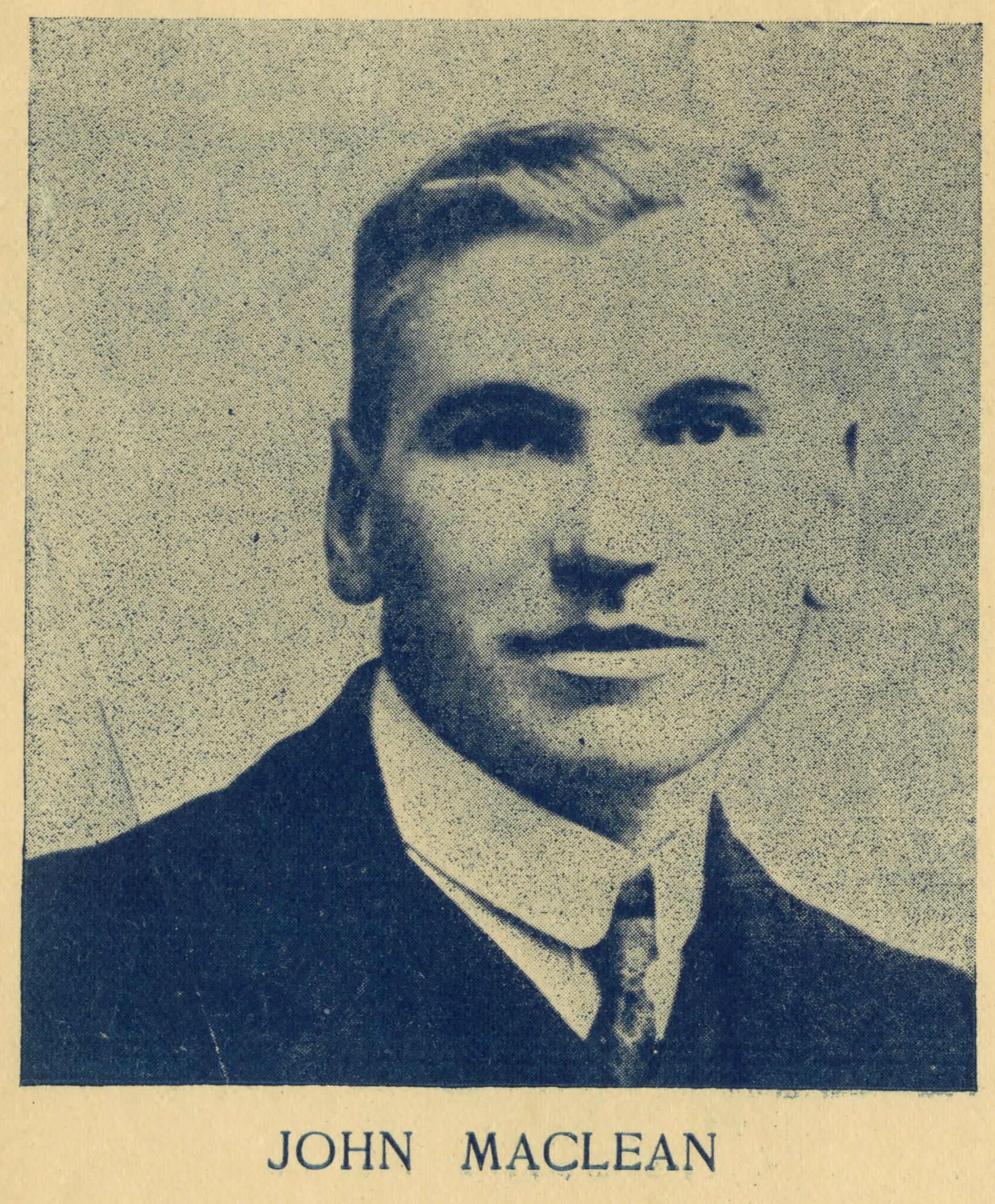
John Maclean’s relation to the movement is, I think, not unlike Kirkwood’s, although Maclean is an intellectual. They both have a lovable but unmanageable recklessness. “You never know what he’s going to do,” is said of both of them. But Kirkwood is a little inclined to melancholy, while Maclean is the cheeriest firebrand you ever saw. He is a mild-mannered, smiling conspirator, with a round-eyed, apple-cheeked face, and white hair. “Be cheerie, comrades,” he says, “you never can win a revolution without being cheerie.” Maclean believes in Revolution now. Since the defection of Hyndman and his pro-war followers, he is perhaps the most distinguished member of that small intellectual doctrinaire left wing group called the British Socialist Party. When I first met Neil Maclean, who is an I.L.P. man and member of Parliament, I thought, “There won’t be much in common between this man and the revolutionary Bolshevik consul of the same name.” But Neil smiled at such a notion. “You’ll find all the Macleans have about the same reputation,” he said, “and it’s a very bad one.”
Then at the Paisley meeting it was John Maclean who proposed sending greetings to Neil, the one member in the House who refused to rise for “God Save the King” on the occasion of Lloyd George’s triumphal return from Paris with the peace treaty in his pocket.
“Neil and I have learned to call each other cousins,” he said, “and I congratulate him on keeping his head and his seat. It doesn’t matter whether a man is standing up for his class, or sitting down for his class, we’re with him.”
Apparently in Scotland the different socialist groups are not very far apart. It seems to be more or less an accident which one a man belongs to. They all work together when there is anything to be done. Maclean’s appointment as Russian Consul for Scotland was not a surprise. He had helped to send both guns and pamphlets to Russia from a Scottish port before the revolution of 1905, and he was one of those who welcomed the terrorist refugees who began to land in Scotland in 1907. Petroff, who arrived in 1908, became his close friend and co-worker. When Maclean started the “Vanguard” to beat Hyndman’s pro-war “Justice,” Petroff became the London agent for it. And later, at the time of Maclean’s first arrest, Petroff came up to Glasgow and took over his classes. (Of course long before this Maclean had lost his position as a teacher of Economics in the city schools, and had started his own socialist classes, out of which evolved the Scottish Labour College of which he is now director.)
When, soon after the first Russian Revolution, Maclean came out of prison, he started a campaign for the release of Petroff and his wife and Tchicherin, who were at that time held in England. But it was not until after the Bolshevik revolution in November when Trotsky demanded their release and threatened to imprison Sir George Buchanan, the British Ambassador, that the Russians were set free, and allowed to go home. They told Petrograd about Maclean, and his appointment followed. He learned it from the press. The official confirmation never reached him, and all the money he ever received was $250 from Litvinoff just before the latter sailed for Russia. He opened headquarters, nevertheless, and actually acted as Consul, listening to the troubles of the Russian workers of Glasgow and helping them where he could, until April 1918, when he was arrested a second time. This time he got five years, but working-class pressure forced his release soon after the armistice. As a candidate for parliament, nominated while in prison and released only nine days before the election, he polled 7,000 votes.
“What were you arrested for?” I asked him.
“Well, things I said in speeches. The first time it was under D.O.R.A. (Defense of the Realm Act) I was speaking outdoors. Some body called out, ‘Why don’t you enlist?’ I said, ‘I’ve been a member of the socialist army for five years; God damn all other armies!”
“And the second time?”
“Oh, the second time, I guess they didn’t need D.O.R.A. to get me. I was urging the people to seize the municipal buildings and banks and electric power stations. I wanted them to start the revolution.”
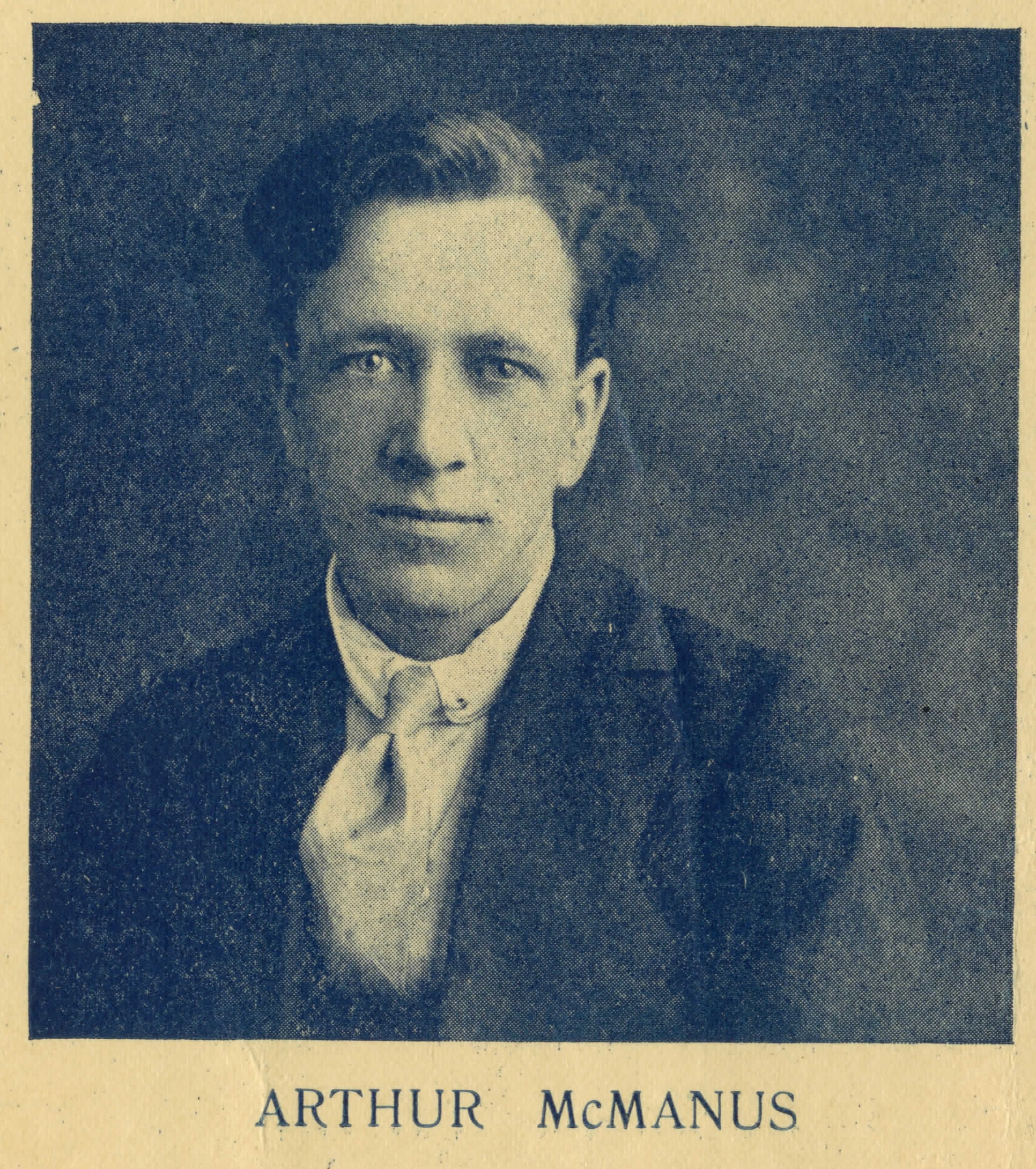
John Maclean and Arthur McManus certainly stand at the left of the Left of the British movement, yet both were Parliamentary candidates last December. Sylvia Pankhurst seems to be the only socialist leader who refuses to have anything to do with political action. Maclean says: “I don’t scorn any method. I would use all methods.” McManus, who is a leading figure in the shop-steward movement and also in the revolutionary Socialist Labour Party, got 4,000 votes last December on a straight Bolshevik platform, and sees no harm in that fact.
McManus is a “wee fellow,” as they say in Glasgow, a rough overworked, undersized, undernourished little fighter, who went into the shops when he was thirteen. He is now perhaps twenty-seven, and recognized as one of the intellectual leaders of the left wing.
In Glasgow, second city in the Empire, both industrial and political expressions of the revolutionary movement find their strongest support. The Socialist Labour Party, which is really the Communist Party of Great Britain and definitely affiliated to the Third International, publishes its monthly journal, the “Socialist,” from Glasgow, The “Worker,” organ of the Shop Steward Movement (that name can’t be Scotch; nobody but an Englishman would express a revolutionary intention in such terms!), is also published in Glasgow. McManus is a frequent contributor to both. He is one of those night and day agitators, always running off to make a speech somewhere. And when he’s lucky enough to have a job, i.e., when the demand for labor is so great that some firm will risk employing a known revolutionary agitator, he’s an engineer in the shops.
McManus is probably the most able intellectually of the group I met in Glasgow, but I think he is a little too bitter and scornful to make a great leader. He thinks Glasgow should have started the revolution in January. He condemns the leaders and scolds the workers for their failure, making the mistake which is not uncommon among left-wing leaders, of not always identifying himself with the movement. himself with the movement. He is a little too given to saying “you” instead of “we” in his speeches. Gallacher, on the other hand, no less eager and ready, no less a scientific revolutionist in mind and spirit, is more generous and more just. He is no fool where a leader has proved false or weak, but he is less ready to condemn. He, too, had a secret hope that the 40-hour strike might “start something.” But he identifies himself with the failure, if it was a failure, and is already looking ahead with a warm-hearted faith in his fellow-workers.

William Gallacher was born in Belfast but has lived all his working life on the Clyde. He has been chairman of the Clyde Workers’ Committee since its formation in 1915. To understand what that means I must try to explain the Shop Steward Movement, or the “unofficial” movement as it is now commonly called in Glasgow. It seems to be a movement within a movement, a system of workshop committees within the existing trade unions. It is an attempt to capture the trade union movement for the workers, to take it out of politics and bring it back home. Its leaders attack the trades union system not only because it separates the workers into 1,100 different unions but also because its unit is the branch, (i.e., all the members who live in a certain area irrespective of where they work) instead of the workshop. They would apply the Soviet idea now to trades union organization, making a small number of workers (15 to 200) in a certain shop of one plant the unit, and one of their number, called a shop steward, elected and recalled at any time, the representative. The stewards in each shop form a shop-committee. There is a convener of shop stewards for the whole plant, and a plan committee on which each shop committee is represented. From these various plant committees a local workers’ committee is chosen, such as the Clyde Workers’ Committee, of which Gallacher is chairman. Sheffield and Coventry also have local workers’ committees, and others are just about to be formed. But these committees, designed of course to represent all the industries of a district, actually represent so far only the engineering, shipbuilding and kindred trades. And the further development of the scheme by the formation of national industrial committees, and a single national workers’ committee elected from these, is as yet only sketched in the literature of the movement.
The shop steward idea offers a radically new plan of representation for the labor movement; the unit of production is made the unit of representation, and it is kept small enough so that there can come no separation between the leaders and the rank and file. There is nothing revolutionary about this; in fact many employers strongly favor the formation of shop committees because they obviate the necessity of dealing with outside trade union officials. But the revolutionary purpose is clear in the minds of the founders of the movement; it aims at establishing industrial unionism and workers’ control just as definitely as the I.W.W. And the machinery of representation lends itself to revolutionary activity. Moreover it gives the workers a strong weapon for organized defiance of the trade union leaders when they prove false, and for forcing their hands if they go too slow. The Glasgow 40-hour strike is a complete illustration of that.
It was Gallacher who gave me a connected story of the strike. Fifty-four hours? Forty-seven hours? Forty-four hours? Forty hours? No; thirty hours, six hours a day for five days a week, that’s what the miners were demanding, and that’s what the Glasgow engineers really wanted. The shorter hours movement was of course primarily for self-preservation, to make place for the thousands of men and women that were emptied out on the streets after the armistice when the wheels began to stop, and for the demobilized soldiers that would come trooping back home looking for work. But it was also an expression of the weariness of these workers after the long war-strain, and a desire for more life, freedom, leisure, education, happiness. The A.S.E. (Amalgamated Society of Engineers) had voted to demand a reduction of ten hours, making a 44-hour week; its leaders were pledged to this. But after a conference with the employers with the employers they distributed a ballot among the men calling for a vote on 54 hours and 47 hours–no mention of 44 hours. The men were confused, they voted of course for 47 hours, but they knew that they had been tricked, and the shorter hours agitation increased. The shop stewards, seeing the opportunity, kept up the agitation, until all the shops were discussing not 44 hours, the original demand, but 40 hours, and 30 hours, and a ways and means committee had been appointed to consider a general strike. On January 11, four days after the 47-hour week went into effect, 200 shop-stewards were in conference with Gallacher in the chair. They had unanimously condemned the 47 hours, and were considering what action to take to get a further reduction, when in came a delegation from the “official” movement, headed by Shinwell, chairman of the Trades Council, to say that they were heart and soul with the rank and file, and suggest “joining forces.” A joint committee was formed that day representing the Glasgow Trades Council, Joint District Committees of the Shipbuilding and Engineering Trades, the Scottish Trades Union Congress, and the Shop Stewards. Shinwell was made chairman. It was agreed that the workers in each shop should vote whether to demand 40 hours or 30 hours, that another conference should be held in one week, to ascertain the result, and the joint committee should then call a strike to enforce the finding. On January 18, this conference was held–300 delegates representing not merely the Clyde Valley, but most of industrial Scotland. When reports from all shops were in, it was clear that a decided majority had voted for 30 hours, but by general consent it was decided, in order to carry the big minority with them, to make the 40-hour demand.
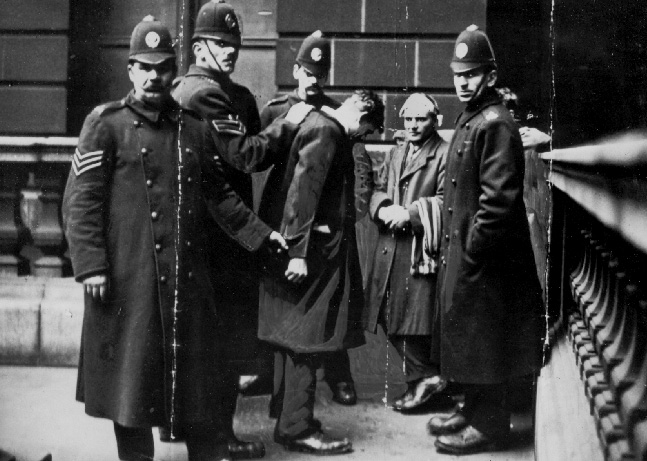
On Monday, January 27, the strike was called. Fifty thousand came out the first day; by Wednesday 100,000 were out. Shipbuilding yards and engineering shops were empty, and many other trades responded. There was a central strike committee, a daily strike bulletin reaching 20,000 in circulation, and daily mass meetings of 20,000 gathered inside and outside St. Andrew’s Hall. Mass picketing was the feature of this strike. Five to ten thousand workers would gather at the gates of a plant at closing time, line up on each side of the road, and when the men came out they’d have to “run the gauntlet,” not hurry past a hundred odd discouraged pickets, but make their way slowly, one by one, through a narrow lane grudgingly allowed them by the vast crowd of jeering fellow-workers outside. This method never failed. Shop after shop came out, and when they came out, they were the most eager to try the same game on the next shop. Mass pickets of women, the engineers’ wives, were found even more effective. The big industrial suburbs were tackled in this way, 5,000 men marching from Glasgow to Paisley, for instance, to picket one shop.
In two respects the strike leaders miscalculated: the municipal employees, despite the presence of their organizer on the joint committee, did not come out; and the response expected from Sheffield, the London district, and the other big engineering districts, failed to come. Gallacher and the other “unofficial” leaders expected workers of all these districts to fall in line, follow Glasgow and make the 40-hour week a national demand. It didn’t happen.
Every strike has its crisis. In Glasgow it was Bloody Friday, January 31st. Two days before, a deputation had gone to the Lord Provost (Mayor), and secured a promise that he would communicate with the Prime Minister and Sir Robert Horne (Minister of Labor), place the 40-hour demand before them, and have an answer ready for the strikers on Friday. When Friday came, owing to the efforts of the strike committee and the Bulletin, 40,000 people had gathered in George’s Square in front of the municipal building, waiting for the word from London. Kirkwood, Shinwell and Neil Maclean were sent in to get it. They were kept waiting a long time. The crowd was getting impatient. The police armed with their batons were ranged in long rows fronting the Municipal Chambers. Suddenly, trouble started in a far corner of the crowd. Two men were injured by automobiles, and the strikers asked the police to turn all traffic up another street, keeping it out of the square. The answer of the police was a baton charge. Gallacher saw it from the base of a monument in the square, from which he was addressing the crowd.
“I saw the police start, the whole lot of them, driving the crowd, beating them with their batons. I never saw such a sight. They pressed the crowd so hard that a flagpole in front of me was bent over. And the people were helpless. They were packed in a tight mass, so they could hardly move when the rush came; they were taken by surprise, and they had nothing in their hands. It was a paved square, there weren’t any stones to pick up, there wasn’t any fence or railing to break up. They had nothing but their bare hands. If the boys could have laid their hands on anything, it wouldn’t have gone the way it did. Well, in a minute, it seemed, I was left alone on that plinth, men were lying all around me trampled and muddy where they had been battened down. I saw a woman lying face down, all in the mud, where she’d been left. I jumped down and lifted her up. Then I ran to an officer and said, ‘For God’s sake, get this stopped.’. He only swore at me. Then I saw the chief, standing and looking on while the police drove that helpless crowd across the square. I didn’t stop to think, but just ran up and hit him a terrific blow in the jaw. He’s a big man, but I knocked him out. Then in a moment three or four of them were on me. I kept hitting up–hitting them in the jaw from underneath.” Here Gallacher jumped up to illustrate, his eyes shining, and his smile as sweet as ever. “But pretty soon they had me down. I was dazed, not really hurt. They picked me up and carried me into the Municipal Chambers under arrest.”
Meanwhile, the deputation inside, still waiting for the Government’s answer, heard the sounds of battle and came running out to the square. Kirkwood, with his usual sense of the dramatic, when he saw what was happening, raised his arms above his head in a gesture of amazement and horror. At that moment he was bludgeoned from behind by a policeman’s club, and carried unconscious and bleeding into the Municipal Chambers. He had received the Government’s answer. Gallacher, by this time quite recovered, saw them bring Kirkwood in, and helped to bring him back to consciousness, and bandage his broken head. Then together they saw the victims carried in, one striker after another beaten into unconsciousness.
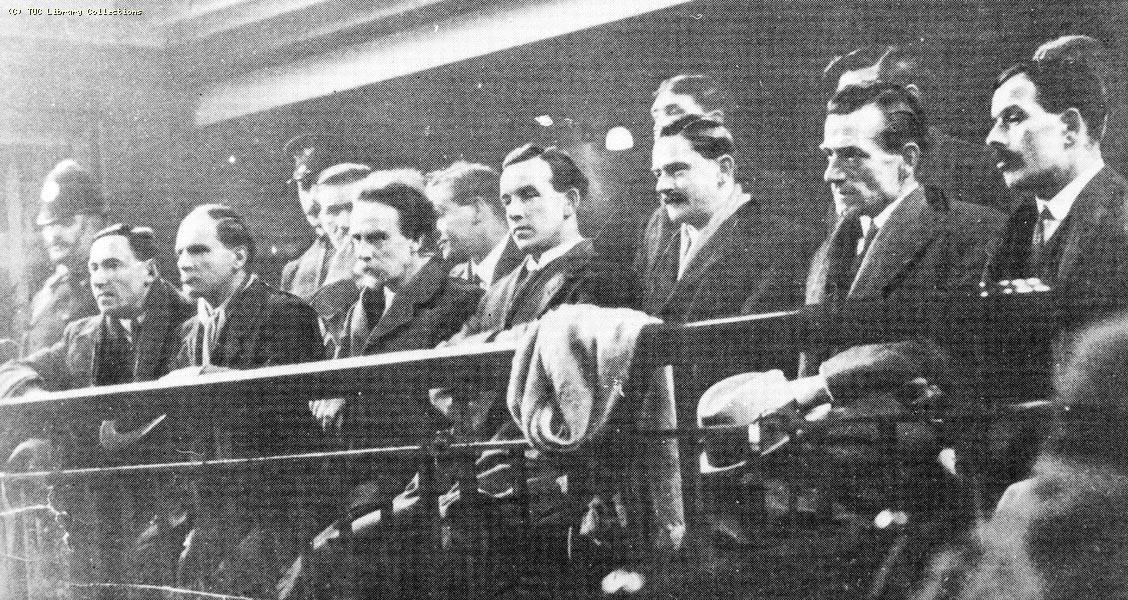
“Suddenly,” said Gallacher, “I saw a sight that was like the sun on a rainy day. I saw policemen being carried in. ‘Thank God!’ I said, ‘thank God! The boys have found weapons at last.’”
Next day he learned that a lorry of beer bottles on its way to a nearby “pub” had been commandeered by the strikers and used with some effect on the charging police. police. By this time the strikers had learned that Gallacher and Kirkwood were arrested; this and the lorry of beer bottles turned them from driven sheep into angry and determined men. Almost anything might have happened. The authorities knew this; in their panic they came and begged the two leaders in order to save terrible bloodshed and loss of life, to go out and tell the crowd to go home. The more cautious strike leaders took the same line. But the men in the square were in a different mood. They sent in word, “Say the word, boys, and we’ll stay here till kingdom come. half-an-hour, Davie, and we’ll annihilate every policeman in Glasgow.”
Kirkwood and Gallacher were finally persuaded to go out on a balcony and tell the strikers to go home, after which they were led off to jail. That was the beginning of the end. Shinwell and twenty others were arrested that night. The next morning troops had arrived, several train-loads of them, with machine-guns, tanks, aeroplanes, etc. The sympathetic strikes all over the country, which the Clyde was hoping for, did not take place. Finally the A.S.E. executive, acting with the government and employers, suspended the Glasgow District Committee. On February 11, the strike was called off. Two months later Gallacher and Shinwell were sentenced respectively to three months and five months in prison.
I asked Gallacher if he was glad or sorry he had told the crowd to go home that Friday in the square.
“I couldn’t do anything else,” he said. “They put the decision on me. I was safe inside. I couldn’t say, ‘Go ahead and get killed.’ If I had been outside I could have said, ‘Come on–it’s worth getting killed for,’ but being inside myself, how could I?”
Gallacher is the sort of leader the Shop Steward Movement is designed to produce. He has never had a salary, never even had his expenses paid by the movement. He is a skilled brass-finisher, has always worked at his trade when he wasn’t in jail, and wants to go right on doing it. He has no political ambition; I don’t know that he is even definitely affiliated with any one of the three socialist parties. Nor does he want to be a labor organizer. He wants to agitate on the job. Perhaps the best thing about these labor leaders of the new order–next to their determination to keep on being workingmen—is their love of poetry. It is so common that I wasn’t surprised when I asked William Gallacher what message he would send from the Clyde to the workers of America, to hear him begin quoting Whitman–
“Come, my tan-faced children,
Follow well in order, have your weapons ready.
Have you your pistols? Have you your sharp-edged axes?
Pioneers! O Pioneers!”
The Liberator was published monthly from 1918, first established by Max Eastman and his sister Crystal Eastman continuing The Masses, was shut down by the US Government during World War One. Like The Masses, The Liberator contained some of the best radical journalism of its, or any, day. It combined political coverage with the arts, culture, and a commitment to revolutionary politics. Increasingly, The Liberator oriented to the Communist movement and by late 1922 was a de facto publication of the Party. In 1924, The Liberator merged with Labor Herald and Soviet Russia Pictorial into Workers Monthly. An essential magazine of the US left.
PDF of full issue: https://www.marxists.org/history/usa/culture/pubs/liberator/1919/10/v2n10-w20-oct-1919-liberator-hr.pdf
 Revolution's Newsstand