
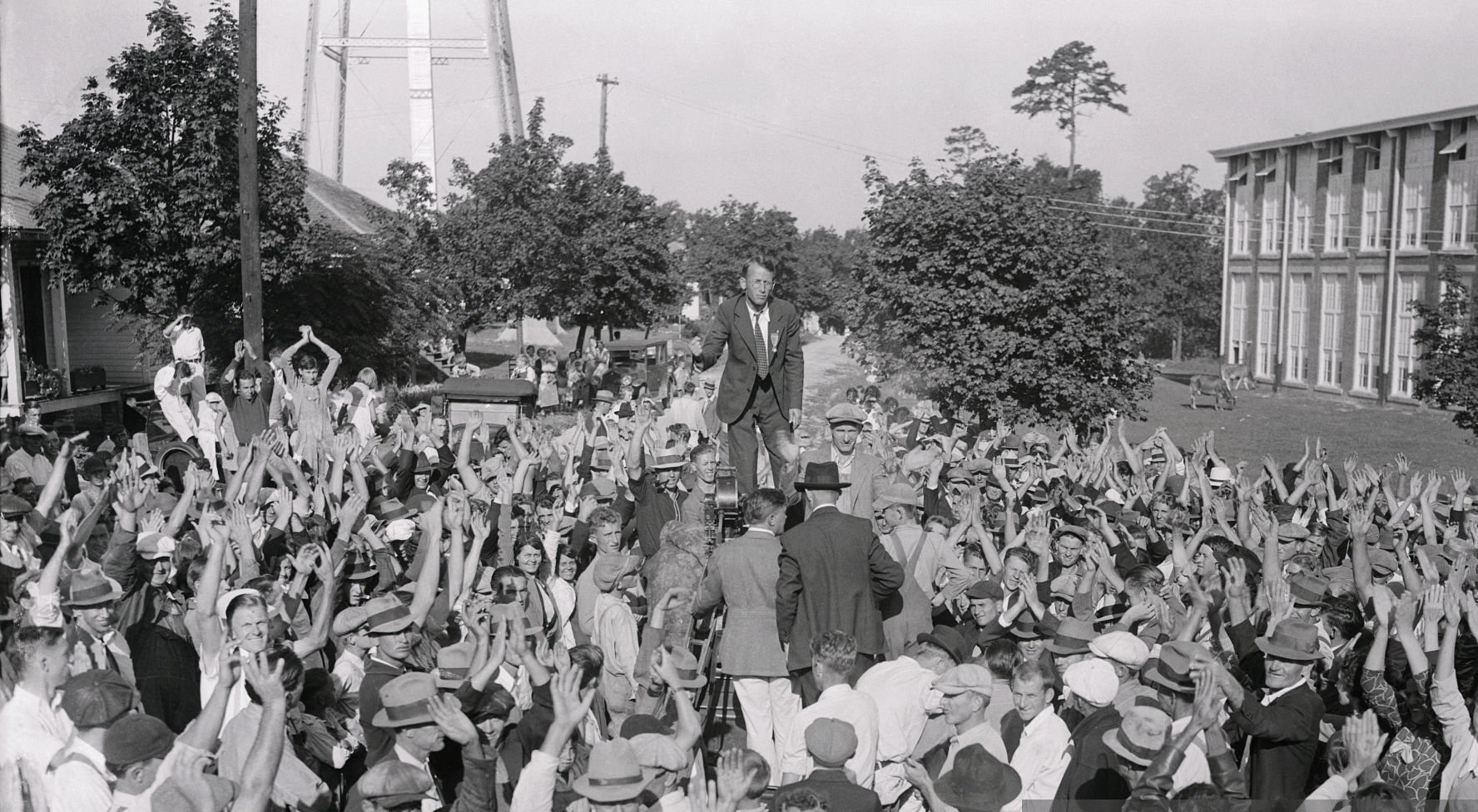
One of the largest strikes in U.S. history, the ‘Uprising of ’34’ in the textile industry remains, 90 years later, the high-point of labor struggle in the South. In many ways were are still living with the consequence of its defeat. The strike, at one point involving upwards of 1,000,000 workers, many in action for the first time, terrified the ruling class and it was met with, even for America, extraordinary violence and repression. The mobilization of nearly 100,000 National Guard troops, murder of two dozen strikers, and the mass arrests of pickets, placing thousands in armed camps, assisted by national union disorganization and bureaucratic duplicity, defeated the strike. Despite its loss, the struggle presaged the victories of the C.I.O. to come, though they would not be in the South. Arne Swabeck greets the momentous strike and places it in context.
‘The Meaning of the Textile Strike’ by Arne Swabeck from The Militant. Vol. 7 No. 36. September 8, 1934.
The powerful textile strike stirring the ranks of labor everywhere and is bringing to its highest point the second strike wave since the inception of the New Deal. Turbulent from the start, militant in all of its aspects, this strike has rallied hundreds of thousands of new union recruits, involving gradually all branches of the industry on a national scale in the effort to put an end to the abominable slave conditions under which the textile workers toil and to establish the union as their recognized spokesman and defender.
Little effort is made by owners of the industry to dispute the completeness of the strike or the completeness of the union adhesion by the workers. Nor would that be to much avail. The facts are there. The verification is contained in the solid workers’ ranks.
The textile workers have made good their vote to tie-up every mill. Mass action is finding a new and splendid expression, and with military precision the “flying squadrons” are heading the battles.
Strike Will Awaken Workers
It is the greatest struggle of recent times, both from the point of view of numbers involved, large scale actions and the sacrifices it has already claimed. One of its outstanding features is the way in which it has penetrated deeply into the ranks of the new proletarian recruits in the industrial south. Unquestionably this strike will go a long way towards the further awakening of the American workers and begin to instill into their minds the feeling of a class.
Posed as a strong motive force in this strike stands the economic background of the textile workers. Wages in many mills range below a ten dollars weekly rate. Added to this is the abominable stretch-out system by which the combination of machinery improvements and intensified speed-up saps the physical strength of the workers beyond human endurance. Compared to this kind of a wage rate, statistics by the U.S. government inform us laconically that the “average housekeeper is now paying 23 per cent more to the grocer and butcher than she paid in April of last year.” It is no wonder that labor is stirring everywhere. There will be more and greater struggles in the near future.
Union Organization Is Issue
However, above all others is posed the question of union organization. That is the main issue. The first strike wave at the inception of the New Deal struck with a sudden force and in many respects the employers and the reactionary trade union officials alike were taken aback. To the equal surprise in both of these camps the workers took the collective bargaining promise seriously and streamed into the union ranks. Once inside they began to insist on fulfillment of the promise and, as it appeared, the surprise found the employers not yet fully prepared to resist.
Now matters are different insofar as the employers are concerned. They are now not only prepared for the stiffest resistance to further union advance, but they are determined to make a head-on fight. That fact has been particularly well illustrated in the strikes of Toledo, San Francisco and Minneapolis.
Company unions are instituted first by sheer coercion. Federal and state authorities are working with police and military force. Red baiting campaigns are followed up with the organization of special vigilantes. These are the conditions met by practically every strike today. But the employers have only begun their attacks. A much more intensified campaign to head off the growth of unionism can be expected. For them it is a matter of restoring profits at the expense of the workers. Naturally they are also out to bring all possible pressure to bear upon their agents within labor’s ranks and they are beginning to force their hands.
Officials Under Pressure
These reactionary trade union officials are still in a dilemma, feeling the pressure from below of the forward moving ranks, fearing that unless the trade unions can measure up to what all the new recruits expect from them new leadership will arise inside the un- ions or new unions will emerge. On the other side there is the pressure from the employers and their government. Which side they will heed has already been made abundantly clear. The decision of the A.F. of L. Executive Council to start a campaign against the “reds” in the unions only foreshadows the new forms of combination of employers and the reactionary trade union officials under these new conditions. Every militant worker will be labelled “red” in justification for the crushing of strike movements. The textile workers will not at all be immune from such attacks.
The United Textile Workers Union is itself a picture of the recent trade union evolution. Formerly there were several unions in the industry, and not so very long ago it could be said that they were all equally impotent and discredited. All of them were not much more than shells of organizations.
N.T.W.-A Name of the Past
In 1929 the National Textile Workers Union, which now has nothing but its name left, led the turbulent strike in Gastonia. That was the time when the Scripps-Howard newspaper chain featured its famous editorial addressed to the A.F. of L. convention calling its leaders swivel chair artists who were sitting comfortable in their luxurious offices while it was left to the Communists to do the job in the south. It was a command to the A.F. of L. to get busy and organize the workers lest other, and the most feared forces, would do it. In this instance, however, as in so many others, the Stalinists, waving the banner of Communism, proved themselves equally incapable of the task.

But the A.F. of L. did not get busy. Even the opportunity and stimulus given by the NRA collective bargaining clause failed to galvanize it into action. Yet the workers by the hundreds of thousands fell into the lap of its unions where they had to be accepted on the penalty of other, more aggressive and more militant forces doing the job. Today we witness the anomaly which is not uncommon for many of the A.F. of L. unions, that the formerly so decrepit U.T.W. has actually united within its ranks the majority of the workers of the industry in the country. It would be preposterous indeed should the employers wheel into motion also in this instance their celebrated proposal for election amongst these workers as to choice of who and which organization is to represent them. The union represents the masses of the workers in the industry. Living, dynamic proof of that is given in this strike. For the American working class as a whole this one example and we repeat, it is not uncommon among the A.F. of L. unions signifies enormous progress.
Mass Unions Beginning
While the American working class is as yet far from being really organized it is clear where the beginnings of mass unions are today. The workers are joining the American Federation of Labor. Its new recruits can be expected to continue to give a good account of themselves, not merely in the strikes they engage in, in the fights for the establishment of mass unions, but also insofar as the future policy and direction of the unions are concerned. They will have something to say about the campaign against the “reds” and take a hand in the defense of the unions against all attacks.
The issue of the defense of the unions and the building and extension of the unions is now paramount. The struggle for its realization reaches ever higher levels. During this short span, through the first and the second strike wave, after the beginning of the New Deal the history of union organization is written in blood. Every strike has been turbulent, but it must also be said that every strike has brought forward constantly more magnificent examples of working class solidarity and militancy. Every strike has brought forward new proofs of working class vitality and of ingenuity in devising ways and methods of meeting the violent onslaughts by the forces of the employers and their government. They will in time also bring forward proof of the working class ability to circumvent the scheming and cunning of the reactionary bureaucrats.
New Period Opening
Without doubt we have entered a period in this country of awakening of new working class strata. That is the period when the militants forge ahead to lead the movements, to put their slogans and ideas to the test in the fire of struggle. Out of every experience it is possible to record lessons which can mean positive gains for the struggles to come.

The American working class may thus be able to learn and to assimilate in abridged form the revolutionary lessons that elsewhere stretched over a protracted period of time. The strikes of today all carry their important preliminary lessons. The Minneapolis strike, especially in view of its victory won despite almost superhuman obstacles, can serve as a great teacher in this present stage. Tactics and strategy of strikes should therefore be given a particularly attentive study by the militants.
The Militant was a weekly newspaper begun by supporters of the International Left Opposition recently expelled from the Communist Party in 1928 and published in New York City. Led by James P Cannon, Max Schacthman, Martin Abern, and others, the new organization called itself the Communist League of America (Opposition) and saw itself as an outside faction of both the Communist Party and the Comintern. After 1933, the group dropped ‘Opposition’ and advocated a new party and International. When the CLA fused with AJ Muste’s American Workers Party in late 1934, the paper became the New Militant as the organ of the newly formed Workers Party of the United States.
PDF of full issue: https://www.marxists.org/history/etol/newspape/themilitant/1934/sep-08-1934.pdf
 Revolution's Newsstand