Ralph Chaplin, who took the pen-name ‘Paint Creek Miner’ reports on conditions and appeals for foot-loose wobblies to come to West Virginia to aid the miners of the Kanawha Valley in their desperate struggle, now know to us as the Paint and Cabin Creek Wars.
‘Mine Vultures in West Virginia’ by Ralph Chaplin from Solidarity. Vol 4 No. 19. May 17, 1913.
How They Have Driven To Desperation The Miners of Kanawha, Who Have Been Left To Fight Their Battle Alone
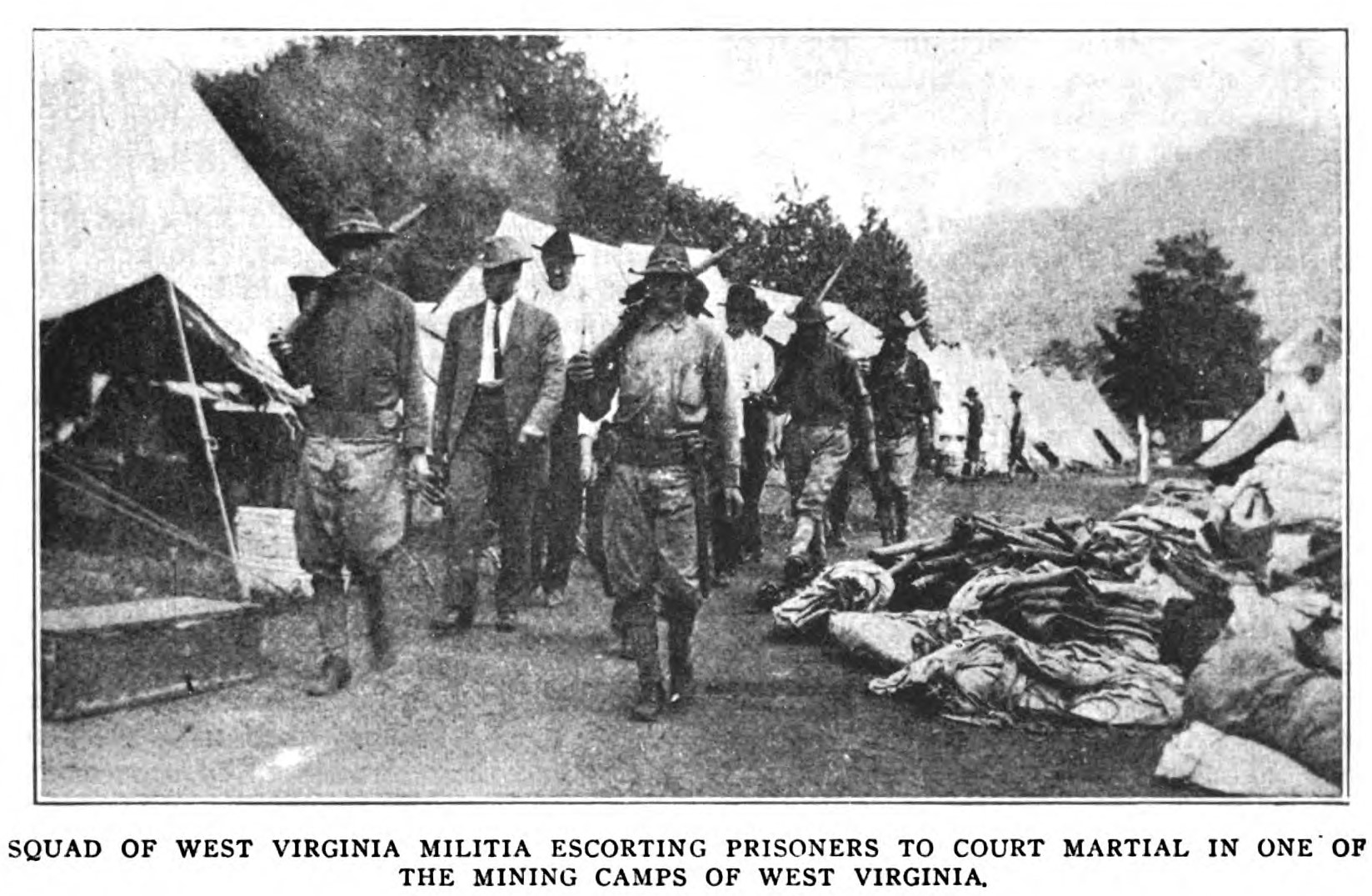
With the last sparks of constitutional freedom stamped out, bullpens full of miners, jails crowded with editors and agitators and with her mountains infested with power-drunken mine-guards and militiamen; West Virginia, rotten with reaction and respectability, presents a spectacle to the world that would make Nicholas of the knout green with envy. In no place in the United Statis are the various elements of the class-struggle more glaringly prominent or more significant than in that greed polluted section of the land. The strike of the fighting coal miners of Kanawha County has called forth all the forces of organized oppression that can possibly be used against the workers–the armed hired thug, the murderous militiamen, capitalist courts, the labor fakir, the drum-head court martial, the palavering preacher, the policeman, the scab, protected by armored trains and privately owned Gatling guns, and last of all the whorish pen-pusher for the prostituted press. West Virginia is a volcano of discontent and rebellion, with Kanawha County as the seething crater. Sooner or later the great eruption is bound to come. More than anything else, at present, the state needs a few I.W.W. scrappers who know the game and can take care of themselves, to go down there and mix up in the rumpus. For when the big fight starts, it will either be a stubborn, hopeless bloody civil war or it will be a short, quick and tremendously useful fight in which the winning tactics of the I.W.W. will carry the day.
All over the state miners have been, and are, herded in “company” towns, living in miserable “company” shacks and, in many places, paid only with “company” paper script good only at the “company” “pluck-me” store. And these men mostly work longer hours for less pay than miners in any other state in the union. They have endured so much and are so desperate, that they are eager and anxious to get out from under the hideous nightmare they live in. They are kept docile and intimidated only by means of hireling plug-uglies and spies who are ever ready to crush out with force the first sign of rebellion manifesting itself.

West Virginia today, represents the perfect type of a perfected industrial despotism. Scarcely an element is required to make the picture complete. And it is a black picture of capitalism rotten ripe for one of its final convulsions. The great grimy hills, covered with gnarled trees and bleak rocks, around which the smoke of the endless coke ovens is always coiling, the squalid mining towns, the hidden armies of half paid, half organized or unorganized slaves, toiling ceaselessly at their hateful tasks in the many sooty hell-holes on the hillsides-waiting and waiting until they will be able to strike and strike hard at the system that is crushing them. In West Virginia the stage is all set for a great industrial drama-maybe a tragedy, possibly a farce, perhaps one of the greatest and most inspiring victories that has yet occurred. At all events, one is safe in predicting that what has already happened is but the prelude to the play.
Thus far the workers have used but one or two rather ineffectual weapons, but they have used them well. And they will use other weapons, the irresistible weapons of modern industrial warfare just as well, when they learn of them. We already know what weapons and methods the “invisible” operators and their hellions will use. They have played out their hand and we mow just what to expect and how to prepare for it. A few I.W.W. boys, backed up by “Solidarity,” the “Industrial Worker” and the “Lumber Jack” could do wonders by working in a quiet, systematic way, in “wiseing up” the workers of West Virginia.
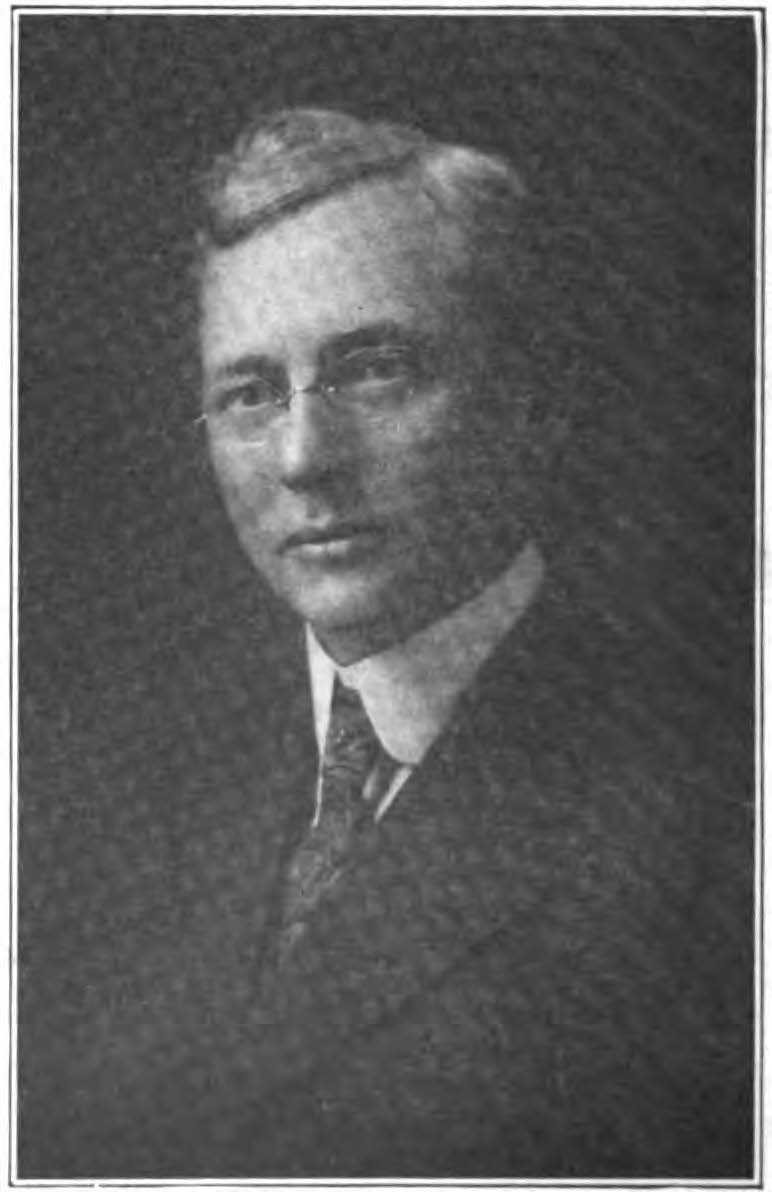
The U.M.W. of A. has displayed none of the strength of an industrial union and all of the weakness of a craft union in the strike. If it were not so, the long-drawn-out struggle of over a year would have been won months ago, supported as it was, by the unbreakable solidarity of the rank and file of the miners. The sacred contract system spiked one of the greatest guns this organization might have used against the bosses, the state-wide strike. The well paid and atrociously conservative “leaders” laden with a yellow cargo of compromise, reform politics, obsolete fighting tactics and contracts, have done everything but help the cause of the strikers, who, finally became so dis- gusted that they took to the hills with rifles in their hands, leaving the fakirs to confer with the enemy alone about the eagerly sought settlement. Then came the socialists telling the miners on strike to vote the socialist ticket. This the miners of Kanawha County did and carried practically the entire county. Some of the men elected were counted out, many were manhandled by mine-guards into unresisting passivity, some became prosperous and “played the game” but all were made practically helpless to assist the miners, by means of martial law. Mother Jones, Boswell and Brown are sturdy and vociferous fighters, but the mine owners are not afraid of talk, votes, or even dynamite ONLY AN INDUSTRIAL ORGANIZATION THAT CAN ENFORCE ITS DEMANDS, so they threw these political revolutionists into jail and proceeded to send their own cut-throats out to browbeat the strikers back to the slavery of the mines. Came then a socialist lawyer to the rescue, Harold W. Houston, of Charleston. Houston said that the constitutions of both West Virginia and the United States guaranteed to its citizens, among other things, the rights of a trial by jury, free speech and a free press, and that as all of these “rights” had been ruthlessly trampled under foot, the prisoners having been kidnapped unlawfully and tried by martial law, the thing to do was to fight it out in the courts. This he did. The cases were taken from one court to another, only to meet ignominious defeat at each turn. When, finally, Houston became sassy about the way he had been treated, they clapped him into jail, where he is now being held, probably completing his education as a revolutionist.
The only papers in the state that dared to mix up in the miners’ fight were the Charleston “Labor Argus” and the Huntington “Labor Star.” Boswell, editor of the “Argus” was “jugged” with Mother Jones. He is now awaiting a term in the state penitentiary. Fritz Merrick, editor of Pittsburg “Justice,” flirted with the editorship of the “Argus” until he incurred the wrath of the operators’ eager and pliant tool, Governor Hatfield. Then Merrick was imprisoned and is still in the tender clutches of the law
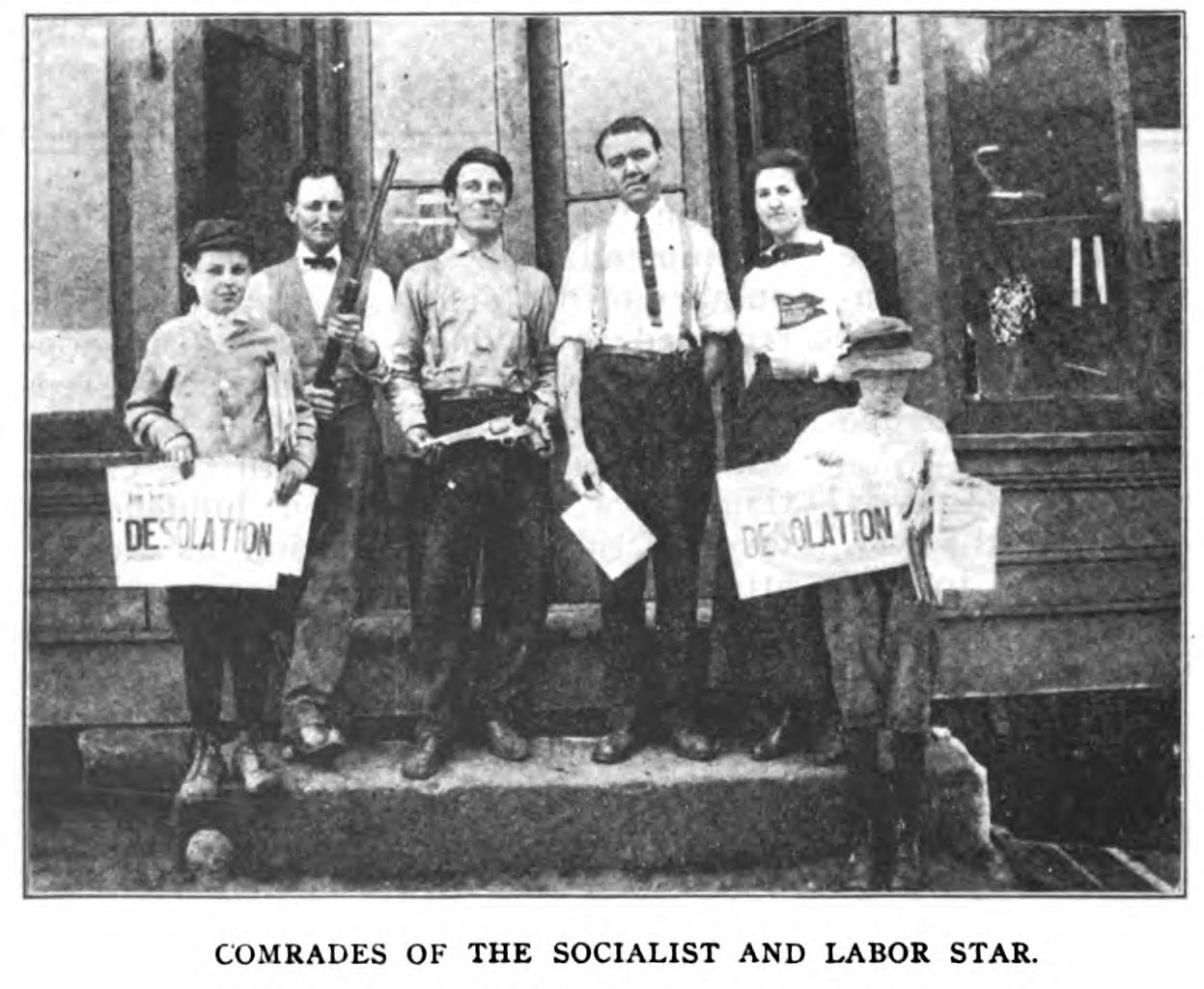
But this is not all. The Governor is as anxious to serve the mine owners as a suffragette is to obtain the ballot, and almost as careless as to what methods he uses. So he dispatched a bunch of his under-sized, yellow-legged tin horns, commanded by one Captain Wood, to put the quietus on the “Argus.” This delectable gang paid the paper a little surprise visit, and good naturedly confiscated the whole works, a la Russia. Thereupon, W.H. Thompson, editor of the “Star” voiced his indignation in 36-point headlines and flooded the state with one big protest edition. This protest fairly gave the arbitrary and labor baiting governor delirium tremens of “respectable” rage. So the inevitable happened. One of the pet pups of his highness, Hatfield; dropped in on the “Star” plant with a gang of uniformed scab-herders. The name of the pup is Tom Davis. He is a little lick-spittle, toad-like creature, a major in the militia and a “union” machinist. The “Star” plant was confiscated, cylinder press, job press, folder and all. Thompson and Elmer Rumbaugh, hobo poet and agitator, and two others, were arrested and railroaded to Charleston. The “Star” was the last and practically the only labor paper in the state and the blow was a telling one, struck by the iron fist of a bombastic and arrant coward, a coward safe in the uneventful security, of a governor’s chair with liveried prostitutes at his beck and call to do his dirty work for him.
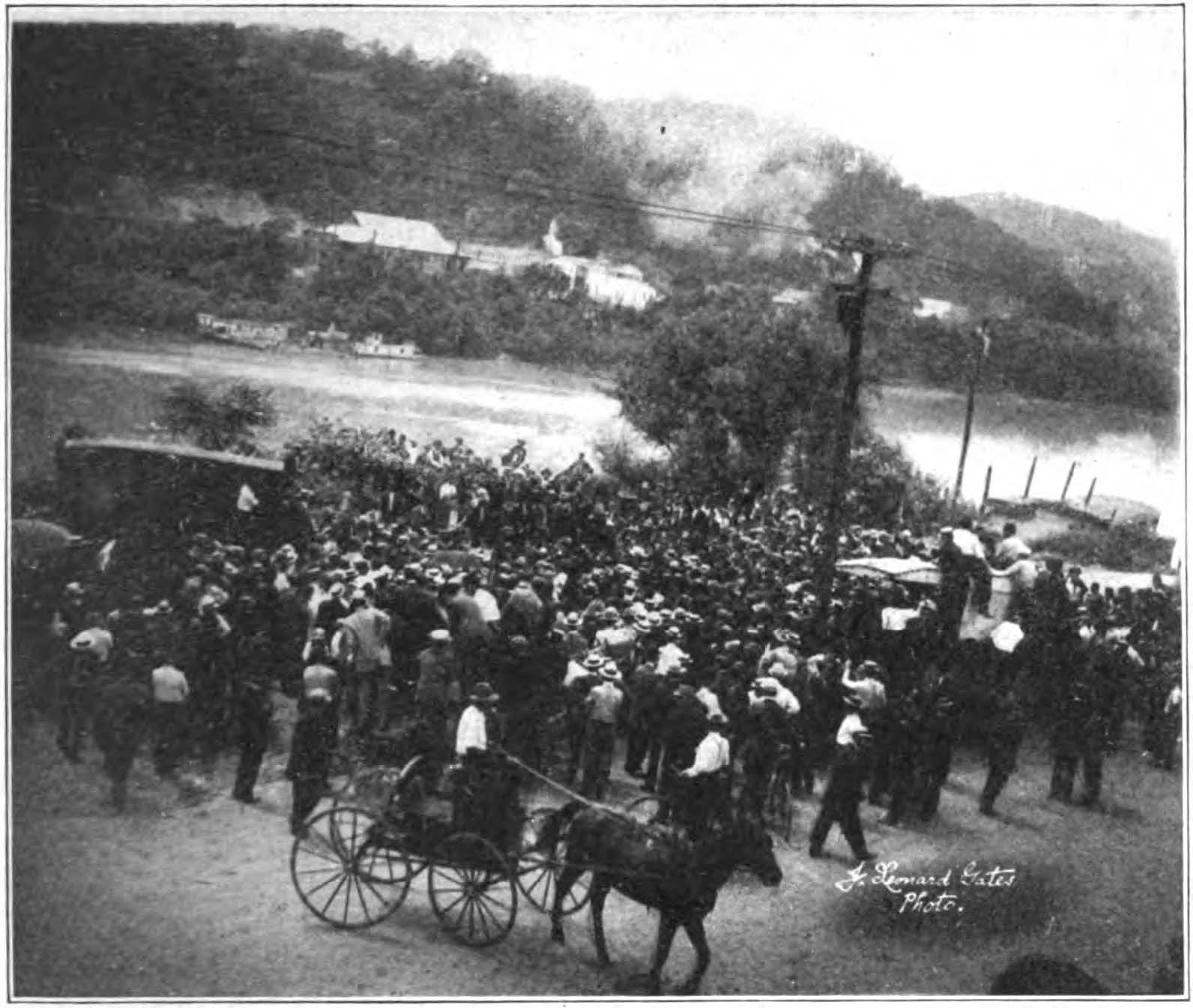
Hatfield is a half educated “hillbilly,” elected to a place of power. He comes of the notorious Hatfield-McCoy feudist stock from the Kentucky outlands. He has been called a tyrant, a dictator and a despot. In reality he is not even made of the timber good tyrants are made of. He is too contemptible and insignificant to be anything–even a shrewd politician. He is trying desperately to do what the mine owners expect-of him, and this is merely his idea of making good. As West Virginia is suffering from an overdose of middle-class “respectability” he manages to “get by” with it. If anyone imagines that a reformer, socialist or otherwise, could do differently, they are greatly mistaken. The political business is not worked that way and reforms never start at that end of the game. Invisible government rules West Virginia as it rules the world. Politicians, good, bad and indifferent, are and can be, in one way or another, merely tools of this hidden and merciless power. Personally, Hatfield is a short-sighted, violent ignoramus, whose lack of brains and unbounded egotism would disgrace an imbecile. The class-struggle, as it develops, will probably produce many such small-bore dictators, but they will “live hard.” And it is a good thing to make such would-be Hessians “live hard,” but the fact must not be over-looked in the meanwhile that IT IS THE PARASITICAL OWN- ER AND HIS HOLY PROFITS THAT SHOULD BE MADE TO SUFFER MOST. His piratical puppets are underlings at best. A good, healthy, STATE-WIDE STRIKE or a little SABOTAGE applied judiciously, here and there-slate and sulphur weighed and shipped as coal or the withdrawal of the customary efficiency on the part of the mine pumpmen and engineers. These are some of the tactics that would turn the trick and these are the tactics feared by the operators more than all else, more than eloquent protests, more than ballots or bullets-more than anything else under the sun. They are not afraid of the U.M.W. of A., for in spite of the fact that the strike has cost them a heap of money, still the miners have got, nor can they get, but very little of that money at the best. And besides, the mine owners have made all kinds of money from the labor of union miners at work in the mines adjoining the strike zone. Then, too, it is such an easy matter to “deal” with officials-labor leaders, whose heads are stuffed with reform politics and compromise and whose pockets are stuffed with contracts. They can bullpen large numbers of the miners who insist upon using guns, they can confiscate unruly labor papers and jail the editors, the laws never worry them and they light their perfectos on their constitution of the state, they can ignore the socialist politician in his search for and pride in votes, BUT LET THEM HAVE CAUSE TO SUSPECT THAT A STATE-WIDE STRIKE IS CONTEMPLATED, OR THAT THE 50,000 UNORGANIZED MINERS OF THE STATE ARE THINKING ABOUT ORGANIZING ON THE JOB TO SECURE A GREATER PORTION OF THE PRODUCT OF THEIR TOIL AND THEY SHRIEK TO HIGH HEAVEN!
Several times the rumor that the I.W.W. was about to invade West Virginia has swept the state and the little drivel-slinging local rags vied with each other in having hysterical spasms of editorial hydrophobia at the very possibility of such a catastrophe.
Already the menacing shadow of the fighting industrial organization of the working class has fallen across the strife torn hills of the Little Mountain State and the mine owner, the politician, the miner, the factory slave, the lumber jack and the labor fakir are all expecting momentarily sight of the horrible reality, each with feelings all his own. The miners of West Virginia have learned much through bitter experience, probably enough to make them ready for the message of real revolutionary unionism and the wonderful high-pressure fighting tactics of the I.W.W. Freight trains are plentiful, and I.W.W. fighters are needed. Is there anything doing?
The most widely read of I.W.W. newspapers, Solidarity was published by the Industrial Workers of the World from 1909 until 1917. First produced in New Castle, Pennsylvania, and born during the McKees Rocks strike, Solidarity later moved to Cleveland, Ohio until 1917 then spent its last months in Chicago. With a circulation of around 12,000 and a readership many times that, Solidarity was instrumental in defining the Wobbly world-view at the height of their influence in the working class. It was edited over its life by A.M. Stirton, H.A. Goff, Ben H. Williams, Ralph Chaplin who also provided much of the paper’s color, and others. Like nearly all the left press it fell victim to federal repression in 1917.
PDF of full issue: https://www.marxists.org/history/usa/pubs/solidarity-iww/1913/v04n19-w175-may-17-1913-solidarity.pdf
 Revolution's Newsstand