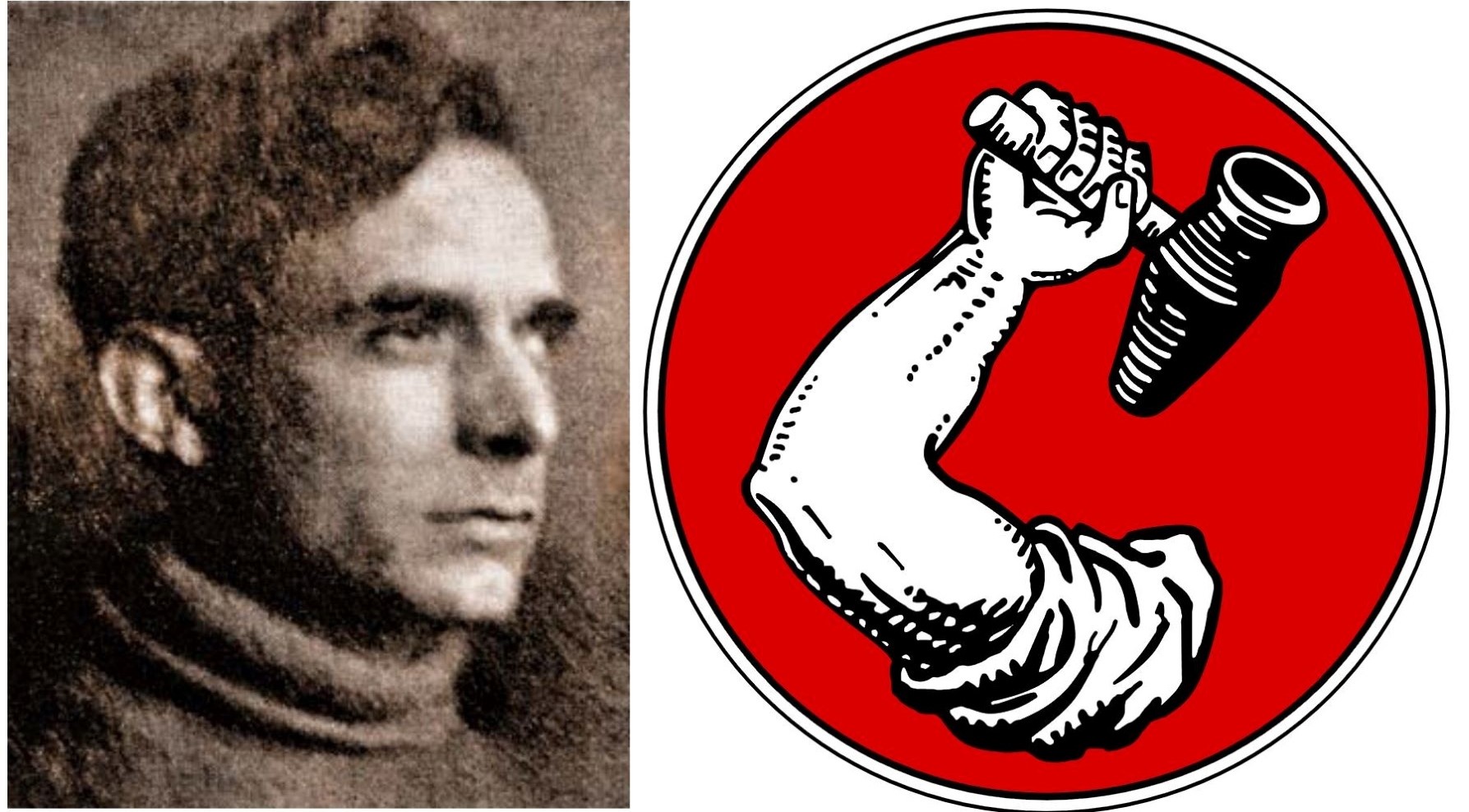
This article from a 17-year-old(!) Louis C. Fraina, one of his first for the left press, is a fascinating read knowing that ten years later he would be the leader of the Left Wing of the Socialist Party and founder of U.S. Communism. Fraina, entirely self educated, joined the S.P. as a teen in early 1909 only to quit several months later to join the Socialist Labor Party. There he quickly became New York City organizer and placed on the Editorial Board of the Daily People. In this essay Fraina describes, in scathing language, what he sees as the the non-proletarian, non-revolutionary character of the Socialist Party. A position he continued to hold after he joined the S.P. in 1914, helping to found the proto-Communist Socialist Propaganda League in 1915.
‘A Question of Tactics’ by Louis C. Fraina from The Weekly People (S.L.P.). Vol. 19 No. 29. October 16, 1909.
A Party of Socialism, In Order To Triumph, Must Be Poised On Bona Fide Revolutionary Principles.
The controversy that has been agitating the Socialist party of Washington state contains much food for thought to the militant Socialist. The causes underlying the controversy, and its outcome- the splitting up of the organization into two hostile factions, each claiming to represent the true Socialist party; and the talk current in one of the factions of launching a “Wage-Labor” party- constitutes material from whence tactical conclusions of the utmost importance to the revolutionary Socialist movement are to be drawn.
To adequately understand the controversy necessitates our going back a few years to the inception of the Socialist party, the causes that lead to its formation, and an analysis of the elements constituting its membership.
The causes leading to the upheaval in the Socialist movement in 1899 had not their roots in personalities; they were the legitimate off-spring of two hostile elements battling for control within the Socialist Labor Party. The revolutionary proletarian element sought to put the Socialist movement on a firm proletarian and revolutionary basis, a policy that led to the formation of the S.T. & L.A., a class-conscious, economic organization; their propaganda was strict, educational, imbued with the spirit of uncompromising class consciousness. The bourgeois-reform element opposed these methods. The propaganda of the S.L.P. was, to them, “narrow,” “intolerant,” etc., an intolerance, however, bred of obedience to facts, and a revolt against which constituted a revolt against facts, and the theories flowing therefrom. A controversy ensued which culminated in an upheaval in 1899, when the bourgeois-reform element bolted the S.L.P.
The Socialist Labor Party, rid of the elements that had paralyzed its normal development, was now free to develop the principles and tactics that American full-grown capitalism rendered necessary. This development culminated in the present posture of the S.L.P.–a posture that calls for the unconditional surrender of the Capitalist Class; and for the POLITICAL and ECONOMIC organization of the Working Class–the first for agitation and warfare on the field of political action; the second to execute the revolutionary act of “taking and holding” the industries of the land, and to carry on production when capitalism shall have been overthrown. The bourgeois-reform element organized in the Social Democratic, now the Socialist, party. The policy of the new organization was one of “broad,” “tolerant,” “practical” inconsistency and opportunism, thereby attracting a large element of freak-frauds to their ranks; so much so, that A.M. Lewis, writing in the International Socialist Review for January, 1906, states (page 438) that in the Socialist party “every third person is a spiritualist or Swedenborgian or theosophist or seventh day adventist or divine healer or astrologer or a believer in the great gospel or message that ‘Man is God’ or ‘I am it’ or ‘I am that I am–which, if not literally true, nevertheless gives a hint as to the elements within the Socialist party–freaks and muddle-heads who perennially attach themselves to a radical organization the propaganda of which is not sound, and “tolerant” to the core. The effect is heightened when we add to this the bourgeois would-be-Socialists who, attracted by the “broad” policy of the Socialist party, by its immediate demands and bourgeois-reform character, joined the organization for the purpose of doing “something now” for the “oppressed and suffering proletariat,” the miseries of whom rent their hearts with anguish. And beneath these elements the voice of the proletariat was stilled and hushed.
In such an organization, wherein such contradictory elements existed, unity and harmony were impossible. A conflict was inevitable from the first, a conflict between that element that had some inkling of revolutionary proletarian ideas, and the muddle-headed bourgeois-reformers. Since the inception of the Socialist party, this conflict has been waged within its ranks. Indeed, so virulent became this conflict in some states that, if it had not been for the state autonomy that prevails in the Socialist party, the whole organization would have been rent asunder, as Berger himself admitted at the 1908 convention of his party.
This conflict has been especially virulent in the State of Washington. There matters have come to a head, and a split has ensued.
The proletarian movement, seeing that harmony was an impossibility so long as their party was dominated by the middle class, sought to rid their organization of this bourgeois element; and are now agitating for a strictly proletarian, a “Wage-Labor” party, to which none but wage-workers shall be admitted as members. With such an organization they believe it possible to avoid all “entangling alliances” and to have a real revolutionary Socialist party.
The proletarian element has acted obedient to a healthy instinct. The revolutionary force requisite for the overthrow of capitalism must come from the only class whose material interests are in harmony with the aims of the Social Revolution, the class of propertyless wage-workers.
The mistake incurred by the proletarians of the Washington S.P. lies in their failing to grasp the fact that the strictly PROLETARIAN CHARACTER OF AN ORGANIZATION IS NO CRITERION OF ITS REVOLUTIONARINESS.
Instances of this are not lacking. The trade unions are notoriously conservative and reactionary. The British Labor party is a “Wage-Labor” party, and yet it is not a revolutionary Socialist organization. A Socialist party requires something more than proletarianism, and that is a propaganda that is uncompromisingly revolutionary in nature, thoroughly class-conscious, that aims at the political and industrial unity of the working class. A Socialist party with such a propaganda would be proof against the freak-frauds that now dominate the Socialist party. The proletarians of Washington, however, do not possess or believe in such a propaganda, theirs differing but slightly from that of the middle-class element. Both believe in pure-and-simple political action and in “immediate demands”; their slogan is, “Revolution at the ballot box!”–in short, theirs is the propaganda of the reformer, not the revolutionist. No reformers will stead. “Capitalism is a Usurpation: the Usurpation must be overthrown. Labor produces all wealth; all wealth belongs to Labor. Any act that indicates–or, rather, I shall put it this way: any action that, looking toward ‘gentleness’ or ‘tolerance,’ sacrifices the logic of the situation, unnerves the Revolution. With the Proletarian Revolution, every proposition must be abreast of its aspirations; where not, it limps, it stumbles and falls.” The Socialist party, with its “tolerant” and “broad,” therefore inconsistent, propaganda; its talk of “buying out the capitalists,” thus putting a class of social felons on a plane of equality with the workers; its general policy of opportunism and reform, has invited to its ranks the reactionary elements that now dominate it. A party that is revolutionary to the core, that demands the unconditional surrender of the Capitalist class, cannot be made the roosting-place of reactionary bourgeois-reformers. What bourgeois recruits may join its ranks will be thoroughly revolutionary.
The above pregnant facts lead to the following pregnant conclusions, which may be termed “canons of the Proletarian Revolution”:
First–Futile and chimerical is the idea of admitting none but proletarians to membership in a Socialist party; its function being, primarily, one of agitation and education, it can ignore only at its peril the intellectual forces in revolt against existing society. These forces must be bent to the service of the Socialist movement; but so as to insure a Socialist party retaining its Working Class character, its propaganda must be thoroughly PROLETARIAN and REVOLUTIONARY in nature; it dare not meddle with bourgeois-reform ideas, but must demand the unconditional surrender of the Capitalist Class.
Second–The force requisite for the overthrow of the Capitalist system of society can only issue forth out of the ranks of the proletariat; this proletarian element must be organized at the point of production, where they are exploited, hence it is the task of the political movement of Socialism to agitate for and seek to promote the integrally organized industrial organization of the Working Class. The industrial organization is the embryo of the future Socialist of Industrial Republic; it alone is fitted to “take and hold” the administration of the county’s productive activity.
New York Labor News Company was the publishing house of the Socialist Labor Party and their paper The People. The People was the official paper of the Socialist Labor Party of America (SLP), established in New York City in 1891 as a weekly. The New York SLP, and The People, were dominated Daniel De Leon and his supporters, the dominant ideological leader of the SLP from the 1890s until the time of his death. The People became a daily in 1900. It’s first editor was the French socialist Lucien Sanial who was quickly replaced by De Leon who held the position until his death in 1914. Morris Hillquit and Henry Slobodin, future leaders of the Socialist Party of America were writers before their split from the SLP in 1899. For a while there were two SLPs and two Peoples, requiring a legal case to determine ownership. Eventual the anti-De Leonist produced what would become the New York Call and became the Social Democratic, later Socialist, Party. The De Leonist The People continued publishing until 2008.
PDF of full issue: https://www.marxists.org/history/usa/pubs/the-people-slp/091016-weeklypeople-v19n29.pdf
 Revolution's Newsstand