
A wonderful look at one of the most important institutions of Russian Culture, The Moscow Art Theatre of Anton Chekhov and Konstantin Stanislavsky by Alexander Chramoff. Chramoff was in charge of Ukrainian theater in the early days of the revolution. Later he directed in Moscow’s Red Cock Theater conducted by Lunacharsky and edited ‘Theatre,’ the national theatrical magazine of Soviet Russia. In 1919 he enlisted in the Red Army, commanding a division in Kiev and putting on performances for soldiers. Captured in 1921 during the Polish War, he escaped to Vienna and then to the United States where he was active in the Communist Party and film industry.
‘The Moscow Art Theatre’ by Alexander Chramoff from The Liberator. Vol. 6 No. 2. February, 1923.
“The Art Theatre is the best page of that book which will some day be written to describe the contemporary Russian theatre.” Chekhov.
ON May 22, 1897 two men met in one of the private dining rooms of the restaurant “Slavonic Bazaar” in Moscow. They were C.S. Stanislavsky and B.I. Nemirovich-Danchenko. The waiters serving them, judging by the character of their discussion, could have concluded that the subject matter of their conversation was the theatre.
Of the two diners, one was advocating a new stage management while the other desired new stage productions. They spoke of everything. They discussed literary tastes, art as an ideal, the methods of stage management and scenic construction. They did not omit the problem of administrative arrangements and financial requirements. They talked while it was day. Night came and they continued to talk. Having talked for eighteen hours at a stretch they parted.
This meeting was destined to play an important part in the history of the theatre of the world. As a result of it was born the Moscow Theatre, at the present time one of the most extraordinary theatres in the world.
The Men at the Helm
WHO are Stanislavsky and Nemirovich-Danchenko? Constantine Sergeevich Stanislavsky was born in Moscow. His parents were merchants. Their real surname was Alexiev. From his childhood he was devoted to the theatrical art, often appearing as a chorus boy in the small private theatre built on his father’s country estate. In Moscow, his parents’ house, near the Red Gate, was the gathering centre of many theatrical amateurs, who under the direction and management of the best contemporary stage directors presented operas and dramas. Among these was the father of Mr. P. Komissargevsky, the stage manager of the Theatre Guild in New York.
His father’s business affairs brought Stanislavsky to Paris. The French theatre made an enormous impression upon young Stanislavsky.
“Perhaps,” Stanislavsky himself has suggested, “this tremendous admiration for the French theatre was partly due to the French blood in my veins.” Stanislavsky’s grandmother was the well known French actress Varley, who had played on the Petrograd stage.

His admiration for French scenic art induced Stanislavsky to join the Conservatory of Paris. But it did not last long. He was soon disillusioned. He saw that the French scenic school thought only about carefully worked out “registering.” His free artistic soul revolted at the idea of stereotyped engineering in the expression of moods and passions. He felt a call for original and individual expressions of feeling, totally at variance with the recognized forms of scenic art.
After its first favorable impression, the French school produced in Stanislavsky a revulsion of feeling, which blossomed into a veritable revolt against the established forms of stage acting. This revolt played an important part in the subsequent history of the Moscow Art Theatre. As important an event in Stanislavsky’s life was the arrival in Moscow of Meiningen and his artists. Stanislavsky fell completely under the influence of Meiningen; and his first plays at the Moscow Art Theatre were directly modeled on the style of Meiningen.
Stanislavsky was particularly impressed by the following event: Mr. Kronengi, chief stage manager of the Meiningen theatre while it was in Moscow, engaged as his prompter a Russian who spoke German fluently. It was the final rehearsal of Schiller’s Robbers. The prompter, reading the German text, got stuck in one place and held up for a few seconds the part of an actor. After the rehearsal, Kronengi called the prompter and asked him for the reason of his blunder. The prompter offered various excuses. Kronengi turning to the nearest stage-hand, asked him: “When is the turn of such an actor?” The workman unhesitatingly answered: “After such and such words.” “You see”, said the German stage manager triumphantly to his confused Russian assistant.
Devotion to duty, responsibility for his part, teamwork, symphonic harmony of acting, iron discipline in the theatre–these were the foundations which helped Stanislavsky to systematize his ideas and give to the Moscow Art Theatre a theoretical basis. However, if Meiningenism suffered from concentrated realism and excessive reproduction, Stanislavsky succeeded in stripping his stage management of unnecessary exaggeration and mummerism.
It is interesting to note that the first play produced by the Moscow Art Theatre in New York, Tsar Feodor Ivanovich, with Moskvin in the title role, was also the first piece played by this theatre, when it opened its doors in Moscow in June, 1898. In theatrical circles, it is considered the triumph of Meiningenism transplanted to Russian soil.
While Stanislavsky is considered the creator of the scenic part of the Art Theatre, to Nemirovich-Danchenko is due the honor of making the Moscow Art Theatre the mirror of the social and political questions of the day.
At the time of the meeting in the “Slavonic Bazaar” Nemirovich-Danchenko was already recognized in Russia as a dramatic author of note. His dramas met with success both in the principal and the provincial cities of Russia. His articles in the theatrical papers and periodicals astonished readers by their depth of thought and originality of taste. He was also a professor at the Philharmonic Society which ultimately supplied the Moscow Art Theatre with many of the latter’s personnel.
The Russian theatre of the time was clogged with French melodramas. Nemirovich-Danchenko was dreaming of the theatre that would reflect undercurrents; that would finely sense the social and economic problems of the day. He wanted to create the theatre of Ibsen and Chekhov.

Stanislavsky and Nemirovich-Danchenko. These two men are responsible for the creation of the Moscow Art Theatre. But not of the Art Theatre alone. They are also the fathers of the contemporary Russian Theatre at large.
From the very beginning of the theatre’s operation, the work of these two men was strictly divided according to a mutual agreement. Nemirovich-Danchenko had a deciding vote upon the questions which dealt with the choice of plays, the definition of the purpose and significance of the selected production, the literary description of a type to be presented and the vital characteristics of that type. Stanislavsky, on the other hand, had the final say in matters of stage management, decorations, stage business, methods of scenic expression and the discipline of the personnel.
Traditions of the Theater
THE first productions of the Moscow Art Theatre were full of deep “naturalism.” The German ex-Kaiser has fittingly described this period of the theatre’s activity by saying that “one of their productions may well equal ten volumes of history.” And, indeed Tsar Feodor Ivanovich by Alexis Tolstoy, Antigona, In the Claws of Life, by Knut Hamsun, The Lower Depths by Gorky–are veritable historical museums. The actors who played the various parts made trips to Western Europe to get personally acquainted with the locations where the scenes were laid.
The decorations in the antiquary store of In the Claws of Life included thousands of various costly antiques. Shylock speaks with a real Jewish accent. For Tsar Feodor Ivanovich actual costumes of that period were used. During the presentation of Chekhov’s Cherry Orchard the spectators can detect the genuine aroma of fresh ripe cherries. A real wind blows the curtains…Beating of hoofs on a wooden bridge… Natural cries, tears and fear.
At first, the newly born theatre was anxious to destroy all the former theatrical traditions, old conventions, everything that restricted the freedom and imagination of creative theatrical art. For example, it was customary on the Rus- sian stage to place the trees along the sides of the stage. Young actors of the Art Theatre, sincere, enthusiastic, with unbounded faith in themselves and their talent, did just the reverse by placing the trees for no apparent reason in the middle of the stage. Russian actors speaking on the stage generally faced the public-the actors of the Moscow Art Theatre, if this was required by the natural course of events, turned their backs on the public.
In order to do away with the “fourth wall”, they placed the furniture in one of Chekhov’s plays along the curtain side of the stage. All these steps were taken in order to impress upon the public the right of actors to freedom of expression, the absolute right to freedom of creation. Stanislavsky defined this period somewhat differently: “It was,” he said, “an exercise of liberty from routine.”
While Stanislavsky with his company of actors and actresses were groping in the dark, slowly finding the road along which the Art Theatre subsequently travelled, while as a result of thousands of various tests, examinations, trials and mistakes, the now famous “Stanislavsky system” was being born, his collaborator, Nemirovich-Danchenko, was searching for new productions which would distinguish the Art Theater from its contemporary rivals. Nemirovich-Danchenko was an intellectual, living in the conditions of tsarist despotism and oppression. The dearest thoughts and most sacred ideals could only be expressed, if at all, by means of suggestion and eloquent silence for fear of punishment by the government. The opposition to the dominant classes had to be clothed in forms which were “censored” and yet well understood by the mass of Russian intellectuals.
Finally, Nemirovich-Danchenko made a choice. Although Stanislavsky was not enthusiastic about his early selections, Nemirovich-Danchenko decided to stage as one of the first productions The Seagull, a piece by his favorite author Chekhov.
In the past this piece had registered two failures, one in Petrograd and another in Moscow. Built out of subtle suggestion and delicate innuendo, it was not grasped by the intellectual public forming the bulk of Russian theatre-goers. Still greater, therefore is our debt to the Moscow Art Theater and to the Russian scenic art of Nemirovich-Danchenko; because by staging this piece they laid out a new field of activity for the Russian theatre and discovered possibilities for new scenic effects.
The production of The Seagull marked a turning point in the history of the Moscow Art Theatre. It decided the fate of the young and as yet unknown theater–in case of failure it would have struggled in vain; in case of success, it was assured of universal recognition, a splendid future. Stanislavsky has again and again told the story of that memorable evening when The Seagull was first produced:

“The first act ended. The curtain fell amid deadly silence. All of us felt a cold sweat creeping down our backs. Madame Kniper fainted. Miss Roxanova, a young actress, could not stop the tears that came streaming from her eyes. The public was so long silent that we left the stage and went to our dressing rooms.
“And then, the theatre burst into tumult. The applause broke like thunder. The public shook off the impression made by the play, awoke from the scenic trance, and the silence, so erroneously interpreted by the artists, gave place to a storm of approval.”
“I remember,” tells Stanislavsky, “how the assistant stage manager with surprising unceremoniousness grabbed me and pushed me forward on the stage. The curtain was already up. The public left its seats and noisily applauded. We were all perplexed, dumbfounded and stood motionless. None of us thought of bowing to the public. After the first act we were called on the stage twelve times. Finally it dawned on us that the play was a success.”
“We felt as happy, as if it were Easter,” says Nemirovich- Danchenko. “Someone, whose nerves could not stand such an abrupt turn of fate, softly sobbed. Everybody who had any connection at all with the play, rushed on the stage, workmen and costumers as well. The intermission was unduly prolonged. Tears of happiness spoiled the make up and it was necessary to paint up all over again.”
In these surroundings, full of love and devotion to their work on the part of all its collaborators, the Art Theatre of Moscow grew and developed.
Years went by. The naturalist productions, realism and neorealism were succeeded by the passion for symbolism.
The Moscow Art Theatre produced with tremendous success such symbolic plays as “Human Life” by Leonid Andreiv. A Maeterlinck. Gordon Craig, the English artist-manager, came cozy nest was found among its walls for the “Blue Bird” of as a guest of the Art Theatre, and produced in Moscow Shakespeare’s “Hamlet” in his original settings.
Passing through all these stages, the Art Theatre constantly learned its lessons, gathered experience, freed itself from mistakes and fallacies and finally became the foremost European theatre. Contemporary Russian art may, indeed, be justly proud of it.
The Stanislavsky System
THERE is a type of theatre where the actor dominates everything, as in Shakespeare’s theatre. Another type of theatre, like that of Antoine and Reinhard, places the responsibility on the stage manager. Still another type like the Kamerny theatre in Moscow, emphasizes stage decorations. And a fourth type where the composer reigns, as in Wagner’s Musical Drama. A fifth type is the theatre of the public, the futuristic theatre of the masses. And there is yet another, where the author or dramatist is supreme, as in the theatre of Yevreinov and Meyerhold.
The Moscow Art Theatre, the theatre of Stanislavsky, is one that belongs neither to the actor nor to the author, neither to the spectator nor to the composer. The Moscow Art Theatre is collective. Everyone shares responsibility, whether he be stage manager or stagehand. The Art Theatre is a dramatic symphony where each musician plays his instrument expertly and is a willing and able cog in a large machine. It is a theatre without stars and without specialization. A theatre without first and second parts. Above all it is not a commercial theatre out for profits. It exists through art and because of art. Amusement, the thing most sought after by the contemporary public in the contemporary theatre, will not be found in the Moscow Art Theatre. According to Stanislavsky, the theatre is not a place for the fattened and overfed parasites of humanity or for the exhibition of coiffeurs, costumes and jewelry.
“Amusement,” says Stanislavsky, “is a worthy aim; it is one of the objects of the theatre. But when the existence of a theatre is limited by amusement alone, it is as if someone used a costly piano for storing oats instead of producing wonderful sounds. Surely, a more appropriate place might be found for the oats. Every actor is a priest. His play on the stage–a liturgy.”

This explains why the actors of the Art Theatre have such tremendous respect for Stanislavsky and his theatre. That is why, when they come for rehearsal, they take off their hats, walk on tiptoe and talk in subdued tones. And the famous German actor, Moysi, was thoroughly justified when he declared: “This theatre is an altar, and the play of the actors a divine performance.”
Let us analyze Stanislavsky’s system. Even in his youth, while still an amateur, Stanislavsky loved posing. Once he arrived at the funeral of a friend riding a dark horse and wearing a wide black hat and a black cape.
“A cape is everything”, he declared proudly. “It allows one to express everything that is necessary.”
His trip to Paris reformed him. Having studied in the Conservatory, seeing how actors were prepared in the French theatrical kitchen in accordance with the prescribed recipes, young Stanislavsky acquired a tremendous hatred for the French scenic school. Returning to Moscow, he headed a re- volt against the system that prescribed the registration of human feeling by certain theatrical motions. Simplicity and sincerity, artistic truth and absence of mannerism-these are the mainstays of the Stanislavsky system and the peculiarities that distinguish his theatre from most American and European theatres.
Stanislavsky has often remarked: “In my theatre actors do not sally forth on the stage; I have men coming into a room.” According to Stanislavsky, the actor must ignore the public. He must not be governed by the will or the whims of the spectators; he does not act for them. The stage is the limit of his activity, because the stage is life itself. The actor must become his part. He must so thoroughly identify himself with this role that it becomes one with him.
The preparation for the production of Hamlet by the Moscow Art Theatre took two years. Crime and Punishment by Dostoyevsky went through 150 rehearsals, and the presentation of the play took two full days.
Boring into your part…Analyzing its smallest details and most minute particulars…Living through it not only in your mind, but actually with your feelings, heart, flesh and blood. This explains why it is so difficult to be an actor in the Art Theatre; why Moskvin, Leonidov and many others were often sick of nervous exhaustion, why others could not stand the trial and sorrowfully left its portals. “Don’t pull your hair frantically and don’t flop into previously arranged chairs,” Stanislavsky taught his actors, “Give better expression to psychological truth; and cut out even artistic gesticulation; do away with the registration of your genuine feelings by external signs. Speak not only with gestures; speak with your eyes when you are silent. Let the public even then understand and feel your presence.”
The Moscow Art Theatre has justly earned the reputation that in its plays, as in symphonies, even the moments of silence live and create indelible impressions upon the public. Here is a true story showing how the actors of the Art Theatre live their parts: A crowd collects on the corner of a street in Moscow. The passersby gather curiously about a small group of men loudly discussing some subject. Cries, threats…The public is divided and takes sides with the disputants. Someone calls a police officer. He stops the fight and asks questions. When the names are given, it is found that the culprits are actors of the Moscow Art Theatre studying their parts. The public bursts into laughter and the policeman departs in disgust.
And here is another illustration: A friend of one of the leading actresses of the theatre, Ydanova, called to see her one day and was astonished to find her greatly changed.
Originally an elegant lady, with a finely developed artistic taste, she was now wearing a cheap dress with ugly yellow flowers. She had a novel head dress. The expression of her eyes, the manner of her walking, the features of her face expressed something new, totally strange.
“What has happened to you?” asked her surprised and bewildered visitor.
“Don’t you know? In two weeks time I am playing the Inkeeper’s Wife by Goldoni, and I must get thoroughly into my part,” she answered nervously.
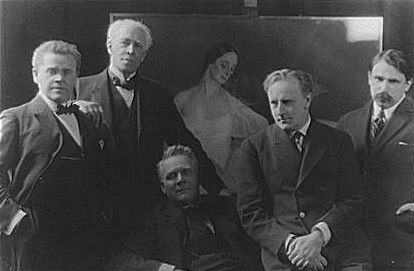
Generalizing the peculiar characteristics of Stanislavsky’s system, we may say that first and foremost it strives to attain artistic liberty and artistic truth. It demands the liberation of the stage from established scenic routine and dead literary forms. It rejects all the conventional scenic symbols and brings to the stage nature itself, and naked, unadulterated truth. It teaches the actor to consider the play as material which must be transformed into a picture of life. It teaches the actor to hold the attention of the public through centering it upon his feelings. It is based on a company well drilled and accustomed to teamwork. Finally, it rejects the word “actor” and contrasts it with the conception of ‘artist.”
The Theater and the Revolution
THE Russian Revolution, having shown the world new forms of combating the capitalistic system of production and distribution, has also pointed out new ways of solving spiritual problems. The revolutionary storm, shaking to their foundations all phases of modern Russian life, naturally had its effect on Russian art. The Moscow Art Theatre through the course of inexorable events was thrown into a whirlwind of human passions. The terrific avalanche of revolutionary events quickened the pulse of human life a thousand times and fundamentally affected the organization of the theatre.
Yes, the theatre of Stanislavsky is collective, but it is a theatre for privileged devotees of art. The theatre of the revolution is also a collective theatre, but a theatre of the masses dancing their carnival, creating impromptu a unique and mighty scenic action.
The productions of the Moscow Art Theatre are those chosen by Nemirovich-Danchenko-plays appealing to the foremost representatives of the Russian intellectuals; plays created by these intellectuals and staged for them. The plays of the revolution are the productions of dynamic movements, of faith in the mighty achievements of man, capable of forging in the furnace of the revolution the approaching millennium of mankind.
The heroes in most of the plays in the repertory of the Art Theatre, in the plays of Chekhov, are not universal. They are not superhuman. They are ordinary men, weak of will, bereft of revolutionary determination. These quiet heroes, fed upon the peace and prosperity of their lordly estates and ancient cherry orchards get no sympathetic reception from the new public, now filling the theatres in Russia.
The new spectators–workmen, peasants and intellectual workers-do not seek in their heroes suggestions for the future or mirages of beautiful dreams. They demand super-humans, performing divine deeds; they insist on artistic, but not stereotyped, reproductions of the deadly struggle between capital and labor, between slave drivers and the driven, between the old world and the new. They yearn for plays where “we laud the madness of the brave,” where new radiant people call, as through a clarion, to struggle, to healthy labor, to love for nature, to gay and happy life.
The Cherry Orchard of Chekhov gives way to The Robbers of Schiller, The Weavers of Hauptman and The Dawns of Verhaeren. The Autumn Song of Tchaikovsky is replaced by the music of Wagner, Debussy and Prokoviev.
The Moscow Art Theatre could not become the theatre of the Revolution. Nevertheless, the great Russian Revolution carefully preserved it, as a living brilliant illustration of the best traditions and achievements of Russian art and as the very best creation of the bourgeois period, now about to depart into the realms of musty history.
PDF of full issue: https://www.marxists.org/history/usa/culture/pubs/liberator/1923/02/v6n02-w58-feb-1923-liberator-hr.pdf
 Revolution's Newsstand